
Every business that relies on a forklift eventually faces the same question: does it make more sense to rent one as needed, or to buy a unit outright and add it to the fleet permanently. There is no universally correct answer, the right choice depends on how often the machine will actually be used, how predictable that usage is, and how much flexibility the business needs to respond to changing demand.
This guide breaks down what renting and buying each actually involve, how the costs compare over time, who carries maintenance and liability responsibility in each case, and the practical business situations where one option clearly outperforms the other.
Renting a Forklift: What It Involves
Renting means paying a supplier for temporary use of a forklift, typically on a daily, weekly, monthly, or long-term basis, without taking ownership of the machine itself.
This arrangement shifts the equipment risk away from the business using it, since the supplier remains the legal owner throughout the agreement and typically retains responsibility for the machine’s underlying condition. Understanding exactly what a rental agreement does and does not cover before signing is essential, since terms can vary considerably between suppliers and contract lengths.
How Forklift Rental Works
A rental agreement gives a business access to a forklift for an agreed period, with the supplier retaining ownership and, in most arrangements, responsibility for major mechanical upkeep. Rental terms can range from a single day to cover a short-term surge in demand, up to multi-year long-term leases that function almost like an extended trial of ownership without the same capital commitment.
Because rental units are typically drawn from a supplier’s existing fleet, availability and lead time depend on what is currently in stock for a given class or capacity of forklift. Understanding the different types of forklifts available before requesting a rental helps ensure the unit supplied actually matches the task at hand rather than settling for whatever happens to be available.
Advantages of Renting
Renting avoids the large upfront capital outlay of a purchase, freeing up cash for other parts of the business and making it far easier to scale a fleet up or down as project demand changes. It also allows a business to trial different forklift types or capacities on a live project before committing to a purchase decision, reducing the risk of buying the wrong configuration outright.
Rental agreements typically shift the burden of major repairs and, in many cases, routine servicing onto the supplier, which removes a significant amount of operational overhead for businesses that would rather focus resources elsewhere than manage an owned fleet’s upkeep. This is particularly valuable for businesses with seasonal or project-based demand that does not justify a permanent asset.
Also read: How to Choose a Forklift: A Complete Buyer’s Guide
Buying a Forklift: What It Involves
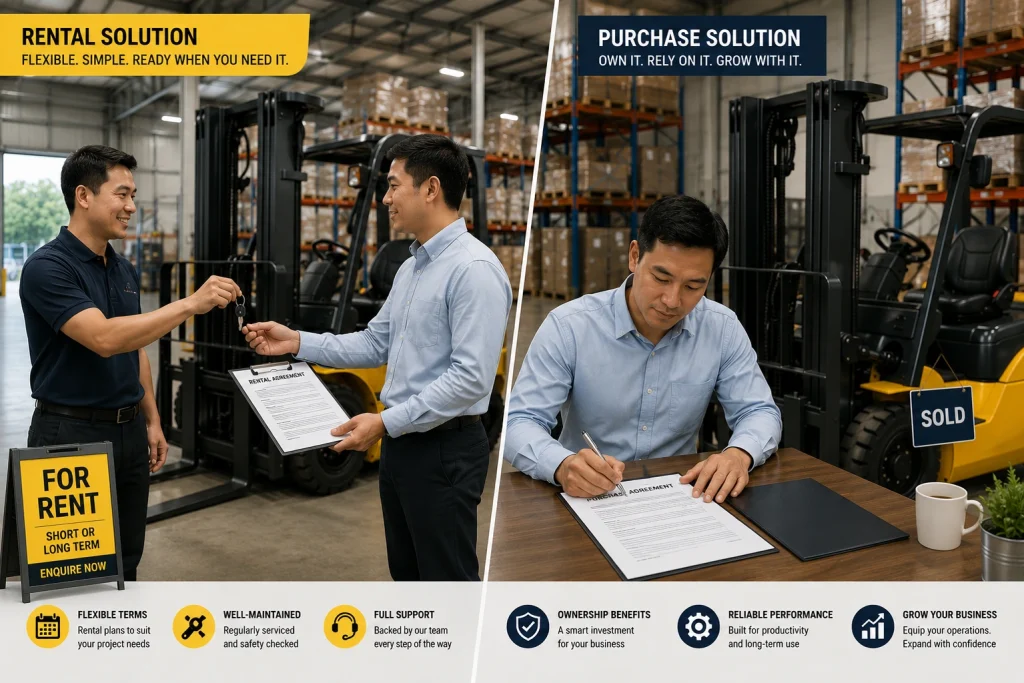
Buying means paying the full purchase price for a forklift upfront or through financing, taking full ownership of the machine and all the responsibilities that come with it.
Unlike renting, this decision commits the business to the machine for its entire useful life, or until it is resold, which makes it a longer-term commitment that should be weighed against how consistently the forklift will actually be needed over that period.
How Forklift Ownership Works
Ownership means the forklift is recorded as a business asset, depreciating in value over time on the company’s books, while the business assumes full responsibility for maintenance, insurance, and eventual resale or disposal. Financing arrangements can spread the purchase cost over several years, similar in structure to a vehicle loan, though the business still carries ownership and the associated risk from day one.
Understanding exactly what is being taken on as an owned asset matters here, since a forklift is a complex machine built from many interdependent systems. A closer look at what makes up the machine itself is covered in Parts of a Forklift: What Each Component Does, useful background for any business about to take on full ownership responsibility for the first time.
Advantages of Buying
Owning a forklift outright removes any ongoing rental payments once the purchase or financing is paid off, which can make it the more cost-effective option over a long enough time horizon for a machine in constant, predictable use. Ownership also means the machine is available at all times without needing to coordinate availability with a rental supplier, a meaningful advantage for operations running around the clock.
An owned forklift can also be customised or fitted with specific attachments permanently, without needing to negotiate this with a rental provider each time, and the business retains full control over how the machine is maintained and by whom. For operations running specialised or rough-terrain work, this control can matter considerably, as covered in Rough Terrain Forklift: Uses and Key Features, where a permanently modified unit often makes more operational sense than a rented one.
Cost Comparison: Renting vs Buying a Forklift
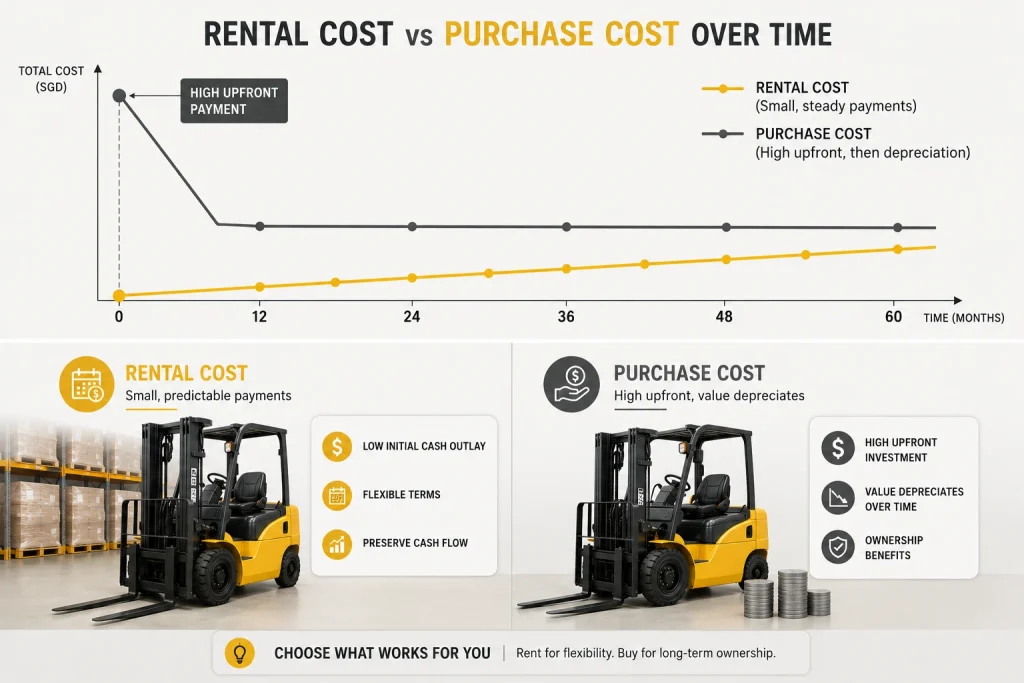
The financial comparison between renting and buying rarely comes down to a single number, since the two options distribute cost very differently over time.
A meaningful comparison needs to account for more than just the headline rental rate or purchase price, factoring in how long the machine will actually be used, how its value changes over that period, and what other costs each option carries beyond the base payment.
Upfront and Ongoing Costs
Renting requires little to no upfront capital, with cost spread evenly across the rental period as an operating expense rather than a large one-time outlay. Buying requires a substantial upfront payment or financing commitment, but avoids the cumulative cost of recurring rental fees that, over enough years of constant use, can exceed the original purchase price of an equivalent machine.
This structural difference is why many businesses treat the decision similarly to the broader distinction between an operating lease and outright ownership, where the operating lease model prioritises flexibility and lower upfront exposure, while ownership prioritises long-term cost efficiency for predictable, continuous use.
Depreciation and Resale Value
A purchased forklift depreciates over time, and its eventual resale value depends heavily on hours of use, maintenance history, and market demand for that specific class of machine when the business chooses to sell it. This depreciation is a real cost of ownership, even though it does not require a cash payment at the time, and it should be factored into any long-term cost comparison against renting.
Rented forklifts carry no depreciation risk for the business at all, since that risk sits entirely with the supplier who owns the asset. For businesses uncertain about how long they will need a given class or type of forklift, this can be a meaningful advantage, since it avoids being exposed to a falling resale market for a machine no longer needed.
Maintenance and Liability Responsibilities
Maintenance and liability obligations differ significantly between renting and buying, and understanding who is responsible for what should factor directly into the decision.
Overlooking these responsibilities until after a machine is already on-site is one of the most common ways businesses end up with unexpected costs, whether that means an owned forklift with deferred maintenance or a rented unit with unclear insurance obligations.
Who Handles Maintenance in Each Option
Most rental agreements include routine servicing and major repairs as part of the supplier’s responsibility, meaning the business renting the machine has minimal exposure to unexpected repair costs or the administrative burden of scheduling upkeep. Owned forklifts place this responsibility entirely on the business, requiring either an in-house maintenance capability or a service contract with a qualified provider.
Regardless of who owns the machine, following a consistent maintenance schedule directly affects safety and uptime. A detailed, practical routine for this is covered in Forklift Maintenance Tips for Safe and Efficient Operation, alongside a step-by-step Forklift Maintenance Checklist: A Complete Guide that applies whether the unit is rented or owned.
Insurance and Liability Considerations
Rental agreements typically specify which party is responsible for insurance coverage during the rental period, and businesses should confirm this explicitly before taking on a rented unit, since assumptions here can create significant liability gaps in the event of an accident or damage. Owned forklifts require the business to arrange and maintain its own insurance coverage indefinitely, an ongoing cost that should be included in any full ownership cost comparison.
Regardless of ownership structure, operator training and adherence to safety procedure remain the business’s responsibility in either case. A complete overview of the safety obligations that apply to forklift operation is available in Forklift Safety Checklist: A Complete Guide, which applies equally to rented and owned equipment.
Which Option Fits Different Business Situations
Beyond the general cost and responsibility trade-offs, the right choice often becomes clear once a business considers its specific pattern of use rather than comparing the two options in the abstract.
Most businesses find that one option clearly outperforms the other once actual usage frequency, cash flow priorities, and internal maintenance capability are laid out side by side, rather than trying to find one universally correct answer.
When Renting Makes More Sense
Renting suits businesses with seasonal demand spikes, short-term projects, or uncertainty about which forklift configuration best fits their long-term needs. It is also the more sensible option for a business testing whether a specific power source or class of machine suits its operations before committing to a purchase, for example, comparing an electric forklift against a diesel model on a live project rather than purchasing one outright based on specifications alone.
Renting is equally suited to businesses without the internal capability or desire to manage maintenance and insurance themselves, preferring to treat forklift access as a straightforward operating expense rather than a managed asset.
When Buying Makes More Sense
Buying makes the most sense for businesses with constant, predictable forklift use across multiple shifts or years, where the cumulative cost of rental would clearly exceed the cost of ownership over the machine’s working life. It also suits operations needing a specific, permanently configured machine, complete with particular attachments or modifications that would be impractical to negotiate repeatedly through a rental arrangement.
Businesses with the internal capacity, or an established service relationship, to manage ongoing maintenance and insurance are also better positioned to capture the long-term cost advantages that ownership can offer over sustained, heavy use.
Also read: Diesel vs Electric Forklifts: Which One Should You Choose?
Flexible Forklift Solutions from RR Machinery
Whether renting or buying makes more sense for your business depends on how predictable your usage is, how much flexibility you need, and how much responsibility you want to take on for maintenance and insurance. Neither option is inherently better, the right decision comes down to matching the structure of the agreement to the actual pattern of use.
RR Machinery Pte Ltd supports both paths with a diverse range of forklifts available for both sale and rental, suited to every application and budget. Contact us today to discuss which option best fits your operational needs and budget.