

Anyone researching mobile cranes across different international markets will eventually run into two terms that seem to describe competing categories of equipment: the hydra crane and the franna crane. Search for either term and the results look similar, hydraulic cranes with a compact chassis, road-legal mobility, and the ability to lift and carry a load in the same motion, which raises the obvious question of whether these are genuinely different machines or simply different names for the same thing.
The short answer is that both terms describe the same broad category of equipment, a pick-and-carry mobile crane, but the terminology itself carries useful information about regional naming conventions, brand history, and, in some cases, real design differences between manufacturers. This guide explains where each term comes from, how the underlying machine actually works, and where genuine differences do and do not exist between what gets called a hydra crane in one market and a franna crane in another.
What Is a Hydra Crane?
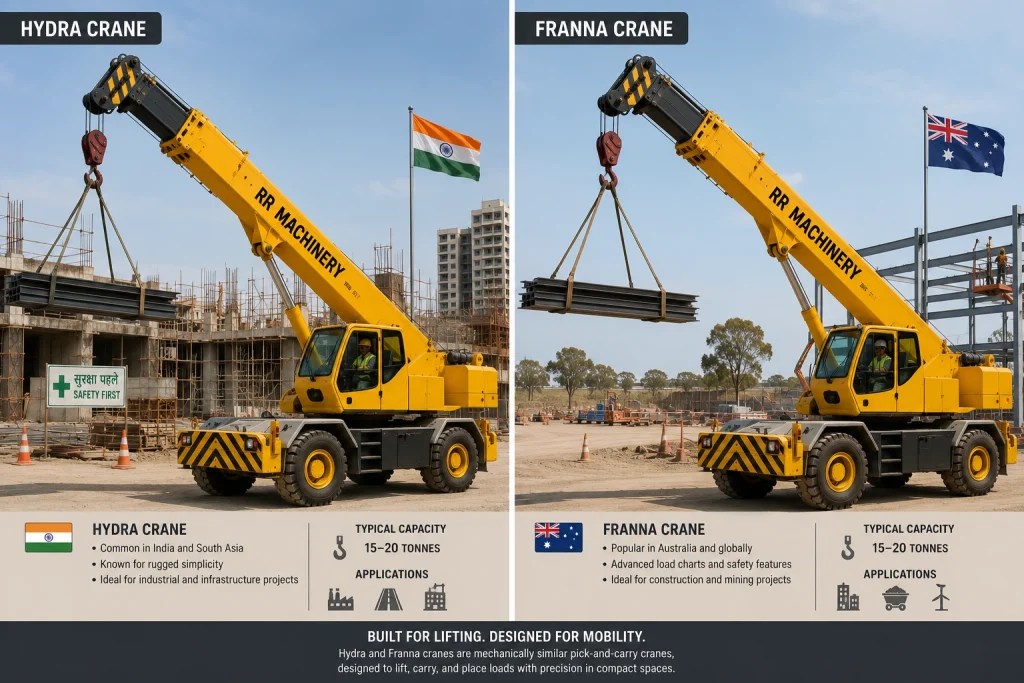
A hydra crane is the common name used across South Asia, particularly in India, for a hydraulic pick-and-carry mobile crane, a compact crane that can lift a load, travel with it suspended, and reposition it without needing to set down and re-rig at every stop.
The term is used so broadly across the Indian construction and material handling industry that it now functions less like a specific product name and more like a general category label, similar to how some workers refer to any tissue paper as a specific brand name regardless of manufacturer. Recognising this distinction early avoids confusion when comparing rental listings, technical specifications, or safety documentation that may use the term loosely to refer to any pick-and-carry crane on-site.
Origin of the Term “Hydra Crane”
The name traces back to a specific manufacturer, TIL Limited, which introduced a hydraulic mobile crane under the brand name Hydra decades ago. The machine became so dominant in the Indian construction and material handling market that, much like other genericised trademarks, the brand name eventually became the everyday term used for this entire category of equipment, regardless of which company actually manufactured a given unit.
This pattern of a brand name becoming the generic term for an entire equipment category is common across heavy machinery markets, and understanding it matters when researching specifications or comparing machines, since a “hydra crane” advertised for rent or sale may come from any number of manufacturers rather than the original brand alone. Its close mechanical relative in other markets, the rough terrain crane, shares many of the same design priorities around compact mobility and off-road capability.
How a Hydra Crane Works
Mechanically, a hydra crane operates on a wheeled chassis fitted with a telescopic hydraulic boom mounted on a rotating turret, very similar in basic layout to other mobile cranes. What distinguishes it operationally is its pick-and-carry capability, the ability to lift a load and then drive with that load still suspended from the boom, rather than needing to lower the load, reposition the entire machine, and re-rig before moving it further.
This capability comes from a combination of a low centre of gravity, a wide wheelbase, and a chassis engineered to remain stable while carrying a suspended load during movement, a stark contrast to cranes that require full stabilisation via outriggers before any lift can begin. This mobility while loaded is the primary reason hydra cranes are so widely used on Indian construction sites and in material yards where materials frequently need to be moved short distances repeatedly throughout a shift.
Also read: Types of Cranes: A Comprehensive Guide
What Is a Franna Crane?
A franna crane is the equivalent common name used across Australia and New Zealand for the same broad category of machine, a hydraulic pick-and-carry mobile crane built for compact, wheeled mobility and the ability to travel with a suspended load.
Much like its Indian counterpart, the term has become so embedded in everyday site vocabulary that it is now applied to pick-and-carry cranes generally, regardless of which manufacturer actually built a specific unit. This makes it important to look past the label itself and confirm the actual make, model, and rated capacity of any machine described as a franna crane before specifying it for a project.
Origin of the Term “Franna Crane”
The name comes from Franna, an Australian manufacturer that became closely associated with pick-and-carry cranes in the Australian market in much the same way TIL’s Hydra brand did in India. Over time, Franna became the default term Australian and New Zealand construction professionals use for this category of crane, regardless of the actual manufacturer of a specific unit on-site.
This naming pattern mirrors the hydra crane’s history closely, a single early manufacturer’s brand name becoming the generic descriptor for an entire equipment category within a specific regional market. Recognising this helps explain why two markets can use completely different vocabulary to describe what is, mechanically, largely the same type of machine.
How a Franna Crane Works
A franna crane shares the same fundamental mechanism as a hydra crane: a telescopic hydraulic boom on a rotating turret, mounted on a compact, wheeled chassis engineered for stability while carrying a suspended load during travel. Australian and New Zealand construction sites rely on this pick-and-carry capability for the same reason Indian sites do, moving materials, equipment, and prefabricated components repeatedly around a site without the delay of repeated rigging and de-rigging.
Franna-branded and franna-style cranes are commonly rated by their maximum lifting capacity and are widely used in civil construction, road works, and utility installation, environments that benefit from a crane capable of relocating quickly between closely spaced lift points across a single site. A closer look at how mobile cranes in general are classified against other lifting equipment is available in Mobile Crane vs Tower Crane: Key Differences and Uses.
Hydra Crane vs Franna Crane: Key Differences
Once the naming history is understood, the practical question becomes whether there are any genuine mechanical or capability differences between what a given market calls a hydra crane and what another calls a franna crane, beyond simply the word used to describe it.
In most cases, the honest answer is that the differences come down to manufacturer, model, and market history rather than the regional term itself. Treating “hydra” or “franna” as a design category, rather than as shorthand for a broad class of similar machines, is the most common source of confusion when comparing specifications across markets.
Regional Usage and Terminology
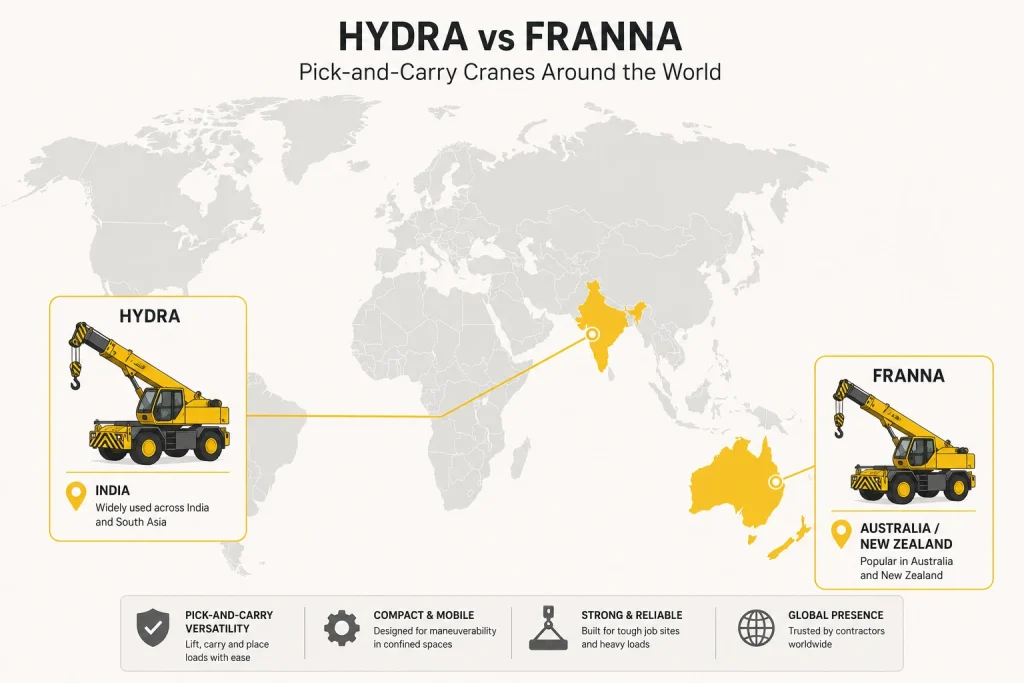
The most significant difference between the two terms is not mechanical at all, it is regional vocabulary. A hydra crane and a franna crane both refer to the same equipment category, a pick-and-carry mobile crane, and a machine imported from one region to another does not change function simply because the local terminology changes. Recognising this prevents unnecessary confusion when comparing specifications, rental listings, or safety guidance published under one regional term against material published under the other.
That said, regional market conditions have shaped some manufacturers’ design priorities differently over time, with certain models optimised more heavily for the specific road regulations, site conditions, or typical load types common in their originating market. These differences come from manufacturer and market history rather than from the terms “hydra” or “franna” themselves carrying any inherent design distinction.
Design and Capacity Variations
Within both the hydra crane and franna crane categories, individual models vary considerably in lifting capacity, boom length, and chassis configuration, meaning two machines called by the same regional term can differ from each other just as much as, or more than, a hydra crane differs from a franna crane of similar capacity. Comparing two specific models by their actual specifications, rather than by which regional term is attached to them, is the only reliable way to evaluate suitability for a project.
Manufacturers in both markets have also converged considerably over recent years, with international crane brands now selling similar pick-and-carry designs across both regions under their own model names, further blurring any remaining distinction between what gets locally called a hydra crane versus a franna crane. Understanding a machine’s actual parts and mechanical components provides a far more useful basis for comparison than regional branding alone.
Lifting Capability and Load Charts
Both categories of crane are governed by the same fundamental engineering principle, lifting capacity decreases as the boom extends further out or is raised to a steeper angle, and every unit, regardless of regional name, is supplied with a load chart specifying safe capacity at each combination of boom length and angle. Reading this chart correctly matters far more to safe operation than which regional term happens to be used for the machine.
Operators moving between markets, or businesses importing a pick-and-carry crane from a different region, should treat the load chart, not the regional name, as the authoritative reference for what the machine can safely lift. A clear walkthrough of how to interpret these charts correctly is available in How to Read a Crane Load Chart: A Clear Guide, applicable to either a hydra crane, a franna crane, or any other pick-and-carry model.
Pick-and-Carry Cranes vs Other Mobile Equipment
Understanding where hydra and franna cranes sit relative to other categories of lifting and access equipment helps clarify when a pick-and-carry crane is actually the right machine for a job, rather than simply the most familiar term.
This matters because construction sites often have several categories of lifting and access equipment available at once, and choosing based on regional habit rather than actual task requirements can lead to using a machine that is either underpowered for the load or poorly suited to the type of work being performed.
Pick-and-Carry Crane vs Tower or Larger Mobile Crane
A pick-and-carry crane’s defining advantage, moving a suspended load without stopping to re-rig, comes at the cost of lower maximum lifting capacity and shorter reach compared to larger mobile cranes or fixed tower cranes used on major construction projects. Tower cranes and larger mobile cranes are built for high-rise construction and heavy structural lifts where reach and capacity matter more than repositioning speed.
This is why pick-and-carry cranes dominate site logistics, material handling, and utility work, while larger mobile and tower cranes remain the standard for structural steel erection and high-rise work where a pick-and-carry unit’s capacity and reach would fall well short of what the task demands.
Pick-and-Carry Crane vs Boom Lift
A pick-and-carry crane and a boom lift are sometimes confused simply because both use a hydraulic boom, but their purposes are entirely different. A pick-and-carry crane’s boom exists to lift and move external loads, materials, equipment, and structural components, while a boom lift’s boom exists to carry a worker safely in a platform to a position at height. Neither machine is designed to substitute for the other’s core function.
A full breakdown of this distinction, and how to decide which type of equipment a specific task actually requires, is available in Boom Lift vs Crane: How to Choose for Your Project, useful reading whenever a task involves both lifting materials and providing worker access at height.
Choosing the Right Pick-and-Carry Crane for Your Project
Whether a specific unit is marketed under the hydra name, the franna name, or a manufacturer’s own model designation, the same practical factors should drive the selection process for any project.
Approaching the decision this way, specification first, regional label second, ensures the machine chosen actually fits the task rather than simply matching whatever term happens to be most familiar in a given market or to a particular team.
Site Conditions and Load Requirements
Ground conditions, travel distance between lift points, and the actual weight and dimensions of the materials being moved should determine the required capacity and chassis configuration, rather than defaulting to whichever regional term or brand happens to be most familiar to the team specifying the equipment. Sites with frequent, repeated short-distance moves benefit most from the pick-and-carry capability that defines this entire equipment category.
Matching the machine’s rated capacity, with an appropriate safety margin, against the heaviest anticipated lift at the furthest anticipated boom extension is the only reliable way to specify a suitable unit, regardless of what the crane is called in the local market.
Safety and Operator Certification
Operating any pick-and-carry crane safely requires proper certification, an understanding of the machine’s load chart, and strict adherence to stability limits while travelling with a suspended load, since the machine’s compact chassis and comparatively high centre of gravity when loaded make it less forgiving of overloading than larger, outrigger-stabilised cranes. Singapore’s Ministry of Manpower publishes detailed Workplace Safety and Health guidance covering the training and operating standards that apply to mobile crane operation on construction sites.
Further technical background on how mobile cranes are engineered and classified internationally is available through Wikipedia’s overview of mobile cranes, useful reading for understanding how pick-and-carry designs fit within the broader mobile crane category regardless of regional naming.
Get the Right Lifting Solution for Your Project
Whether referred to as a hydra crane, a franna crane, or simply a pick-and-carry mobile crane, the underlying machine and the factors that determine whether it fits a given project remain the same. Focusing on actual specifications, load charts, and site conditions, rather than regional terminology, is what leads to the right equipment decision every time.
RR Machinery Pte Ltd supports Singapore’s construction and industrial sectors with a full range of heavy machinery solutions tailored to your specific site conditions. Browse our complete heavy machinery services or contact our team today for practical advice on the right lifting or access equipment for your project.


This is a clear and informative comparison that clears up a common misconception in the construction industry. I like how the article explains that “Hydra” and “Franna” are largely regional terms for the same type of pick-and-carry crane while also highlighting where manufacturer-specific differences can exist. The sections on load charts, site conditions, and equipment selection make this a valuable resource for anyone comparing lifting solutions across different markets. Great job breaking down a potentially confusing topic into an easy-to-understand guide.