
Table of Contents
When your job needs safe access at height, two common options show up: boom lifts (mobile elevating work platforms/MEWPs) and cranes. Both lift people and/or loads, but they solve different problems. This guide breaks down when to choose each, how costs, safety, and site logistics compare, and a quick checklist to make the right call for your project in Singapore.
Choose a boom lift when you need people to work at height (inspection, installation, painting, M\&E) with frequent repositioning, tight spaces, or overhead obstacles. See our boom lifts.
Choose a crane when you need to rators, prefab sections) to a specific spot, especially at heights a MEWP cannot reach.
Definitions and Basic Concepts
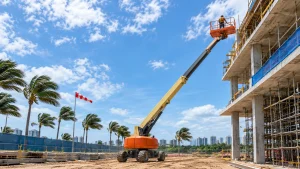
A boom lift, also known as a Mobile Elevating Work Platform (MEWP), is a self-propelled machine designed to safely lift people and their tools to work at height. Boom lifts come in various types, such as articulating (knuckle) models for reaching up and over obstacles, and telescopic (straight) models for maximum horizontal outreach and height. They are commonly powered by electricity for indoor, low-emission tasks or diesel for outdoor, high-reach applications. In contrast, a crane is a lifting machine built primarily for moving heavy loads rather than people.
Cranes operate from ground level, using a system of cables and pulleys to hoist materials like steel beams, machinery, or large equipment to elevated positions. Personnel lifting with cranes is only allowed under strict controls and with specialized man-baskets. Understanding these basic differences is essential for selecting the right equipment for any project involving work at height or heavy lifting.
Boom lifts, boom trucks, and cranes are three distinct categories of lifting equipment commonly used in construction and maintenance projects. A boom lift, also known as a mobile elevating work platform (MEWP), is designed to safely raise workers and their tools to elevated work areas using a hydraulically operated arm that can extend vertically and horizontally. A boom truck, on the other hand, is a commercial truck fitted with a hydraulic crane mounted on its chassis, allowing it to function both as a transport vehicle and as a material lifter for moderate loads and heights. Cranes represent a broader class of machines built primarily for lifting and moving heavy objects, utilizing systems of cables, pulleys, and counterweights.
There are various types of cranes, such as tower cranes for high-rise projects, mobile cranes for flexibility across sites, and crawler cranes for rough terrain. While boom lifts rely on articulated or telescopic booms for positioning, cranes use a combination of wire ropes, hydraulic systems, and structural components to manage much heavier loads, often ranging from several hundred kilograms to many tons. Understanding these foundational differences in design and operation is essential for selecting the right equipment for any task involving work at height or heavy lifting.
What Each One is
Boom lift (MEWP): A self-propelled platform for people (and light tools) with working-height access. Types: articulating (knuckle) for up-and-over reach, telescopic (straight) for maximum outreach/height, electric for indoor/low-emission, diesel for outdoor/high reach. Designed for productivity and safe work-at-height.
Learn the basics of MEWP safety from WSH Council and general MOM WSH guidance.
For an alternative platform style, see our scissor lifts.
Crane: A lifting machine for loads, not a working platform. Operators lift from ground level and place materials at height, personnel lifting is only allowed with specific man-baskets and strict controls.
Key Differences and Comparative Analysis
When deciding between a boom lift and a crane, it’s important to understand the fundamental differences in their design, operation, and optimal use. Boom lifts are engineered to safely elevate people and light tools to various heights, offering exceptional maneuverability and quick repositioning, ideal for tasks that require frequent access to multiple elevated points or work in confined spaces.
Cranes, on the other hand, are purpose-built for lifting and placing heavy loads, often reaching greater heights and distances but requiring more setup space and specialized rigging. While boom lifts excel in projects focused on work-at-height for personnel, cranes are essential for moving large materials or equipment in construction, infrastructure, and industrial settings. Comparing criteria such as payload capacity, reach, mobility, setup requirements, and operator expertise helps ensure you select the right equipment for your project’s unique demands.
Side-by-side Comparison
Criteria | Boom lift (MEWP) | Crane |
Primary purpose | Lift people to work at height | Lift loads to position |
Typical payload | 200–450 kg (people + tools) | Hundreds of kg to many tonnes |
Reach & access | Up-and-over (articulating), long outreach (telescopic), great in tight sites | Extreme height/outreach, needs setup space & clear swing radius |
Mobility | Self-propelled, fast repositioning | Static during lifts, requires setup/rigging |
Setup time | Minutes (pre-use check, some models use outriggers) | Longer (site survey, rigging plan, outriggers, traffic mgmt) |
Surface needs | Flat, sufficient ground bearing, slabs/finished floors often OK (verify) | High ground bearing, often needs mats & exclusion zones |
Operator | Trained MEWP operator | Licensed crane operator + rigger/signaller |
Best for | Facade works, M&E, maintenance, signage, cleaning, fit-outs | Steel erection, plant placement, heavy modules, container moves |
Cost pattern | Predictable daily rates, great for many repositionings | Priced by crane size, hours, rigging, logistics, efficient for few heavy lifts |
Singapore context: on dense job sites (CBD, facilities, warehouses), a boom lift often wins for speed and repeat access, for one-off heavy placements, a crane is the correct tool.
Industry Applications for Boom Lifts
Boom lifts are widely used across industries where safe, flexible access to elevated work areas is essential. For example, in building maintenance and commercial cleaning, boom lifts allow workers to efficiently reach and service high windows, facades, or signage. Utility companies frequently deploy boom lifts for power line maintenance and streetlight installation, especially in urban environments where space is limited and frequent repositioning is required.
In the events and media sector, boom lifts provide stable platforms for positioning cameras, lighting, or sound equipment at large venues. Their ability to maneuver in tight or confined spaces and to quickly move between multiple work points makes them ideal for tasks that require both elevation and mobility, such as facility inspections, HVAC installation, or tree trimming in landscaping projects.
Industry Applications for Boom Cranes
Cranes are indispensable for projects that involve lifting and placing heavy materials at significant heights or distances. They are commonly seen on high-rise construction sites, where their superior lifting capacity is needed to hoist steel beams, concrete panels, or prefabricated building modules to upper floors.
In major infrastructure projects, such as bridges, stadiums, airports, and industrial facilities, cranes are used to move large machinery, structural components, and other oversized loads that exceed the capabilities of boom lifts. Their stability and reach make them the preferred choice for tasks like erecting towers, installing large rooftop equipment, or handling shipping containers at ports. Whenever a project demands the safe and precise placement of heavy loads in environments with ample setup space, cranes are the go-to solution.
Choosing with Intent
What’s going up, people or heavy loads?
People + tools → Boom lift.
Heavy materials → Crane.
How many lift points per day?
Many, spread-out work points → Boom lift (reposition in minutes).
One/few critical placements → Crane.
Is there up-and-over geometry?
Obstructions (pipes, parapets, canopies) → Articulating boom.
Long straight reach to a rooftop edge → Telescopic boom or crane depending on height and load.
Site constraints
Tight aisles/indoors/low-emission → Electric boom.
Limited slab capacity or soft ground → check ground bearing (both options may need engineering review).
Height & outreach limits
If required height/outreach exceeds available MEWPs, crane may be mandatory.
Safety & permits
MEWP: pre-use checks, trained operator, fall protection as required.
Crane: lifting plan, rigger/signaller, exclusion zones, traffic control.
Cost & Scheduling Notes
Boom lift rental (SG): better value when teams need hours of work at height, moving frequently. Explore options on our boom lift page or speak to our team via Contact.
Crane hire: efficient for planned heavy lifts, overall cost depends on tonnage, boom length, site time, rigging crew, permits, and possible traffic management.
Tip: If you only need to place a heavy item once and then do extended work around it, plan a hybrid: book a crane for the placement, then switch to a boom lift for the work-at-height tasks. Need help planning? Talk to us.
Safety First
Pre-use inspection and daily checks (leaks, tyres, alarms, interlocks).
Competency: trained MEWP operator or licensed crane team, follow site’s WSH procedures.
Ground conditions: verify slab rating/soil bearing, use mats if required.
Exclusion zones: keep people clear of swing/radius and under suspended loads.
Weather: respect wind limits (MEWPs) and stop lifts during unsafe conditions.
Maintenance and Durability
Both boom lifts and cranes require regular maintenance to ensure safe and reliable operation, but their upkeep needs can differ based on complexity and usage. Boom lifts, especially those used for frequent repositioning or in challenging environments, benefit from routine inspections of hydraulic systems, tires, safety interlocks, and control panels. Their simpler design often means easier day-to-day maintenance, though attention to battery health (for electric models) or engine servicing (for diesel models) is important for long-term durability. Cranes, on the other hand, typically face heavier loads and more demanding cycles, requiring thorough checks of structural components, cables, pulleys, and counterweights. Scheduled servicing, detailed record-keeping, and adherence to manufacturer guidelines are critical for maximizing crane lifespan and minimizing unexpected downtime. Investing in preventive maintenance for both types of equipment not only extends service life but also helps reduce the risk of costly breakdowns and ensures compliance with safety standards.
Common Scenarios
Facade cleaning/painting for a mid-rise → Articulating boom lift (up-and-over reach, frequent repositioning).
Lift a 2-ton chiller to a rooftop → Crane (load capacity + precise placement).
Indoor M\&E on a high atrium → Electric boom lift (zero emissions, quiet).
Replace rooftop signage letters along a long edge → Telescopic boom (side outreach), or a crane if reach exceeds MEWP range.
How RR Machinery can Help
Fleet fit for purpose: articulating & telescopic boom lifts (electric/diesel) sized to your height and outreach needs.
Fast delivery & support: pre-use checks, maintenance during rental, and quick call-outs.
Job planning help: tell us your height, outreach, load/tooling, site photos, and ground info, we’ll recommend the safest, most cost-effective option.
Unsure Which is Safer or Faster for Your Job? Get a quick recommendation and quote from RR Machinery: Contact us, You can also explore Servicing & Support for ongoing maintenance.
Skid Steer Attachments Explained, From Buckets to Breakers