Key Factors in Generator Selection
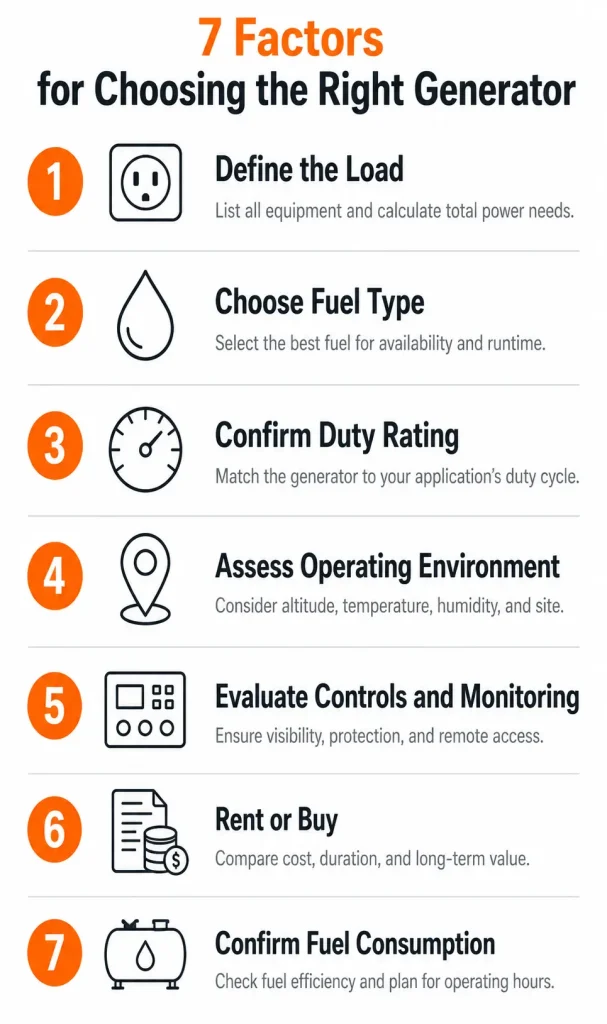 Choosing a generator involves assessing several independent variables simultaneously. Each factor narrows the field of appropriate options, and the correct generator is the one that satisfies all of them, not just the most obvious one.
-
-
Define the Load
-
The starting point for generator selection is always the load, every piece of electrical equipment that will be connected to the generator and the power each draws. Without a clear load assessment, every other selection decision is guesswork.
The load assessment must establish the total running load in kilowatts, the power factor of the connected equipment, the peak starting load created by the largest motor or group of motors starting simultaneously, and whether the load is consistent or variable across the operating cycle.
A systematic load assessment, listing every connected device, its running wattage, its power factor, and its starting current, is covered in full detail in the practical guide to generator sizing and load calculation for construction and industrial applications. The output of that process is the minimum kVA and kW rating the generator must deliver, which then becomes the baseline for every subsequent selection decision.
As a general principle, select a generator whose rated output is 20 to 25 percent above the calculated peak load. This margin accommodates load variations, future additions, and ensures the generator runs within its efficient operating range, typically 70 to 80 percent of rated output, rather than at its maximum.
Also read : What Size Generator Do I Need? A Practical Sizing Guide
-
-
Choose the Fuel Type
-
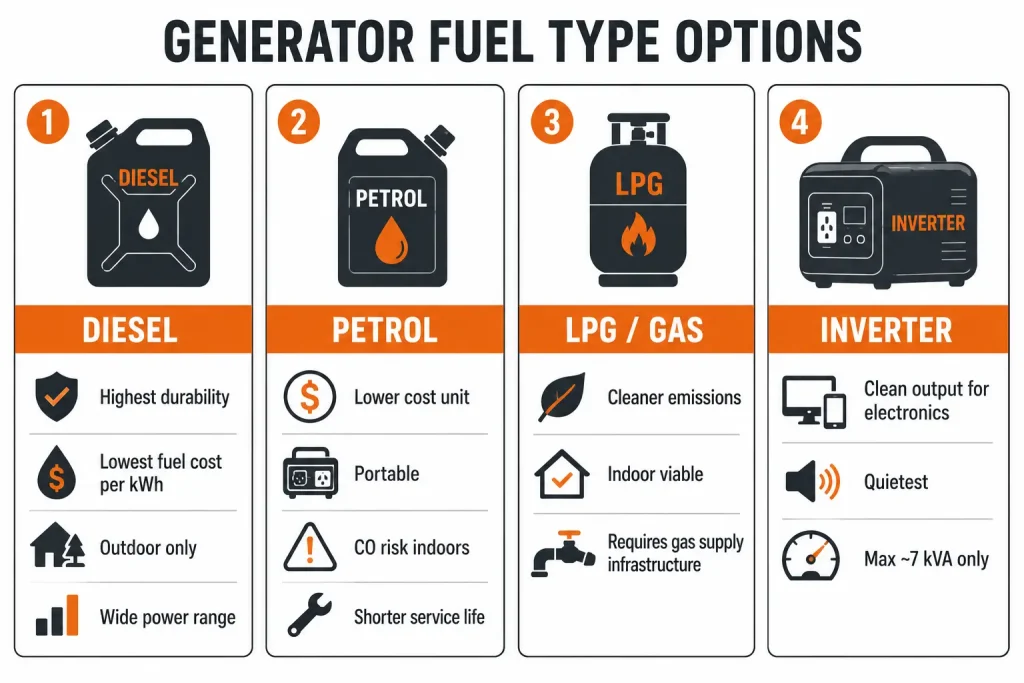
The fuel type determines the generator’s running cost, its availability in the operating environment, its emissions profile, and its suitability for indoor or enclosed space operation.
-
-
-
Diesel Generator
-
-
The diesel generator is the dominant choice for construction sites, industrial applications, mining operations, and any application where the generator will run for extended periods under sustained load. Diesel fuel has higher energy density than petrol, meaning more energy per litre and lower fuel consumption per kWh of electricity generated. Diesel engines are more durable under sustained high-load operation and have longer service intervals than equivalent petrol engines.
Diesel generators are available across the widest power range, from 6 kVA portable units to multi-megawatt containerised power stations, and are the default specification for prime power applications where the generator is the primary power source running continuously during operations.
The primary limitation of diesel generators is exhaust emissions, diesel combustion produces nitrogen oxides, particulate matter, and carbon monoxide that make diesel generators unsuitable for indoor operation without exhaust extraction. On construction sites, this limits their placement to outdoor or well-ventilated locations. For indoor applications where no exhaust extraction is available, a petrol generator, an LPG generator, or, for smaller loads, an inverter generator must be used instead.
Diesel generators also suffer from wet stacking, carbon accumulation in the exhaust system and engine, when run at very low loads for extended periods. A diesel generator should be sized so that its normal operating load is at least 30 percent of its rated output, to prevent wet stacking and the engine damage it causes.
-
-
-
Petrol Generator
-
-
Petrol generators are lighter, more compact, and less expensive than diesel equivalents at the same power output. They are suited to lower-power applications, portable power for small tools, lighting, and welfare facilities on small sites, and to applications where the generator will be moved frequently or where low capital cost is the primary constraint.
Petrol engines are less durable than diesel under sustained high-load operation and have shorter service intervals. For applications where the generator will run continuously for eight or more hours per day, a diesel unit is more economical over any period exceeding a few months, despite its higher purchase or rental cost.
Petrol generators emit carbon monoxide and must not be operated in enclosed spaces. Carbon monoxide is colourless and odourless, and accumulation in enclosed spaces is rapidly fatal. This restriction applies regardless of the generator’s size or the apparent ventilation of the space.
-
-
-
LPG and Natural Gas Generator
-
-
Liquid petroleum gas (LPG) and natural gas generators burn cleaner than diesel or petrol, producing lower particulate emissions and reduced carbon monoxide output. They are suited to applications where fuel supply infrastructure is available, fixed installations connected to a natural gas main, or sites where LPG cylinders can be supplied and exchanged regularly.
LPG and natural gas generators are widely used for standby power in commercial buildings and hospitals where natural gas supply is continuous and reliable, and where diesel storage and the associated fire risk and regulatory requirements are undesirable. They are also used for indoor temporary power in applications where emissions must be minimised and where the load does not justify a fully electric solution.
-
-
-
Inverter Generator
-
-
The inverter generator is a specialist category, typically in the 1 to 7 kVA range, that produces clean, stable electrical output suitable for sensitive electronic equipment including computers, audio systems, and medical devices. A standard generator produces power with minor voltage and frequency fluctuations; an inverter generator converts the raw AC output to DC and then back to clean AC at a precise frequency and voltage, eliminating these fluctuations.
Inverter generators are significantly more fuel-efficient than conventional generators at partial load, the engine speed adjusts to match the load rather than running at a fixed speed, and they are substantially quieter. Their limitation is power output: inverter generators are not available above approximately 7 to 8 kVA as a single unit, making them unsuitable for applications with significant motor loads or high total power demands.
Also read : Bulldozer vs Excavator: Differences and When to Use Each
-
-
Confirm the Duty Rating
-
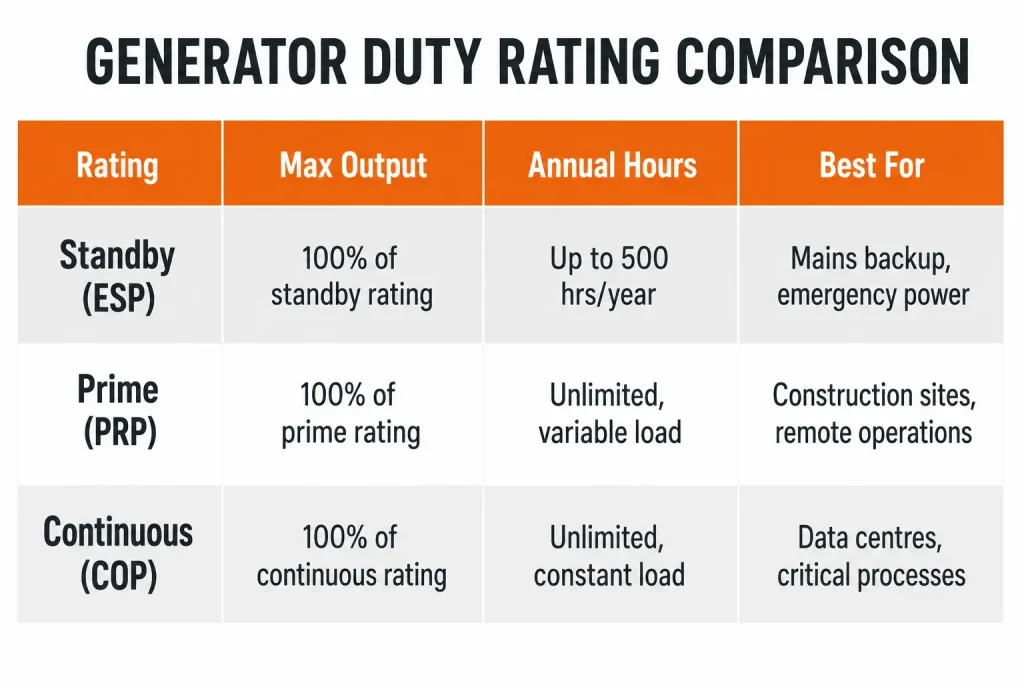
Every generator is rated for a specific duty cycle, the intensity and duration of the load it is designed to sustain. Selecting a generator without confirming its duty rating for the intended application is a common and consequential error.
-
-
- Standby rating (ESP, Emergency Standby Power)
-
The maximum output the generator can sustain for short periods during mains power outages. Standby-rated generators are not designed for continuous operation, they are rated for use at up to 100 percent of their standby output for a maximum of 500 hours per year, with an average load not exceeding 70 percent of standby rating. Using a standby-rated generator as a prime power source, running it continuously at high load, will cause accelerated wear and is likely to void the manufacturer’s warranty.
-
-
- Prime rating (PRP, Prime Power)
-
The maximum output the generator can sustain continuously, with variable load, for unlimited hours per year. Prime-rated generators are designed for applications where the generator is the primary power source, construction sites without mains connection, remote industrial operations, mining sites. The prime rating of a generator is typically 10 percent lower than its standby rating for the same unit.
-
-
- Continuous rating (COP, Continuous Power)
-
The maximum output the generator can sustain indefinitely at a constant load. The continuous rating is typically 10 percent lower than the prime rating. Applications requiring constant load at maximum output, data centre backup power, certain industrial processes, require a generator sized to its continuous rating, not its prime or standby rating.
For most construction site applications, a prime-rated generator is the correct specification. For standby power in buildings and facilities, a standby-rated generator sized appropriately for the essential load is correct. Confusing these ratings, specifying a standby-rated generator for prime power use, or oversizing a prime power unit when standby duty was intended, creates either reliability problems or unnecessary cost.
-
-
Assess the Operating Environment
-
The environment in which the generator will operate determines its required enclosure type, its noise output specification, and its cold-start capability.
-
-
- Open set vs canopy enclosed
-
An open generator set, the engine and alternator mounted on a baseframe without an enclosure, is the most compact and lowest-cost configuration, but it provides no weather protection, no noise attenuation, and no security against tampering. Open sets are suited to indoor or covered locations where weather protection is provided by the building and where noise is not a constraint.
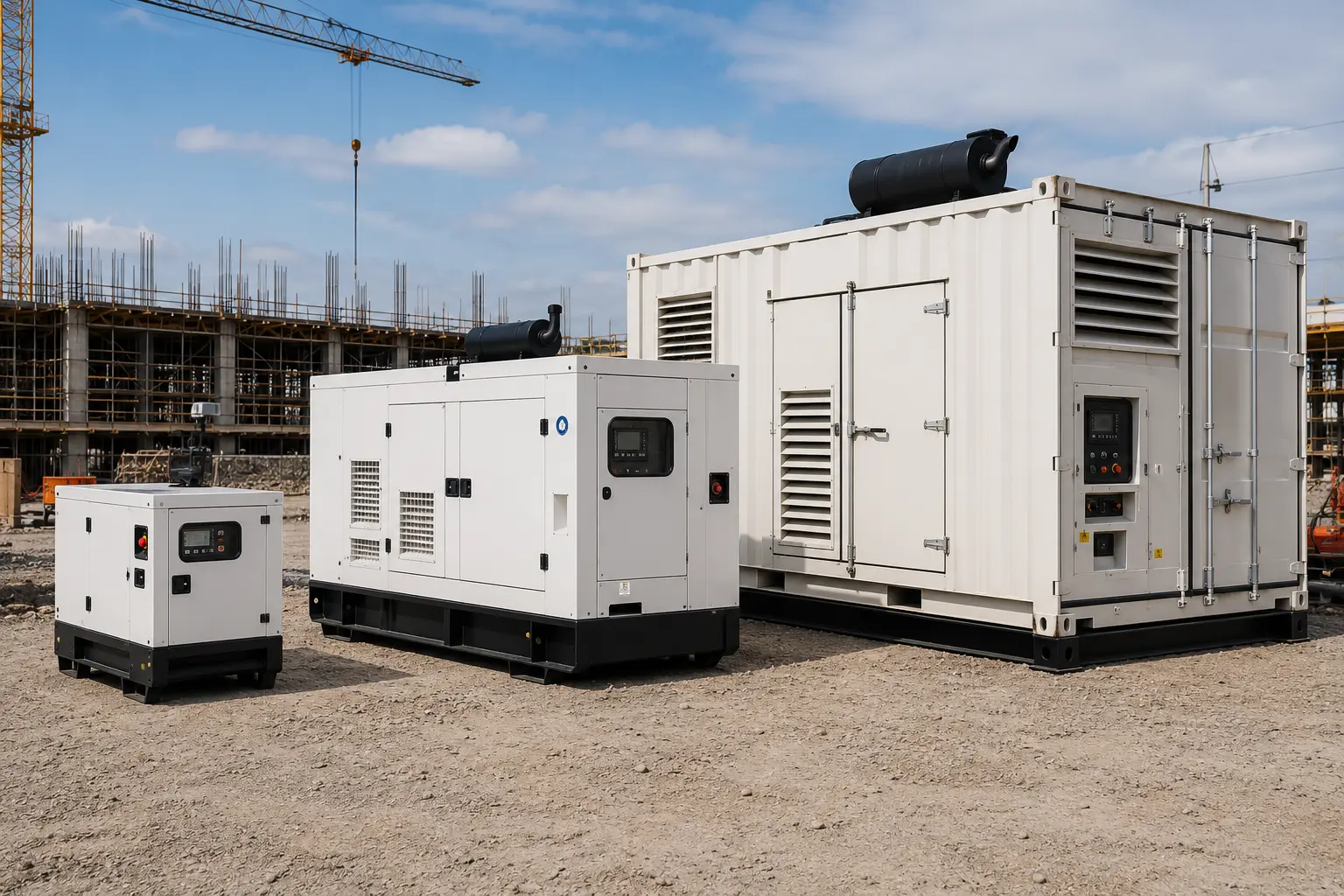
A canopy-enclosed generator, the engine and alternator housed in a steel acoustic canopy, provides weather protection, significantly reduced noise output, and security. Canopy generators are the standard specification for outdoor construction site use, events, and any application where the generator will be left unattended or where noise is a concern. Sound-attenuated canopy generators are available with noise outputs as low as 55 to 65 dB(A) at 7 metres, suitable for use adjacent to residential areas or in noise-sensitive environments.
-
-
- Noise requirements
-
Many urban construction sites, events, and facilities applications impose noise limits, either regulatory limits or contractual requirements, on generator operation. The generator’s noise output at a specified distance must be confirmed against the applicable limit before specification. If the standard canopy model exceeds the noise limit, a super-silenced or ultra-silent canopy model must be specified.
-
-
- Cold weather operation
-
In climates where ambient temperatures fall below 5 degrees Celsius, diesel generators require cold-start aids, block heaters, battery warmers, or glow plug systems, to ensure reliable starting. In tropical and equatorial climates such as Singapore and the surrounding region, cold-start capability is not a constraint, but high ambient temperature derating must be considered: generator output falls as ambient temperature rises above the standard rating temperature of 25 or 40 degrees Celsius, and the nameplate kVA rating must be derated accordingly for sustained operation in high-temperature environments.
-
-
- Altitude
-
Generator output falls with altitude, approximately 1 percent per 100 metres above sea level for naturally aspirated engines. For sites at significant altitude, the generator’s rated output must be derated before comparing it to the calculated load requirement.
-
-
Evaluate Control and Monitoring Features
-
The control and monitoring features of a generator determine its suitability for unattended operation, automatic mains changeover, remote monitoring, and paralleling with other generators.
-
-
- Manual start vs automatic start
-
A manually started generator requires an operator present to start it when power is needed. An automatic start generator, fitted with an automatic mains failure (AMF) controller, starts automatically when mains power fails and stops when mains power is restored, without operator intervention. For standby power applications, automatic start is not optional, the purpose of a standby generator is to restore power without delay when the mains fails, and manual start defeats this purpose.
-
-
- Automatic Transfer Switch (ATS)
-
The ATS is the switching panel that disconnects the mains supply and connects the generator output when the generator starts, and reverses the sequence when the mains is restored. The ATS must be sized for the full load current of the connected installation and must be compatible with the generator’s AMF controller. For applications where the transition from mains to generator must be seamless, data centres, medical facilities, critical processes, a static transfer switch with sub-cycle transfer time may be required.
-
-
- Remote monitoring
-
Modern generator control panels support remote monitoring via GSM, ethernet, or proprietary telemetry systems, allowing fuel level, runtime hours, fault codes, and load data to be monitored from a central location or a mobile device. For unattended remote site generators and for fleet management of multiple generators across a project, remote monitoring is operationally essential, it prevents fuel run-outs, enables proactive maintenance scheduling, and provides early warning of developing faults before they cause downtime.
-
-
- Paralleling capability
-
For applications requiring more power than a single generator can supply, or for applications requiring redundancy, two or more generators can be paralleled, synchronised to operate as a single power source sharing the load. Paralleling requires generators with compatible control systems and a synchronising panel. Not all generators support paralleling; if this capability may be required, it must be confirmed before purchase or rental.
The control and monitoring requirements for a generator operating on an active construction site, where it must interact with the site’s electrical distribution, support the power demands of multiple plant types, and be managed as part of the overall site services plan, are directly connected to the broader site services coordination requirements covered in guidance on construction site planning and the management of temporary power and services.
-
-
Rent or Buy?
-
For most construction site applications and short to medium-duration project requirements, generator rental is more economical than purchase. The rental cost includes maintenance, servicing, and in most cases replacement in the event of mechanical failure, eliminating the capital cost, the maintenance overhead, and the residual value risk of ownership.
Generator purchase makes economic sense when the usage is continuous and long-term, typically more than two to three years of sustained operation, when the application requires a highly specific configuration that is not available in the rental market, or when the operational environment makes rental logistics impractical.
For rental, the key considerations are the rental provider’s maintenance programme, their response time in the event of breakdown, their fuel delivery capability, and the compatibility of their control systems with the site’s electrical distribution and ATS requirements. A rental generator that fails on a Friday evening with no replacement available until Monday morning has a very high effective cost, regardless of its daily rental rate.
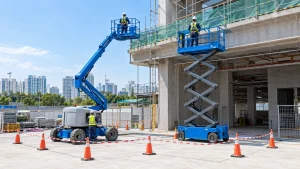
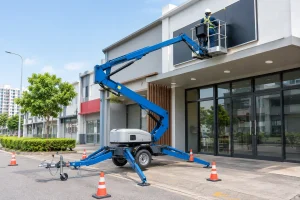
For the same reasons that correct equipment selection matters across all categories of construction plant, whether choosing between an excavator and a bulldozer for an earthmoving task, or between a boom lift and a cherry picker for an access task, the generator selection decision benefits from the same systematic approach applied to choosing the right type of lifting and access equipment for construction site operations.
-
-
Confirm Fuel Consumption and Runtime
-
Fuel consumption determines the operational cost and the required fuel storage capacity. Generator fuel consumption is typically expressed in litres per hour at full load and at partial load, most generator specifications include consumption figures at 25, 50, 75, and 100 percent of rated output.
A generator running at 75 percent of rated output, the mid-point of its efficient operating range, typically consumes 0.25 to 0.35 litres of diesel per kWh of electricity generated, depending on the engine technology and the generator’s age and condition. For a 100 kVA generator running at 75 kVA for ten hours per day, this equates to approximately 180 to 260 litres per day, a fuel storage and delivery requirement that must be planned for before the generator is mobilised.
Runtime between refuelling is determined by the fuel tank capacity divided by the consumption rate at the expected load. Most canopy generators have integral fuel tanks sized for eight to twelve hours of operation at 75 percent load. For remote sites or applications where refuelling is infrequent, extended fuel tanks or external day tanks must be specified.
Also read : Types of Graders: How Each Works and When to Use One
Choosing Confidently
Generator selection is a systematic process, not an intuitive one. Define the load precisely. Choose the fuel type that matches the operating environment and the duty cycle. Confirm the duty rating against the intended use. Assess the environmental requirements, noise, weather, temperature. Specify the control features the application demands. Decide between rental and purchase based on duration and operational context. And confirm the fuel consumption against the available storage and supply logistics. Each step eliminates unsuitable options and converges on a generator specification that will run reliably, efficiently, and within budget for the duration of the project or application it serves. RR Machinery provides a comprehensive range of power generators for rental and sale, diesel prime power units, standby generators, and silent canopy models across a wide kVA range, all maintained to full operational standard and supported by experienced power specialists. Explore our full range of power generator options for construction, industrial, and standby applications, or contact our team for load assessment support, practical selection advice, and a clear quotation matched to your power requirements and site conditions.