Why Site Planning Deserves More Attention Than It Typically Receives
Site planning is frequently treated as a preliminary task, something to be done quickly before the real work of construction begins. In practice, the decisions made during site planning have consequences that persist for the entire duration of the project. The location of the tower crane determines where the heaviest lifts can occur and at what radius. The position of the site entrance determines traffic flow patterns that will be difficult to change once surrounding works are established. The location of temporary storage areas determines how far materials must be carried to the point of use. The layout of scaffold access determines how efficiently workers can move between levels. Every one of these decisions is made once, or at significant cost if it needs to be remade. The investment in thorough site planning before setup begins is recovered many times over in programme efficiency, safety performance, and reduced cost during construction.Also read : Building Construction Types: Structural Systems and What Each One Requires
The Main Elements of Construction Site Planning
-
-
Site Layout and Establishment
-
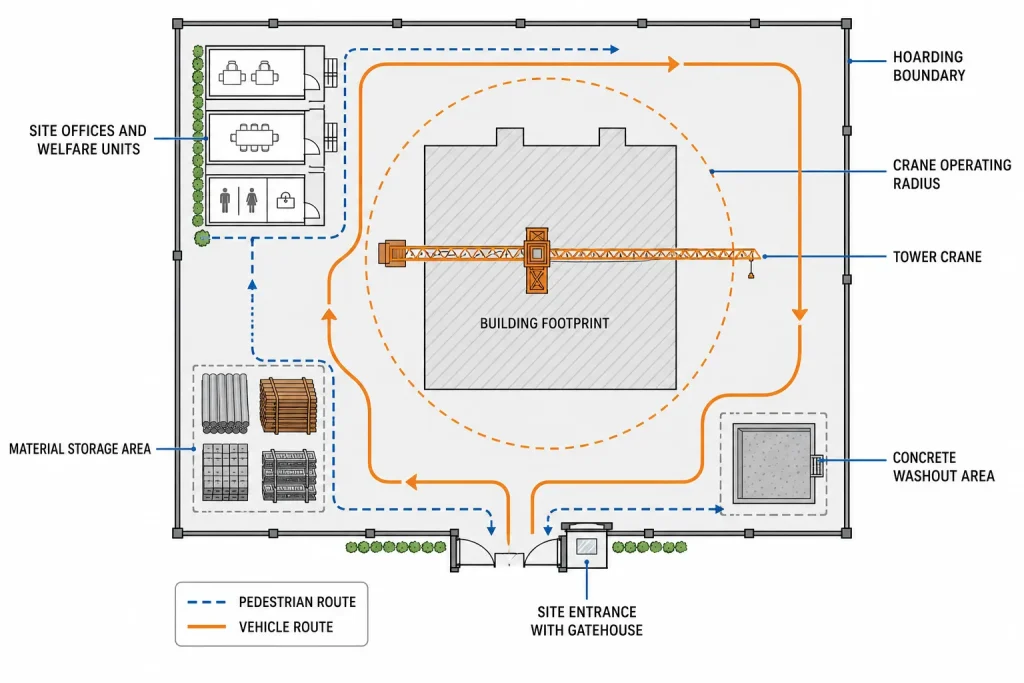
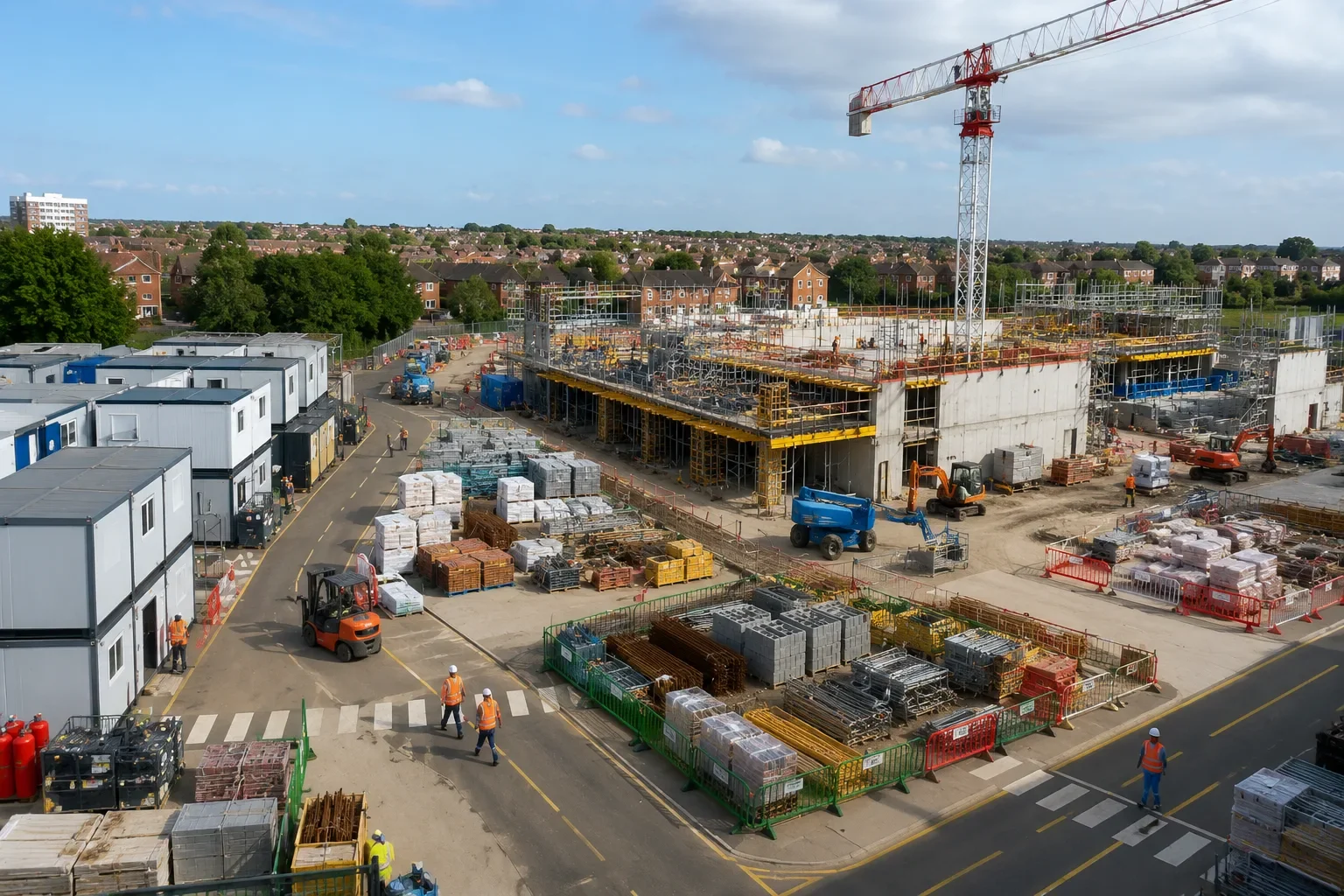
The site layout plan, sometimes called the construction site logistics plan or temporary works layout, is the foundational planning document for any construction project. It shows the physical arrangement of all temporary elements on the site: the location of cranes, site offices, welfare facilities, material storage areas, access routes, concrete washout areas, temporary power distribution, and hoarding.
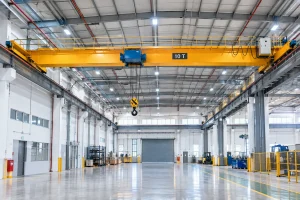
Crane positioning is typically the first constraint to resolve in site layout planning. The crane must be positioned to cover all areas of the building where heavy lifts will be required, structural steel, precast panels, formwork, and plant and equipment. The operating radius at maximum lift capacity must be confirmed from the crane’s load chart, and the crane must be positioned so that all critical lift zones fall within the permitted capacity envelope. Where a single crane cannot cover the full site, two cranes may be required, their operating radii must be planned to avoid collision.
Understanding the different types of cranes used in construction and their specific operational parameters is essential background for anyone responsible for crane positioning decisions in a site layout plan.
Site offices and welfare facilities must be positioned in locations that will not be built over during the project, that are accessible without crossing active work zones, and that comply with the minimum welfare requirements for the number of workers on site. Welfare facilities, toilets, drying rooms, canteen, and first aid room, must be adequate in number and condition for the peak workforce.
Material storage areas must be positioned to minimise the distance materials must travel from delivery to point of use, while avoiding obstruction of plant movement routes and access to the building under construction. Heavy materials, precast units, steel sections, concrete blocks, must be stored on adequate bearers on ground capable of supporting the load, in a sequence that allows the first items needed to be accessed first without moving other stored items.
Hoarding and site perimeter must be established before any other work begins. The hoarding defines the controlled area of the site, excludes the public, and provides the secure perimeter within which all site activities take place. Its position must account for the footprint of all temporary works, cranes, scaffolding, welfare units, as well as the building being constructed.
-
-
Construction Sequence Planning
-
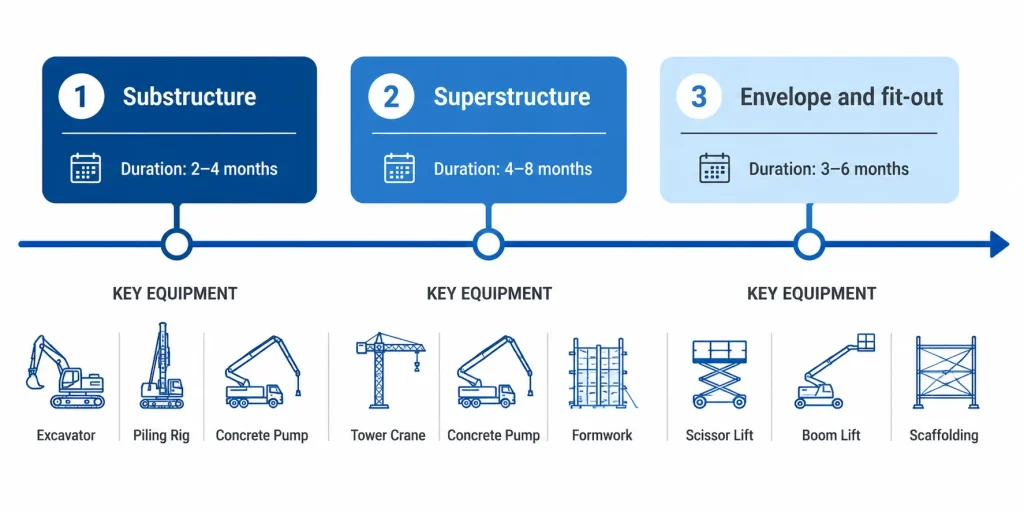
The construction sequence, the order in which different elements of the building are constructed, directly drives the site layout, the equipment deployment, and the logistics plan. Site planning that is disconnected from the construction sequence produces layouts that work for one phase of the project but become obstructive as the sequence progresses.
Substructure works typically require excavation equipment, piling rigs, and concrete production and placing equipment. The site layout during substructure must accommodate the movement of excavated material off site, the delivery and positioning of piling equipment, and the logistics of concrete supply. The ground conditions established during substructure also affect what plant can operate on site, soft or waterlogged ground may restrict access for heavy equipment until the substructure is completed and the site is properly drained.
Superstructure works shift the primary equipment requirements from earthmoving to lifting. The tower crane becomes the dominant piece of plant, and the site layout must support the flow of materials, formwork, reinforcement, precast panels, to the crane’s lift zones. Concrete pump placement must be planned for each slab pour, accounting for the pump’s maximum horizontal and vertical reach.
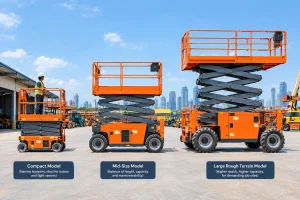
Envelope and fit-out works require elevated access, scaffolding for external facade work, scissor lifts and boom lifts for internal mechanical and electrical installation, and access platforms for ceiling and services work. The transition from structural to finishing trades changes the site’s character significantly, the number of different subcontractors on site increases, the trades work in closer proximity, and the coordination of access becomes more complex. Understanding the differences between the main types of aerial work platforms, and deploying the right type for each finishing trade’s access requirements, is a key site planning decision during this phase.
-
-
Equipment and Plant Planning
-
Equipment planning is one of the most consequential elements of site planning. The wrong equipment, too small, too large, incorrectly positioned, or deployed at the wrong phase, creates programme delays and cost overruns that are difficult to recover.
Lifting equipment must be selected and positioned to handle the heaviest planned lift at the maximum required radius. The load chart is the governing document for crane capacity, it must be consulted for every significant planned lift, not just once during equipment selection. As the project progresses and lift configurations change, the load chart must be re-consulted to confirm continued compliance.
Elevated access equipment, scissor lifts, boom lifts, and mobile scaffolding, must be specified for the specific access requirements of each phase of work. The specification must account for the height required, the surface conditions on which the equipment will operate, the load the platform must carry (workers, tools, and materials combined), and the proximity of the work to other structures or services. Practical guides on how to select the right access equipment for specific site conditions provide useful context for this decision.
Material handling equipment, forklifts, telehandlers, and pallet trucks, must be specified for the loads they will handle and the surfaces on which they will operate. A telehandler that can lift to the third floor of a low-rise building may eliminate the need for a tower crane during the structural phase of a smaller project, significantly reducing plant hire cost. A forklift specified for a concrete ground slab may not be appropriate if the site surface is temporarily unpaved during early works.
Temporary power, from generators or a temporary utility supply, must be planned to cover the peak electrical demand of all plant and welfare equipment operating simultaneously. A generator that is undersized for peak demand will trip under load, disrupting operations. Understanding how to size and specify temporary power generation equipment for construction sites is a fundamental part of site services planning.
Also read : Equipment to Clear Land: Every Machine You Need and How to Use It
-
-
Traffic and Logistics Management
-
Construction sites generate significant volumes of vehicle movements, concrete trucks, delivery vehicles, plant transporters, skip lorries, and workers’ vehicles, that must be managed to prevent congestion, conflict with pedestrians, and disruption to the surrounding road network.
Site entrance and exit must be positioned to allow vehicles to enter and exit without reversing onto the public road where possible. A single controlled entry point simplifies access management and supports induction control. The entrance must be wide enough for the largest vehicles expected on site, concrete trucks and low-loaders transporting plant can be very wide and have significant turning radius requirements.
One-way vehicle systems reduce the risk of vehicle conflict within the site and simplify traffic management. Where one-way systems are not possible due to site geometry, banksmen must be deployed to manage vehicle movements in areas of restricted visibility.
Delivery sequencing is a logistics planning function that ensures materials arrive on site in the sequence in which they are needed, not before, when there is no storage space, and not after, when the work is waiting. On constrained urban sites where storage space is minimal, a just-in-time delivery approach may be necessary, with deliveries booked in time slots coordinated with the crane programme.
Waste removal must be planned to prevent accumulation of debris that creates fire hazard, blocks access routes, and conceals developing hazards beneath the surface disorder. Skip positioning must account for crane reach, vehicle access, and safe loading by excavator or manual labour.
-
-
Safety Planning
-
Safety planning is not a separate exercise from site planning, it is an integral part of it. Every site layout decision has safety implications, and those implications must be considered at the planning stage rather than resolved reactively during construction.
Pedestrian-vehicle segregation must be designed into the site layout from the outset. Pedestrian routes must be clearly defined, physically separated from vehicle routes wherever possible, and maintained throughout the project as the site configuration changes.
Fall protection must be planned for every area of the site where unprotected edges will exist, slab edges, stairwell openings, lift shafts, and scaffold platforms. The planning must account for the changing configuration of the building as it rises, fall protection that is adequate at foundation stage will not be adequate at superstructure stage.
Emergency access must be maintained at all times, for ambulance, fire, and rescue services. The positioning of stored materials, plant, and temporary works must never block emergency vehicle access to any part of the site or to any building adjacent to the site.
A comprehensive approach to safety planning, covering equipment, access, electrical hazards, and emergency preparedness, is covered in practical construction site safety checklists and guides that support systematic safety management across all phases of a project.
-
-
Temporary Works
-
Temporary works are structures that are required to enable the construction of the permanent works, scaffolding, formwork, shoring, falsework, cofferdams, and temporary propping systems. They must be designed to carry the loads imposed on them during construction, installed correctly, and inspected regularly throughout their period of use.
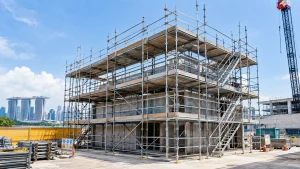
Scaffolding is the most visible and most extensively used category of temporary works on most construction sites. Its design, erection, and inspection must be managed by competent scaffolders under an appropriate management system. Scaffold that is modified without the involvement of a competent scaffolder, even for apparently minor changes, may be structurally compromised without any visible indication.
Formwork and falsework carry the weight of fresh concrete during casting. Failure of formwork during a concrete pour, caused by inadequate design, poor construction, or premature striking, results in catastrophic collapse with potentially fatal consequences. Formwork must be designed by a competent engineer, constructed to the design, and struck only when the concrete has reached sufficient strength as confirmed by cube or cylinder testing.
Temporary propping is used to support existing structures during adjacent excavation or underpinning, and to support partially completed structures during construction. Propping loads can be very significant, and the ground on which props bear must be capable of supporting them without settlement.
-
-
Programme and Progress Monitoring
-
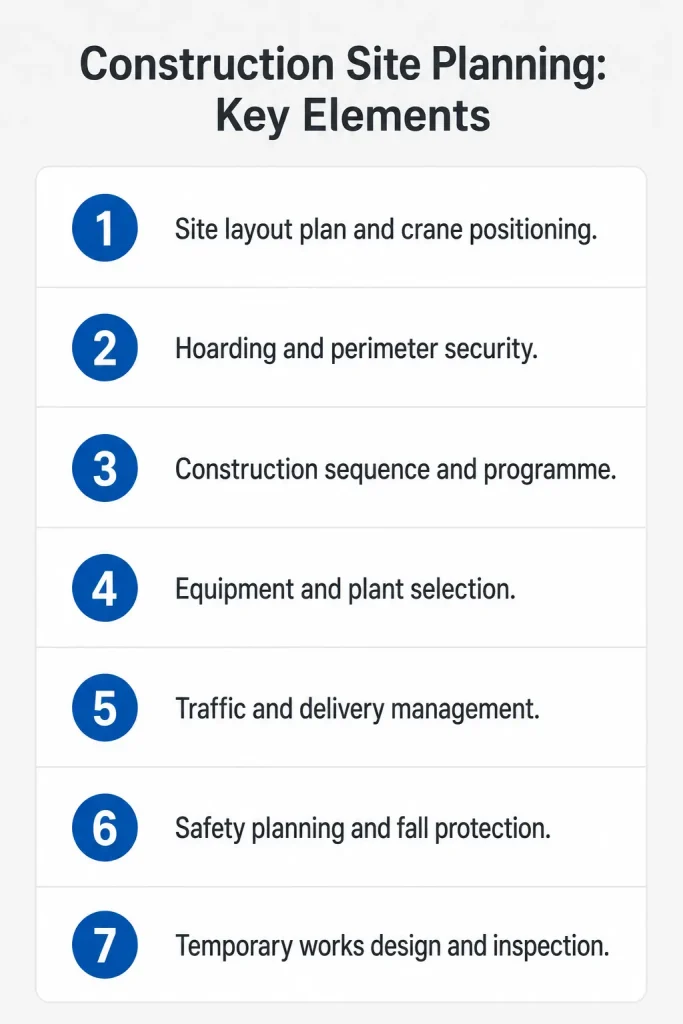
A site plan that is established at the beginning of a project and then not updated is of limited value. As the project progresses, the site configuration changes, cranes are climbed, scaffolding rises, materials are consumed and new deliveries arrive, temporary works are struck and re-erected, and the site plan must reflect current conditions rather than initial intent.
Regular site layout reviews, at least monthly on a typical project, and more frequently during periods of significant change, ensure that the site layout continues to support the current phase of construction efficiently and safely. These reviews should involve the site manager, the safety manager, the logistics coordinator, and the principal subcontractors whose trades are most active at the time.
For technical reference on construction site management principles, site organisation standards, and international best practice for temporary works and site logistics, resources on construction project management and site organisation provide useful background on how site planning integrates with broader project management frameworks.
Also read : Workplace Safety Tips for Construction and Industrial Sites
Plan the Site Well and the Project Will Follow
Construction site planning is not a preliminary task to be completed quickly before the real work begins. It is an ongoing management discipline that determines the efficiency, safety, and cost performance of the entire project. A site that is well planned, with the right equipment in the right positions, a clear construction sequence, safe and efficient logistics, and adequate temporary works, gives the project the best possible chance of delivering on time, within budget, and without serious incidents. The equipment deployed on a well-planned construction site, cranes, forklifts, access platforms, scaffolding, generators, must be correctly specified, professionally maintained, and operated by trained and competent personnel. These are not variables to be minimised, they are investments that determine what the site can achieve. RR Machinery offers a comprehensive range of construction equipment for sale and rental, including boom lifts, scissor lifts, mobile scaffolding, forklifts, and power generators, all maintained to operational standard and supported by experienced technicians. Explore our full range of construction and site equipment solutions or contact our team for practical advice and a clear quotation tailored to your project requirements.