A forklift is one of the most productive pieces of equipment in a warehouse, logistics facility, or construction site. It is also one of the most hazardous. Unlike many items of plant, a forklift operates in close proximity to other workers, in spaces shared with pedestrians, vehicles, and racking systems, carrying loads that can weigh several tonnes, often in environments with limited visibility and tight clearances. The consequences of a mechanical failure, an operator error, or an inadequate pre-shift inspection in that environment are serious.
A forklift safety checklist is the structured procedure that stands between normal operations and those consequences. It is the daily inspection routine that confirms the machine is mechanically sound, the safety systems are functional, and the operator is ready to work. It is not a bureaucratic formality. It is the primary mechanism by which forklift-related incidents are prevented before they happen.
This guide covers what a forklift safety checklist includes, why it is mandatory, how the inspection sequence is structured, and what operators and supervisors need to know to implement it correctly.
Why the Forklift Safety Checklist Is Not Optional
Forklifts cause a disproportionate number of serious workplace incidents relative to the time they are in use. The data is consistent across markets: tip-overs, pedestrian strikes, falling loads, and runaway trucks are among the most frequently cited causes of serious and fatal industrial injuries. The majority of these incidents share a common characteristic: the hazard that caused the incident was present before the shift started, and a thorough pre-shift inspection would have identified it.
This is why regulatory frameworks across all major industrial jurisdictions require daily forklift inspections before each shift. The inspection is not recommended practice. It is a mandatory requirement, and failure to conduct it, or to act on defects identified during it, is a compliance violation that carries real consequences: enforcement action, prohibition notices, and liability exposure.
Beyond compliance, there is a practical logic to the daily checklist. Forklifts accumulate wear faster than most people expect. Tyre damage, hydraulic leaks, chain wear, and brake degradation can develop within a single shift. An inspection that was valid at the end of the previous shift does not confirm that the machine is safe at the start of the next one. Each shift requires its own assessment, because each shift begins with an unknown quantity of changes to the equipment’s condition since the last inspection was completed.
The relationship between forklift maintenance and safety runs in both directions: well-maintained machines are inspected faster and with more confidence, while inspection data reveals what maintenance is required before failure occurs. Understanding how a structured forklift maintenance checklist integrates with daily safety inspection creates a more complete and effective approach to forklift fleet management.
Also read : Classes of Forklifts and Their Uses in Material Handling
The Two-Phase Structure of a Forklift Safety Checklist
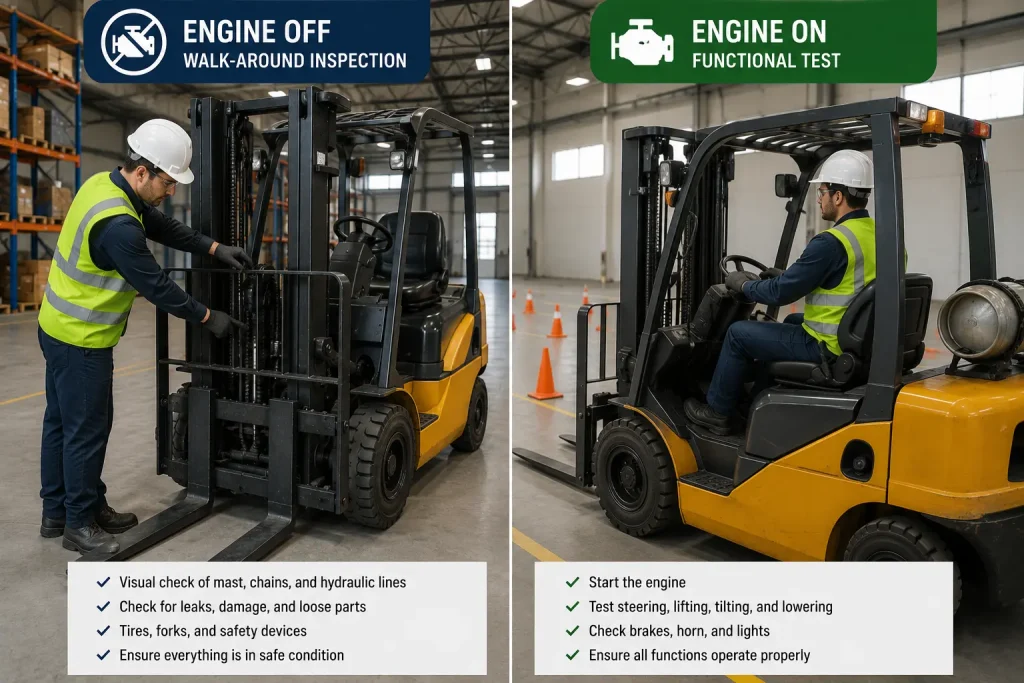
A properly structured forklift safety checklist is not a single list of items checked in any order. It follows a two-phase sequence that reflects the different categories of problems that can only be detected with the machine off, or only with the machine running. Both phases are required. Skipping either one produces an incomplete picture of the machine’s condition.
Pre-Start Visual Inspection (Engine Off)
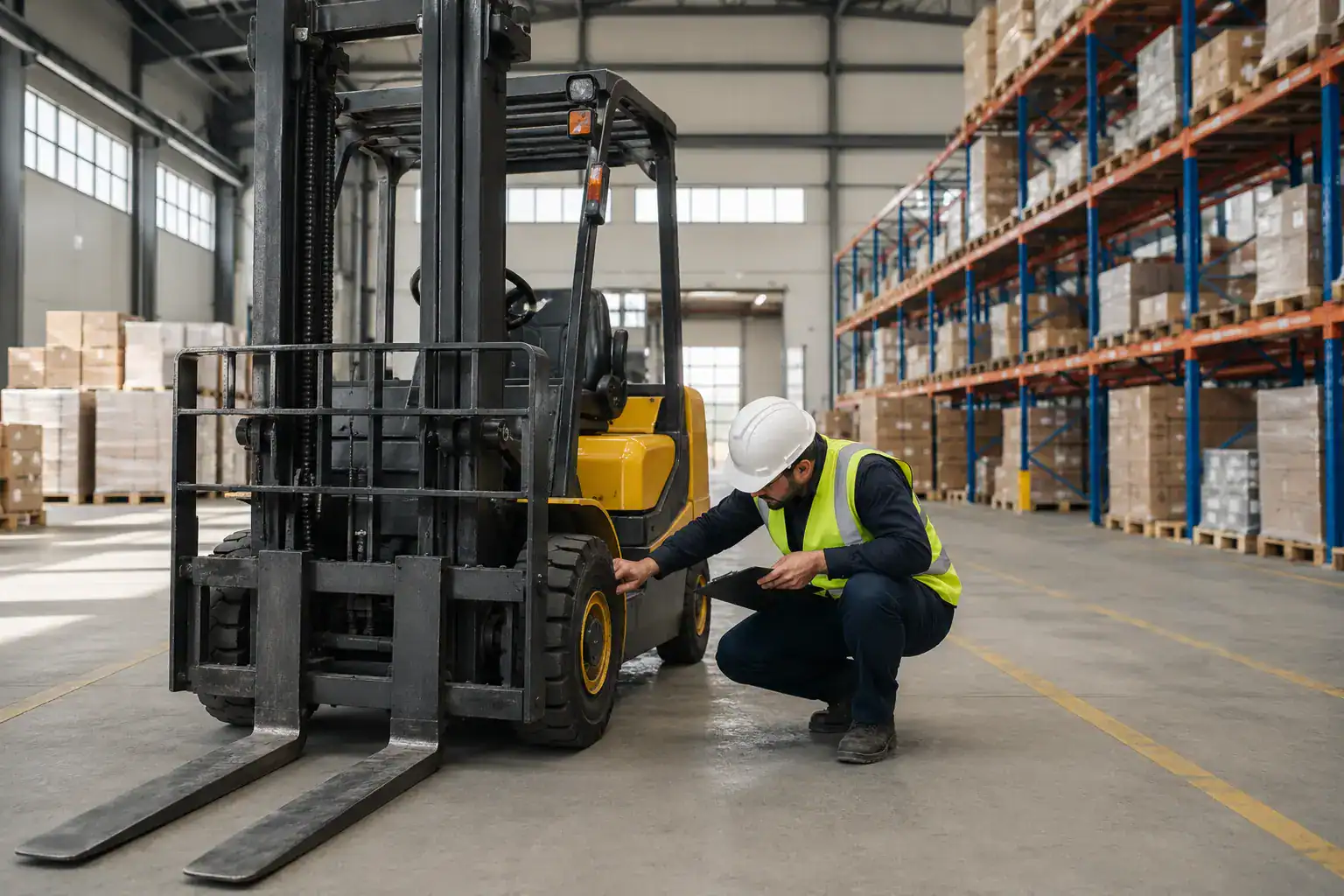
The pre-start visual inspection is conducted before the operator mounts the machine and before the engine or motor is started. Its purpose is to identify any visible defect, damage, or abnormality that would prevent safe operation or require the machine to be taken out of service before it moves.
The walk-around inspection covers the entire machine. The operator moves around the forklift systematically, checking all accessible components. Nothing is assumed to be in the same condition it was at the end of the last shift.
- Tyres and wheels
Check tyre condition on all positions. Pneumatic tyres require inspection for cuts, sidewall damage, embedded objects, and inflation pressure. Cushion tyres require inspection for flat spots, chunking, and visible deformation. Any tyre with visible structural damage or inadequate inflation pressure must be addressed before the machine is used. Check wheel nuts for security.
- Fork tines
Inspect both fork blades for cracks, particularly at the heel, which is the inner bend where the vertical blade meets the horizontal blade and the point at which fatigue cracking most commonly initiates. Check that blade thickness at the heel is not worn beyond 10 percent of the original specification. Confirm that both forks are the same length. Verify that fork locking pins or hooks are secure and that the forks cannot slide laterally off the carriage.
- Mast and carriage assembly
Inspect the mast channels, rollers, and carriage for visible damage, deformation, or wear. Check the mast chains for visible wear, corrosion, or elongation. Lubricate chains if required. Inspect the backrest extension, if fitted, for security and condition.
- Hydraulic system
Check beneath and around the mast, lift cylinders, tilt cylinders, and hydraulic lines for drips, puddles, or staining that indicates a hydraulic leak. Any hydraulic leak is grounds for taking the machine out of service until the source is identified and repaired. Check hydraulic fluid level via the dipstick or sight glass.
- Engine fluid levels (IC machines)
Check engine oil level, coolant level, and, where applicable, transmission fluid and brake fluid. Low fluid levels indicate either consumption or a leak. Both require investigation before the machine operates.
- Battery (electric machines)
Inspect the battery for visible damage to the casing, corrosion at the terminals, or electrolyte leakage. Check that the battery connector is secure and undamaged. Confirm that the battery is sufficiently charged for the shift.
- LPG or fuel system (as applicable)
For LPG-powered machines, check the cylinder mounting, the connection to the regulator, and the fuel line for damage or leaks. For diesel machines, check the fuel level and inspect the fuel lines and tank for damage or leakage.
- Overhead guard
Confirm that the overhead guard is fitted, undamaged, and secure. The overhead guard is a structural protection system for the operator against falling objects. Any damage to the guard structure requires the machine to be taken out of service.
- Seatbelt and operator restraint
Inspect the seatbelt for webbing damage, secure attachment at both the belt and buckle ends, and confirm that the buckle latches and releases correctly.
- Lights and warning devices
Inspect all fitted lights, horn, and reverse alarm or blue spotlight for visible damage. Functional testing of these items is completed in Phase 2, but obvious damage identified during the walk-around should be noted.
Operational Checks (Engine or Motor Running)
Once the walk-around inspection is complete and no defects have been identified that require the machine to remain out of service, the operator starts the machine and conducts the operational checks. These are function tests of the systems that can only be verified with the machine running.
Operational checks are conducted in a safe area away from other workers, racking, and pedestrian traffic. The machine should not be driven into the operating area until all operational checks are satisfactorily completed.
- Brakes
Test the service brake (foot brake) by applying moderate pressure and confirming the machine stops promptly and without pulling to one side. Test the parking brake by applying it on a level surface and confirming the machine holds position when the drive is released.
- Steering
Turn the steering wheel through its full range in both directions and confirm that the machine responds smoothly, without excessive free play, binding, or delay. Power steering systems should respond evenly in both directions without unusual noise.
- Lift and tilt functions
Operate the lift control through a full raise-and-lower cycle and confirm smooth, even operation without juddering, drifting, or abnormal noise. Operate the tilt control through its full forward and back range and confirm correct response. If auxiliary hydraulic attachments are fitted, test these functions also.
- Mast chain tension
During the lift cycle, observe both chains and confirm they are tensioned evenly. Uneven chain tension indicates a problem with the chain or anchor that requires investigation.
- Instruments and gauges
Confirm that the fuel gauge, battery charge indicator, temperature gauge, and any other fitted instruments are displaying readings within normal range. Any instrument reading outside normal range requires investigation before the shift proceeds.
- Horn and warning devices
Test the horn and confirm it produces a clear audible signal. Test the reverse alarm or blue spotlight where fitted and confirm operation. On machines with flashing amber warning lights, confirm these are operational.
- Lights (where applicable)
Test all fitted lights including headlights, reversing lights, and any work lights fitted to the machine and confirm correct operation.
- Unusual noises or vibration
During the operational checks, listen for any noise or vibration that was not present during previous operation. Knocking, grinding, squealing, or rattling during any function is a signal that requires investigation before the machine is put into productive use.
Also read : Workplace Safety Tips for Construction and Industrial Sites
What to Do When a Defect Is Found
The value of a forklift safety checklist is only realised if defects found during the inspection are properly managed. A checklist that records defects but allows the machine to operate anyway provides a false record of compliance while doing nothing to prevent the incident the inspection was designed to avoid.
The protocol is straightforward. Any defect identified during Phase 1 or Phase 2 that could adversely affect the safe operation of the machine requires the following response:
- Remove the machine from service immediately
The forklift is not used until the defect is assessed and cleared.
- Tag the machine out of service
A physical out-of-service tag or lock placed on the key or controls prevents another operator from starting the machine without knowing of the defect.
- Report the defect to the supervisor and maintenance team
The report should document what was found, where on the machine, and during which phase of the inspection.
- Do not return the machine to service until cleared
The machine returns to service only after the defect has been repaired and a return-to-service inspection has confirmed the machine is safe.
The threshold for removing a machine from service is any defect that could affect safety, not just defects that make the machine inoperable. A minor hydraulic weep that does not stop the machine from operating may progress to a failure within the shift. A tyre with a sidewall cut may appear functional but represents a risk of sudden deflation under load. The operator’s role is to identify and report, not to assess whether the risk is tolerable.
Supervisors who allow machines with identified defects to continue operating, either explicitly or by failing to act on defect reports, carry direct responsibility for incidents that result.
Documentation and Record-Keeping
The inspection is not complete until the result is documented. A completed forklift safety checklist, signed by the operator and filed, serves multiple functions: it creates a compliance record, it provides evidence that the inspection was completed, and it produces a data trail that reveals patterns of recurring defects or accelerated wear.
Documentation requirements for a compliant forklift inspection record include
- Date and time of the inspection
- Machine identifier (fleet number, registration, or serial number)
- Name and signature of the inspecting operator
- Result for each checklist item (pass, fail, or not applicable)
- Description of any defect found
- Action taken in response to any defect
- Confirmation that defects have been cleared before return to service
Paper checklists meet the minimum documentation standard. Digital inspection systems, whether purpose-built apps or integrated fleet management platforms, provide additional benefits: they cannot be backdated, they automatically timestamp each inspection, they alert supervisors when a defect is logged, and they aggregate inspection data in a form that allows fleet-wide analysis over time.
Patterns in inspection data are operationally valuable. If the same machine consistently records brake fade warnings, tyre wear observations, or hydraulic leak indicators across consecutive shifts, the data is signalling a maintenance requirement before failure occurs. Operators who review their own inspection records over time become more effective at identifying emerging issues early.
Also read : Types of Material Handling Equipment
Forklift Safety Beyond the Pre-Shift Checklist
The pre-shift checklist addresses mechanical readiness. It does not by itself address the operational hazards that arise during the shift from the way the machine is used, the loads it carries, the environment it operates in, and the interaction between forklifts and pedestrians in shared spaces.
Load Handling Safety
Every forklift has a rated capacity displayed on the data plate attached to the mast. This rating is specific to the machine configuration: the load centre distance (typically 500mm from the face of the forks to the load’s centre of gravity), the lift height, and any attachments fitted. Exceeding the rated capacity, or lifting at a load centre distance greater than the rated distance, reduces the effective capacity and raises the risk of tip-over.
Load handling procedures that operators must apply on every lift include confirming the load weight against the machine capacity plate, centering the load on both forks, ensuring the load is stable before lifting, tilting the mast back slightly to stabilise the load during travel, keeping the forks as low as practical during travel, and never allowing passengers to ride on the forks or the machine.
Pedestrian Safety and Traffic Management
Pedestrian-forklift collisions are among the most serious incident types in warehouse and industrial environments. The dynamics of these collisions are particularly severe: a forklift operator’s forward visibility with a loaded mast is significantly restricted, pedestrians may not hear an approaching forklift in a noisy environment, and the weight of the machine means that contact at even low speeds causes serious injury.
Traffic management controls that reduce pedestrian-forklift conflict include designated forklift lanes marked on the floor, physical barriers at pedestrian crossing points, convex mirrors at blind intersections, one-way traffic systems where the facility layout permits, and speed limits enforced operationally and through site rules. Where forklifts and pedestrians must share space, the pedestrian has priority and the operator is responsible for coming to a stop if there is any doubt about the pedestrian’s awareness of the forklift’s approach.
Stability and Tip-Over Prevention
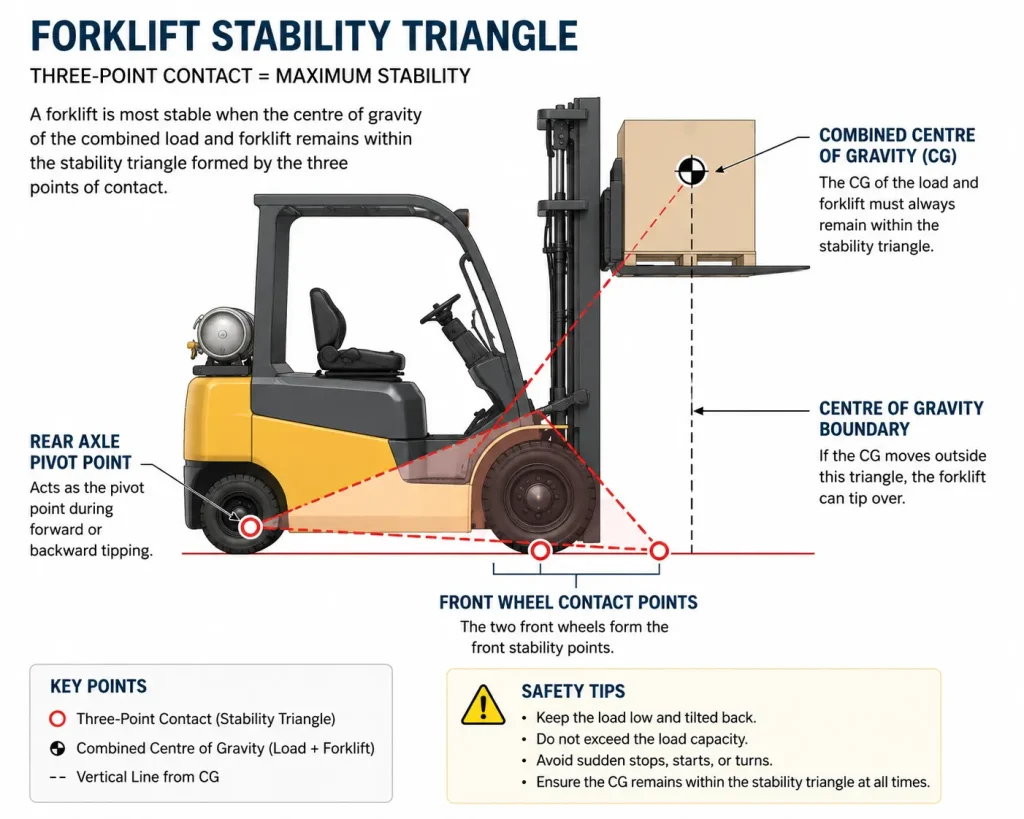
Forklift tip-overs are the leading cause of operator fatalities in forklift incidents. The instability that leads to tip-over can develop rapidly and with little warning. A forklift that appears stable during normal operation can reach its tipping point within seconds if the operator turns sharply while travelling with an elevated load, drives across a slope with the load pointing uphill, hits a kerb or floor depression at speed, or brakes sharply with a heavy load at height.
Tip-over prevention requires operators to understand the stability triangle, the three-point contact system between the two front wheels and the rear axle pivot point that defines the machine’s stability boundary. Any combination of load, speed, turn radius, and terrain that moves the combined centre of gravity outside this triangle will cause the machine to tip. Staying within the operating parameters defined by the manufacturer is the fundamental protection against tip-over.
Operators must remain in the machine with the seatbelt fastened if a tip-over begins. The instinct to jump clear is dangerous. The overhead guard is designed to protect the operator within the machine during a tip-over. Jumping clear of a tipping forklift carries a high risk of being struck by the falling machine.
Understanding the full range of equipment used in material handling environments, and the specific safety disciplines that each type requires, provides the broader operational context in which forklift safety sits. A guide on the types of material handling equipment covers the range of plant and machinery used across warehouse, logistics, and construction environments.
Also read : Types of Cranes and Their Lifting Capabilities
Operator Training and Certification
A forklift safety checklist is only as effective as the operator using it. An operator who does not understand what a correctly tensioned mast chain looks like, or what hydraulic leak evidence indicates, or why fork heel cracking is a serious defect and not a cosmetic issue, cannot perform a reliable inspection regardless of how well designed the checklist is.
Operator training is the foundation on which inspection competence rests. Training programmes must cover the mechanical principles of the forklift, the function of each major system and its safety significance, the inspection procedure and what each item is looking for, the defect reporting and machine tagging procedure, load handling principles and capacity calculations, traffic management and pedestrian safety procedures, and emergency procedures including what to do if a tip-over begins.
Certification is not a one-time event. Operators must demonstrate practical inspection and operating competence during initial training, and should receive refresher evaluation at regular intervals and whenever a new type of forklift is introduced to the fleet. Authorisation to operate a specific machine type should be documented and kept current.
Supervisors have a parallel training requirement. A supervisor who has not been trained in forklift inspection requirements cannot effectively oversee the inspection process, assess defect reports, or make informed decisions about taking machines out of service. Supervisory training should cover all the same technical content as operator training, plus the management, documentation, and compliance dimensions of the safety programme.
Choosing the Right Forklift for Your Operation
Safety performance is also a function of the right machine being used for the right application. A forklift selected without adequate attention to the operating environment, the load types, the aisle widths, the floor surface, and the lift heights required, will be operated at or beyond its capability by necessity, which compounds every other safety risk.
Key selection criteria for forklift type include:
- Operating environment
Indoor operations on smooth warehouse floors suit electric cushion-tyre machines. Outdoor operations on uneven ground or rough terrain suit diesel or LPG pneumatic-tyre machines. Mixed environments require a machine specified for the most demanding surface condition encountered.
- Lift height and aisle width
Standard counterbalance forklifts require wide aisles. Reach trucks, very narrow aisle trucks, and order pickers are designed for progressively tighter racking configurations at the cost of different load capacity and operating constraints.
- Load capacity
The machine must be capable of handling the heaviest load in the operation at the maximum lift height required, with capacity to spare. Operating machines at or near their rated capacity for extended periods accelerates wear and reduces the safety margin available for operator error.
- Fuel type
Electric machines produce no exhaust emissions and are suited to enclosed environments. IC machines require adequate ventilation. LPG machines produce lower emissions than diesel but both require ventilation for indoor use.
The classes of forklifts and their application in material handling provides a detailed breakdown of the seven standard forklift classes, what distinguishes each, and what operations each class is designed to serve.
Implementing a Forklift Safety Checklist That Actually Works
A forklift safety checklist is the daily mechanism by which mechanical problems are identified before they cause incidents, safety devices are confirmed to be functional, and operators take an active and documented role in the safety of their own equipment. It is not an administrative burden. It is the most practical and direct intervention available to prevent the most common categories of forklift incidents.
Making the checklist effective requires three things: a well-designed inspection procedure that covers all safety-critical items in a logical sequence, trained operators who understand what they are checking and why, and a management system that acts on defect reports rather than filing them. All three are required. A good checklist without trained operators produces paperwork. Trained operators without a management system that acts on their reports produces frustration and, eventually, shortcuts.
The investment in a structured, documented, consistently applied forklift safety checklist pays back in reduced incident frequency, reduced equipment downtime, lower maintenance costs through earlier defect detection, and a demonstrable compliance record that protects the organisation if an incident is ever investigated.
Get the Right Forklift and Support for Your Operation
Understanding the forklift safety checklist, from the two-phase pre-shift inspection to load handling procedures, pedestrian management, and operator training, gives operations managers the framework they need to run forklift operations safely, compliantly, and efficiently. The checklist is the daily habit that protects operators and equipment alike.
RR Machinery offers a comprehensive range of forklifts for sale and rental across Singapore, maintained to operational standard and supported by experienced technicians who understand the demands of daily warehouse and construction operations. Explore our full range of forklifts for sale and rental or contact our team for practical advice and a clear quotation tailored to your project requirements.