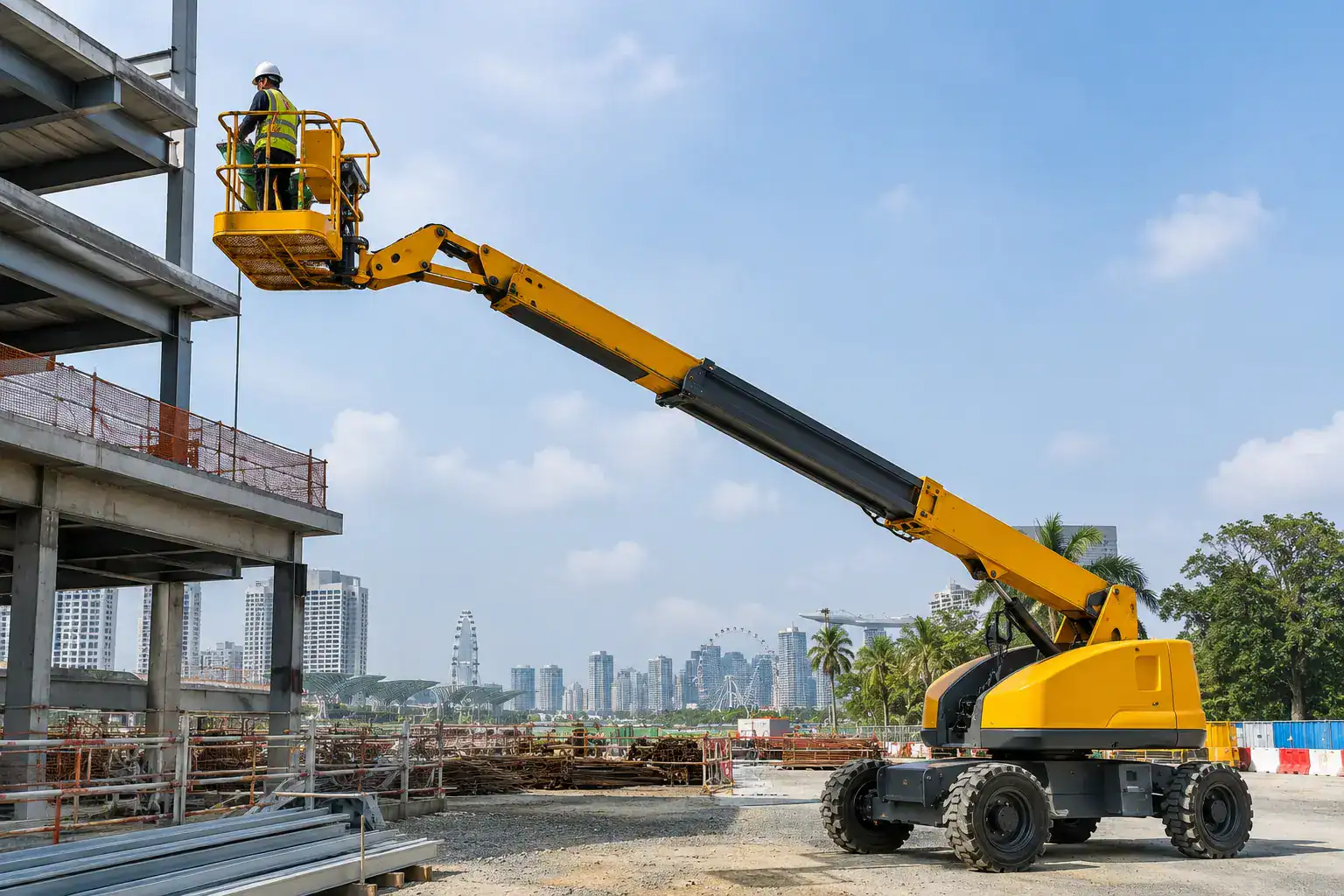
Every boom lift has a maximum weight it can safely carry, but that number is rarely as simple as a single figure printed on a specification sheet. A boom lift’s actual weight limit changes depending on how far the boom is extended and at what angle, which means the same machine can safely carry a very different load at full extension compared to when the boom is retracted close to the base.
Understanding how this limit actually works, what counts toward it, and what happens if it is exceeded is essential for anyone specifying, operating, or supervising work involving a boom lift. This guide breaks down the mechanics behind boom lift weight limits and the practical steps for staying safely within them on every job.
What Is a Boom Lift’s Weight Limit?
A boom lift’s weight limit refers to the maximum combined weight the platform can safely carry at any given position of the boom, covering the operator, any additional personnel, tools, and materials in the basket at once.
This limit exists because the boom, hydraulic system, and stability structure of the machine are engineered around a specific maximum load, and exceeding it introduces risk not just of mechanical strain but of the entire machine becoming unstable. Understanding this limit thoroughly starts with recognising that it is not one fixed number but a variable that changes throughout the boom’s range of motion.
Platform Capacity vs Machine Capacity
It is easy to confuse a boom lift’s platform capacity with its overall machine capacity, but the two are different measurements. Platform capacity refers specifically to the maximum weight the basket itself can carry, while machine capacity more broadly reflects the structural and hydraulic limits of the entire boom assembly at a given extension and angle.
A machine’s rated platform capacity is always the lower, more conservative figure that operators should reference day to day, since it already accounts for the machine’s structural limits at various boom positions. Understanding the full mechanism behind how a boom lift’s various systems work together is covered in How Does a Boom Lift Work? Mechanics & Components Explained, useful background for understanding why these two figures are not the same thing.
Why the Limit Isn’t a Fixed Number
Unlike a simple weighing scale with one maximum reading, a boom lift’s actual safe carrying capacity decreases as the boom extends further out or is raised to a steeper angle, since the platform’s distance from the machine’s centre of gravity directly affects how much leverage the load exerts on the structure. This is why the same boom lift might be rated to carry several hundred kilograms at full retraction but considerably less at maximum reach.
This variable nature of the limit is precisely why every boom lift includes a load chart or capacity chart specifying the maximum safe load at different combinations of boom length and angle, rather than a single number that applies universally across the machine’s entire range of motion.
Also read: How Does a Boom Lift Work? Mechanics & Components Explained
How Boom Lift Weight Limits Are Calculated
The weight limit at any given position of the boom is not arbitrary, it is calculated based on the physical forces acting on the machine’s structure at that specific extension and angle.
Manufacturers determine these limits through structural engineering analysis and physical testing, establishing exactly how much load the boom, turret, and base can safely support before the risk of structural failure or tipping becomes unacceptable. This data is then built into the machine’s rated load chart and, on modern units, into an electronic load sensing system that continuously monitors actual conditions during operation.
Boom Angle and Extension
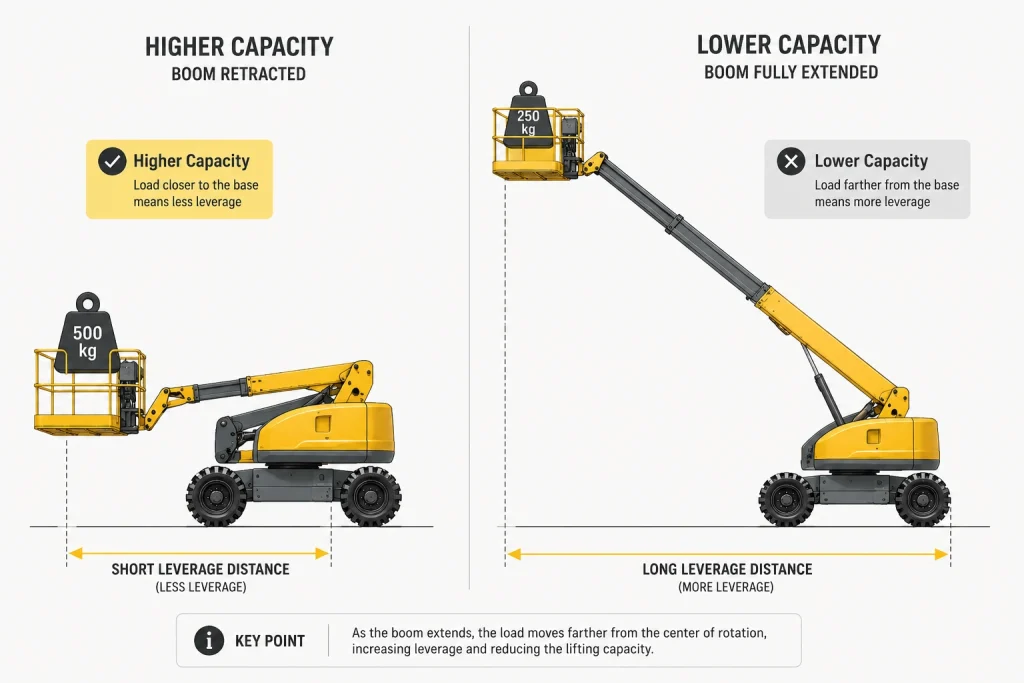
As a boom extends further from its base, the load at the platform end exerts progressively more leverage on the structure, in the same way holding a weight at arm’s length feels harder than holding it close to the body. This is why capacity decreases as extension increases, even though the load itself has not changed, only its distance from the point of support has.
Boom angle affects this calculation as well, since a boom raised to a steep angle changes how the load’s weight is distributed across the structure compared to a boom held at a shallower angle. Manufacturers calculate safe limits across this entire range of angles and extensions, which is why load charts typically present capacity as a matrix rather than a single figure.
Load Moment and Stability Systems
The underlying calculation behind these limits is often described as load moment, the combined effect of load weight and its distance from a pivot point, which determines how much force is actually being exerted on the machine’s structure and base at any given position. A small load far from the base can generate the same load moment as a much heavier load positioned close to it.
Modern boom lifts include electronic load sensing systems that calculate this load moment in real time, comparing the platform’s current weight against its position and automatically restricting further extension or triggering an alarm if the safe limit is approached. Similar load moment principles apply to other lifting equipment, and a detailed explanation of how this plays out for cranes specifically is available in How to Read a Crane Load Chart: A Clear Guide, useful for understanding the same underlying physics from a different equipment perspective.
Also read: Types of Boom Lifts: Which One Does Your Job Need?
What Counts Toward the Weight Limit
A boom lift’s rated weight limit applies to the combined total of everything placed in or attached to the platform, not just the materials being carried for a specific task.
Overlooking any single component of this total is one of the most common ways a boom lift ends up operating beyond its safe limit without the operator immediately realising it, since each individual item may seem insignificant on its own but the combined weight can add up quickly.
Operator and Personnel Weight
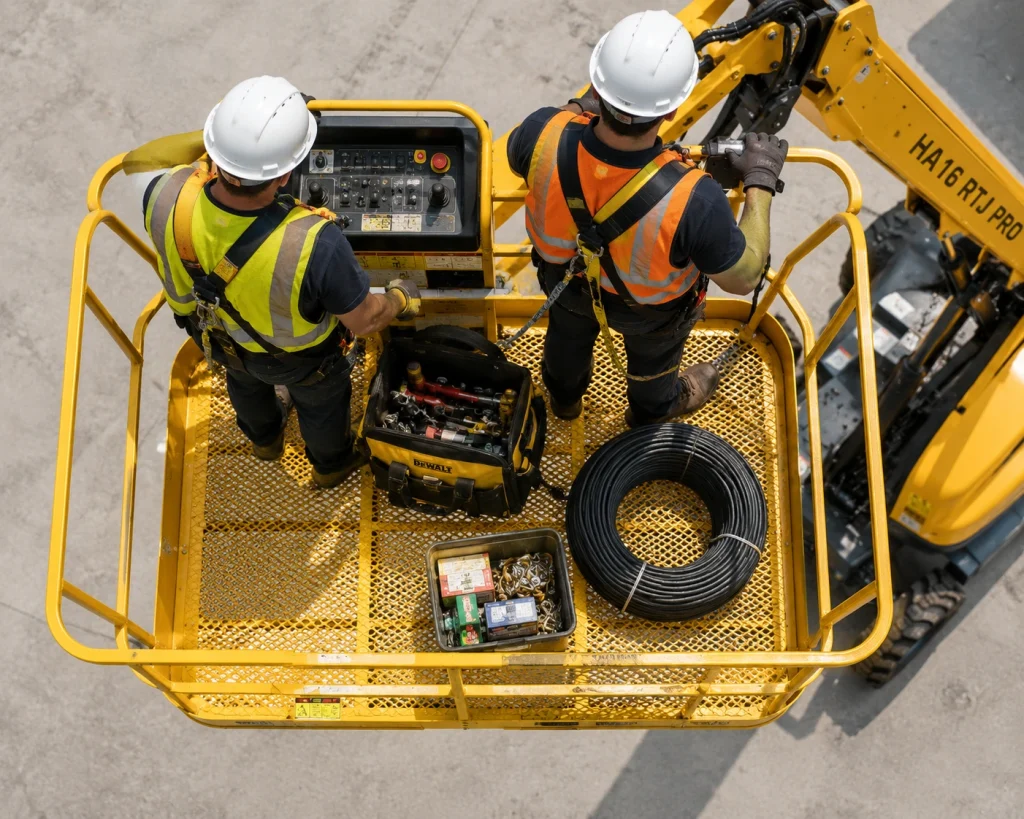
The weight of every person standing in the platform counts directly toward the total load, and this is often underestimated when a second worker joins the platform temporarily or when calculating capacity based on an assumed average weight rather than the actual weight of the people involved. Manufacturers typically calculate rated capacity using a standard assumed weight per person, which may not reflect the actual weight of a specific crew.
This is particularly important on tasks involving two operators in the platform simultaneously, since adding a second person can consume a significant portion of the platform’s total rated capacity before any tools or materials are even accounted for. Reviewing a machine’s actual rated occupancy and per-person weight assumption before a task begins helps avoid this being discovered only once the load sensing system triggers a restriction mid-task.
Tools, Materials, and Attachments
Tools, fasteners, coiled cable, replacement parts, and any other materials carried into the platform all count toward the total weight limit, even when their individual weight seems negligible compared to the platform’s overall rated capacity. Heavier items such as power tools, welding equipment, or building materials can consume a surprising share of the available capacity, particularly on boom lifts with more modest platform ratings.
Any permanently or temporarily fitted attachment, such as a material tray, pipe rack, or welding lead reel, also counts toward the total and should be accounted for separately from the task-specific materials being carried on a given day. Planning the full list of what will be in the platform before the boom is raised is the most reliable way to confirm the combined weight stays within the rated limit.
Typical Weight Limits by Boom Lift Type
Weight limits vary considerably across different categories and sizes of boom lift, reflecting differences in boom design, platform size, and the overall structural engineering of each model.
Understanding these general patterns helps set realistic expectations when specifying equipment for a task, though the specific rated capacity of the exact model and configuration being used should always take precedence over general assumptions based on category alone.
Articulating and Telescopic Boom Lifts
Telescopic boom lifts, with their straight-line extension and typically greater maximum reach, often have platform capacities in a similar general range to comparable articulating models, though the specific figures vary by manufacturer and model size. Articulating boom lifts, with their jointed, multi-section booms, are generally optimised more for manoeuvrability around obstacles than for maximum reach, which can affect how capacity is distributed across their range of motion.
The structural differences between these two boom designs, covered in detail in Choosing Between Articulating and Telescopic Boom Lifts, directly affect how each type’s load chart is structured, making it worth understanding the mechanical distinction before comparing rated capacities between the two.
Compact vs Heavy-Duty Models
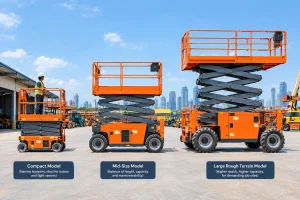
Compact and lower-height boom lifts generally carry lower rated platform capacities, reflecting their lighter overall structure and typically smaller intended workload, while larger, heavy-duty models built for greater working heights and outreach are engineered with correspondingly higher capacity platforms and more robust structural components. This scaling relationship exists because larger machines are built from the outset to handle both greater reach and the heavier loads that larger-scale tasks typically require.
Selecting a machine based on required working height alone, without checking its corresponding platform capacity, is a common specification mistake, since a taller machine does not automatically guarantee a higher weight allowance for a specific task. Cross-checking both figures against the actual planned task is the only reliable way to confirm a specific model will work.
What Happens If the Weight Limit Is Exceeded
Exceeding a boom lift’s rated weight limit does not simply reduce a margin of safety, it introduces a genuine risk of structural failure, tipping, or loss of control that the machine’s engineering was never designed to accommodate.
Understanding exactly what happens when a limit is approached or exceeded, both in terms of the machine’s built-in safety response and the underlying physical risk, reinforces why these limits should never be treated as flexible guidelines.
Automatic Safety Systems and Alarms
Modern boom lifts equipped with load sensing systems will typically trigger an audible or visual alarm as the platform’s load approaches its rated limit for the current boom position, and many units will automatically restrict further boom extension or elevation once the limit is reached. This automatic restriction exists specifically to prevent an operator from unknowingly pushing the machine beyond a limit that changes constantly with boom position.
These systems are a safeguard, not a substitute for proper load planning, since relying on the alarm to catch an overload after the platform is already loaded and the boom is already extended is a far riskier approach than confirming the load is within limits before the boom is raised in the first place.
Risks of Overriding or Ignoring Limits
Deliberately overriding a load sensing restriction, or operating an older machine without such a system installed, removes the built-in safeguard that would otherwise prevent the machine from being pushed beyond its structurally rated limit. The consequences of doing so range from accelerated wear on hydraulic and structural components to, in the most serious cases, structural failure or the machine tipping entirely, particularly at full extension where stability margins are already at their narrowest.
Singapore’s Ministry of Manpower publishes detailed Workplace Safety and Health guidance covering the training, inspection, and load limit obligations that apply to aerial work platform operation on construction sites, guidance that exists precisely because of how serious the consequences of exceeding rated capacity can be.
How to Stay Within a Boom Lift’s Weight Limit Safely
Staying within a boom lift’s weight limit is primarily a matter of planning before the task begins, rather than monitoring and reacting once the platform is already loaded and the boom is already in motion.
Building this planning step into standard task preparation, rather than treating it as an afterthought, is the most effective way to prevent overloading situations from arising in the first place, regardless of how sophisticated the machine’s own safety systems are.
Planning the Load Before You Start
Before any task begins, the combined weight of every person, tool, and material expected to be in the platform should be estimated and checked against the machine’s rated capacity at the specific boom position the task will require, not simply against the machine’s maximum capacity at full retraction. This is particularly important for tasks requiring significant reach, where the available capacity may be considerably lower than the platform’s capacity when fully retracted.
Where a task’s total expected load is close to the rated limit at the required boom position, planning ahead to reduce unnecessary tools or materials, or splitting the task across multiple platform trips, is a far safer approach than discovering the shortfall only once the load sensing system intervenes mid-task.
Working With Operators and Supervisors
Operators should be trained not just to read a load chart but to understand why the limit changes with boom position, since this understanding is what allows them to make sound judgement calls in situations the load chart alone does not explicitly cover. A clear step-by-step walkthrough of correct operating procedure, including how to interpret load limits during actual operation, is available in How to Operate a Boom Lift: A Step-by-Step Safety Guide.
Site supervisors play an equally important role, ensuring that task planning accounts for the specific boom lift model’s rated capacity at the reach required, rather than assuming any boom lift on-site can handle any task regardless of its specific load chart. This shared responsibility between operator and supervisor is what ultimately keeps a task within a machine’s safe operating limits from start to finish.
Also read: How to Operate a Boom Lift: A Step-by-Step Safety Guide
Get a Boom Lift Matched to Your Load Requirements
A boom lift’s weight limit is not a single number but a variable that changes with boom position, and understanding this is what allows a task to be planned safely from the outset rather than discovered mid-operation. Further technical background on how aerial work platforms are engineered and rated is available through Wikipedia’s overview of aerial work platforms, covering the broader engineering principles behind platform capacity ratings.
RR Machinery Pte Ltd offers an extensive range of boom lifts with clearly rated capacities suited to a wide range of tasks and reach requirements. Contact us today for expert advice on matching the right machine and capacity to your specific job.