Boom lifts are among the most versatile pieces of access equipment in construction, maintenance, and industrial work. Their defining characteristic, an extendable or articulating boom arm that elevates a work platform both vertically and horizontally, sets them apart from every other type of aerial work platform. A scissor lift goes straight up. A boom lift goes up, out, over, and around.
But “boom lift” is not a single product. It is a category that encompasses several distinct machine types, each designed to solve a specific combination of reach, height, terrain, power, and access requirements. Specifying the wrong boom lift type for a project does not simply reduce efficiency, it can make certain tasks physically impossible, create safety hazards on unsuitable surfaces, or result in a machine that cannot access the work location due to size or clearance constraints.
Understanding the different types of boom lifts, what each configuration offers, how it performs under different site conditions, and what operational requirements it imposes, is the foundation of making a good equipment selection decision. This guide covers every major boom lift type in widespread use, explains the engineering rationale behind each design, and provides practical guidance on matching the right type to the specific demands of the job.
What Makes a Boom Lift Different from Other Aerial Work Platforms
Before comparing individual boom lift types, it helps to understand what distinguishes boom lifts as a category from other elevated work platforms.
A scissor lift raises its platform directly upward from its base, the platform is always directly above the machine’s footprint. This makes scissor lifts highly stable and well-suited for work directly above the machine, but it means they cannot reach over obstacles, into recessed areas, or past obstructions between the machine and the work location.
A boom lift, by contrast, uses an articulating or telescoping arm to position the platform anywhere within its operating envelope, not just directly above the base. This gives boom lifts the ability to work over parapets, into machinery bays, around structural elements, and at positions that no other access equipment can reach. The trade-off is a larger footprint, greater complexity, and, in the case of articulating booms, the need for more operator skill to navigate around obstacles at height.
This capability profile makes boom lifts the equipment of choice for a wide range of tasks that other types of aerial work platforms and access equipment cannot perform, particularly wherever the work location is not directly above a clear, unobstructed floor position.
Also read : Boom Lift vs Scissor Lift: Which One Should You Use?
The Main Types of Boom Lifts
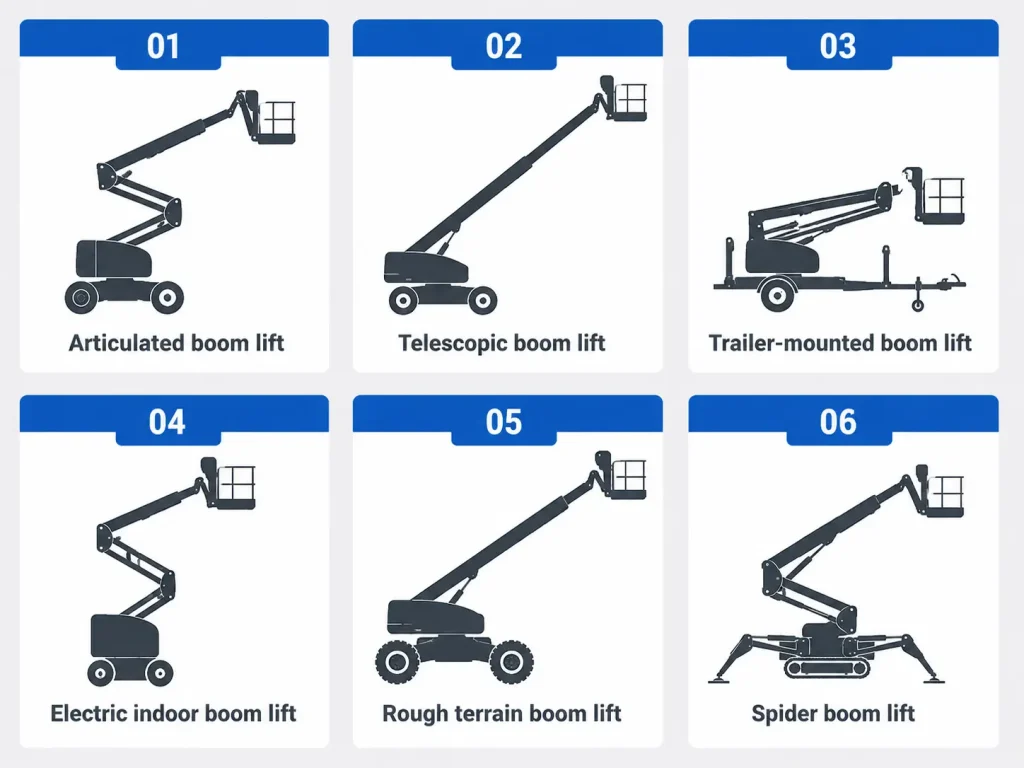
Articulated Boom Lift
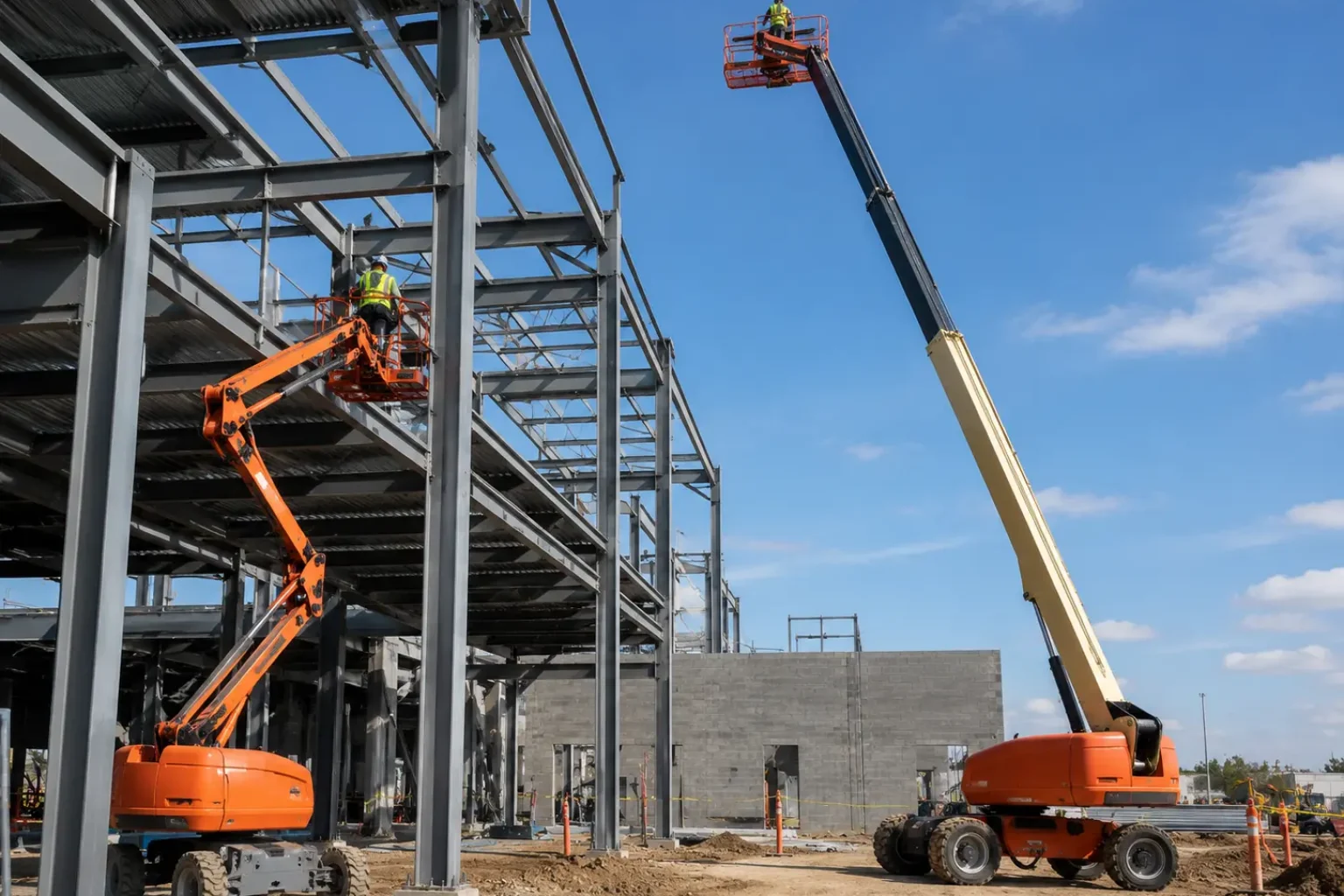
The articulated boom lift, also called a knuckle boom lift or knuckle boom, is the most widely used boom lift type in construction, building maintenance, and industrial work. Its jointed boom arm bends at one or more knuckles, allowing it to reach up, over, and around obstacles that a straight-arm machine cannot negotiate, positioning the platform above, behind, or extended out from the machine’s base.
This up-and-over reach makes articulated boom lifts the standard choice for building maintenance, facade inspection, and industrial work where structural elements sit between the machine and the work face, though their footprint and tail swing require more clearance than a scissor lift and their outreach is less than an equivalent telescopic model. For a complete breakdown of how the articulated boom works, its key specifications, common uses, and how to choose the right size for a project, see our full guide: Articulating Boom Lift: How It Works, Uses, and When to Choose One.
Also read : Articulating Boom Lift: How It Works, Uses, and When to Choose One
Telescopic Boom Lift
The telescopic boom lift, also called a straight boom lift or stick boom, uses a single boom that extends in sections like a telescope to achieve its working reach. There are no articulating joints, the boom extends in a straight line from its base angle, which can be varied from horizontal to near-vertical.
How it works:
The boom extends outward and upward from a rotating turntable. By adjusting the boom angle and the degree of extension, the operator positions the platform at the required height and horizontal distance. The simplicity of the straight-line extension gives telescopic booms their primary advantage: greater horizontal outreach for a given height compared to an equivalent articulated model.
A telescopic boom lift that reaches 30 metres in height may achieve 20 metres or more of horizontal outreach, significantly more than an articulated boom of equivalent height. This makes telescopic booms the preferred choice for open-span work where maximum reach from a fixed ground position is the priority.
Key specifications:
- Working heights: typically 14 to 56 metres (the tallest boom lifts in common use are telescopic)
- Horizontal outreach: typically 10 to 27 metres
- Platform capacity: typically 230 to 500 kg
- Power: diesel (primarily, due to outdoor use profile), electric models available for smaller sizes
- Drive: four-wheel drive standard on most models, with rough terrain variants
Best suited for:
- Large open construction sites, steel erection, precast installation
- Outdoor industrial facilities, plant maintenance, tank farm access
- Powerline and telecommunications infrastructure work
- Aviation and aerospace maintenance
- Any application requiring maximum reach from a fixed ground position in open terrain
Limitations:
The telescopic boom cannot navigate around obstacles the way an articulated boom can. If the direct line between the machine base and the work location is obstructed, the telescopic boom cannot be repositioned to work around it, the machine must be moved. This makes it less suitable for cluttered indoor environments or sites with numerous structural obstructions.
Trailer-Mounted Boom Lift (Towable Boom Lift)
A trailer-mounted boom lift is a self-contained elevated work platform designed to be towed behind a standard vehicle, typically a van, SUV, or light truck, using a standard tow hitch. Once on site, the unit is unhitched, the stabiliser outriggers are deployed, and the electric or petrol-powered boom can be operated by a single person.
How it works:
Most trailer-mounted boom lifts use an articulating boom configuration, a knuckle boom, mounted on a compact trailer chassis. The boom is powered by an electric motor fed from an onboard battery bank (which can be charged from a standard mains socket) or by a small petrol generator. The outriggers provide the stability footprint required for safe elevated operation.
Key specifications:
- Working heights: typically 9 to 17 metres
- Horizontal outreach: typically 5 to 9 metres
- Trailer width: typically 1.5 to 2.5 metres, fits through standard gates and access ways
- Power: electric/battery, petrol, or dual
- Tow rating: most require a tow vehicle rated for 1,500 to 3,500 kg
Best suited for:
- Facilities maintenance where equipment must travel between multiple sites regularly
- Electricians, telecommunications engineers, signage installers, and arborists who move between sites daily
- Sites with restricted access where a self-propelled boom lift could not enter
- Operations where a full-size machine cannot be justified for occasional access needs
Limitations:
Working height and outreach are significantly less than self-propelled models. The platform capacity is lower, typically one person with light tools. Outrigger deployment requires a flat, firm surface around each outrigger pad. These machines are not appropriate for sustained multi-shift work at significant height.
Also read : Construction Site Safety Checklist: A Comprehensive Guide
Self-Propelled Electric Boom Lift (Indoor Boom Lift)
Electric boom lifts, particularly the smaller articulated models designed for indoor use, deserve specific treatment as a distinct category because their operating characteristics are substantially different from outdoor diesel models, even when the boom configuration is similar.
How it works:
These machines use electric motors for both drive and boom functions, powered by large battery packs. Non-marking foam-filled tyres or solid rubber tyres protect sensitive floor finishes. They typically feature a more compact chassis than outdoor equivalents, with a smaller turning radius suited to warehouse and facility environments.
Key specifications:
- Working heights: typically 12 to 20 metres for indoor models
- Drive: electric, zero emissions, quiet operation
- Tyre type: non-marking, suitable for polished concrete, epoxy floors, vinyl tile
- Drive classification: typically two-wheel drive for smooth indoor floors
Best suited for:
- Warehouse maintenance, racking inspection, sprinkler servicing, light fitting
- Retail and commercial facility fit-out and maintenance
- Data centre and clean-room environments
- Any indoor application where emissions, noise, or floor damage is a concern
Limitations:
Battery runtime must be managed to ensure sufficient charge for the full shift. These machines are not suitable for outdoor or rough terrain use, smooth solid tyres have no grip on loose or wet ground, and the machines are not designed for gradients that exceed their rated limits.
Rough Terrain Boom Lift
Rough terrain boom lifts are designed specifically for outdoor, unpaved, uneven, or sloped ground. They feature large pneumatic tyres with deep tread, four-wheel drive, high ground clearance, and typically diesel power. The chassis is designed to remain stable on gradients that would be unsafe for standard boom lifts.
How it works:
The rough terrain boom lift uses the same articulating or telescopic boom configuration as standard models, but the undercarriage is fundamentally different. Large diameter, wide-section tyres distribute the machine weight over a greater footprint, reducing ground pressure on soft ground. Four-wheel drive provides traction on loose, wet, or sloped surfaces. Ground clearance is increased to allow passage over rough terrain without the chassis grounding.
Key specifications:
- Working heights: typically 14 to 30 metres
- Drive: diesel, four-wheel drive standard
- Tyre type: large pneumatic, lug or multi-directional tread
- Gradient capability: typically 40 to 45% grade (compared to 25–30% for standard models)
- Ground clearance: significantly greater than compact indoor models
Best suited for:
- Construction sites with unpaved or disturbed ground
- Civil engineering and infrastructure projects
- Forestry and agricultural applications
- Mining, quarrying, and extractive industry maintenance
- Any site where ground conditions exclude standard boom lifts
Limitations:
These machines are large, heavy, and not suitable for sensitive floors or indoor use. They consume more fuel than standard models due to engine size and four-wheel drive systems. The larger tyre footprint and greater counterbalance requirements mean they need more clearance at the machine base.
Spider Boom Lift (Spider Lift)
The spider boom lift, also called a spider lift or tracked aerial platform, is a specialist machine that combines a compact, very low ground footprint with the ability to operate on irregular terrain through a tracked undercarriage and four individually levelling outrigger legs that can be adjusted to accommodate uneven, sloped, or stepped surfaces.
How it works:
Spider lifts travel on rubber tracks, similar to a compact tracked excavator, allowing them to navigate extremely tight spaces, travel up and down steps, and operate on surfaces that would defeat a wheeled machine. Once in position, four articulating outrigger legs level the machine and provide the stability base for the boom operation. The boom is typically an articulating type with very high reach relative to the machine’s compact dimensions.
Key specifications:
- Working heights: typically 14 to 35 metres
- Machine width (travelling): as narrow as 0.75 metres, fits through standard single doorways
- Outrigger footprint: significantly wider than travel width, providing stability during operation
- Power: electric, petrol, or bi-energy
- Surface capability: stairs, slopes, soft ground, narrow corridors
Best suited for:
- Heritage buildings and churches where access is through narrow doorways and the interior floor cannot bear wheeled machine loads
- Roof and external maintenance on dense urban properties where access is severely restricted
- Indoor industrial maintenance in plants with narrow aisles and equipment-crowded floors
- Any situation where conventional boom lift access is impossible due to size or terrain
Limitations:
Spider lifts are significantly more expensive to hire than standard boom lifts. Outrigger setup takes longer than a wheeled machine. Travel speed is slow. These machines are specialist tools for situations where nothing else can access the work location, they are not general-purpose replacements for standard boom lifts.
How to Choose the Right Boom Lift Type
Selecting the right boom lift type requires working through a structured set of questions about the job conditions:
What is the required working height and outreach?
Working height determines whether a small articulated model is sufficient or whether a large telescopic or rough terrain boom is required. Outreach determines whether the machine can reach the work location from the available ground position. Both must be confirmed, not estimated, before specifying a machine.
What is the ground condition?
Smooth, hard indoor floor: electric indoor model with non-marking tyres. Firm, flat outdoor ground: standard self-propelled outdoor model. Soft, uneven, or unpaved outdoor ground: rough terrain model. Extremely confined or restricted access: spider lift. This single factor eliminates the majority of unsuitable options immediately.
Is the boom path obstructed?
If there are obstructions between the machine base and the work location, beams, pipes, walls, parapet edges, an articulated boom is required. If the path is clear and maximum reach is the priority, a telescopic boom achieves greater outreach at equivalent height.
What are the power and emission requirements?
Indoor or enclosed environments require electric, bi-energy, or diesel with exhaust filtration. Food-grade, pharmaceutical, and clean environments require electric. Outdoor sites with no power supply access require diesel or petrol.
How frequently does the machine move between locations?
If the machine stays on one site for weeks: self-propelled standard or rough terrain. If it moves between sites daily: trailer-mounted. If it needs to enter through doorways and navigate inside a building: compact electric or spider lift.
These selection principles are consistent with the approach used for all access equipment decisions, understanding the full demands of the task before specifying the machine, as covered in detail in practical guides to working at height safely and selecting the right equipment.
For technical reference on boom lift design standards, rated capacity testing, and international safety classifications for mobile elevated work platforms, engineering resources on aerial work platform engineering and safety standards provide comprehensive background on how boom lift types are classified and regulated.
Also read : What Is a Cherry Picker? Types, Uses and How It Works
Find the Right Boom Lift for Your Project
Understanding the types of boom lifts, articulated, telescopic, trailer-mounted, electric indoor, rough terrain, and spider lift, gives project teams the information they need to specify the right machine before it arrives on site rather than discovering its limitations after deployment.
Each type was engineered to solve a specific set of access problems. The articulated boom navigates around obstacles. The telescopic boom reaches the furthest. The trailer-mounted boom moves between sites easily. The rough terrain boom works where standard machines cannot. The spider lift accesses where nothing else can. Matching the right type to the right job is the decision that determines whether the machine adds value or creates problems.
RR Machinery offers a comprehensive range of boom lifts for sale and rental, including articulated and telescopic models in a wide range of working heights, all maintained to operational standard and supported by experienced technicians. Explore our full range of boom lift solutions for sale and rental or contact our team for practical advice and a clear quotation matched to your specific access requirements.