
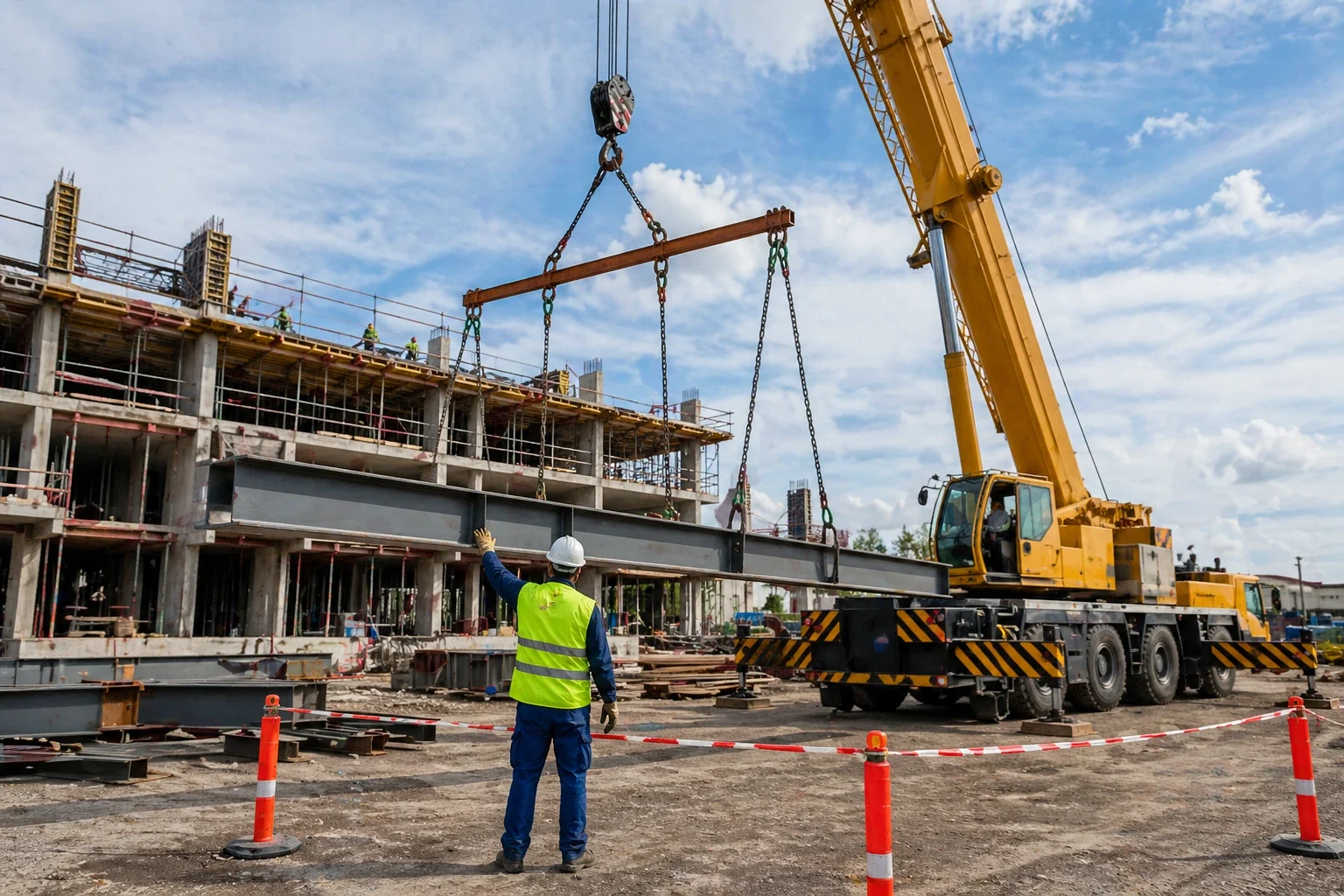
Lifting operations are among the highest-risk activities in construction and industrial work. When a load is suspended, whether by a crane, a forklift, a hoist, or any other lifting device, the consequences of equipment failure, operator error, or inadequate planning can be catastrophic. Loads that fall, equipment that tips, and structures that collapse under overloading do not give warning. They fail suddenly and completely, and the outcomes are frequently fatal.
Yet the vast majority of serious lifting incidents are preventable. Investigation after investigation into crane collapses, forklift tip-overs, and hoist failures arrives at the same conclusions: the hazard was foreseeable, the controls were known, and the incident occurred because those controls were not applied. A load chart was ignored. An inspection was skipped. An unqualified operator was permitted to work. A pre-lift plan was not prepared. The equipment was not correctly maintained.
Lifting equipment safety is not complicated in concept, but it requires consistent, disciplined application of well-established principles across every lift, every shift, and every site. This guide covers the full scope of lifting equipment safety: the regulatory framework, pre-lift planning, rigging and load management, equipment-specific safety requirements, inspection and maintenance obligations, and the competency requirements for everyone involved in a lifting operation.
The Regulatory Framework for Lifting Operations
In most jurisdictions, lifting operations and lifting equipment are subject to specific legislation that imposes legal obligations on employers, equipment owners, and operators. While the specific regulations vary between countries, the core obligations are broadly consistent:
Equipment must be of adequate strength and stability for the loads it will lift, in the conditions in which it will operate. This means equipment must be correctly rated, certified, and used within its rated parameters.
Equipment must be thoroughly examined at defined intervals by a competent person, typically a qualified lifting equipment inspector or engineer. The examination intervals are specified by regulation and must be adhered to regardless of the equipment’s apparent condition.
Lifting operations must be properly planned by a competent person, including assessment of the load, the equipment, the environment, the rigging arrangement, and the exclusion zones required.
Operators must be trained and competent for the specific type of lifting equipment they operate. Competency must be assessed and documented, self-declaration is not sufficient.
Records must be maintained for all examinations, inspections, and significant repairs. These records must be available for inspection by the relevant authority.
Understanding these obligations is the starting point for any organisation that owns, rents, or operates lifting equipment. Just as the selection of lifting and access equipment must be matched to the specific requirements of each task, the safety management of lifting operations must be matched to the specific risks of each lift.
Also read : Parts of a Crane: Key Components and How They Work
Pre-Lift Planning
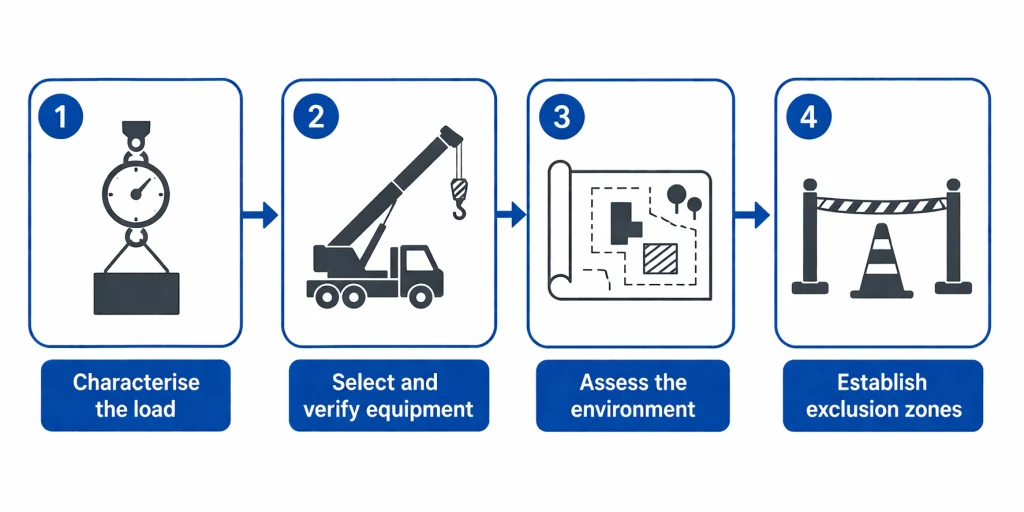
The most effective safety measure in any lifting operation is thorough pre-lift planning. A lift that has been properly planned, with the load characterised, the equipment selected and verified, the rigging specified, the area prepared, and the personnel briefed, is a lift in which the hazards are understood and controlled before the load leaves the ground.
Characterise the load
Before any lift begins, the following must be known:
- Weight
The actual weight of the load, not an estimate. Where the exact weight cannot be determined, a conservative upper-bound estimate must be used. Underestimating load weight is one of the most common causes of crane overloads.
- Centre of gravity
The location of the load’s centre of gravity determines how it will hang when lifted. An asymmetric load, one whose centre of gravity is not at its geometric centre, will hang at an angle. Rigging must be arranged to account for this, or the load will tilt and potentially shift or fall.
- Dimensions
Length, width, height, and any protrusions that may create clearance issues or wind resistance.
- Fragility and slinging points
Where the rigging can be safely attached without damaging the load. Some loads, precast concrete panels, steel structures, pressure vessels, have designated lifting points that must be used. Using improvised rigging attachment points on loads with designated lift points is a common cause of load damage and dropped load incidents.
Select and verify the equipment
The lifting equipment must have a rated capacity that exceeds the load weight at the required operating radius and conditions. For cranes, this requires reference to the load chart, a document that specifies the permitted load at every combination of boom length, boom angle, and operating radius. Understanding how crane components and load management systems work together is essential knowledge for anyone responsible for planning or supervising crane lifts.
For forklifts, the rated capacity decreases as the load is lifted higher and as the load centre distance increases. The effective capacity at the required operating conditions must be confirmed from the forklift’s data plate and load chart before the lift is attempted.
For mobile elevated work platforms, scissor lifts, boom lifts, and similar equipment, the platform rated working load must not be exceeded by the combined weight of workers, tools, and materials on the platform.
Assess the environment
The lift environment presents hazards that must be identified and controlled before the lift begins:
- Ground conditions
The ground must be capable of supporting the loads imposed by the lifting equipment, particularly for mobile cranes and forklifts, where outrigger loads can be very high. Soft, waterlogged, or undermined ground can cause equipment to sink or tip unexpectedly.
- Overhead hazards
Power lines are the most critical overhead hazard in any lifting operation. Contact between a crane boom, load, or rigging and an energised power line is invariably fatal. Safe working distances from overhead power lines must be established and enforced.
- Wind
Wind loading on a suspended load can be significant, particularly for large flat loads (precast panels, steel decking, formwork). Wind speed limits for lifting operations must be established and the lift suspended if wind exceeds the limit.
- Proximity to structures
The swing arc of a crane, the travel path of a suspended load, and the operating envelope of a forklift must all be assessed for proximity to existing structures, other equipment, and personnel.
Establish exclusion zones
A lifting exclusion zone is an area beneath and around a lifting operation from which all non-essential personnel are excluded for the duration of the lift. The zone must be sized to contain the load in the event of a dropped load or equipment failure. It must be physically demarcated, with barriers, tape, or signage, and actively enforced.
“Exclusion zone” means exactly that, no one enters the zone while a load is suspended, regardless of seniority, urgency, or convenience. The temptation to allow brief incursions into exclusion zones is one of the most consistent contributing factors in struck-by fatalities involving lifting operations.
Rigging Safety
Rigging, the slings, shackles, hooks, eyebolts, lifting beams, and other hardware that connects the load to the hook, is the most failure-prone element in any lifting system. Rigging failures, broken slings, failed shackles, pulled eyebolts, account for a significant proportion of dropped load incidents.
Rigging equipment selection
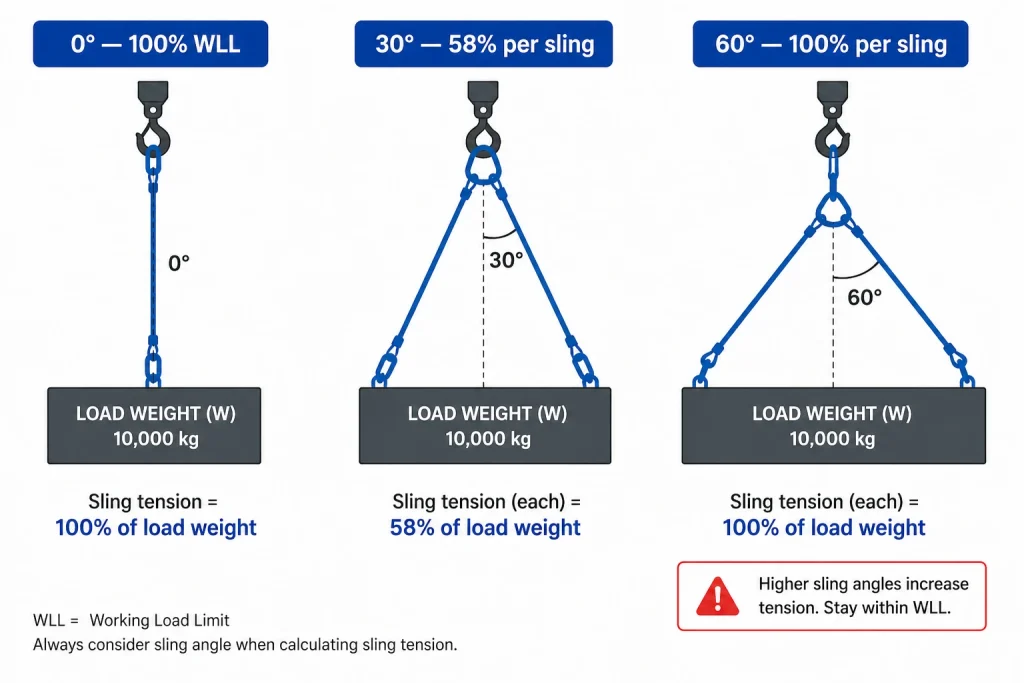
Every piece of rigging equipment has a working load limit (WLL), the maximum load it is permitted to carry under normal lifting conditions. The WLL applies to a single sling in a vertical (straight) lift. When slings are used in a bridle arrangement, two or more slings sharing the load, the angle between the slings and the vertical affects the tension in each sling. As the angle increases, the tension in each sling increases. A bridle with slings at 60 degrees from vertical carries twice the tension of a vertical lift, meaning the WLL of each sling is halved.
All rigging equipment must be rated for the loads it will carry in the configuration in which it will be used. Using slings at steep angles without accounting for the increased sling tension is a systematic rigging failure mode.
Rigging inspection
All rigging equipment must be inspected before each use. The inspection looks for:
- Wire rope slings: broken wires, kinking, crushing, corrosion, damaged ferrules
- Chain slings: stretch, cracking, bent links, worn bearing surfaces
- Web slings: cuts, tears, chemical damage, heat damage, UV degradation
- Shackles: pin condition, thread engagement, evidence of overloading (deformation of the bow)
- Hooks: deformation, cracks, safety latch condition, evidence of overloading
Any item that fails inspection must be removed from service immediately and either repaired or destroyed. Damaged rigging equipment must not be returned to the rigging store, it must be destroyed to prevent inadvertent future use.
Tagging and colour coding
Rigging equipment should be subject to a regular thorough examination programme with colour-coded tags indicating the period in which the examination was conducted. Equipment without a current valid tag, or with an expired tag, must not be used until it has been examined and re-tagged.
Also read : How to Choose a Forklift: A Complete Buyer’s Guide
Equipment-Specific Safety Requirements
Crane safety
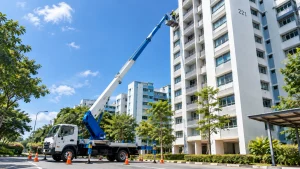
Crane operations present the highest consequence risk of any common lifting activity. Key crane safety requirements:
- Load chart compliance
Never exceed the load chart limits for any combination of operating radius, boom configuration, and counterweight arrangement. The load chart is a structural safety document, not a guideline.
- Operator certification
Crane operators must hold appropriate certification for the type and capacity of crane they operate. Tower crane operators, mobile crane operators, and overhead crane operators have different certification requirements in most jurisdictions.
- Slinger/signaller
All crane lifts must have a designated slinger (responsible for rigging the load) and a signaller (responsible for communicating with the crane operator). These roles may be combined in one person where visibility permits, but the responsibility must be clearly assigned.
- Pre-use inspection
Cranes must be inspected before each shift, checking the hook, wire rope, limit switches, brakes, controls, and structural condition.
Forklift safety
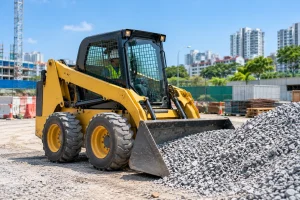
Forklift lifting operations, raising loads on the forks, present specific hazards distinct from those of cranes. The stability triangle concept is fundamental: a loaded forklift’s stability depends on the combined centre of gravity of the machine and load remaining within the stability triangle defined by the two front wheels and the rear axle pivot. Overloading, raising loads too high when travelling, and cornering too fast all move the combined centre of gravity outside the stability triangle, causing tip-over.
Never travel with the mast tilted forward and the load elevated, this is the single most common cause of forklift tip-over. Travel with the mast tilted back and the forks at the lowest safe travel height.
Never allow passengers on the forks, a person riding on the forks or a pallet carried by the forks is exposed to the full risk of a fall from the platform height, without guardrails or any fall protection.
Mobile Elevated Work Platform (MEWP) safety
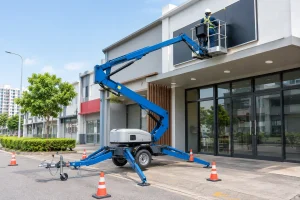
Scissor lifts, boom lifts, and other MEWPs present hazards specific to elevated work platforms. Key safety requirements are covered in detail in practical guides on scissor lift maintenance and safe operation, but the core principles include:
- Never exceed the platform rated working load
- Always work within the rated operating envelope, do not attempt to extend reach by leaning over the guardrail
- Conduct a daily pre-operation inspection before each shift
- Operate only on surfaces within the machine’s rated slope and ground bearing capacity
- Wear a personal fall arrest harness attached to the designated anchor point inside the platform at all times when using a boom lift
Inspection and Maintenance Obligations
Lifting equipment must be maintained in a condition that ensures it remains safe for its intended use throughout its service life. The maintenance obligations for lifting equipment typically include:
- Pre-use inspection
Conducted by the operator before each shift. A structured check of visible condition, controls, safety devices, and any obvious defects.
- Periodic thorough examination
Conducted at defined intervals by a competent person (typically a qualified lifting equipment inspector). The examination is more comprehensive than a pre-use inspection and includes assessment of wear, fatigue, and structural integrity that may not be visible without technical knowledge. Thorough examination intervals are defined by regulation.
- Planned preventive maintenance
Conducted at manufacturer-specified intervals, covering lubrication, adjustment, filter replacement, fluid changes, and other maintenance tasks that sustain equipment reliability.
- Post-incident inspection
Any lifting equipment involved in an incident, a dropped load, a tip-over, a structural impact, must be taken out of service and subjected to a full technical inspection before it is returned to use. Lifting equipment that has been involved in an incident may have sustained structural damage that is not immediately visible.
For technical reference on lifting equipment safety standards, rigging engineering principles, and international best practice for the management of lifting operations, engineering resources on crane and lifting equipment safety management provide comprehensive background on how safety obligations are defined and implemented across different regulatory frameworks.
Competency Requirements for Lifting Operations
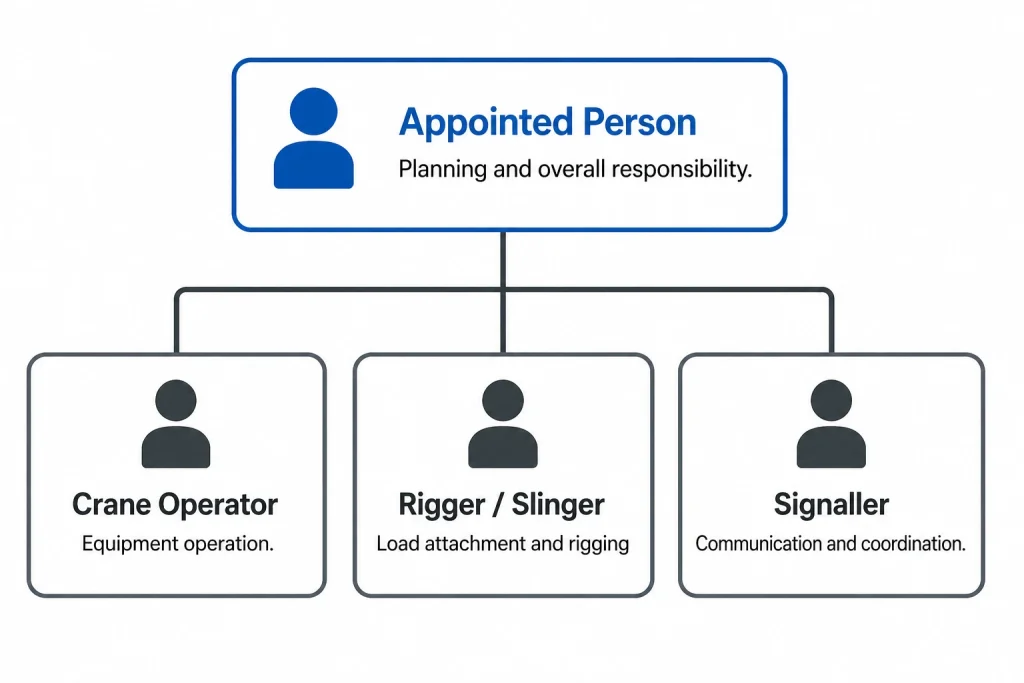
A lifting operation is only as safe as the people conducting it. Competency requirements for lifting operations typically include:
- Lifting equipment operators
Must be trained, assessed, and certified for the specific type of equipment they operate. Certification for one type of lifting equipment does not automatically extend to other types.
- Appointed person
For complex or high-risk lifts, many regulatory frameworks require an “appointed person”, a competent individual responsible for planning the lift, selecting the equipment, and ensuring the operation is conducted safely. This role requires specific technical knowledge and, in many jurisdictions, formal qualification.
- Riggers and slingers
Personnel who rig loads and operate in the vicinity of suspended loads must be trained in rigging principles, rigging equipment identification, and the inspection of rigging hardware.
- Signallers
Personnel responsible for communicating with the crane operator during blind lifts or complex manoeuvres must be trained in standard signalling conventions and understand the operational limits of the equipment.
Maintaining competency records, training certificates, assessment records, and refresher training, is a regulatory requirement and a fundamental element of safety management for any organisation conducting lifting operations.
Also read : Types of Scaffolding Materials: A Practical Guide
Build a Culture of Safe Lifting
Lifting equipment safety is ultimately built on a culture, the collective attitude of everyone involved in a lifting operation toward the risks involved and the controls that manage them. Rules and procedures are necessary but not sufficient. The most important safety factor in any lifting operation is the willingness of every person involved, operator, rigger, signaller, supervisor, and site manager, to stop the lift when something is not right and refuse to proceed until it is.
That culture starts with the right equipment, correctly specified, properly maintained, and operated only by trained and certified personnel. RR Machinery offers a comprehensive range of lifting and access equipment for sale and rental, including forklifts, boom lifts, scissor lifts, mobile scaffolding, and power generators, all maintained to operational standard by factory-certified technicians.
Explore our full range of safe, well-maintained lifting and access equipment or contact our team for practical advice on selecting the right equipment for your lifting and access requirements.

Clear and practical breakdown of lifting equipment safety. Building a strong safety culture really is the key to preventing accidents in crane and forklift operations.