Why Scissor Lift Maintenance Matters
Scissor lifts are classified as mobile elevated work platforms (MEWPs) in most regulatory frameworks. As such, they are subject to workplace safety legislation that imposes specific obligations on both owners and operators regarding inspection, maintenance, and record-keeping. Beyond the regulatory dimension, scissor lift maintenance directly affects three operational outcomes that every business cares about:-
- Safety
A scissor lift failure at height puts the operator, and anyone below, at serious risk. The most critical failures, unexpected platform descent, structural collapse, tip-over, are almost always preceded by warning signs that a proper maintenance programme would have detected. Maintaining a scissor lift correctly is not primarily a compliance exercise. It is the most direct way of ensuring that no one is injured because of equipment failure.
-
- Reliability
Equipment that fails on site costs far more than the repair itself. A machine breakdown on a project with a tight deadline triggers knock-on delays, subcontractor costs, and potentially liquidated damages. Planned maintenance eliminates the majority of unscheduled breakdowns.
-
- Asset life and value
A well-maintained scissor lift retains its operational capability and resale value over a significantly longer service life than a neglected machine of the same specification. For owned equipment, this directly affects the return on the capital investment. For rental fleet operators, machine condition is directly tied to utilisation rates and customer satisfaction.
The maintenance principles that apply to scissor lifts are consistent with those that apply to all mobile elevated work platforms and aerial access equipment, regular inspection, scheduled service, and prompt attention to developing faults before they become failures.Also read : What Is Scaffolding in Construction? Types, Uses, and Key Components
Daily Pre-Operation Inspection
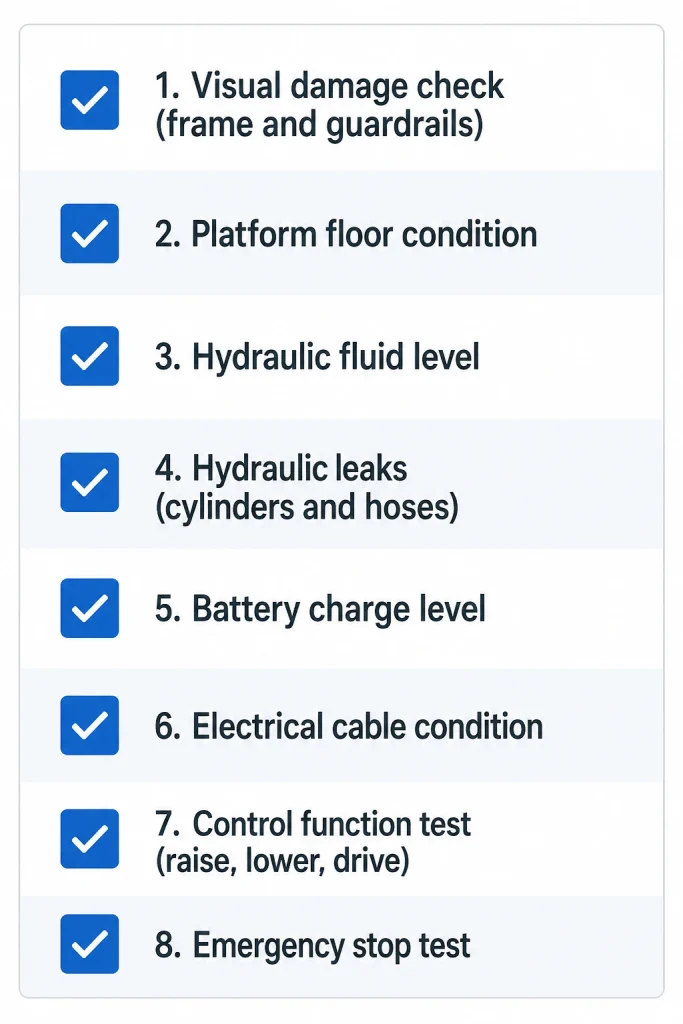 The most important maintenance activity for any scissor lift is the daily pre-operation inspection conducted by the operator before the machine is used. This inspection takes five to fifteen minutes and is the first line of defence against equipment failures that could result in injury.
A thorough daily inspection covers the following areas:
The most important maintenance activity for any scissor lift is the daily pre-operation inspection conducted by the operator before the machine is used. This inspection takes five to fifteen minutes and is the first line of defence against equipment failures that could result in injury.
A thorough daily inspection covers the following areas:
-
-
Visual and structural check
-
Walk around the machine and inspect for visible damage, dents, cracks, bent components, missing fasteners, or loose guard panels. Pay particular attention to the scissor arms, which are the primary structural element of the lift mechanism. Any visible deformation, cracking at weld joints, or unexpected asymmetry in the scissor stack should be reported and the machine taken out of service immediately.
Inspect the platform guardrails, all four sides, including the entry gate, for damage, missing pins, or sections that are not securely latched. Guardrail integrity is critical: a guardrail that fails under load at height provides no protection against a fall.
Check the platform floor surface for damage that could create a slip or trip hazard. Non-slip surfaces that have worn smooth should be reported for replacement.
-
-
Hydraulic system check
-
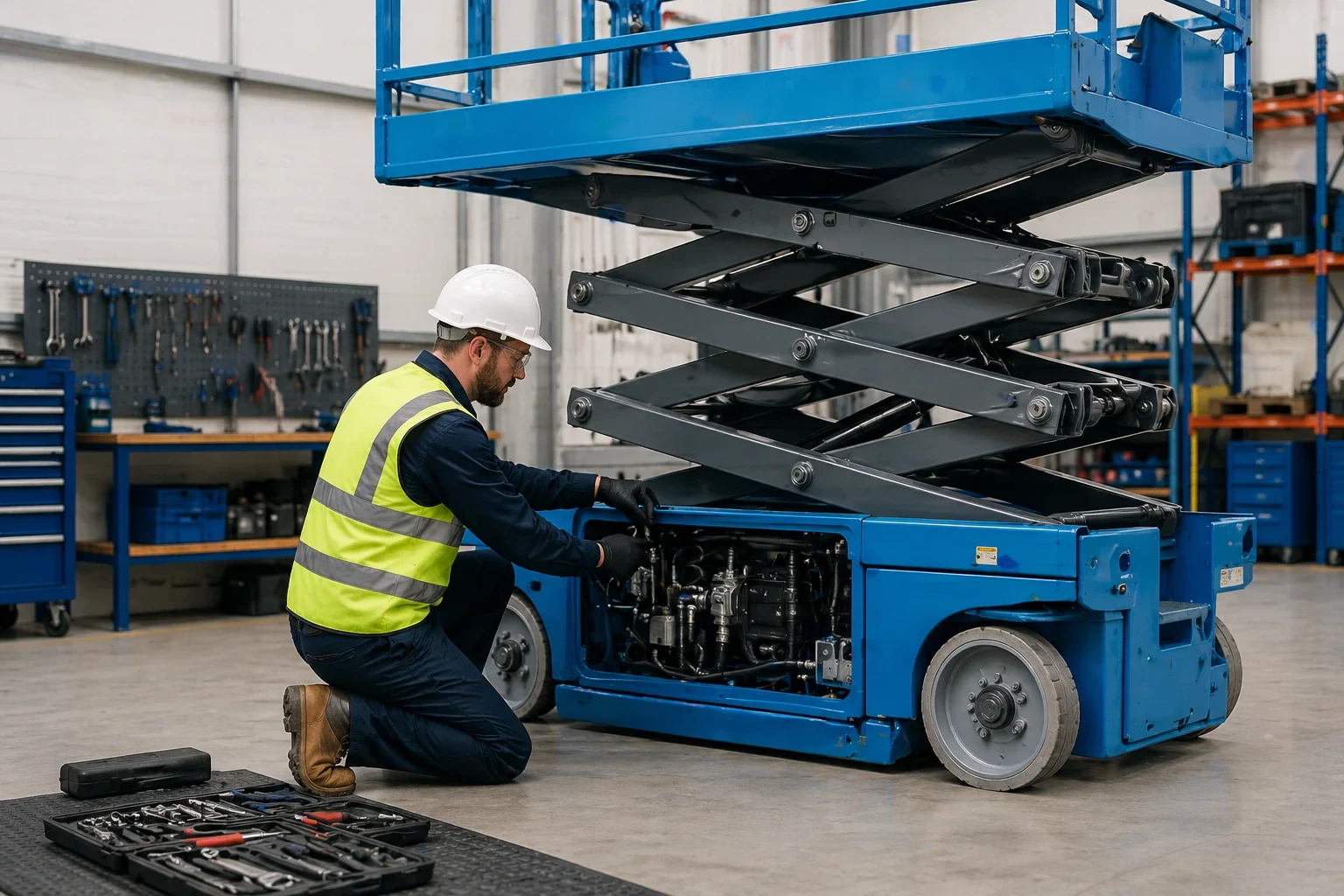
Inspect all hydraulic cylinders, hoses, and fittings for visible leaks. A small hydraulic leak that appears minor at ground level becomes a critical safety hazard if it causes platform descent while the operator is at height. Check the hydraulic fluid level in the reservoir and top up if necessary, but investigate the cause of any fluid loss before returning the machine to service.
Operate the lift through one full raise-and-lower cycle and observe the motion. The platform should rise and lower smoothly, without jerking, hesitation, or unexpected speed changes. Any irregularity in motion should be investigated before the machine is used for work.
-
-
Electrical and battery check
-
On electric scissor lifts, check the battery state of charge before the shift begins. A machine that starts a shift with insufficient charge will not complete the day’s work, and a battery that discharges to a very low level (over-discharge) on a regular basis will suffer permanent capacity loss. Check that the charging cable and plug are undamaged and that the charger has completed a full charge cycle.
Inspect all electrical cables visible on the machine for damage to insulation, particularly around pivot points and in areas where cables may contact moving parts. Frayed or damaged insulation creates both electrical fault and fire risk.
-
-
Controls and safety devices check
-
Test all operator controls, raise, lower, drive, steer, emergency stop, before beginning work. Confirm that the emergency stop button cuts all power when pressed and that it resets correctly. Test the tilt alarm (if fitted) by placing the machine on a slope beyond the rated gradient, the alarm should activate and prevent platform elevation. Confirm that the platform overload indicator (if fitted) functions correctly.
Check that the operation and safety manuals are in their designated location on the machine, operators must have access to these documents.
Scheduled Maintenance Intervals
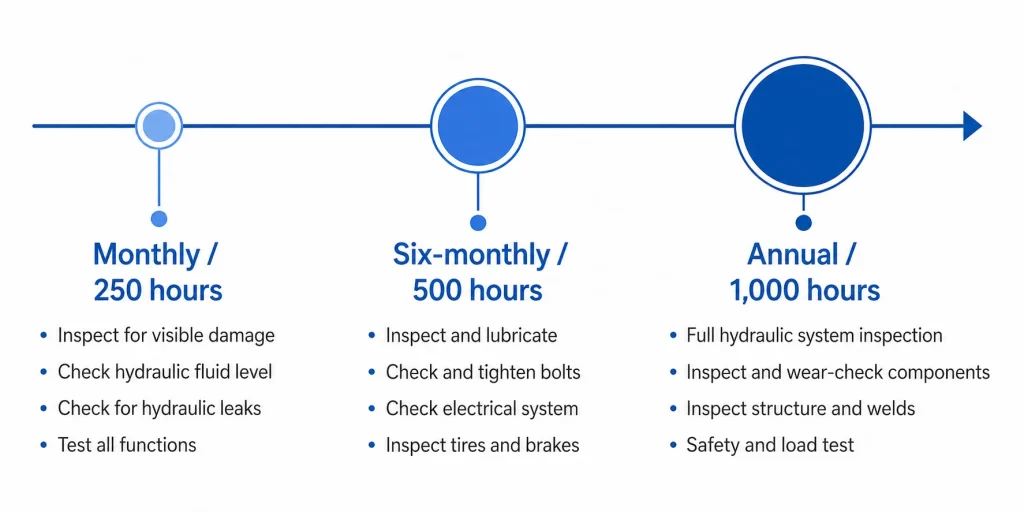
Beyond the daily pre-operation check, scissor lifts require scheduled maintenance at defined intervals, typically measured in operating hours, calendar time, or a combination of both. The specific intervals and tasks are defined by the manufacturer in the machine’s service manual and must be followed. The following represents a typical framework:
-
-
Monthly or 250-hour service
-
The monthly service covers consumable checks and minor adjustments that go beyond the daily inspection:
-
-
- Lubricate all grease points on the scissor mechanism, pivot pins, slide pads, and bearing surfaces. Inadequate lubrication of the scissor mechanism is one of the leading causes of premature wear and binding under load.
- Check and adjust wheel nut torque on all wheels. Loose wheel nuts on an indoor scissor lift can cause the wheel to shift, creating instability at height.
- Inspect tyres (or wheels, on cushion-tyred machines) for wear, flat spots, cuts, and embedded debris. Replace any tyre that shows wear beyond the manufacturer’s specified limit.
- Check all hydraulic hose connections for tightness and early signs of leakage at fittings.
- Test all safety interlocks, the tilt sensor, overload sensor, and ground control override, and confirm they function as designed.
- Check battery water levels on lead-acid battery systems (if applicable) and top up with distilled water to the correct level. Never use tap water, mineral content accelerates sulphation and reduces battery life.
-
-
-
Six-monthly or 500-hour service
-
The six-monthly service is more comprehensive and should be conducted by a qualified technician rather than the operator:
-
-
- Full hydraulic system inspection, including checking hydraulic fluid condition (colour, cleanliness, and water content), cylinder seals, control valve condition, and pump performance. Hydraulic fluid degrades over time, and contaminated fluid is the primary cause of premature valve and cylinder wear.
- Replace hydraulic fluid and filter if due (manufacturer intervals typically specify fluid change every 1,000–2,000 hours or annually, whichever comes first).
- Inspect all structural welds on the scissor mechanism, platform frame, and chassis for cracks or signs of fatigue. Weld inspection requires adequate lighting and may require the machine to be cleaned before inspection can be effective.
- Test and calibrate the load sensing system and platform overload indicator against a known reference weight.
- Inspect the drive system, drive motors, gearboxes, and brake systems on electric machines, for wear, noise, and correct adjustment.
- Inspect all electrical connections for corrosion, particularly in the battery compartment where hydrogen off-gassing from lead-acid batteries creates a corrosive environment.
- Functional test of all emergency systems, emergency lowering, emergency stop, and ground control.
-
-
-
Annual or 1,000-hour service
-
The annual service represents the most thorough scheduled maintenance interval and should be performed by the manufacturer’s authorised service network or a qualified MEWP service technician:
-
-
- Full structural inspection including non-destructive testing of high-stress weld areas if indicated by visual inspection or machine history.
- Full hydraulic system overhaul, replace all service items, inspect cylinder condition internally, and pressure-test all circuits.
- Battery capacity test on electric machines, measure actual battery capacity against rated capacity and replace the battery if capacity has fallen below a defined threshold (typically 80% of rated capacity).
- Replace all consumables due for replacement, filters, seals, belts, and brake pads.
- Full function test against the manufacturer’s acceptance criteria.
- Issue of a service certificate confirming the machine’s fitness for continued use.
-
Also read : Workplace Safety Tips for Construction and Industrial Sites
Hydraulic System Maintenance in Detail
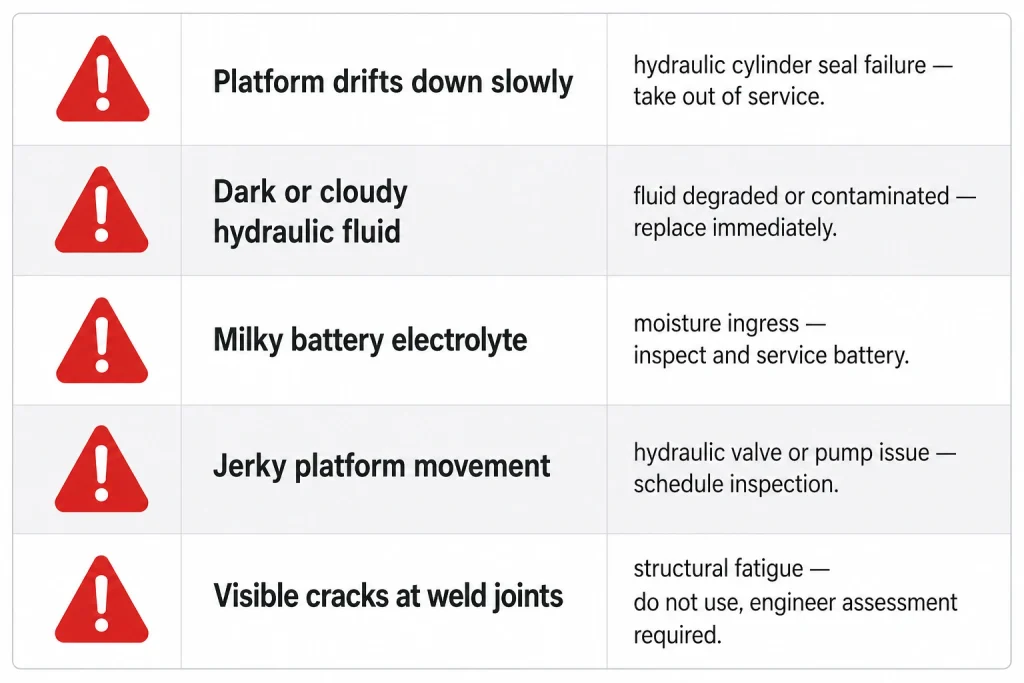 The hydraulic system is the most maintenance-sensitive sub-system on a scissor lift. It is responsible for platform elevation, and any failure in the hydraulic circuit can result in uncontrolled platform descent, the most serious failure mode for any aerial work platform.
Key hydraulic maintenance practices:
The hydraulic system is the most maintenance-sensitive sub-system on a scissor lift. It is responsible for platform elevation, and any failure in the hydraulic circuit can result in uncontrolled platform descent, the most serious failure mode for any aerial work platform.
Key hydraulic maintenance practices:
-
- Fluid quality maznagement
Hydraulic fluid degrades through oxidation, contamination, and moisture ingress over time. Regular sampling and testing of hydraulic fluid allows deterioration to be detected before it causes component damage. Dark or cloudy fluid, fluid with a burnt smell, or fluid with visible water droplets (milky appearance) should be replaced immediately rather than waiting for the scheduled interval.
-
- Cylinder seal condition
Hydraulic cylinder seals deteriorate over time, leading to internal bypass (fluid leaking past the piston internally) or external leakage (visible on the cylinder rod). Internal bypass causes the platform to drift downward slowly under load, a subtle but dangerous condition. Any platform that descends slowly when stationary at height must be taken out of service immediately and the cylinder seals inspected and replaced.
-
- Filter maintenance
The hydraulic filter removes particulate contamination from the fluid circuit. A blocked filter reduces flow to the pump and cylinders, causing slow lift speeds, increased pump wear, and eventually complete hydraulic failure. Replace filters at the manufacturer’s specified interval without extending the interval, the cost of a filter is negligible compared to the cost of hydraulic pump or cylinder damage from contaminated fluid.
Battery and Electrical Maintenance for Electric Scissor Lifts
Electric scissor lifts are the standard choice for indoor operations, and their batteries are the most maintenance-sensitive component in the machine. Proper battery care is essential both for machine reliability and for the safety of personnel working in the vicinity of the charging area. Lead-acid battery maintenance:-
- Check electrolyte level weekly and top up with distilled water after charging (never before, as charging causes the electrolyte to expand)
- Clean battery terminals and cable connections regularly to prevent corrosion-induced resistance
- Ensure the charging area is adequately ventilated, lead-acid batteries off-gas hydrogen during charging, creating an explosion risk in enclosed spaces
- Never discharge a lead-acid battery below 20% of capacity, chronic deep discharge permanently reduces capacity
- Equalise charge (a slow overcharge cycle) monthly to balance cell voltages in a battery bank
-
- Lithium-ion batteries require minimal manual maintenance but should be kept within the temperature range specified by the manufacturer
- Avoid storage at very low or very high state of charge for extended periods, store at approximately 50% charge if the machine will not be used for several weeks
- Monitor battery management system (BMS) fault codes and address any BMS alerts promptly
Structural Inspection and Fatigue Management
The scissor mechanism, the interconnected pairs of folding arms that extend to elevate the platform, is subjected to significant cyclic loads during every raise-and-lower operation. Over thousands of cycles, this cyclic loading creates the conditions for metal fatigue, particularly at stress concentrations around weld joints, pin bores, and areas where geometry changes abruptly. Structural inspection should focus on:-
- Weld joints on the scissor arm pivot points, look for cracking at the toe or root of the weld
- Pin bore areas, inspect for elongation or deformation of the hole
- Slide pads and bearing surfaces, worn pads allow metal-to-metal contact that accelerates wear and introduces shock loading
- Platform frame corners and mounting points, areas where repeated loading over time can initiate fatigue cracks
Documentation and Compliance
Maintaining proper maintenance records is a regulatory requirement in most jurisdictions and a practical necessity for any organisation managing a fleet of scissor lifts. Records to maintain for each machine include:-
- Daily pre-operation inspection records, signed by the operator, retained for a minimum period specified by local regulations
- All scheduled service records, including date, operating hours, tasks performed, parts replaced, and technician identity
- Records of any defects identified and the corrective action taken
- Load test records if applicable
- Annual inspection and certification records
Also read : Parts of a Forklift and Their Functions Explained
Keep Your Scissor Lift Safe, Reliable, and Ready to Work
Scissor lift maintenance is not a cost, it is an investment in safety, reliability, and asset life. A machine that is inspected daily, serviced on schedule, and repaired promptly when faults are identified will operate safely and productively for many years. A machine that is neglected will eventually fail, and when failure happens at height, the consequences can be severe. Whether you operate a single scissor lift or manage a fleet of aerial work platforms, the maintenance programme described in this guide provides a framework for keeping your equipment in the condition it needs to be in, every shift, every day, every year. RR Machinery offers professional servicing and maintenance for all scissor lifts and aerial work platforms, including scheduled service, breakdown repair, and compliance inspection. We also offer a comprehensive range of scissor lifts for sale and rental, all maintained to operational standard and ready for deployment. Explore our full range of scissor lift solutions for sale and rental or contact our team for a service enquiry or equipment quotation tailored to your requirements.