Choosing the wrong forklift is more expensive than most buyers anticipate. A machine that is underpowered for the loads it handles creates productivity bottlenecks. One that is oversized for the facility it operates in damages racking, walls, and vehicles while consuming excess fuel. A diesel model deployed in an enclosed food-grade facility creates air quality problems that can shut operations down. An electric model specified for an outdoor yard without adequate charging infrastructure runs out of power mid-shift.
These are not edge cases, they are the predictable consequences of selecting a forklift based on price or availability rather than a systematic assessment of the application. The right forklift for any operation is the one that matches the load, the environment, the racking system, the floor type, the duty cycle, and the operator profile. Getting all of these right simultaneously requires a structured approach that goes beyond comparing capacity ratings and price points.
This guide walks through every key factor in forklift selection, load capacity, lift height, mast configuration, fuel type, tyre type, attachment requirements, operator certification, and the buy-versus-rent decision, giving operations managers, procurement teams, and business owners the framework they need to specify the right machine for their specific requirements.
The Forklift Selection Process: Seven Key Decisions
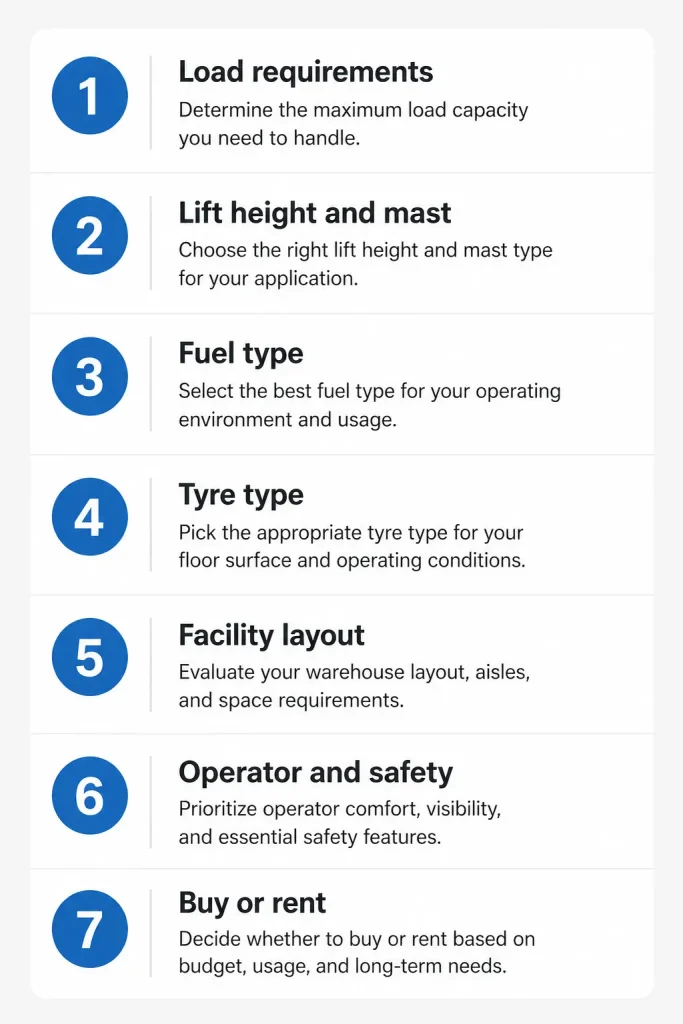
Choosing the right forklift requires working through seven interconnected decisions in sequence, each one informing the next. Skipping any step, or making assumptions rather than measuring and confirming, is where specification errors occur. The following sections address each decision in the order in which it should be made.
Also read : Parts of a Forklift and Their Functions Explained
Define Your Load Requirements
The load is the starting point for every forklift selection decision. Before evaluating any machine, you need to know:
Maximum load weight
The heaviest load your forklift will ever need to carry. This is not the average load, it is the maximum. The forklift must be capable of handling this load safely at the conditions under which it will be handled (height, load centre, attachment used).
A critical point that many buyers miss: a forklift’s rated capacity is only valid at a specified load centre distance, which is typically 500 mm (the distance from the face of the forks to the centre of gravity of the load). If your loads have a load centre greater than 500 mm, because they are long, wide, or stacked with heavy items at the outer end, the effective capacity of the forklift is reduced. This reduction must be calculated from the machine’s load chart before specifying the capacity.
Load dimensions
The width, depth, and height of the loads you handle affect fork spacing, mast height requirements, and, if loads are unusually wide or long, may require attachments such as sideshifters, fork positioners, or extended forks. Knowing the load dimensions before specifying the machine prevents the common mistake of buying a standard-capacity forklift that cannot physically handle the loads it needs to carry.
Load type and condition
Are you handling uniform palletised loads, or irregular, fragile, or unstable materials? Palletised loads are the standard case for which counterbalance forklifts are optimised. Non-palletised loads may require specialist attachments, clamps for paper rolls, rotators for tipping, carpet poles for rolls of carpet. These attachment requirements affect both the machine selection and the rated capacity calculation. Understanding the full range of forklift types and configurations available for different load types is an important starting point before finalising the specification.
Determine Your Lift Height Requirements
Lift height is the second major determinant of forklift specification, and it is closely linked to mast configuration.
Maximum lift height
The highest position to which the forks must be raised during normal operation. This is typically the top rack level in a racking system, the forks must be able to raise a pallet to the height of the top beam, allowing it to be placed on the rack with adequate clearance.
Mast configuration
The mast is the vertical assembly through which the forks travel. Three main configurations are available:
- Duplex (two-stage) mast
The inner mast raises within the outer mast to achieve the rated lift height. Duplex masts have a relatively tall collapsed height, relevant in facilities with restricted overhead clearance (low doors, overhead conveyors, mezzanine floors). They provide good visibility through the mast but are limited to moderate lift heights.
- Triplex (three-stage) mast
Three telescoping sections allow the mast to achieve significantly greater lift height with a much lower collapsed height than a duplex mast of equivalent reach. A triplex mast can pass through a standard warehouse doorway (typically 4 m clear height) while still reaching rack positions at 6 m or higher. This makes triplex the standard choice for high-bay warehousing.
- Free lift
The amount the forks can be raised before the mast channels begin to extend upward. High free lift allows the operator to raise the forks to a useful working height, enough to place a load on a raised platform or travel over a dock leveller, without increasing the overall mast height above the operator’s head. Essential in facilities with overhead restrictions.
Overhead clearance
Measure the minimum clearance height in every area the forklift will operate, doorways, under conveyors, under mezzanines, inside vehicles and containers. The forklift’s overall height with the mast fully lowered must pass through the lowest clearance point it will encounter. Failing to account for this is a common and costly specification error.
Choose the Right Fuel Type
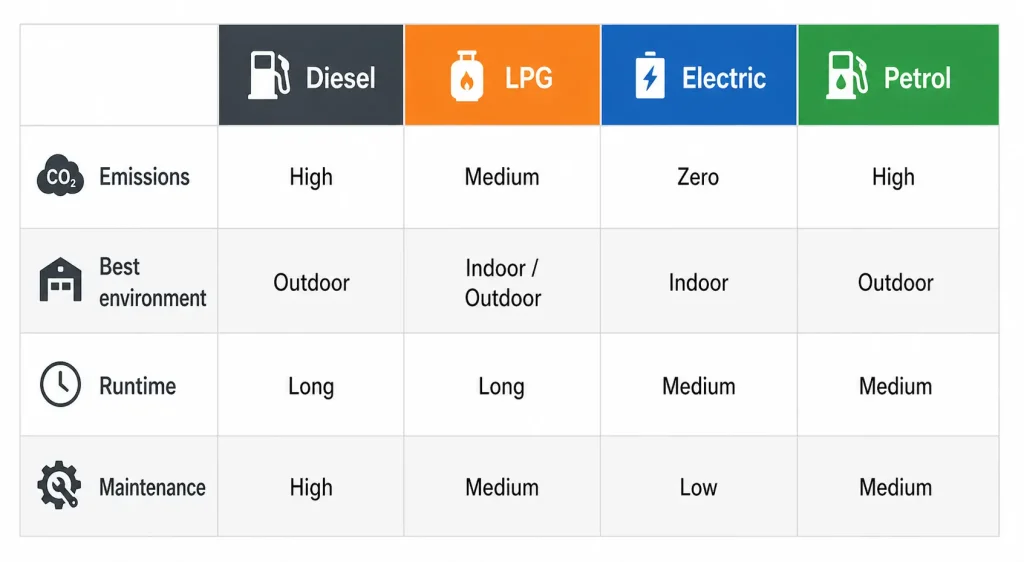
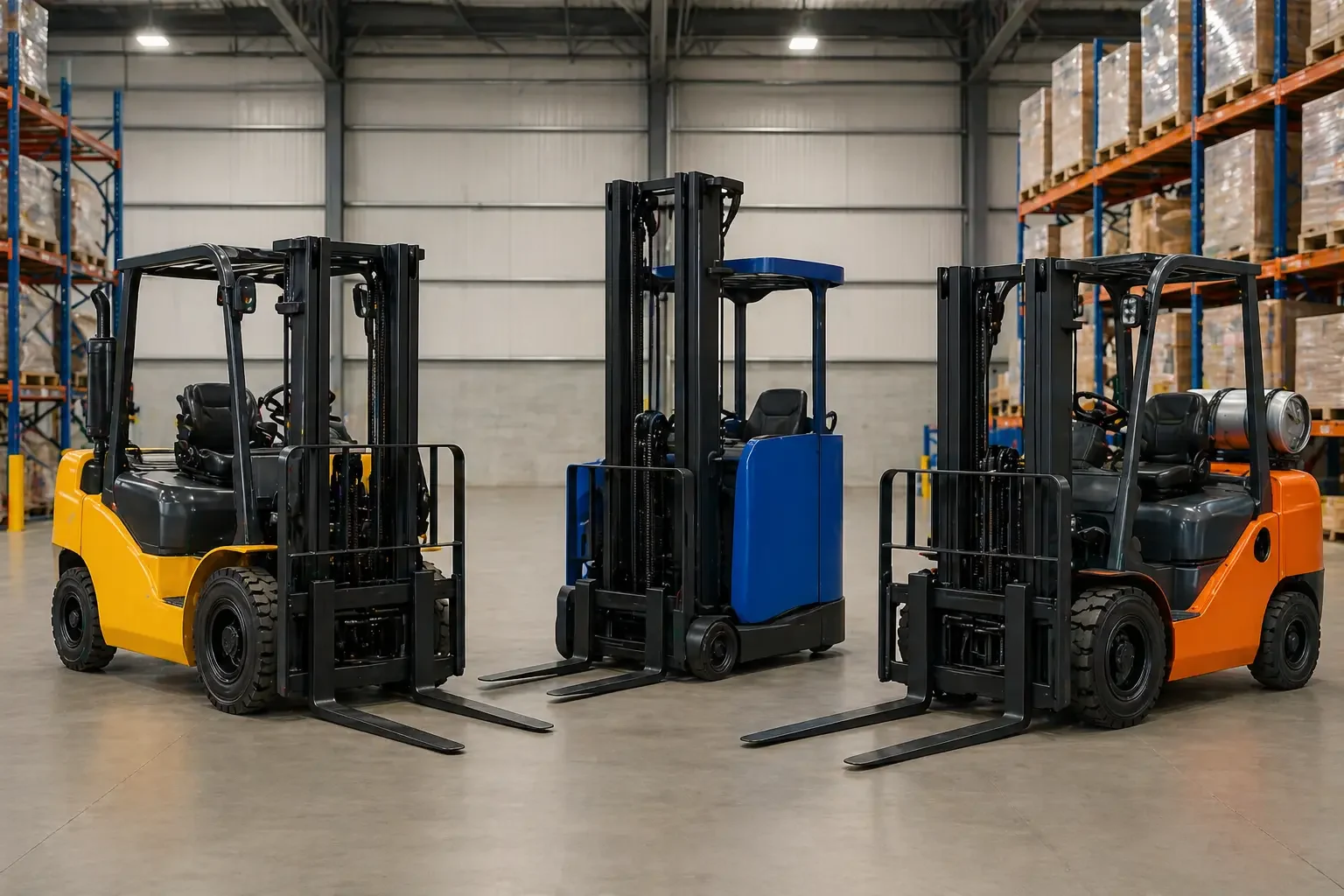
Fuel type determines where the forklift can operate, its running costs, its maintenance requirements, and its environmental impact. The main options are diesel, LPG (liquefied petroleum gas), petrol, and electric.
Diesel forklifts
Diesel forklifts are the standard choice for outdoor operations and heavy industrial use. They deliver high torque at low speeds, important for heavy loads and ramps, and refuel quickly with readily available diesel. They perform well on rough terrain and in wet or cold outdoor conditions.
Diesel engines produce exhaust emissions, carbon monoxide, nitrogen oxides, and particulate matter, that make them unsuitable for enclosed facilities without dedicated ventilation. In a well-ventilated factory or warehouse they may be acceptable, but in food processing, pharmaceutical, or enclosed public environments they are not appropriate.
Best for: Construction sites, outdoor yards, loading docks, large warehouses with mechanical ventilation, heavy industrial operations.
LPG forklifts
LPG forklifts run on propane cylinders, producing significantly lower emissions than diesel. They are quieter, cleaner, and more suitable for use in partially enclosed or semi-enclosed facilities. LPG cylinders can be swapped out quickly, giving LPG forklifts effectively unlimited runtime as long as cylinders are available, unlike electric forklifts, which require charging downtime.
Best for: Mixed indoor-outdoor operations, facilities where diesel emissions are unacceptable but electric charging infrastructure is impractical, multi-shift operations where continuous runtime is required.
Electric forklifts
Electric forklifts run on large lead-acid or lithium-ion battery packs. They produce zero direct emissions, operate quietly, and require less mechanical maintenance than combustion models, no oil changes, no exhaust system, no fuel filters. Running costs per hour are significantly lower than diesel or LPG.
Their limitation is charging time and battery management. Lead-acid batteries require 8 hours of charging after an 8-hour shift, manageable in single-shift operations but problematic in two or three-shift operations without opportunity charging or battery-swap systems. Lithium-ion batteries charge faster (often 2–3 hours) and support opportunity charging during breaks, but carry a higher initial cost.
Electric forklifts are the standard choice for food-grade, pharmaceutical, cold storage, and any enclosed facility where air quality and noise are priorities. Cold storage operation suits electric forklifts well because battery performance at low temperatures is acceptable with modern lithium systems, and the absence of combustion heat is advantageous.
Best for: Indoor warehouses, food processing, pharmaceutical manufacturing, cold storage, facilities with strict air quality or noise requirements.
Petrol forklifts
Petrol forklifts are less common in industrial applications due to higher fuel costs and emissions compared to LPG, and lower torque compared to diesel. They are sometimes used in light-duty applications where LPG infrastructure is not available and electric charging is impractical.
Also read : Forklift vs Pallet Jack: Differences, Uses, and How to Choose
Select the Right Tyre Type
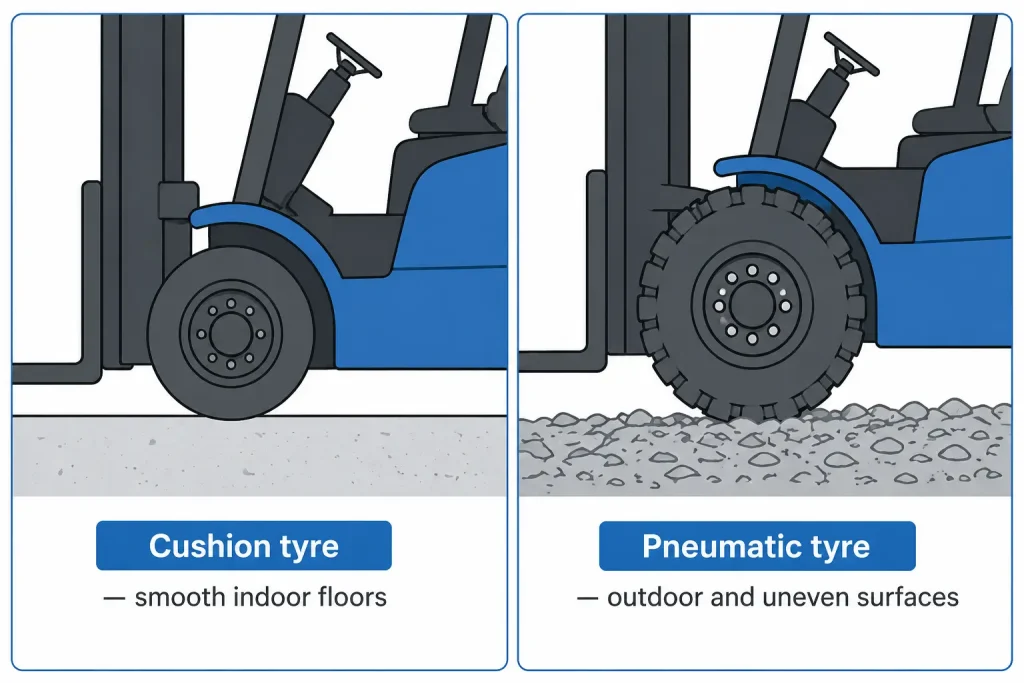
The tyre type determines where the forklift can operate safely and effectively, and must match the floor surface conditions.
Cushion tyres
Cushion tyres are solid rubber tyres bonded directly to the wheel rim, with a lower profile and smaller diameter than pneumatic alternatives. They are designed for smooth, hard indoor floors, concrete warehouse floors, factory floors, and loading dock areas. Cushion-tyred forklifts sit lower than their pneumatic equivalents, giving them a lower centre of gravity and improved stability for high-rack operations.
Cushion tyres should not be used on uneven surfaces, gravel, or outdoor terrain, they offer no cushioning and can cause the forklift to become unstable on imperfect surfaces.
Best for: Smooth indoor concrete floors, warehouses, distribution centres, manufacturing facilities.
Pneumatic tyres
Pneumatic tyres, either air-filled or solid pneumatic (which have the external profile of an air-filled tyre but are made from solid rubber throughout), are used on forklifts designed for outdoor or mixed terrain use. They provide cushioning over uneven surfaces, better traction on soft or wet ground, and are required for any operation involving ramps, kerbs, loading docks with uneven surfaces, or outdoor yards.
Solid pneumatic tyres eliminate the puncture risk of air-filled pneumatics, making them the practical choice for outdoor industrial environments where sharp debris (nails, metal, stone) would quickly damage air-filled tyres.
Best for: Outdoor yards, construction sites, mixed indoor-outdoor operations, uneven or unpaved surfaces.
Match the Forklift to Your Facility Layout
The physical dimensions of the forklift, its turning radius, overall width, and mast height, must be compatible with the facility in which it will operate.
Aisle width
Counterbalance forklifts require wide aisles, typically 3.5 metres or more, to turn, pick, and deposit loads in a standard racking system. If your warehouse has narrower aisles, a reach truck (which uses extending forks rather than travelling into the rack face) can operate in aisles of 2.5–2.7 metres. Very narrow aisle (VNA) trucks can operate in aisles under 2 metres but require guidance systems and smooth, level floors.
The choice of forklift type must be made in conjunction with the racking layout, changing from a counterbalance to a reach truck may allow significantly denser racking, which is a major operational advantage in space-constrained facilities.
Turning radius
Every forklift has a specified turning radius, the minimum radius through which it can turn when the rear steer wheels are at full lock. This radius determines the minimum aisle width required and the minimum clear floor area at the end of each aisle. Measuring and confirming turning radius compatibility before specifying a forklift prevents the costly discovery on delivery day that the machine cannot operate in the available space.
Floor load capacity
Electric counterbalance forklifts are heavier than comparable diesel models because of the weight of the battery. On upper floors of buildings, raised platforms, or mezzanine structures, the floor must be capable of supporting the total weight of the fully loaded forklift. This is a structural engineering consideration that must be confirmed before deploying any forklift in a non-ground-floor location. The same assessment applies to container floors, vehicle decks, and any elevated surface on which the forklift will operate.
Consider Operator Requiremzents and Safety
Operator licensing
In most jurisdictions, forklift operators are required to hold a valid licence or certification before operating a forklift in any workplace. This requirement applies regardless of the employer’s size or the informality of the operation. Employers have a legal duty to ensure that only licensed, trained, and assessed operators use forklifts. When specifying a new forklift, confirm that your operator pool holds the relevant licences for the specific type of forklift being acquired, licensing for an electric counterbalance forklift does not automatically cover a reach truck or an order picker.
Safety features on the forklift itself, overhead guard, load backrest, operator presence system, seatbelt, and load moment indicator, must all be present and functional. Understanding the safety-critical components of a forklift and what each one protects against is important context for anyone responsible for specifying or managing forklift equipment.
Ergonomics and visibility
Operator comfort directly affects productivity and safety over a full shift. Modern forklifts offer adjustable seating, tiltable steering columns, low-effort hydraulic controls, and visibility-optimised mast designs. Visibility through and around the mast, particularly when travelling with a raised load, affects both safety and the operator’s ability to work efficiently in racking environments.
Buy or Rent?
The final decision in forklift selection is not about the machine itself, it is about the acquisition model.
Purchasing makes sense when the forklift will be in continuous use over a long period, when the specific configuration required is highly customised, or when the total cost of ownership over the asset’s life is lower than the equivalent rental cost.
Renting makes sense for seasonal demand spikes, short-term project requirements, during periods of business uncertainty, or when capital is better deployed elsewhere. Rental also removes the responsibility and cost of maintenance, the rental provider services the machine and replaces it if it fails. For businesses comparing their options in detail, a practical comparison of forklift capabilities versus simpler alternatives for different material handling tasks can help clarify whether a full counterbalance forklift is genuinely required, or whether a more cost-effective solution exists for certain operations.
For technical reference on forklift classifications, international safety standards, and load chart methodology, engineering resources on industrial forklift standards and safe operating principles provide useful background on how capacity ratings and stability requirements are determined across different jurisdictions.
Also read : Workplace Safety Tips for Construction and Industrial Sites
Choose the Right Forklift with Confidence
Choosing a forklift is not a single decision, it is a series of interconnected decisions about load, height, environment, fuel, tyres, facility layout, operator requirements, and acquisition model. Working through each factor systematically produces a specification that matches the actual demands of the operation, rather than a compromise driven by budget pressure or sales convenience.
A forklift that is correctly specified, properly maintained, and operated by trained and licensed personnel is a reliable, productive, and safe asset. One that is poorly matched to its application is a source of ongoing operational friction, safety risk, and unplanned cost.
RR Machinery offers a comprehensive range of forklifts for sale and rental across Singapore, including diesel, electric, and LPG models in a wide range of lifting capacities and mast configurations. Our team can help you work through the specification process and identify the right machine for your specific requirements. Explore our full range of forklift solutions for sale and rental or contact our team for practical advice and a clear quotation tailored to your operation.