Forklifts move goods in almost every warehouse, factory, port, and construction site in Singapore, and the people who drive them need proper training before they take the controls. Many people search for a forklift license, often spelled forklift license, but what employers and safety officers actually look for is proof that an operator has completed a recognised forklift operator course and been assessed as competent.
This guide explains what a forklift license means in Singapore, who needs one, the steps to get certified, what the training usually covers, and what happens after certification. Course names, entry requirements, fees, and durations differ between providers and can change, so the final step before enrolling should always be to confirm the current details with the training provider and the Ministry of Manpower.
What a Forklift License Means in Singapore
In everyday conversation, a forklift license usually means the certificate an operator receives after completing a forklift operator course with a training provider accredited by the Ministry of Manpower. It is not a road driving license, and it is not issued in the same way as a car license. Instead, it shows that the holder has been trained in safe forklift operation and has passed the course assessment.
Singapore’s workplace safety framework places clear duties on employers to make sure that anyone operating machinery is trained and competent for the work, and the Ministry of Manpower publishes detailed Workplace Safety and Health guidance setting out these responsibilities. For forklift work, completing an accredited operator course is the recognised way to demonstrate that training, and employers will typically ask to see the certificate before allowing someone to operate a forklift on site.
Driving a forklift on public roads is a separate matter that falls under road traffic rules rather than workplace training, so anyone who expects to move a forklift on a public road should check the current requirements with the Land Transport Authority.
Who Needs a Forklift License?
Anyone who will operate a forklift as part of their work should be trained and certified before doing so. This includes new warehouse and logistics staff, construction workers who handle materials on site, factory workers moving goods between production areas, and anyone who operates a forklift occasionally rather than every day.
Experience gained elsewhere does not automatically count. Workers who learned to drive a forklift overseas, or informally on the job, should still complete a recognised course in Singapore unless their employer and training provider confirm that their existing qualification is accepted. Employers carry the responsibility for checking this, so it is worth raising the question early rather than assuming previous experience is enough.
How to Get a Forklift License, Step by Step
The path to certification follows a clear sequence. The steps below describe the general process, and the exact arrangements depend on the provider and the course you choose.
Following the steps in order avoids the most common delays, such as enrolling in a course that does not match the type of forklift you will actually drive, or discovering an entry requirement after paying for a place.
Identify the Type of Forklift You Will Operate
Forklifts come in several types, from counterbalance trucks used in most warehouses to reach trucks used in narrow aisles and rough terrain models used on construction sites. The machine you will drive at work should guide your choice of course, since training focuses on the controls, stability, and handling of particular machine types.
If you are not sure which type you will operate, ask your employer before enrolling. An overview of how forklifts are grouped by design and power source is available in Classes of Forklifts and Their Uses in Material Handling, and the most common type in Singapore workplaces is explained in Counterbalance Forklift: How It Works and When to Use It.
Choose an Accredited Training Provider
The most important decision is choosing a provider whose course is accredited by the Ministry of Manpower. A certificate from a provider that is not accredited may not be accepted by employers, which can mean paying for training twice.
Check the provider’s accreditation on the Ministry of Manpower’s website or ask the provider to show it before you register. It also helps to compare providers on location, class schedules, the language of instruction, and the practical training facilities they offer, since hands on time with a real machine is a large part of learning to operate safely.
Confirm Entry Requirements Before Registering
Each course has its own entry requirements, which can include a minimum age, a basic level of spoken and written language for the theory lessons, and the physical fitness needed to operate machinery safely. Some providers also ask for identification documents or employer sponsorship details when you register.
Confirm all of these with the provider before paying. If your employer is arranging the training, check whether they will register you directly and whether any funding or subsidy applies, since this can affect how the booking is made.
Complete the Theory Training
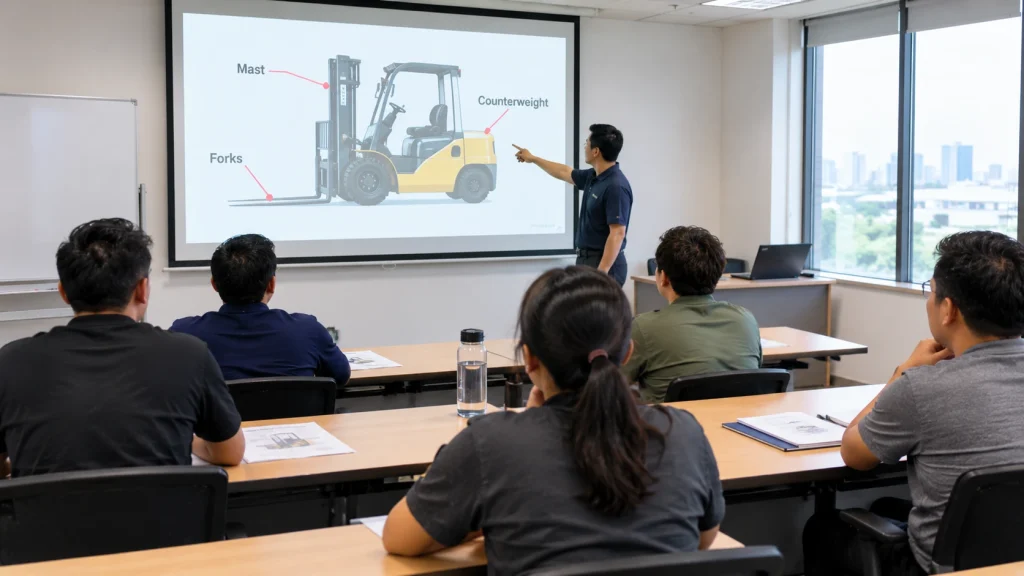
Theory lessons cover the knowledge an operator needs before touching the controls. This typically includes the main parts of a forklift, how its stability works, how loads affect that stability, safety rules, and the hazards found in workplaces where forklifts operate.
Take this part seriously, because it explains why the practical rules exist. Understanding why a load must be carried low, or why a forklift tips more easily on a turn, makes it much easier to make the right decision when something unexpected happens on the job.
Complete the Practical Training
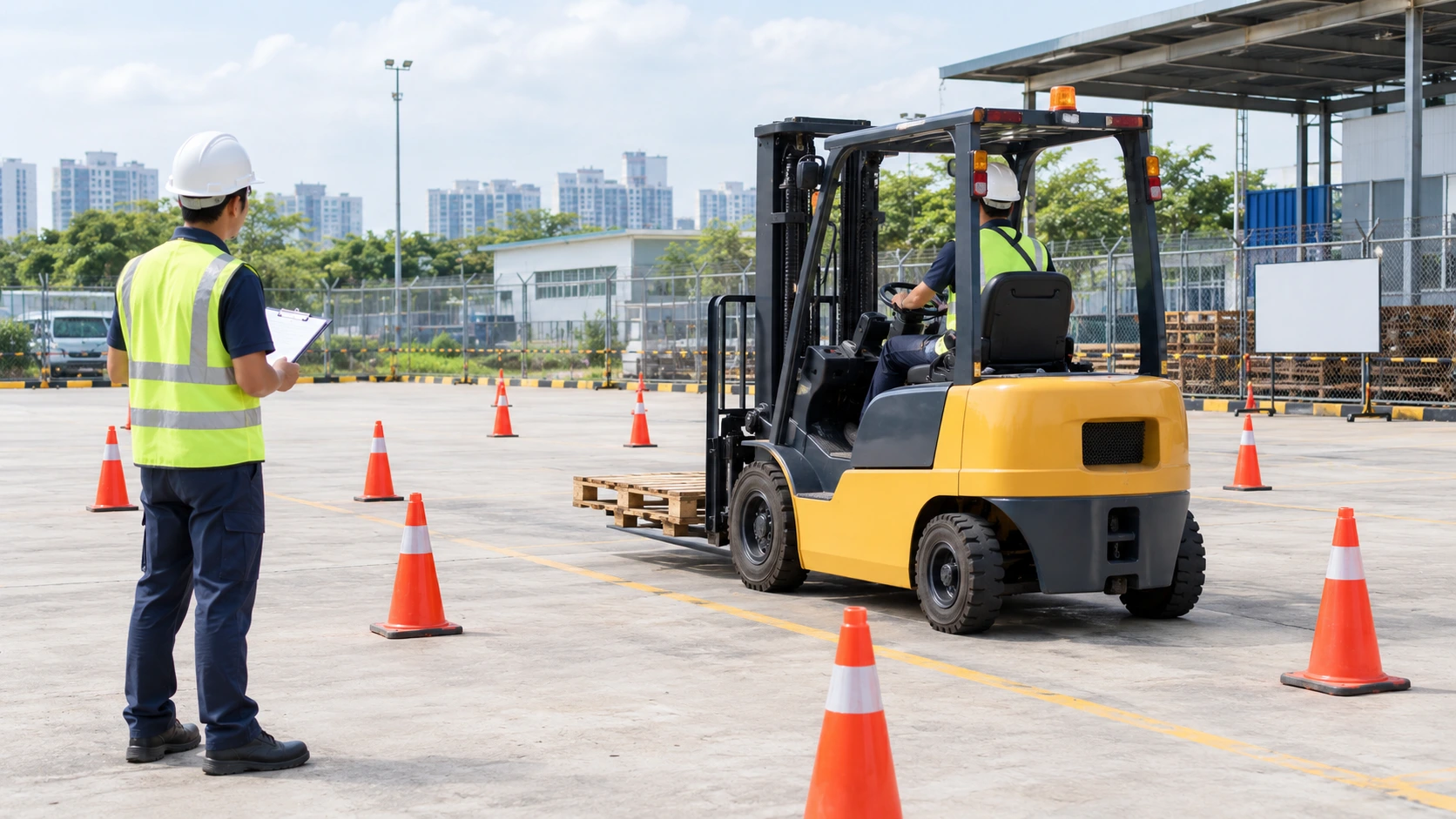
Practical training puts you behind the controls under the supervision of an instructor. You will usually practise pre use checks, starting and stopping, driving forwards and in reverse, turning, picking up and setting down loads, stacking at height, and parking and shutting the machine down correctly.
Use this time to build good habits rather than speed. Smooth, controlled movements, constant awareness of people nearby, and correct load handling matter far more than how quickly a task is finished, both during the assessment and on the job afterwards.
Also read: How to Drive a Forklift Safely and Correctly
Pass the Assessment
At the end of the course, candidates are assessed on both their theory knowledge and their practical skills. The theory assessment checks understanding of safety rules and forklift principles, while the practical assessment checks that the candidate can operate the machine safely and correctly through a set of tasks.
If you do not pass on the first attempt, ask the provider about the options for further practice and reassessment. It is better to take extra training than to start work without the confidence and skill the job demands.
Receive Your Certificate and Keep It Safe
After passing the assessment, you receive a certificate from the training provider. Keep the original safe and make a copy for your records, because employers and site safety officers may ask to see it before you start work, and some sites check certificates at their entrance.
If you lose the certificate, contact the training provider who issued it to ask about a replacement, rather than waiting until an employer asks for it.
What a Forklift Course Usually Covers
While the exact syllabus depends on the provider, most forklift operator courses cover the same core subjects:
- Forklift parts and controls. The function of the mast, forks, carriage, counterweight, and operator controls, which are explained in more detail in Parts of a Forklift: What Each Component Does.
- Stability and load handling. How the weight and position of a load affect stability, and how to read the capacity plate.
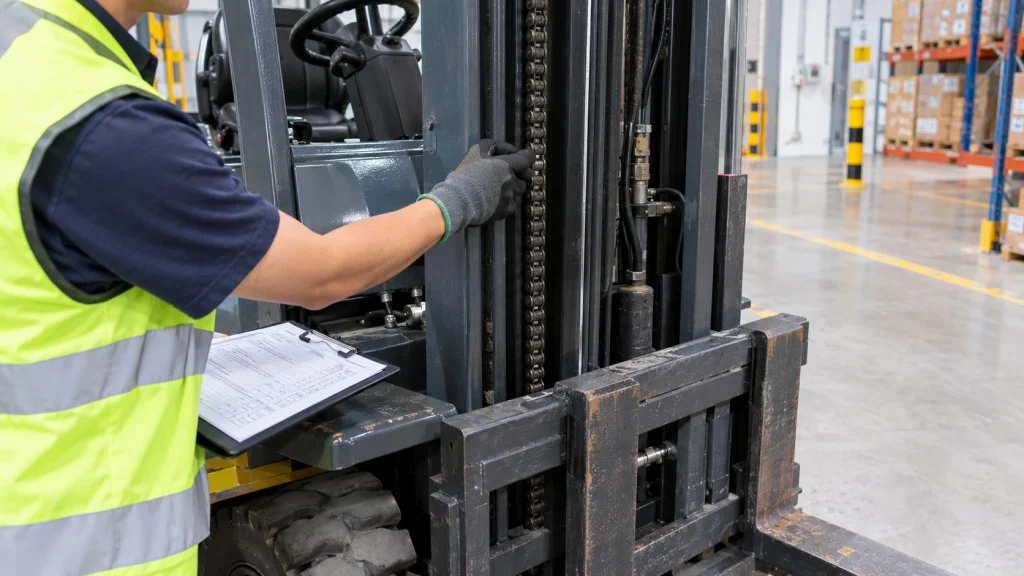
- Pre use inspection. Checking tyres, forks, chains, hydraulics, brakes, steering, lights, and warning devices before each shift.
- Safe driving. Speed, visibility, travelling with and without a load, ramps, turning, and working near pedestrians.
- Stacking and unstacking. Placing and retrieving loads at height safely.
- Refuelling and battery charging. Safe practices for diesel, gas, and electric forklifts.
- Emergency procedures. What to do in the event of a tip over, a fire, or a collision.
The pre use inspection is one of the most important habits an operator takes from the course, because it catches faults before they cause an accident. A practical checklist that operators can use every day is covered below.
Also read: Forklift Safety Checklist: A Complete Guide
Course Duration, Fees, and Language
Course duration, fees, and the languages in which training is delivered vary between providers and course types. Some courses are short and focused on a single type of forklift, while others are longer and cover more content, and the price usually reflects the amount of practical training included.
Because these details change, the most reliable approach is to request the current course outline, schedule, fees, and any available funding directly from two or three accredited providers and compare them. Employers who train several workers at once may be able to arrange group sessions at their own premises, which can be more convenient and lets workers practise on the machines they will actually use.
After You Are Certified
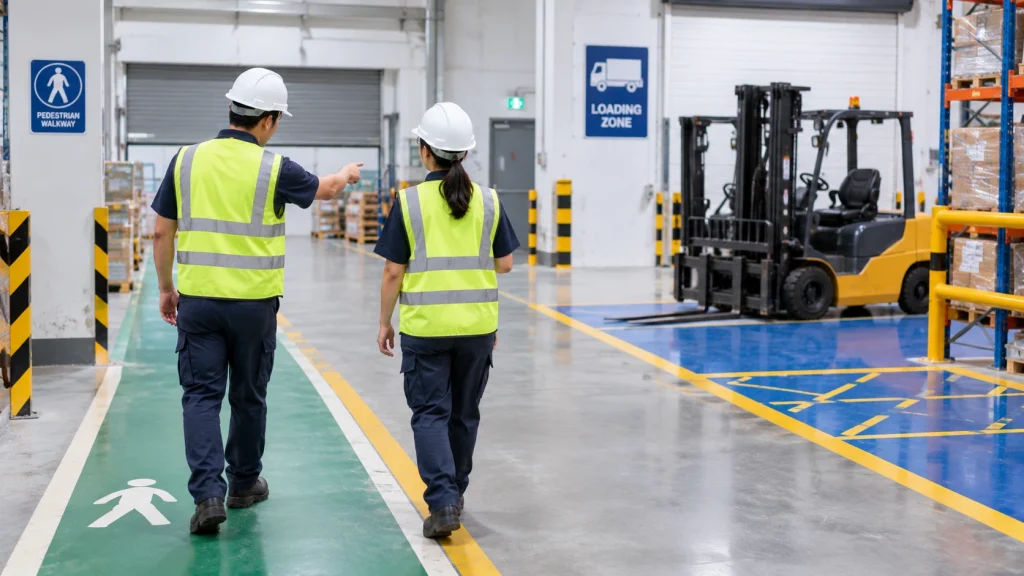
A certificate shows that you have completed training, but it does not replace familiarisation with the specific forklift and workplace you will be working in. Before operating on a new site or a new machine, an operator should be shown the controls of that particular model, the site’s traffic routes, pedestrian areas, loading zones, and any site specific rules.
Employers should also keep training records, monitor how operators work in practice, and arrange refresher training when needed, for example after an incident, a long break from operating, or a change to a different type of forklift. Good daily habits, including routine checks and reporting faults promptly, are covered in Forklift Maintenance Checklist: A Complete Guide, and the wider principles of safe operation are explained below.
Also read: Forklift Safety Tips for Safe and Efficient Operations
Common Mistakes When Getting Certified
A few avoidable mistakes cause most of the problems people run into on the way to certification:
- Enrolling with a provider whose course is not accredited by the Ministry of Manpower
- Assuming an overseas license or informal experience is automatically accepted in Singapore
- Training on one type of forklift and then operating a very different type without further training or familiarisation
- Treating the certificate as the end of learning rather than the start of supervised work
- Confusing workplace certification with the separate rules for driving on public roads
Avoiding these mistakes saves both time and money, and it gives employers confidence that a new operator is ready to work safely.
Do You Need a License to Operate a Rented Forklift?
Yes. The training requirement applies to the person operating the forklift, regardless of whether the machine is owned or rented. A rental company may ask for proof that the people who will operate its machines are trained, and the employer using the forklift remains responsible for making sure that every operator is competent.
When renting, it also helps to confirm the type, capacity, and power source of the forklift in advance so that your operators are trained on a matching machine. A guide to matching the machine to the task is available in How to Choose a Forklift: A Complete Buyer’s Guide. Further general background on forklift design and history is available through Wikipedia’s overview of forklifts.
Renting a Forklift in Singapore
Once your operators are trained, choosing the right machine is the next step. When you contact the team, it helps to share the type and weight of the loads, the lifting height needed, whether the work is indoors or outdoors, the space available for manoeuvring, and how long you expect to need the forklift. With these details, the right capacity and power source can be recommended from the start rather than adjusted after delivery.
RR Machinery Pte Ltd offers a diverse range of forklifts for rent for warehouses, factories, and construction sites across Singapore, backed by factory certified technicians and full servicing support. Contact us today for expert advice on the right forklift for your operation.