Some jobs at height are too small to justify a large self propelled machine, yet too awkward for a ladder or a scaffold. A single sign to fix above a shopfront, a tree to prune beside a narrow driveway, or a few lights to replace on a building with poor access all fall into this gap, and it is exactly where a towable boom lift earns its place.
This guide explains what a towable boom lift is, how it is set up on site, what kind of reach and power options to expect, where it works best, and what to check before hiring one, so the machine chosen fits the job rather than the other way around.
What a Towable Boom Lift Actually Is
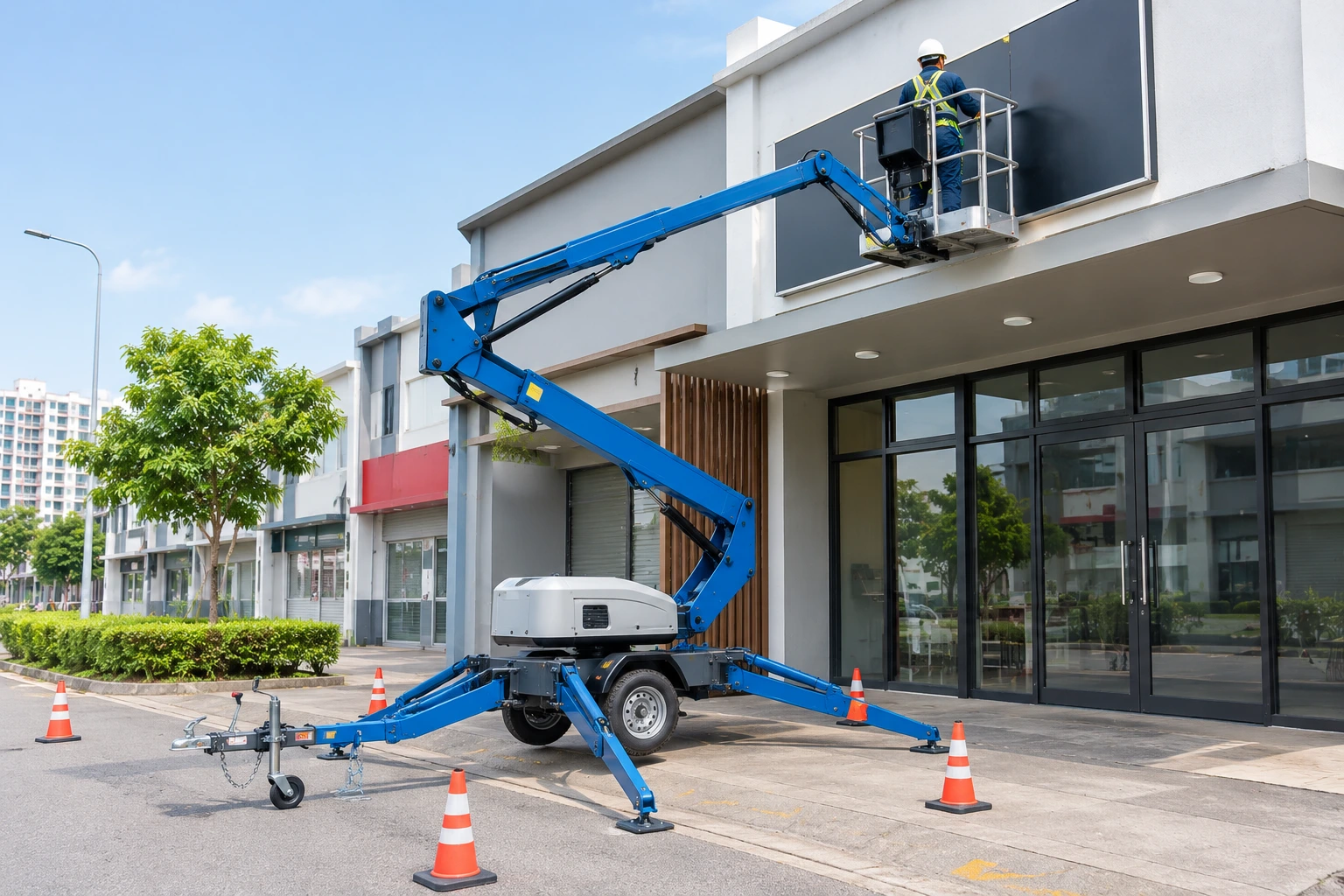
A towable boom lift is a boom lift mounted on a trailer, so it can be hitched to a vehicle, pulled to the work site, and set up on its own stabilisers. Once in position, a worker raises the platform with a jointed or telescopic boom, in the same way as with any other boom lift, but the machine itself is lighter, more compact, and designed to be moved by towing rather than driving under its own power.
It belongs to the wider family of aerial work platforms, a category that also includes scissor lifts, vehicle mounted lifts, and self propelled booms, which is explained in What Is an Aerial Lift? Types, Uses and Safety. Within that family, towable machines are usually chosen for occasional, light or medium duty tasks where convenience and easy transport matter more than outright reach. Further general background on how these platforms are classified is available through Wikipedia’s overview of aerial work platforms.
The trailer design is the main thing that separates a towable model from other boom lifts, and it affects everything from how the machine is delivered to how it is positioned. A broader comparison of every boom lift configuration, including how the towable type differs from the rest, is covered below.
Also read: Types of Boom Lifts: Which One Does Your Job Need?
How a Towable Boom Lift Is Set Up on Site
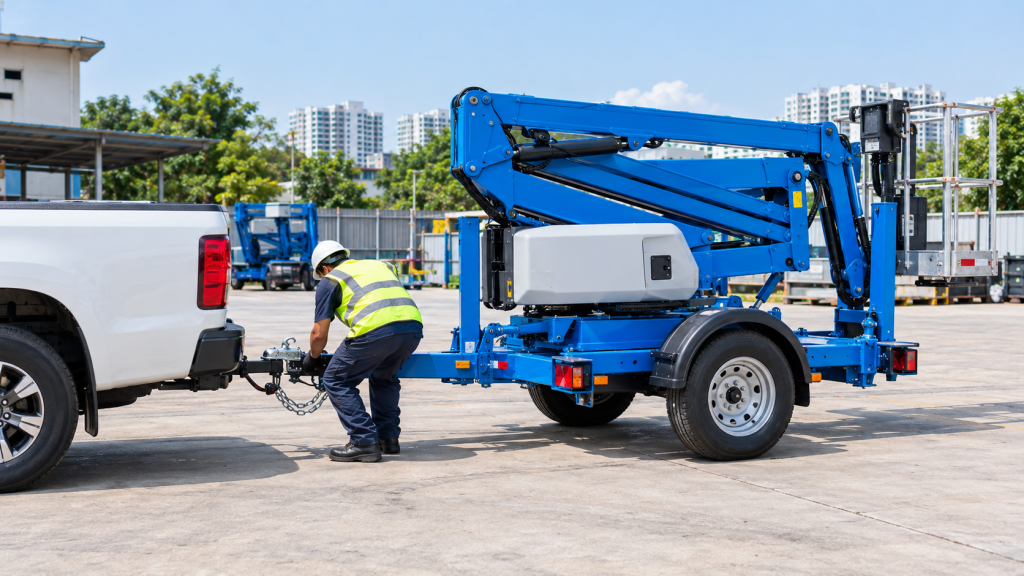
Setting up a towable boom lift involves a few more steps than driving a self propelled machine into position, and doing them in the right order is what keeps the machine stable once the boom goes up. Most setups follow the same basic sequence, from arrival to the moment the platform leaves the ground.
Because the machine relies on its stabilisers rather than a heavy chassis for stability, careful setup matters more here than with a larger machine. The manufacturer’s manual sets out the exact procedure for each model, and it should always be followed, but the principles below apply across most units.
Towing and Positioning
The tow vehicle must be capable of pulling the trailer safely, which means checking its rated towing capacity, the hitch and coupling, and the trailer’s braking and lighting arrangements before it leaves the yard. Road rules and licence requirements for towing differ, so it is worth confirming them with the supplier and the relevant authorities rather than assuming they match another vehicle you may have towed before.
At the site, the trailer is positioned as close as practical to the work, with enough space around it for the stabilisers to extend fully. Because towable machines cannot easily be repositioned once set up, it pays to think carefully about where the platform needs to reach before the trailer is unhitched, and to choose a position that covers as much of the job as possible.
Levelling and Stabilisers
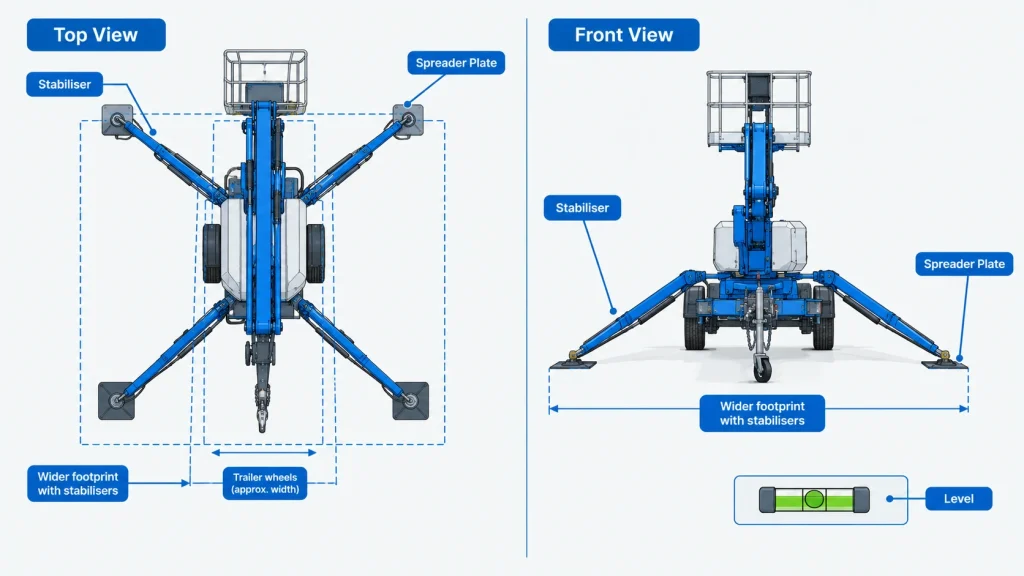
Once the trailer is in position, the stabilisers, sometimes called outriggers, are extended and set until the machine is level. These legs widen the machine’s footprint and take the load that would otherwise rest on the trailer’s wheels, and the boom should never be raised until every stabiliser is correctly deployed and every pad is on firm ground.
Soft or uneven ground is the most common cause of trouble at this stage. Spreader plates or timber mats are often used to spread the load, and the ground should be checked for drains, voids, and underground services that could fail under a concentrated load. A machine that is not level is a machine that is not safe to use.
Raising the Boom
With the machine level and stabilised, the operator checks the surroundings for overhead hazards, confirms the ground controls work, and then raises the platform in a controlled way. Many towable models offer controls at both the platform and the base, so a second person on the ground can lower the platform in an emergency.
It is good practice to carry out a short test movement before anyone climbs in, and to keep the full range of the boom’s travel clear of obstructions rather than only the final position. Moving the boom slowly, particularly near structures, gives time to react if something is not as expected.
Reach and Working Height
Towable boom lifts are generally built for lower working heights than the large self propelled and truck mounted machines, because a trailer that can be towed by an ordinary vehicle has to stay within practical limits on weight and size. That makes them a good match for work on low and medium height structures, and a poor match for tall buildings.
Many towable machines use a jointed boom, which allows the platform to reach over and around obstacles, a design covered in more detail in Articulating Boom Lift: Uses, Benefits, and How It Works. Telescopic versions exist too, offering more straight line reach in places with a clear approach. The specification sheet for each model gives its platform height, working height, and outreach, and these should be checked against the actual point of work, with some margin to spare, before the machine is booked.
Power Options
Towable boom lifts are usually powered in one of a few ways, and the right choice depends on where the machine will work and how often it will be used:
- Battery power. Quiet, free of exhaust, and well suited to work near buildings, in public areas, and in places where noise or fumes would be a nuisance. Batteries need charging between uses, so the supply and the time available matter.
- Engine power. A small petrol or diesel engine gives independence from a power supply and suits remote sites, but adds noise and exhaust fumes.
- Dual power. Some models offer both, so they can run quietly on battery where that matters and switch to an engine when a longer run or a charging point is not available.
Whichever type is chosen, it is worth confirming how long a full charge or tank lasts under working conditions, since the time spent at height varies a great deal from one job to another.
Where Towable Boom Lifts Work Best
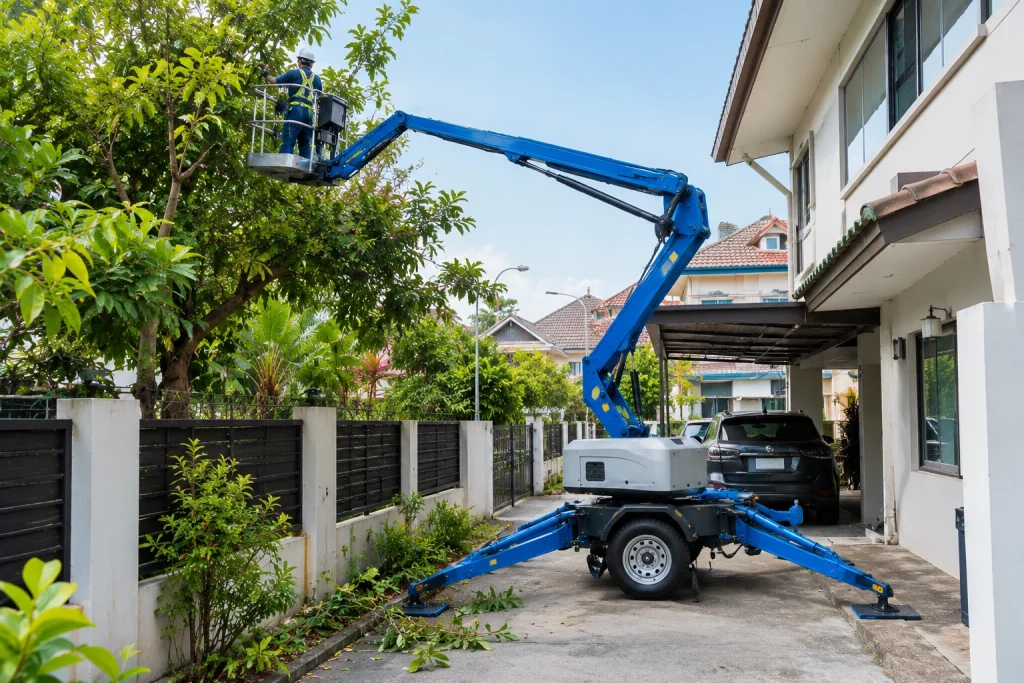
The strengths of a towable machine, easy transport, a modest footprint, and good flexibility in tight places, make it a natural fit for a particular kind of work:
- Tree pruning and removal beside buildings, driveways, and fences
- Signage installation, repair, and replacement above shopfronts and entrances
- Replacement of lighting, cameras, and fittings on low and medium height structures
- Building maintenance such as painting, gutter work, and facade repairs in places with limited access
- Property and estate maintenance, where an occasional need for access at height does not justify a larger machine
- Short term event and production rigging in places where a larger machine could not be positioned
Truck mounted machines, often called cherry pickers, are the closest relatives for outdoor roadside work, and the terminology around them is explained in What Is a Cherry Picker? Types, Uses & How It Works. The main difference is that a towable machine needs a separate vehicle to move it and a setup step on arrival, while a truck mounted machine arrives ready to deploy.
Towable Boom Lift Compared With Other Options
Several other machines overlap with a towable boom lift on certain tasks, and it helps to understand where each one fits before choosing. The decision usually comes down to height, access, how long the work will last, and how much setup time is acceptable.
Comparisons are most useful when they are made against the specific job. A machine that is ideal for one site can be the wrong choice for the next, even when the two jobs sound similar on paper.
Towable vs Self Propelled Boom Lifts
A self propelled machine drives itself around the site and into position, which makes it quick to reposition and well suited to extended work across a large area. It is usually heavier, more capable, and more expensive to move to site, but it saves time when the platform needs to travel between several work points during the day.
A towable machine is generally lighter and cheaper to transport, which suits short, occasional jobs at a single location. If the job needs the platform to move between many positions, the repeated setup of a towable machine can cancel out its other advantages, and a self propelled machine is likely to be the better choice.
Towable vs Scissor Lift
A scissor lift raises its platform straight up, giving a large, stable working floor, but no ability to reach over or around obstacles. A towable boom lift trades that big platform for flexibility in reach, which makes it better when the work point is not directly above a clear patch of ground.
For tasks that need straight vertical access on a flat, clear surface, a scissor lift is often the simpler and more stable option. A full comparison of boom lifts and scissor lifts, including how to choose between them, is available below.
Also read: Boom Lift vs Scissor Lift: Which One Should You Choose?
Limits to Plan Around
A towable boom lift is a practical tool, but it has limits, and recognising them early prevents a poor match. Its working height and capacity are lower than those of larger machines, it needs a suitable tow vehicle and a route the trailer can travel, and it takes time to set up and to move once deployed.
Ground conditions matter a great deal, because the machine depends on its stabilisers and cannot easily be used on steep, soft, or very uneven ground. Wind limits apply as with any boom lift, and tall, lightweight machines of this type can be more sensitive to gusty conditions at height. If the job involves lifting heavy loads rather than carrying people and tools, a different category of equipment is needed altogether, a distinction explained in Boom Lift vs Crane: How to Choose for Your Project.
What Should You Check Before Hiring One?
A short checklist helps avoid the most common mismatches between a towable machine and the job it has been booked for:
- Is the tow vehicle capable of pulling the trailer, and is the route to the site suitable for it?
- Is there enough space, on ground that can carry the load, for the stabilisers to extend fully?
- Does the machine’s working height and outreach cover the work point with a sensible margin?
- Does the power source suit the location, including noise limits, fumes, and access to charging?
- Will the platform need to move between several positions, or stay in one place?
- Is the person operating it trained, and are the required safety systems, including a harness anchor point, in place?
Answering these questions before the booking, rather than on the day of delivery, avoids delays and helps the supplier recommend the right size and configuration from the start.
Safe Operation of a Towable Boom Lift
Working at height always carries risk, and a lighter machine on stabilisers calls for particular care with setup, ground conditions, and weather. Everyone on the platform should wear a harness connected to the designated anchor point, the machine should be inspected before each use, and overhead power lines and structures should be identified before the boom is raised. The wider principles that apply to any task above ground are explained in Working at Height: Safety Tips and Guidelines.
Operators should be properly trained, and Singapore’s Ministry of Manpower publishes detailed Workplace Safety and Health guidance covering training, inspection, and operating standards that apply to aerial work platforms on local worksites. A practical walkthrough of safe operating technique, from checks before use through to shutdown, is available below.
Also read: How to Operate a Boom Lift Safely: A Step-by-Step Guide
Hiring a Towable Boom Lift in Singapore
Choosing the right machine starts with a clear description of the job. When you contact the team, it helps to share the height of the work point, how far from the machine’s position it sits, what the access route and ground are like, whether the work is indoors or outdoors, and how long you expect to need the machine. With these details, the right type and size can be recommended from the start rather than adjusted after delivery.
RR Machinery Pte Ltd offers an extensive range of boom lifts, including trailer mounted options for lighter work at height, backed by factory certified technicians and full servicing support. Contact us today for expert advice on the right machine and a quote tailored to your project.