Working at height is a routine requirement in construction, maintenance, industrial servicing, and facility management. Yet many elevated work areas cannot be reached directly from below. Building façades, roof edges, pipe racks, machinery, beams, ceiling services, and fixed structures often create obstacles that make simple vertical access insufficient.
An articulating boom lift is designed for these conditions. Unlike a scissor lift, which mainly moves vertically, an articulating boom lift uses hinged boom sections to reach up, out, and over obstacles. This makes it especially useful where workers need flexible access rather than only height.
For contractors, site supervisors, and equipment rental buyers, choosing the right access equipment affects productivity, safety, and project cost. A lift that is too small may not reach the work area, while an oversized machine may be difficult to manoeuvre or unnecessarily expensive. Understanding how an articulating boom lift works helps project teams choose equipment that matches the actual site conditions.
This guide explains what an articulating boom lift is, how it works, where it is commonly used, how it compares with other access equipment, and what to consider before renting or buying one.
Also read: Boom Lift vs Cherry Picker: Key Differences Explained
What Is an Articulating Boom Lift?
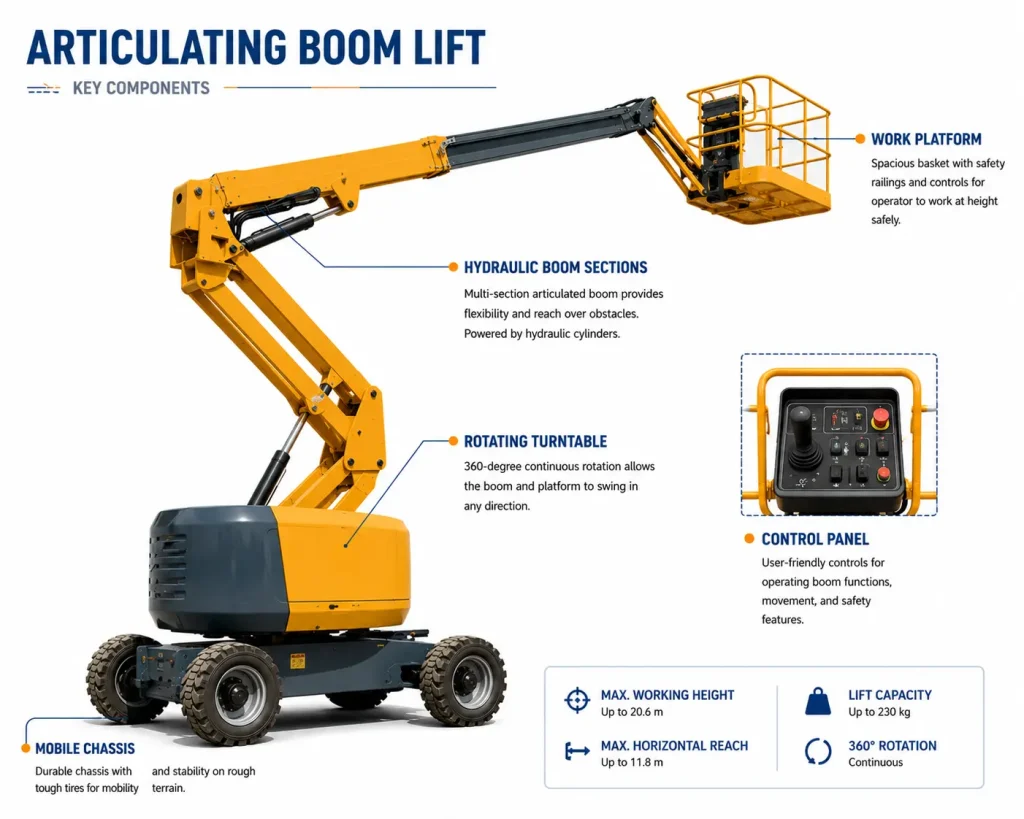
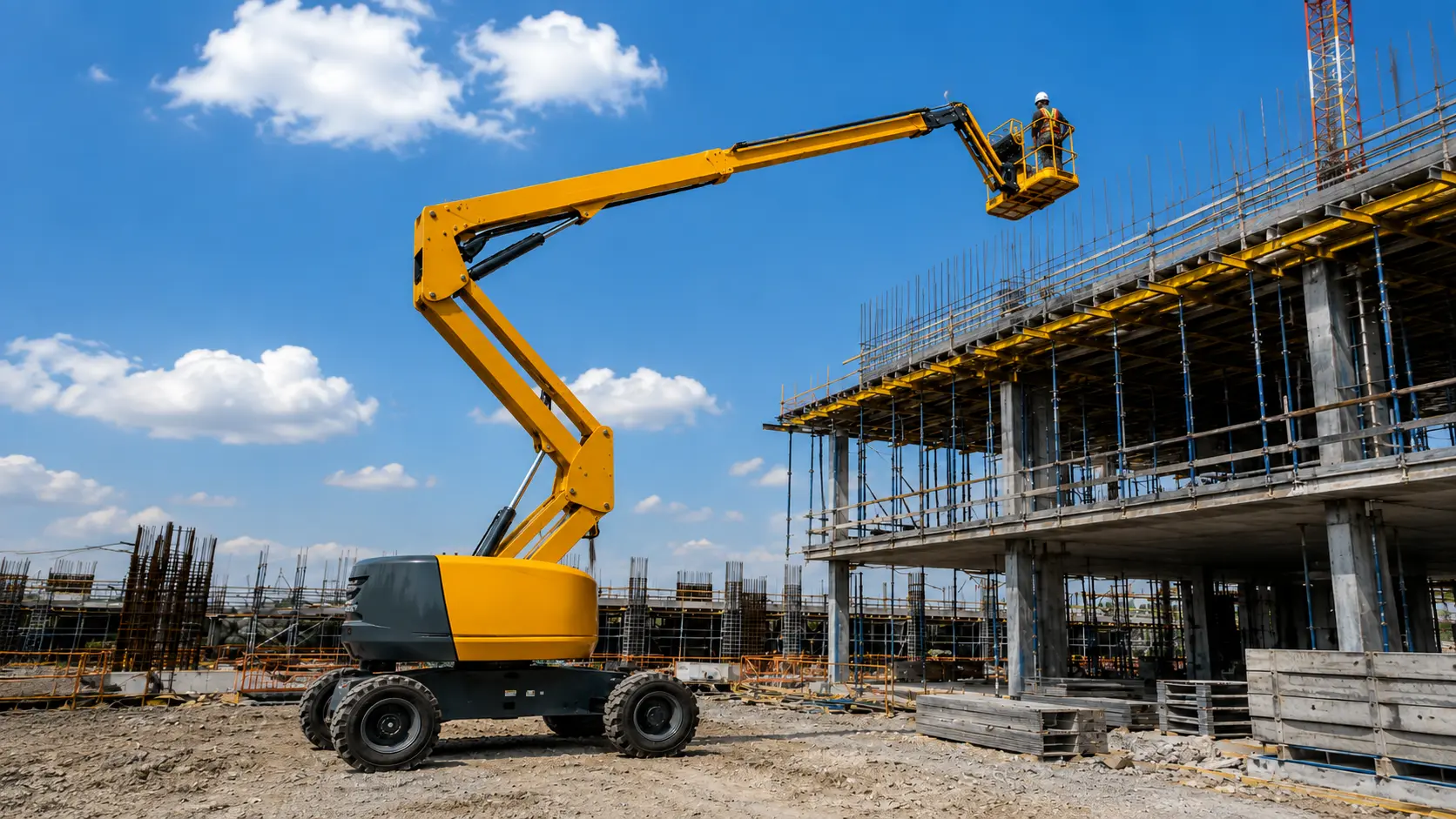
An articulating boom lift is a type of mobile elevating work platform designed to lift workers, tools, and light materials to elevated work areas. Its defining feature is the articulated boom arm, which consists of multiple hinged sections. These joints allow the boom to bend and reposition the platform around obstacles.
The machine usually consists of a mobile chassis, rotating turntable, boom assembly, hydraulic system, control panel, and work platform. The operator can control the boom from the platform, allowing accurate positioning while working at height. This is especially useful for inspection, installation, maintenance, and repair work where the platform must be placed close to a specific work area.
Articulating boom lifts are available in electric, diesel, and hybrid models. Electric models are commonly used indoors because they are quieter and produce no direct exhaust emissions. Diesel or rough terrain models are more suitable for outdoor construction sites, uneven ground, and industrial environments where additional power and terrain capability are required.
The main advantage of an articulating boom lift is access flexibility. Instead of positioning the machine directly below the work area, the operator can place the lift in a practical ground location and use the boom joints to reach over barriers, machinery, landscaping, or structural elements.
Articulating Boom Lift Key Specifications
Specifications vary by model and manufacturer, but most articulating boom lifts on the market fall within the following typical ranges:
- Working height: typically 12 to 43 metres depending on model
- Horizontal outreach: typically 6 to 22 metres
- Platform capacity: typically 200 to 450 kg, enough for one to two workers with tools
- Power source: electric for indoor use, diesel or bi-energy for outdoor and rough terrain use
- Drive configuration: two-wheel drive for smooth indoor floors, four-wheel drive for outdoor and rough terrain models
These figures are a useful starting reference, but the exact working height, outreach, and capacity required should always be confirmed against the specific work location before a machine is selected.
Also read : Types of Boom Lifts: Which One Does Your Job Need?
How an Articulating Boom Lift Works
An articulating boom lift works through a hydraulic boom system. Hydraulic cylinders raise, lower, and bend the boom sections, allowing the platform to move through a controlled working envelope. The turntable rotates the boom, while the articulated sections provide the up-and-over movement that distinguishes this machine from a straight boom lift.
The machine’s safe operating range depends on platform height, horizontal outreach, platform capacity, boom angle, machine weight, and ground conditions. As the boom extends outward, the centre of gravity changes, which is why operators must follow the manufacturer’s load and operating limits. The machine should never be used beyond its rated capacity or slope allowance.
Most articulating boom lifts include platform controls and ground controls. Platform controls allow the worker to position the basket precisely while performing the task. Ground controls are used for emergency lowering, maintenance checks, or operation from below when required.
Because the boom can move in several directions, safe operation requires proper planning. The operator must consider overhead obstructions, nearby workers, ground stability, wind conditions, and the distance between the machine and the work area. A capable machine is only safe when used within the correct operating conditions.
Also read: What Is a Cherry Picker? Types, Uses and How It Works
Key Features of an Articulating Boom Lift
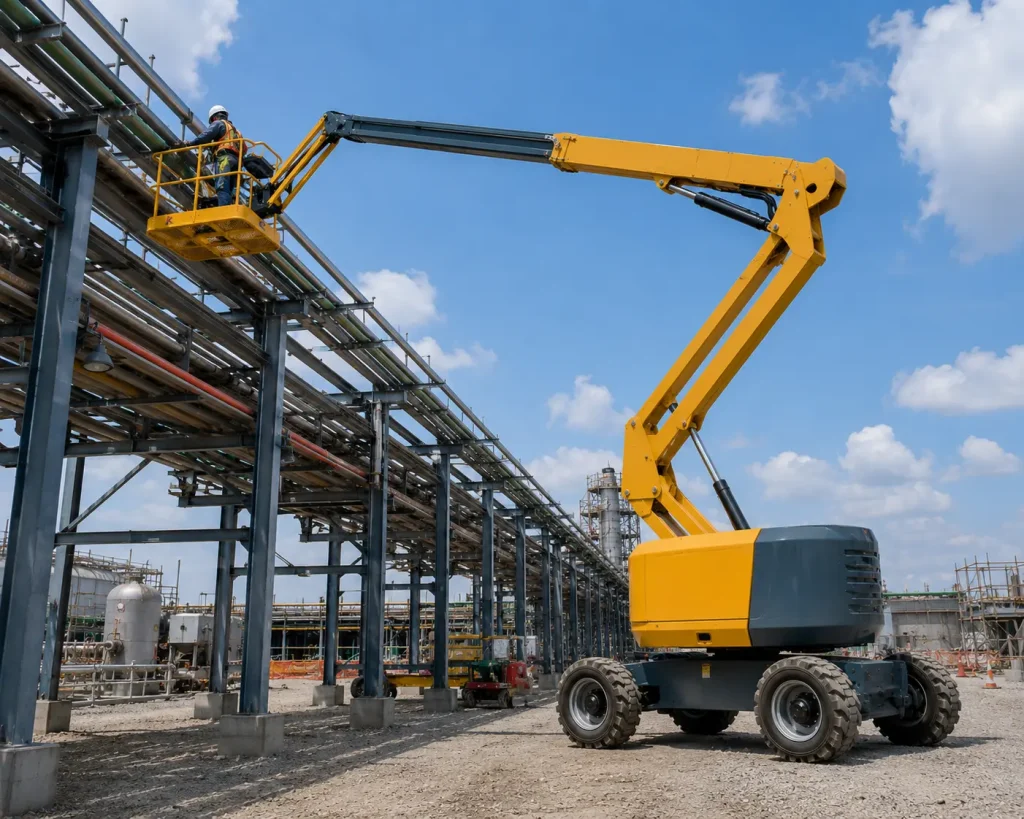
Up-and-Over Reach
The most important feature of an articulating boom lift is its ability to reach up and over obstacles. This means the platform can be raised above an obstruction and then positioned beyond it. For example, a worker may need to access pipework above fixed machinery, a wall behind landscaping, or external building elements behind a canopy.
This capability makes articulating boom lifts useful in congested or irregular work areas. Instead of building temporary scaffolding or repositioning equipment repeatedly, the operator can often reach several access points from one machine position. This can reduce setup time and improve work efficiency.
Flexible Platform Positioning
An articulating boom lift provides more flexible positioning than a vertical lift or a straight boom lift. The hinged sections allow the platform to approach the work area from different angles, which is valuable around beams, building edges, pipe racks, machinery, or façade details.
This flexibility also helps workers maintain a safer and more practical working position. Instead of stretching from a ladder or working from an awkward angle, the platform can be positioned close to the task area. For maintenance, installation, painting, inspection, and electrical work, this can improve both safety and work quality.
Indoor and Outdoor Options
Articulating boom lifts are available in configurations suited to different environments. Electric models are often used indoors in warehouses, shopping centres, factories, airports, and commercial buildings. They are quieter, cleaner, and can be fitted with non-marking tyres for finished floor surfaces.
Outdoor models are usually diesel-powered or hybrid and may include rough terrain tyres, four-wheel drive, oscillating axles, and higher ground clearance. These features make them suitable for construction sites, industrial yards, and maintenance work on uneven surfaces. The correct choice depends on working height, site surface, ventilation, access route, and project duration.
Common Uses of Articulating Boom Lifts
Building Construction and Façade Work
Articulating boom lifts are widely used in building construction because many exterior and interior work areas are obstructed. Workers may need to reach cladding, windows, roof edges, external lighting, signage, waterproofing areas, or structural details that cannot be accessed directly from below.
Compared with fixed scaffolding, an articulating boom lift can be faster to deploy for short-duration tasks or isolated work areas. It can be moved between elevations and work zones without dismantling a larger access structure. This makes it useful for inspection, installation, defect rectification, and maintenance tasks.
Mechanical, Electrical, and Plumbing Work
Mechanical, electrical, and plumbing installations often take place above ground level and around dense service areas. Workers may need to access ducting, cable trays, fire protection pipes, lighting systems, or air-conditioning equipment. These areas are often blocked by beams, machinery, or other building services.
An articulating boom lift allows the operator to reach over equipment and into difficult ceiling or plant room areas. The platform provides a stable work area for tools and materials, making it safer and more efficient than ladders for many elevated tasks.
Industrial and Facility Maintenance
Industrial facilities often include tanks, conveyors, pipework, production machinery, and structural frames. These fixed elements can make access difficult, especially when maintenance teams need to inspect, clean, paint, repair, or service equipment at height.
An articulating boom lift is useful because it can reach around existing structures without requiring major disruption to the facility. For indoor maintenance, electric models may be suitable. For outdoor plants, utility sites, or heavy industrial areas, diesel or hybrid models with rough terrain capability may be required.
Warehouse and Logistics Operations
Warehouses and logistics facilities often require access to lighting, racking, sprinkler systems, signage, ceiling services, and roof-level equipment. These environments can include narrow aisles, storage racks, conveyors, and active operations that limit available working space.
An articulating boom lift can be useful where a scissor lift cannot reach across racking or around fixed layouts. Compact electric models are especially suitable for indoor maintenance, provided the floor can support the machine and the access route is clear.
Articulating Boom Lift vs Other Access Equipment
Articulating Boom Lift vs Telescopic Boom Lift
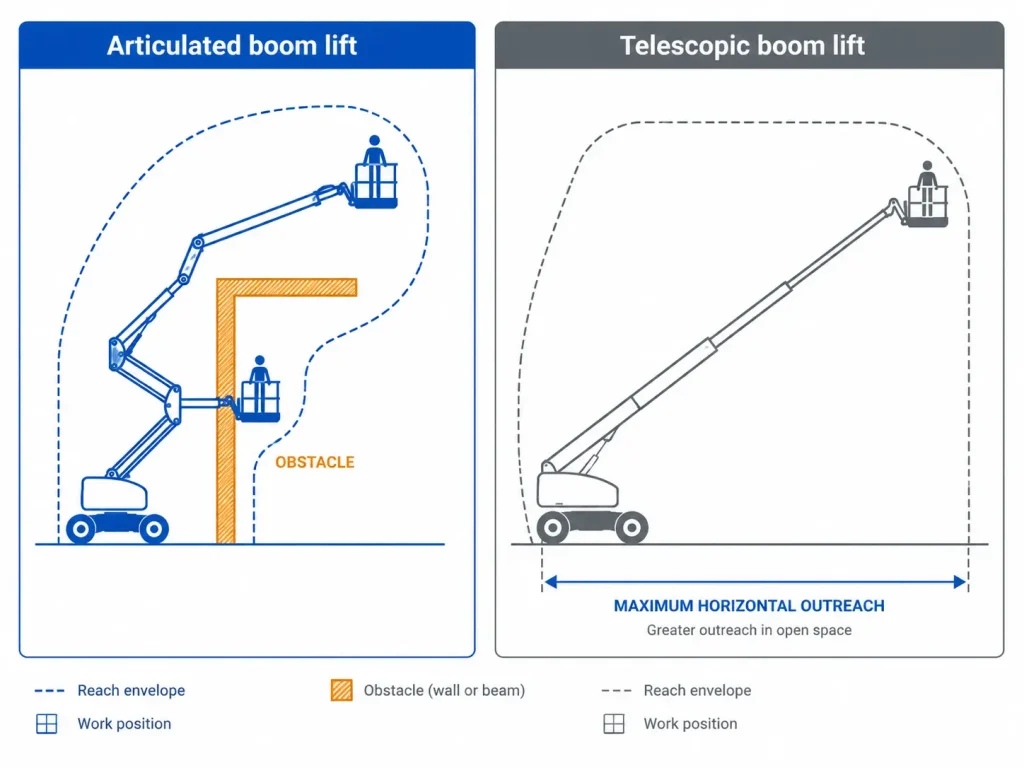
An articulating boom lift and a telescopic boom lift are both types of boom lifts, but they solve different access problems. A telescopic boom lift, also called a straight boom lift, extends in a more direct line and is usually better for reaching high or far areas where the path is open.
An articulating boom lift is better when the work area is obstructed. Its hinged boom allows the platform to bend around obstacles and provide up-and-over access. It may not always provide the same maximum horizontal outreach as a telescopic boom, but it offers better positioning flexibility in congested work areas.
Articulating Boom Lift vs Scissor Lift
A scissor lift is designed for vertical access. It raises the platform straight upward and is useful when the task is directly above the machine. Scissor lifts are commonly used for ceiling work, warehouse maintenance, indoor installation, and general overhead access.
An articulating boom lift is more suitable when the worker needs to reach outward or over an obstacle. It usually has a smaller platform than a scissor lift, but it provides greater access flexibility. If the task is directly overhead, a scissor lift may be more efficient. If the task requires up-and-over positioning, an articulating boom lift is usually the better choice.
Also read: Boom Lift vs Scissor Lift: Which One Should You Use?
Articulating Boom Lift vs Mobile Scaffolding
Mobile scaffolding can be useful for lower-height work, repeated access in one area, or tasks that require a simple temporary platform. It is often cost-effective for straightforward indoor work on level surfaces.
An articulating boom lift is more suitable where access points change frequently, where height and outreach are required, or where obstacles prevent direct access. It can reduce manual setup time and allow workers to reach several locations more efficiently, especially on construction and maintenance projects with complex site layouts.
When to Use an Articulating Boom Lift
When the Work Area Is Obstructed
An articulating boom lift is the right choice when the work area is blocked by physical obstacles such as machinery, pipework, walls, landscaping, trenches, parked equipment, or building projections. The boom can move around these obstructions and place the platform close to the task area.
This is one of the clearest reasons to choose an articulating boom lift instead of a scissor lift or ladder. If the machine cannot be positioned directly below the work area, up-and-over reach becomes essential for safe and efficient access.
When Precise Access Is Required
Some elevated tasks require accurate platform positioning. Examples include façade inspection, electrical installation, painting, cladding repair, mechanical servicing, signage installation, and maintenance of overhead systems. In these tasks, the worker needs to be close enough to the work face without leaning or overreaching.
An articulating boom lift allows finer positioning because the boom sections can be adjusted independently. This improves working posture, reduces unnecessary movement, and helps the operator place the platform safely in relation to the structure.
When Scaffolding Would Take Too Long
Scaffolding remains useful for long-duration work over large areas, but it can be inefficient for short tasks, inspection jobs, maintenance visits, or isolated repair points. Building and dismantling scaffolding requires labour, time, and planning.
For many access tasks, an articulating boom lift can be driven into position, elevated, adjusted, and moved to the next area more quickly. This makes it a practical choice where the work is temporary, spread across multiple locations, or difficult to justify with a full scaffold setup.
How to Choose the Right Articulating Boom Lift
Working Height and Outreach
Working height is the first specification most project teams consider, but it should not be the only one. Working height refers to the approximate maximum height a worker can reach from the platform, while platform height refers to the actual height of the platform floor.
Horizontal outreach is equally important. A machine may reach high enough vertically but still fail to reach the task if it cannot extend far enough from its base. Before renting or buying, the project team should measure both the height of the work area and the distance from the available machine position.
Platform Capacity and Power Source
Platform capacity includes the weight of workers, tools, and small materials. Exceeding this capacity is unsafe and can affect the stability and operation of the machine. For inspection tasks, a standard platform capacity may be enough. For installation or repair work involving tools and materials, capacity should be checked more carefully.
The power source should match the work environment. Electric models are better for indoor, quiet, or low-emission areas. Diesel models are better for outdoor construction and rougher conditions. Hybrid models may be suitable when the same machine needs to operate across both indoor and outdoor zones.
Ground Conditions and Access Route
Ground conditions are critical for safe boom lift operation. The surface must be strong and stable enough to support the machine, especially when the boom is elevated or extended. Soft ground, slopes, trenches, floor openings, drainage covers, and recently disturbed surfaces can all create risk.
Access route is equally important. A machine that has the right height and outreach may still be unsuitable if it cannot pass through the site entrance, doorways, ramps, loading bays, or narrow routes. Width, stowed length, turning radius, transport height, and floor loading should be checked before delivery.
External reference: For Singapore work-at-height safety context, refer to the Ministry of Manpower’s work-at-height guidance.
Safety Considerations for Articulating Boom Lift Operation
Articulating boom lifts should be operated by trained and competent personnel. Operators must understand the controls, emergency lowering procedure, platform capacity, slope limits, travel restrictions, and site-specific hazards. Pre-use inspection should include tyres, controls, alarms, hydraulics, guardrails, platform gate, emergency systems, and visible damage.
Work-at-height safety also depends on the surrounding environment. Operators should consider overhead power lines, nearby structures, moving vehicles, pedestrians, wind conditions, and exclusion zones. The platform should not be overloaded, and workers should follow the site’s fall protection and safe access procedures.
Weather can also affect safe operation. Wind is especially important when working outdoors at height. Rain can reduce visibility, affect surface grip, and soften ground conditions. The equipment should always be used within the manufacturer’s stated limits and the site’s safety requirements.
Articulating Boom Lift Rental Considerations
Renting an articulating boom lift requires more than choosing a machine based on height. The supplier should understand the actual work task, access restrictions, site surface, required outreach, indoor or outdoor use, platform load, and project duration. Clear information helps ensure the recommended machine is suitable.
For short-term tasks, availability and fast deployment may be the priority. For longer projects, equipment reliability, maintenance support, and service response become more important. Downtime caused by unsuitable or poorly maintained equipment can affect labour productivity and project scheduling.
The most cost-effective machine is not always the cheapest model. A smaller lift may cost less but fail to reach the work area efficiently. A larger lift may reach the task but create access or manoeuvring problems. The best choice is the machine that matches the job requirement without unnecessary overspecification.
The Right Boom Lift for Safe and Flexible Work at Height
An articulating boom lift is one of the most practical access solutions for work areas that require height, outreach, and up-and-over positioning. It is especially useful where workers need to reach around obstacles, above machinery, across restricted ground areas, or close to complex building and industrial structures.
The right boom lift depends on the working height, horizontal outreach, platform capacity, power source, ground conditions, and access route. For projects that involve façade work, maintenance, installation, inspection, or access around obstructions, choosing the correct boom lift can improve site safety, reduce setup time, and make elevated work more efficient.
RR Machinery provides reliable boom lift equipment for sale and rental across Singapore, supported by a team that can help match the right machine to your working height, site access, and project requirements. Explore our boom lift equipment range or contact our team for practical advice and a clear quotation for your project.