The comparison between a telehandler vs crane comes up on almost every active construction site, because both machines lift loads to height and both are widely available through equipment rental across Singapore and the wider region. From a distance the two appear to address the same problem. Look more closely at what each machine is built to do, and the differences are substantial, practical, and directly relevant to site safety, project efficiency, and cost control.
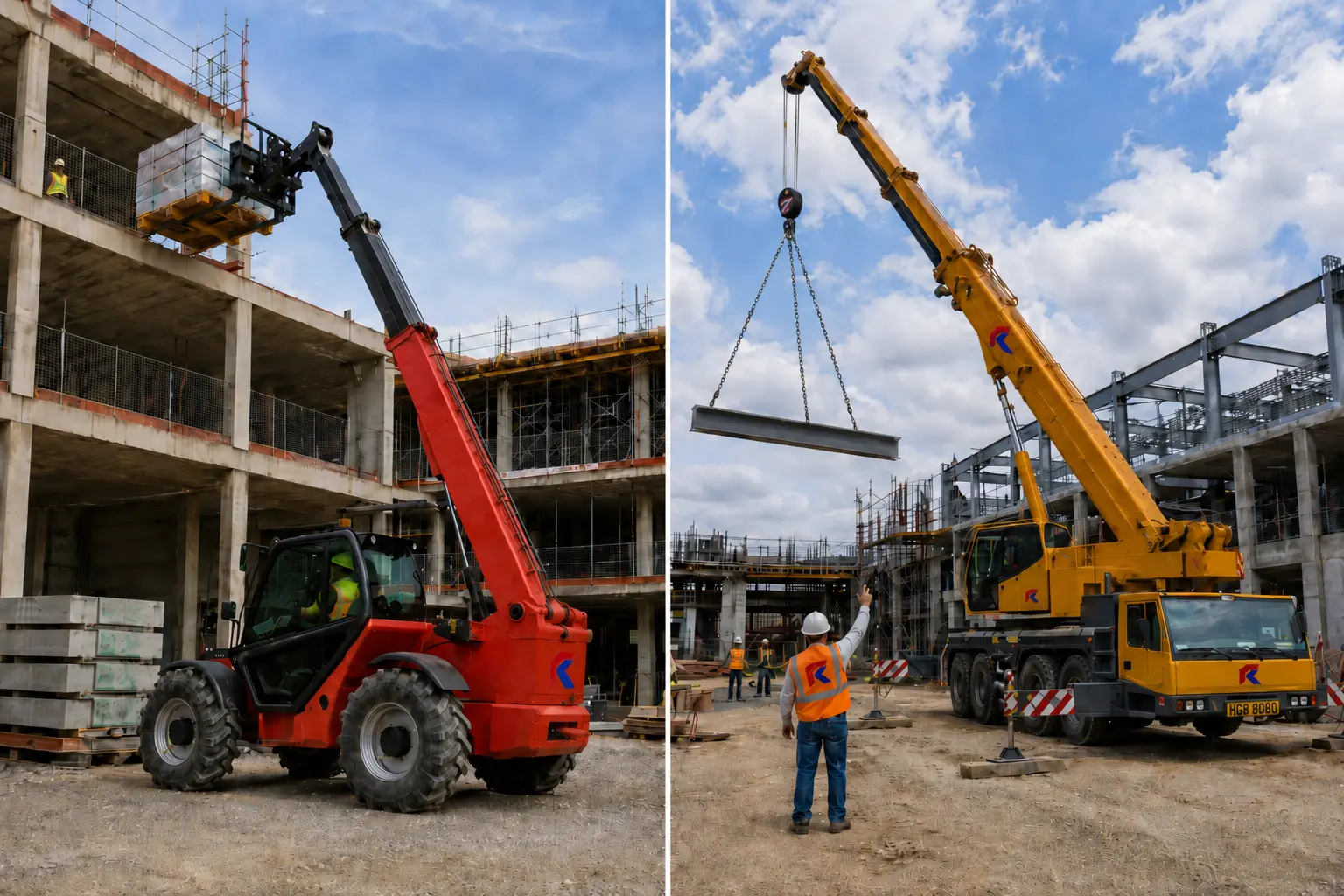
A telehandler is a versatile, self-propelled material handling machine built around a forward-reaching telescopic boom. It moves materials across a site, lifts them to height, and places them where they are needed. It travels with the load, which makes it the workhorse of site logistics on busy construction projects. A crane, by contrast, is a dedicated lifting machine designed to hoist heavier loads to greater heights and position them at a working radius that no telehandler can match. It lifts from a fixed position, suspending the load precisely beneath a hook for controlled placement at height or long radius.
Choosing the wrong machine for the task affects more than cost. Using a telehandler where a crane is required puts personnel and structure at risk. Using a crane where a telehandler would be more productive ties up specialist plant and adds unnecessary mobilisation cost to routine logistics work. Understanding the practical difference between the two machines, grounded in lifting capacity, lift height, working radius, ground conditions, and site access requirements, is what allows project teams to match equipment to task correctly from the outset.
Understanding the Core Difference Between a Telehandler and a Crane
The most important distinction between a telehandler and a crane lies in how each machine transfers its load and what it is structurally built to accomplish. A telehandler handles materials. A crane lifts loads. This distinction sounds straightforward but carries significant engineering implications that determine the suitability of each machine for any given task.
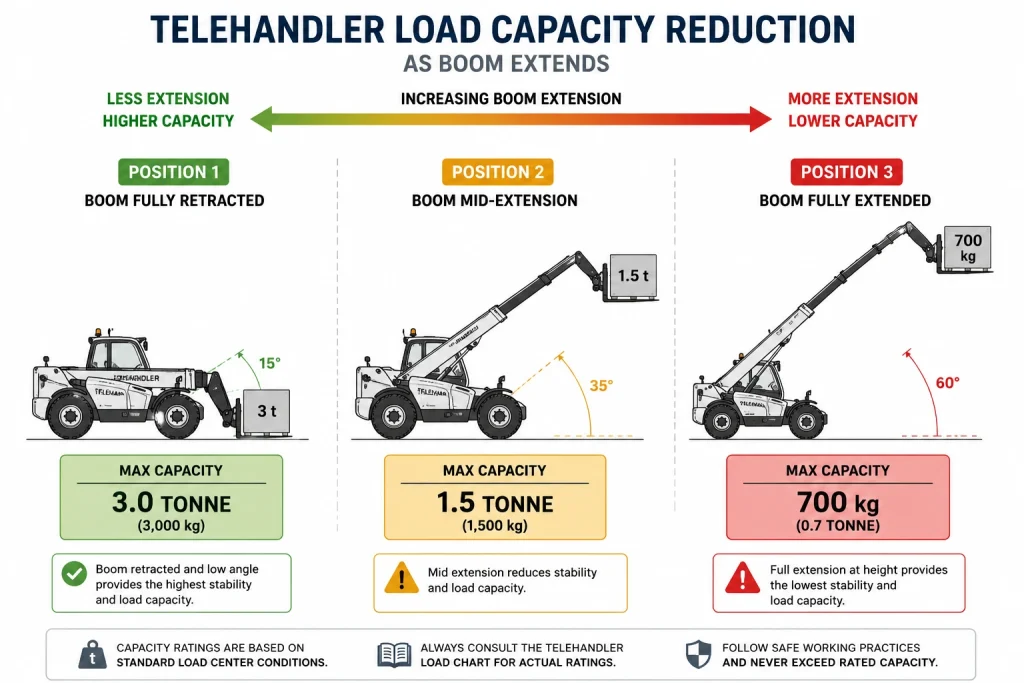
A telehandler carries its load on a fork or attachment at the end of an extending boom. The machine drives to the load, picks it up, travels with it, and places it at the destination. The machine’s rated capacity is defined by a stability envelope, the combination of boom angle, extension length, and load weight at which the machine remains stable on its tyres without tipping. As the boom extends further forward and higher, that rated capacity decreases, sometimes dramatically, because the leverage applied to the machine’s centre of gravity increases with boom extension.
A crane lifts loads from a fixed or semi-fixed position using a boom that reaches to a defined working radius, suspending the load from a hook on a wire rope. The load hangs vertically beneath the hook throughout the lift. The crane’s capacity is governed by a load chart specifying the maximum safe load at every combination of boom length and working radius. A properly configured crane on outriggers can lift far heavier loads than a telehandler of comparable size, can position them at greater height and longer radius, and provides a more controlled, documented lift for critical operations. What it cannot do is drive to the next pick-up point and travel across the site as part of the same continuous operation.
What Is a Telehandler
A telehandler is a four-wheel-drive, self-propelled machine built around a telescopic boom that pivots from a point above the rear axle and extends forward and upward. The boom typically carries a fork attachment similar to a forklift, though telehandlers accept a wide range of alternatives including work platforms, concrete buckets, winches, and grapples. This attachment versatility, combined with the machine’s all-terrain mobility, is what makes the telehandler the preferred material handler across a wide range of construction, infrastructure, industrial, and logistics environments.
In practice, a telehandler functions as a mobile material handler capable of reaching positions that a standard counterbalanced forklift cannot access. It drives over rough terrain with a load on the forks, navigates the uneven ground conditions of an active construction site, and extends its boom to deliver palletised materials to upper floor slabs, scaffold platforms, or elevated storage positions. On building construction projects, the telehandler is typically the primary machine for supplying block, brick, bagged cement, and prefabricated elements to working floors, repeating that cycle dozens of times per shift to keep the building programme moving.
The telehandler’s limitation is defined by the same geometry that gives it reach. As the boom extends, the rated capacity falls because an increasing moment is applied about the front axle. A machine rated at three tonnes with the boom fully retracted may carry a rated capacity of under a tonne at full extension. This reduction is not a flaw in the machine but a fundamental consequence of its design, and it is the primary reason that telehandler load charts must be consulted for the actual boom configuration in use on each lift, not simply the machine’s headline rated capacity.
Also read: Types of Cranes: A Comprehensive Guide
What Is a Crane
A crane is a dedicated lifting machine designed to hoist loads vertically and position them at a defined working radius using a boom, wire rope, and hook assembly. Unlike a telehandler, which carries its load directly on an attachment, a crane suspends the load beneath the hook, keeping it vertical throughout the lift and allowing precise placement at the required position without the machine needing to travel to the placement point.
The three crane types most commonly deployed on construction and infrastructure sites in Singapore and across the region are the mobile crane, the crawler crane, and the rough terrain crane. A mobile crane is road-legal, self-propelled, and capable of travelling between project sites under its own power. On site it deploys outriggers to provide a stable base, extends its boom to the required configuration, and operates within the parameters defined by its load chart for that configuration. Mobile cranes are the most common choice for short-duration structural lifts, equipment installation, and projects where the crane must work at multiple positions across the site.
A crawler crane sits on tracked undercarriage rather than wheels, distributing its weight over a larger footprint and allowing it to work on softer ground where a wheeled crane would require more extensive preparation. Crawler cranes can lift heavier loads at longer radii than most mobile cranes of comparable size, and they can travel slowly across a site with a load suspended. A rough terrain crane is a compact, purpose-built site machine on large all-terrain tyres, suited to lifting on unprepared ground in the confined access conditions of active construction sites. All three types operate from a fixed position during the lift, governed by a load chart, and all require a formal lifting plan before work begins.
Telehandler vs Crane: Key Differences
The practical differences between a telehandler and a crane are not marginal. They affect the fundamental suitability of each machine for a given task, and they compound quickly when equipment is selected on the basis of availability or familiarity rather than task requirements.
Lifting Capacity
Most construction telehandlers carry a maximum rated capacity of two to five tonnes with the boom retracted and the load centred on the forks. At full boom extension, that rated capacity may fall to well under a tonne depending on the model. A mobile crane with a rated capacity of fifty tonnes retains significant lifting capability even at extended working radii, with the load chart defining the reduction in capacity as radius increases. For any lift where the load weight exceeds the telehandler’s rated capacity at the required boom configuration, a crane is the only appropriate equipment choice.
Lift Height and Working Radius
Telehandlers typically achieve maximum lift heights of six to eighteen metres depending on model size, with the forward reach at any given height constrained by the stability envelope and the rated capacity at that extension. Cranes operate at heights and working radii that no telehandler can approach. A mobile crane configured with a fifty-metre boom can reach heights and radii that are simply inaccessible to any telehandler, making it the only option for structural work at height, high-rise material placement by crane hook, or any operation where the required lift geometry falls outside the telehandler’s published load chart.
Load Movement and Placement
A telehandler moves with its load. It picks up a pallet, drives across the site, and delivers it to the placement position. This continuous travel-with-load capability is the telehandler’s core strength on logistics-intensive sites. A crane lifts from a fixed position, swings the load to the placement point within its working arc, and returns to pick up the next load without repositioning the machine. This makes the crane highly productive for operations where multiple loads must be lifted from one area and placed at height within its working radius, but unsuited to the multi-point logistics that a telehandler manages efficiently.
Site Mobility and Ground Conditions
Telehandlers are designed for continuous site mobility and can navigate the tight corners, congested access routes, and uneven terrain of active construction sites with loads on the forks. Cranes require a set-up position that meets ground bearing capacity requirements beneath each outrigger pad, provides adequate clearance for the boom and counterweight sweep, and is positioned to cover the required working radius. Ground bearing assessment is a standard part of the lifting plan process and must be completed before any crane lift begins. On soft, variable, or disturbed ground, both the telehandler’s stability and the crane’s outrigger bearing capacity must be carefully verified before lifting.
Safety, Lift Planning, and Regulatory Requirements
Routine telehandler operation within rated capacity on prepared ground does not require a formal lifting plan. Crane lifts of any significance do, covering lift geometry, equipment configuration, ground conditions, rigging details, exclusion zones, communication protocols, and emergency procedures. For notifiable lifts above defined load thresholds, regulatory notification may also be required. The crane safety and lifting standards published by OSHA provide a comprehensive reference for the procedural and regulatory requirements applicable to crane operations in construction environments globally. Singapore’s Ministry of Manpower similarly publishes Workplace Safety and Health guidance covering the lifting plan, training, and equipment inspection requirements that apply directly to crane and telehandler operation on local construction sites.
Cost and Rental Efficiency
Telehandlers carry lower day rates than cranes and do not require the additional costs of outrigger pad hire, lifting plan preparation by a competent person, and the specialist personnel required for crane operations. For repetitive material handling and site logistics tasks, the telehandler delivers a lower cost per tonne-metre of material moved than any crane. For lifts that only a crane can perform safely, the cost comparison is irrelevant. The machine that can do the job safely is the machine that must be used, regardless of the day rate.
When to Use a Telehandler
A telehandler is the correct machine when the primary requirement is flexible, mobile material handling rather than high-capacity or long-radius lifting. On building construction sites, the telehandler is the primary machine for supplying materials to working floors throughout the building programme. Block, brick, bagged products, and palletised materials arrive by delivery vehicle, and the telehandler lifts them from the vehicle and places them on the required slab level, repeating that cycle throughout the shift to sustain the pace of the building programme.
For loading and unloading delivery vehicles, moving materials between the laydown area and points of use, and any task requiring the machine to travel continuously between multiple pick-up and placement positions, the telehandler’s combination of all-terrain mobility and telescopic reach makes it more productive than any crane deployed in the same role. It does not require set-up time, outrigger deployment, or a formal lifting plan for routine material handling within its rated capacity, which allows it to respond to changing site conditions and priorities with a speed and flexibility that crane operations cannot match.
The telehandler also earns its place when site access is restricted, the working area is congested, and a machine with a large set-up footprint would be impractical. Its compact chassis, articulating steering, and all-terrain tyres allow it to operate in conditions that would prevent crane deployment entirely. Where versatility and continuous mobility matter more than maximum lifting capacity, the telehandler is consistently the most productive and cost-efficient machine available.
When to Use a Crane
A crane is required when the lift weight, height, radius, or regulatory classification of the operation exceeds what a telehandler can safely manage. The decision to use a crane is not typically a design preference. It is driven by the engineering requirements of the lift and the limitations of every alternative, and it is confirmed by checking the required lift parameters against the telehandler’s load chart and finding that the task falls outside the machine’s safe operating envelope.
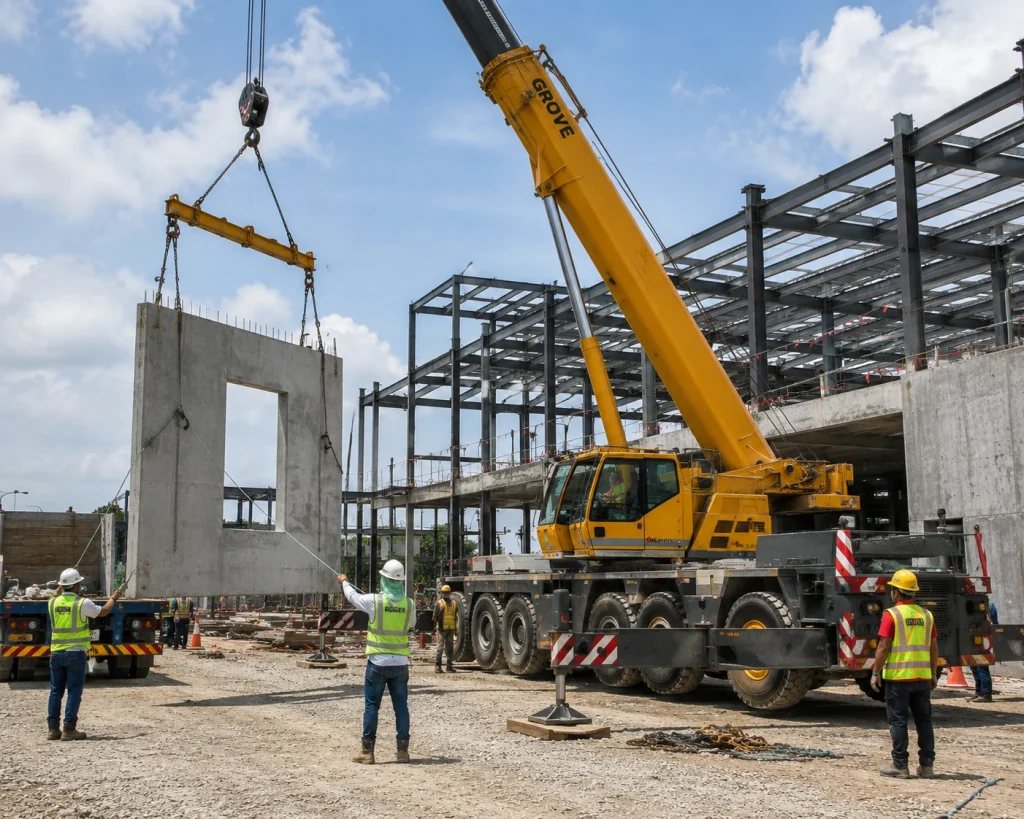
Structural steel erection is almost always a crane operation. Columns, beams, and trusses are heavy, often long, and must be lifted to height and positioned precisely within a structure that is being built around them. The load weights, the height at which placement must occur, and the precision required during final positioning are all characteristics that place structural steel work firmly in crane territory. Precast concrete installation, including wall panels, hollow-core slabs, and facade elements, similarly requires a crane whenever the element weight exceeds the telehandler’s rated capacity at the required reach, or when the placement height is beyond the telehandler’s maximum lift.
Heavy plant and equipment installation, including generators, transformers, process equipment, and mechanical plant, routinely requires cranes because the equipment weights are above telehandler capacity, the placement positions may be at height or within confined plant rooms, and the installation sequence may require the load to be held stationary in position while it is connected or bolted into place. A crane provides the stability and control for this kind of precision placement that a telehandler, with its load resting on forks rather than suspended from a hook, cannot replicate.
Can a Telehandler Replace a Crane
For light to medium lifting tasks, within the telehandler’s rated capacity at the required boom configuration and height, a telehandler can often replace a crane productively and at substantially lower cost. On sites where the heaviest lifts involve palletised materials to five or six storeys and no single lift approaches the load or height boundary of the machine’s load chart, a crane may not be required at all during that phase of the project.
The answer changes decisively when the load exceeds the telehandler’s rated capacity at the required boom configuration, when the required lift height or working radius is beyond the machine’s envelope, when the load must be suspended rather than supported on forks, or when the lift is classified as a critical or notifiable operation requiring a formal lifting plan and certified supervision. In any of these situations, the telehandler is not a cost-effective alternative to a crane. It is simply not capable of performing the task safely, and no operational adjustment changes that.
One of the most frequent and preventable errors in telehandler operation is failing to account for how sharply the rated capacity falls as the boom extends. A machine rated at three tonnes with the boom fully retracted may carry a rated capacity of seven hundred kilograms at full extension. An operator who loads the forks to two tonnes and then extends the boom to reach the placement position is operating at nearly three times the rated capacity for that configuration. The load chart must be consulted for the actual boom angle and extension in use, not the machine’s headline capacity, before every lift.
Choosing the Right Equipment for Your Project
Equipment selection follows directly from the parameters of the lift and the conditions of the site, not from equipment availability or budget preference. The questions that lead to the correct decision are consistent across project types and must be answered using the actual load charts of the machines under consideration, not general assumptions about what each machine is capable of.
What is the load weight, and how does that compare to the telehandler’s rated capacity at the required boom configuration and height? If the load falls within the load chart with an adequate margin, a telehandler may be appropriate. If it does not, a crane is required. How high must the load be lifted and how far from the machine must it be placed? The combination of height and working radius at the required load weight determines whether the telehandler’s geometry can reach the placement point within its stability envelope. Is the load palletised or does it need to be suspended? Suspended load handling in a telehandler is a specialist operation and is not appropriate as a substitute for crane lifting on loads of any significant weight.
What are the ground conditions at the machine position and along the travel route? Is the lift a repetitive logistics task or a single critical heavy lift requiring documented planning and certified personnel? Is the site access sufficient for crane set-up, outrigger deployment, and the exclusion zone required during the lift? Working through these questions against the actual capabilities of the available machines is the process that produces a correct equipment decision, and it is a process that should be completed before equipment is mobilised to site, not after the machine arrives and the mismatch becomes apparent.
The Right Lifting Equipment for Every Construction Site
Choosing between a telehandler and a crane depends on more than lifting capacity alone. The right equipment must match the load weight, lift height, working radius, site access, ground conditions, and the way materials need to move across the project site. A telehandler may be the more practical choice for repeated material handling, loading, and site logistics, while a crane is required for heavier, higher, or more complex lifting operations that demand greater control and lifting capability.
RR Machinery supports construction projects across Singapore with reliable lifting and material handling equipment for sale and rental. Whether your project requires equipment for material handling, elevated access, or heavy lifting support, our team can help assess your site requirements and recommend a suitable solution.
Explore our heavy machinery services or contact our team for practical advice and a clear quotation matched to your lifting requirements, site conditions, and project schedule.