Table of Contents
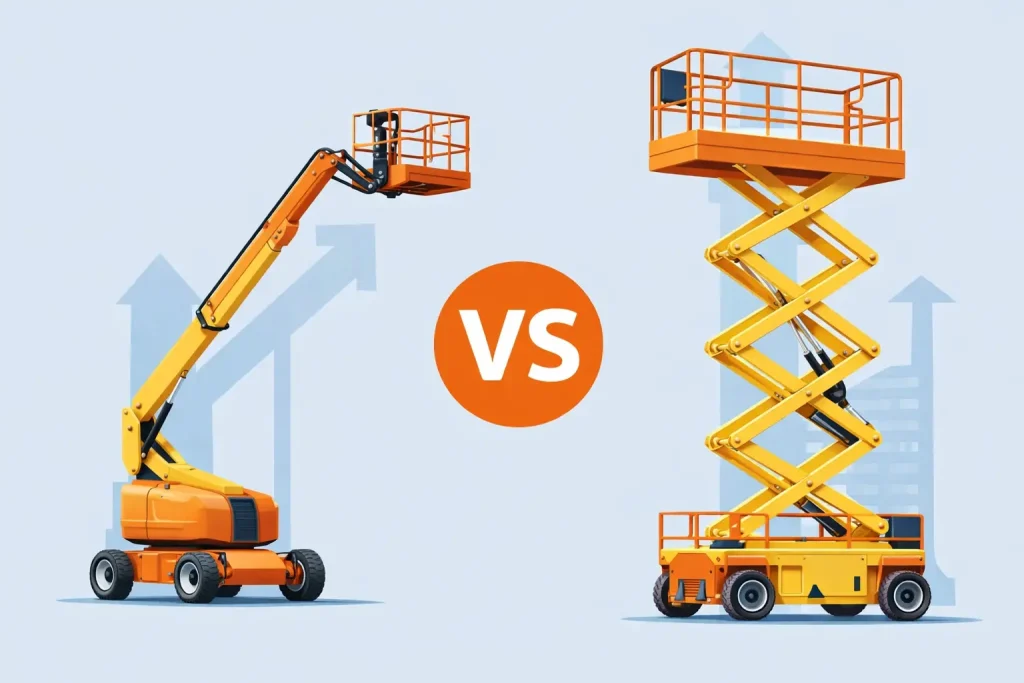
If you’re planning work at height, choosing between a boom lift and a scissor lift isn’t just a “price vs height” decision, it affects how safely you can access the work area, how often you’ll need to reposition, and how efficiently the job gets done. In simple terms: boom lifts are for reaching up and out, while scissor lifts are for going straight up. (Both fall under the broader family of access equipment often discussed as MEWPs/aerial work platforms.)
What Is a Boom Lift?
A boom lift raises a platform using an extendable arm, allowing the basket to move up, out, and around obstacles. That’s why boom lifts are commonly used for façade access, roofline work, external repairs, or any situation where you can’t park directly under the work point. A helpful way to remember this is IPAF’s classification: mobile booms are grouped under 3B categories.
Operating a Boom Lift
Operating a boom lift involves using a set of intuitive controls located on the platform or base to maneuver the lift safely and precisely. Before operation, it’s essential to perform a pre-use inspection to check for any mechanical issues or obstructions in the work area. Once on the platform, operators use joysticks or switches to raise, lower, and extend the boom arm, as well as to rotate the platform if needed.
Most boom lifts allow for both vertical and horizontal movement, enabling users to position the basket exactly where it’s needed, even around obstacles. It’s important for operators to be familiar with the specific controls and safety features of the model in use and to always follow manufacturer guidelines and local safety regulations during operation. Proper training and attention to surroundings help ensure efficient and safe use of the equipment on site.
Also Read: Different Types of Forklifts and Their Uses in Construction and Warehousing
What Is a Scissor Lift?
A scissor lift is an aerial work platform that elevates workers and materials vertically using a crisscrossing support mechanism, which expands and contracts like a pair of scissors. One of its defining features is the spacious and stable platform, allowing multiple workers to operate together and handle tools or materials efficiently. Scissor lifts are widely used for tasks that require direct overhead access, such as ceiling installation, lighting, sprinkler fitting, painting, and routine maintenance in warehouses or factories.
There are several types of scissor lifts, each designed for specific applications and power sources:
Electric scissor lifts are compact, operate quietly, and produce zero emissions, making them ideal for indoor environments or sensitive areas.
Diesel scissor lifts offer greater power and higher weight capacities, suitable for outdoor use and rugged job sites.
Rough terrain scissor lifts come equipped with special tires and four-wheel drive, enabling them to handle uneven surfaces and challenging outdoor conditions.
Hydraulic and pneumatic scissor lifts use oil or air pressure to raise the platform, offering simple operation and low maintenance, which is beneficial for basic or clean environments.
With load capacities ranging from a few hundred to over a thousand kilograms, scissor lifts provide a safe and efficient solution for medium-height jobs that require ample working space at elevation. Selecting the right type of scissor lift depends on your project’s requirements, work location, and specific power or environmental needs.
Key Differences at a Glance
The biggest difference is access style. Boom lifts help you reach areas that are offset or blocked by obstacles, while scissor lifts are usually better when you need stable vertical access with more platform space. In practice, scissor lifts often feel more “workbench-like” (more room for tools/materials), while boom lifts feel more “positioning-focused” (precise basket placement around structures). Manufacturers commonly frame the decision around these capability differences, reach and positioning vs straightforward vertical access.
Comparison of Key Features
When comparing boom lifts and scissor lifts, several key features set them apart and influence which is best for a particular job. Boom lifts generally offer greater maximum height and horizontal outreach, allowing operators to access elevated or hard-to-reach areas. They are equipped with articulated or telescopic arms for maneuverability around obstacles, but typically have a smaller platform and lower weight capacity.
In contrast, scissor lifts provide a larger, more stable platform with higher weight limits, making them ideal for tasks that require multiple workers or heavy tools. However, scissor lifts are limited to vertical movement and usually have a lower maximum height than boom lifts. Additionally, both types come in models suitable for indoor or outdoor use, but rough terrain versions are more common among boom lifts. Understanding these feature differences helps ensure the right equipment is chosen for the specific requirements of each project.
When to Choose a Boom Lift
Choose a boom lift when the job requires outreach, for example, working along the side of a building, reaching over a canopy, accessing a point behind piping, or positioning next to racking where a straight vertical lift can’t line up. If you already know your required height and outreach, it’s easier to shortlist equipment by browsing boom lift options first, rather than trying to “make do” with a platform that can’t comfortably reach the work area.
When to Choose a Scissor Lift
Choose a scissor lift when the work is directly overhead and you want a stable, spacious platform, common for ceiling works, lighting, ducting, sprinklers, and indoor maintenance. Scissor lifts also suit repeatable workflows (“move, lift, work, lower, move again”) on flatter ground because you typically don’t need to manage outreach angles. If that sounds like your project, comparing scissor lift options helps you pick the right platform height range for your site.
Also Read: Machine Maintenance and Preventive Maintenance Best Practices for Effective Maintenance and Repair
Safety Considerations for Both
Regardless of type, most incidents come back to the same basics: unstable ground, overhead hazards, fall risks, and working too close to structures or moving traffic. NIOSH highlights that aerial lifts (including boom lifts and scissor lifts) expose workers to fall hazards and are used across tasks like maintenance and installation, so planning and safe work habits matter just as much as the machine choice.
For a quick, plain-language overview of common aerial lift types and how they’re generally described on job sites, OSHA’s Aerial Lifts overview is a useful reference to keep bookmarked.
Here’s a natural way to connect both internal options and an external reference in one line: when you’re deciding between boom lifts and scissor lifts, IPAF’s explanation of MEWP categories (3A vs 3B) is a quick way to sanity-check whether you need vertical access or boom outreach.
Advantages and Disadvantages
Both boom lifts and scissor lifts offer distinct advantages and limitations that should be considered before making a selection. Boom lifts excel in providing access to high or hard-to-reach areas thanks to their extendable arms and flexible maneuverability, making them ideal for complex outdoor projects. However, they generally have smaller platforms, lower weight capacities, and higher rental costs compared to scissor lifts.
In contrast, scissor lifts are valued for their spacious platforms and higher load capacities, which make them well-suited for tasks requiring multiple workers or substantial tools and materials. They are typically more affordable and stable for vertical access, but their movement is limited to straight up and down, and they cannot reach the same heights or navigate obstacles as effectively as boom lifts. Understanding these pros and cons can help you choose the most suitable equipment for your project’s unique demands.
Quick Decision Checklist
If you want a fast, practical decision process, start with:
Working height
Whether the work point is offset (needs outreach),
Indoor vs outdoor environment
Ground conditions and space constraints
Platform load (people + tools + materials).
Once those are clear, the lift choice usually becomes obvious, and you avoid wasting time on site with a machine that forces awkward positioning.
Cost and Budget Factors
When choosing between a boom lift and a scissor lift, budget considerations play a significant role in the decision-making process. Generally, boom lifts are more expensive to rent than scissor lifts due to their greater reach and flexibility. Boom lifts are ideal for projects that require access to high or hard-to-reach areas, but their higher rental costs can be a key consideration if you are working within a tight budget. On the other hand, scissor lifts typically offer a more economical solution for jobs that require straightforward vertical access and a larger platform.
Several factors influence rental costs, including the type of lift (electric or diesel), platform height, lifting capacity, and the duration of the rental (daily, weekly, or monthly). To maximize your budget, consider renting for longer periods, weekly or monthly rates are often more cost-effective than daily rates for extended projects. Booking equipment early and matching your choice to the specific requirements of your job can also help avoid unnecessary extra costs. By weighing these factors carefully, you can select the most cost-efficient access solution for your project needs.
Also Read: 7 Different Types of Forklifts You Should Know
Get the Right Access Lift with RR Machinery
Choosing between a boom lift and a scissor lift isn’t just about height. What matters even more for day-to-day site and facility operations is having equipment that fits your work area, is ready to work, and is backed by responsive support. With proper planning, you can reduce downtime, keep productivity steady, and complete jobs more safely and efficiently.
Every project is different. Some teams need a short-term solution for a specific job, while others prefer to invest in ownership for long-term use. Many also rely on technical support and maintenance to keep equipment performing reliably over time. Working with one supplier that can support rental, sales, and servicing makes the process smoother and helps avoid delays on-site.
To explore options, you can browse boom lift options, compare scissor lift options, view rental equipment, or Contact our team for a faster response.