
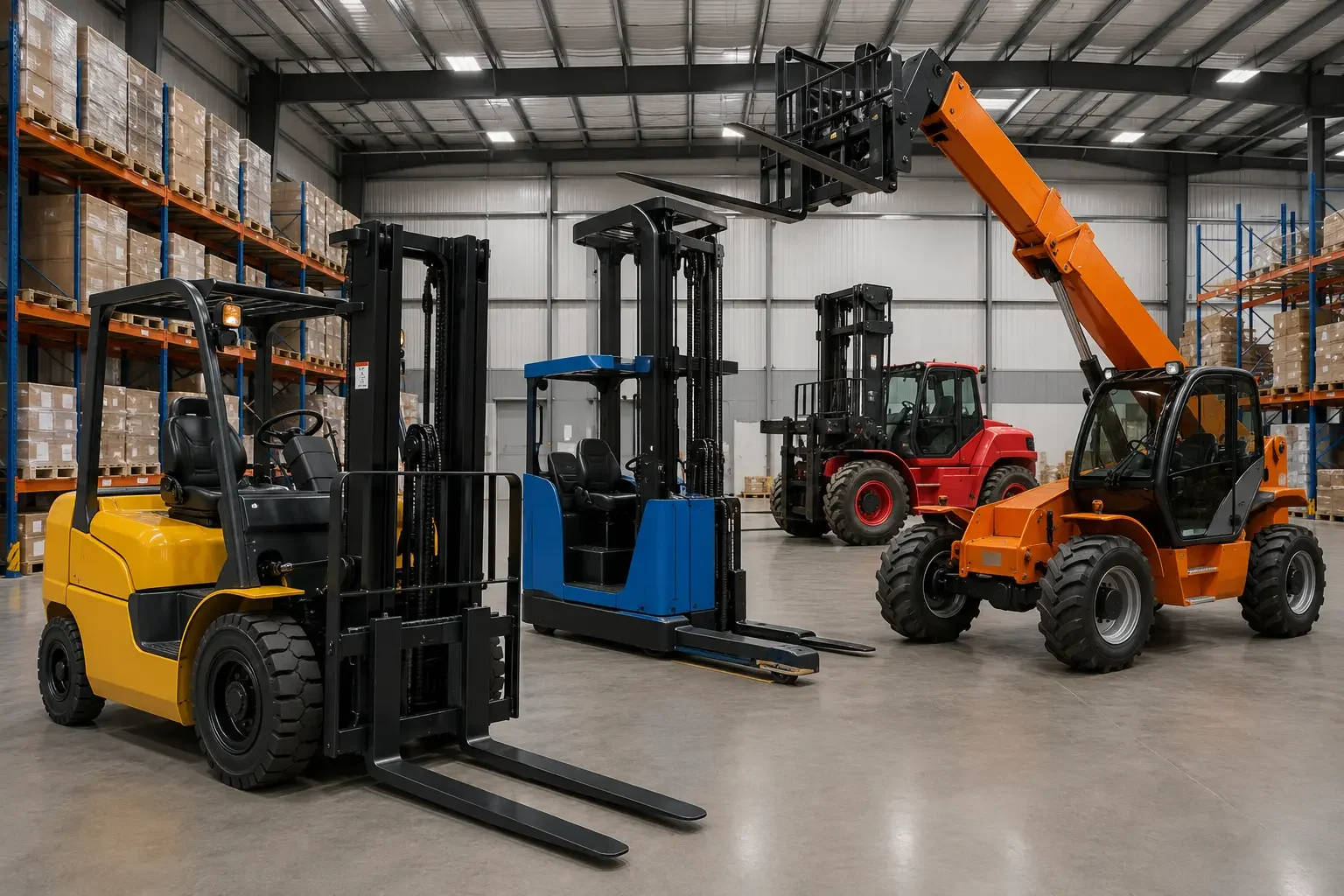
The word “forklift” covers a far broader range of machines than most people realise. In common usage, it typically conjures an image of a yellow counterbalance forklift with a diesel engine, the kind seen on construction sites and in loading yards. In practice, the forklift category encompasses more than a dozen distinct machine types, from compact pedestrian-operated pallet jacks to high-reach electric order pickers that elevate operators to ten metres, from rough terrain forklifts that climb unpaved construction sites to four-way forklifts that handle long loads in narrow aisles.
Each type was designed to solve a specific operational problem, a particular combination of load weight, load type, lift height, aisle width, surface condition, and operating environment. Specifying the wrong type does not merely reduce efficiency. It creates safety hazards, accelerates equipment wear, limits operational capability, and in some cases makes certain tasks physically impossible.
Understanding the full range of forklift types, what each one does, how it is configured, and where it excels, is the foundation of any intelligent equipment selection decision, whether for a new warehouse, a construction site, a port operation, or a manufacturing facility. This guide covers every major forklift type in widespread use, explaining the design rationale, operational capability, and appropriate application for each.
How Forklift Types Are Classified
Forklift types are typically classified by several overlapping criteria:
By operating mechanism: How the forklift lifts and positions loads, conventional counterbalance, extending forks, rotating mast, reach mechanism, or articulating chassis.
By operating environment: Whether the machine is designed for indoor smooth floors, outdoor paved surfaces, rough terrain, narrow aisles, or very narrow aisles.
By power source: Electric battery, diesel, LPG (liquefied petroleum gas), or petrol, each with different emission, noise, maintenance, and runtime implications.
By operator position: Whether the operator rides on the machine (sit-down or stand-on) or walks alongside it (walkie/pedestrian).
Understanding these classification dimensions helps make sense of why so many distinct forklift types exist, they are the result of different combinations of these variables producing different machines optimised for different operating conditions. This same principle, that equipment must be matched to its specific operating conditions, applies equally to selecting the right type of aerial work platform for a given access task and to every other category of industrial equipment.
Also read : Parts of a Forklift and Their Functions Explained
The Main Types of Forklifts
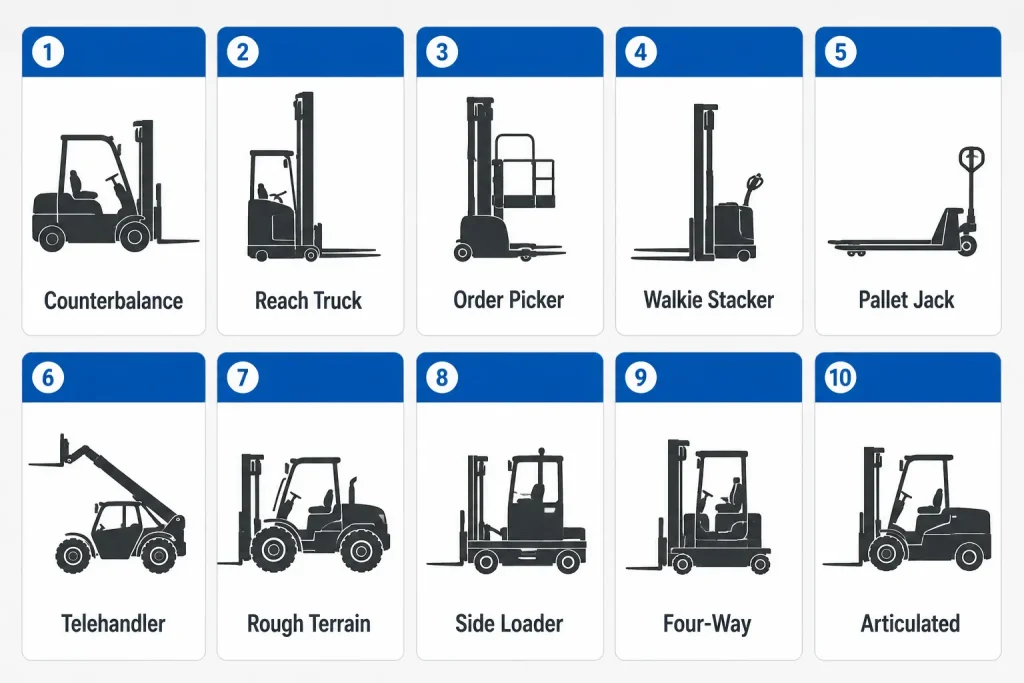
Counterbalance Forklift
The counterbalance forklift is the most widely recognised and most versatile forklift type. It takes its name from the heavy counterweight mounted at the rear of the machine that balances the load carried on the front-mounted forks, preventing the machine from tipping forward under load.
The counterbalance forklift drives directly forward to engage a load, lifts it on the forks, and carries it to the destination. There are no extending mechanisms or special operational sequences, it is the most intuitive forklift to operate. This simplicity and versatility make it the default choice for general material handling across a wide range of industries.
Fuel and power configurations:
- Diesel counterbalance: High torque, suitable for outdoor and heavy industrial use, rapid refuelling, produces exhaust emissions limiting indoor use
- LPG counterbalance: Lower emissions than diesel, cylinder-swapping gives effectively unlimited runtime, suited for mixed indoor-outdoor operations
- Electric counterbalance: Zero direct emissions, quiet, lower running costs, requires charging infrastructure, ideal for food-grade and enclosed environments
Load capacity range: 1,500 kg to 25,000 kg+ depending on size class
Aisle requirement: 3.5 metres or more for standard operation in racking
Best suited for: Loading docks, general warehousing, construction sites, logistics yards, manufacturing, cold storage (electric), heavy industrial (diesel)
Limitations: Requires wide aisles; electric models require charging downtime management; diesel models unsuitable for enclosed spaces without ventilation
Reach Truck
A reach truck is a warehouse-specific forklift designed to operate in narrower aisles than a counterbalance forklift while reaching greater lift heights. The distinguishing feature is the extending fork carriage, the forks slide forward on a pantograph mechanism to reach into the rack, place the pallet, and then retract before the machine moves, eliminating the need to drive the entire machine into the rack face.
Reach trucks operate on electric power only, they are designed exclusively for smooth, level indoor floors. Their stability depends on the floor being level and undamaged, and they should not be operated on gradients, rough surfaces, or outdoors.
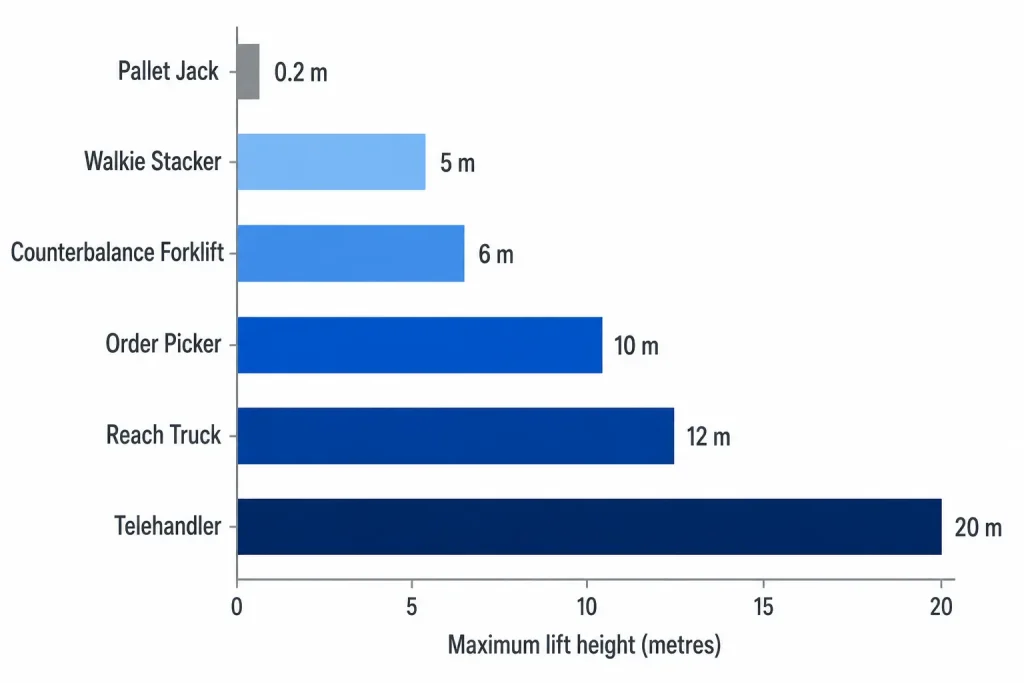
Lift height: Up to 12 metres or more, depending on model
Aisle requirement: 2.5 to 2.7 metres, significantly narrower than counterbalance requirements, enabling denser racking layouts
Best suited for: High-bay warehouses, distribution centres, operations where maximising storage density per square metre is a priority
Limitations: Indoor smooth floors only; higher initial cost than counterbalance forklifts; requires flat, undamaged concrete floor; not suitable for loading dock operations or outdoor use
Order Picker (Stock Picker)
An order picker is a forklift on which the operator is elevated with the forks, both the forks and the operator platform rise to the pick face level. This allows the operator to manually pick individual items, cases, or cartons from racking positions at height, rather than retrieving entire pallets as a reach truck does.
Order pickers are designed for case-level or each-level picking in high-SKU environments, e-commerce fulfilment, pharmaceutical distribution, retail distribution, and any warehouse where individual items are picked from multiple racking levels rather than complete pallets.
Lift height: Up to 10 metres, depending on model
Operator position: Stand-on elevated platform, operator wears a harness attached to the platform
Best suited for: High-SKU picking operations, e-commerce fulfilment, pharmaceutical and retail distribution warehouses
Limitations: Not designed for transporting full pallet loads; operator must wear fall arrest harness at height; requires smooth, level floors; training requirements more complex due to elevated operator position
Walkie Stacker (Pedestrian Stacker)
A walkie stacker is a pedestrian-operated electric machine that combines the ground-level transport capability of a pallet jack with the ability to stack loads to moderate heights. The operator walks behind the machine rather than riding on it, controlling it via a tiller arm. The forks can be raised to place pallets in racking up to approximately 4 to 5 metres, making walkie stackers suitable for small warehouses, cool rooms, and confined spaces where a counterbalance forklift would be too large.
Types of walkie stacker:
- Straddle stacker: Stability legs straddle the pallet, allowing use on standard single-entry pallets
- Counterbalanced stacker: A compact counterweight replaces stability legs, allowing use with closed-base pallets and in tighter spaces
Load capacity: Typically 1,000 to 2,000 kg
Lift height: Typically up to 4 to 5 metres
Best suited for: Small warehouses, cool rooms, retail stockrooms, confined spaces, infrequent stacking requirements where a counterbalance forklift cannot be justified
Limitations: Operator fatigue over long shifts due to walking; lower capacity and lift height than ride-on forklifts; not suitable for high-throughput operations
Pallet Jack (Pallet Truck)
The pallet jack is the simplest and most widely used material handling machine in any warehouse or logistics environment. A manual pallet jack uses a hydraulic pump handle to raise the forks just enough to clear the floor, allowing a loaded pallet to be pushed or pulled to its destination by the operator. An electric pallet jack uses a battery-powered motor for propulsion, reducing physical effort over longer distances and for heavier loads.
Pallet jacks do not stack, they move loads only at ground level. For vertical stacking, a walkie stacker, counterbalance forklift, or reach truck is required. Understanding the precise operational boundary between pallet jacks and forklifts, including when each is appropriate and when one is clearly insufficient, is covered in detail in practical comparisons of forklift and pallet jack capabilities for different material handling tasks.
Load capacity: Up to 2,000 to 3,000 kg for electric models
Best suited for: Short-distance horizontal transport of palletised loads, receiving and despatch areas, retail backrooms, supplementary transport within a warehouse
Limitations: Ground level only, no stacking capability; manual models require significant physical effort for heavy loads; not suitable as a primary material handling solution for any operation requiring vertical storage
Also read : Warehouse Equipment List: Every Machine Your Operation Needs
Telehandler (Telescopic Handler)
A telehandler, also called a telescopic handler or reach forklift, combines the lifting capability of a forklift with the extended reach of a telescoping boom. The boom extends forward and upward, allowing the telehandler to place loads at heights and distances beyond the capability of a conventional counterbalance forklift, including above obstacles, through window openings, onto scaffold platforms, and into the upper floors of low-rise structures.
Telehandlers are highly versatile through their attachment capability, in addition to forks, they can accept a rotating headstock, a winch, a personnel work platform, a bucket, and a range of other attachments, making a single machine capable of performing multiple functions on a construction or agricultural site.
Lift height: 6 to 20 metres, depending on model
Load capacity at maximum height: Significantly reduced compared to ground-level capacity, always consult the load chart
Best suited for: Construction sites, agricultural operations, events and infrastructure projects, any operation requiring elevated load placement beyond the capability of a standard forklift
Limitations: Larger footprint than a standard forklift; load capacity reduces significantly as the boom extends and elevates; not suitable for high-throughput indoor warehouse operations; requires outdoor or large indoor spaces for operation
Rough Terrain Forklift
A rough terrain forklift is a counterbalance forklift specifically designed for outdoor operation on unpaved, uneven, or soft ground. It features large pneumatic tyres with deep tread, higher ground clearance, and a more robust chassis than a standard counterbalance forklift. Most rough terrain forklifts are powered by diesel engines, and many feature four-wheel drive for operation on steep or soft ground.
Rough terrain forklifts are the standard material handling machine on construction sites, in quarrying and mining operations, in timber yards, and in any environment where the ground surface cannot be relied upon to be smooth and level.
Load capacity: Typically 2,000 to 10,000 kg
Best suited for: Construction sites, quarries, timber yards, outdoor storage areas with unpaved surfaces, agricultural operations
Limitations: Not suitable for indoor use on polished or sensitive floors due to tyre type; higher fuel consumption than electric alternatives; larger turning radius than indoor forklifts
Side Loader Forklift
A side loader, also called a sideloader or lateral stacker, carries its load on a platform that extends to the side of the machine rather than the front, allowing it to travel with long loads in aisles without the load protruding ahead of or behind the machine. The operator typically stands or sits sideways relative to the direction of travel.
Side loaders are specifically designed for handling long, unwieldy loads, steel bar, timber, pipes, aluminium extrusions, rolled carpet, and similar materials, that cannot be handled on conventional forks without the load extending dangerously beyond the machine’s footprint.
Best suited for: Steel service centres, timber merchants, pipe and cable distributors, any operation handling long loads regularly
Limitations: More complex to operate than a counterbalance forklift; requires smooth floors for electric models; not suitable for general palletised goods handling
Four-Way Forklift
A four-way forklift can travel in four directions, forward, backward, and sideways in both directions, by switching between conventional forward travel and lateral travel modes. This capability allows it to handle long loads in very narrow aisles: it approaches the rack in conventional forward mode, then switches to lateral mode to slide the long load into the rack without requiring a wide turning area.
Four-way forklifts are used in very narrow aisle environments where long loads must be stored in racking, combining the aisle-width advantage of a narrow aisle truck with the long-load capability of a side loader in a single machine.
Best suited for: Operations handling both standard palletised goods and long loads in the same facility, very narrow aisle warehouses, steel and timber distributors with racking systems
Articulated Forklift
An articulated forklift, sometimes called a Flexi or narrow aisle forklift, has a chassis that articulates (bends) in the middle, allowing the operator to position the forks into a rack bay while keeping the rear of the machine in the aisle. This eliminates the need to drive forward into the rack face as a counterbalance forklift does, and avoids the mechanical complexity of a reach truck’s extending carriage.
Articulated forklifts typically achieve aisle widths of 1.6 to 2.0 metres, narrower than a reach truck, while maintaining the ability to handle standard UK or European pallets in both single and double-deep configurations.
Best suited for: Very narrow aisle warehouses, operations converting from wide-aisle to narrow-aisle racking, facilities where floor space is at a premium
Choosing the Right Forklift Type for Your Operation
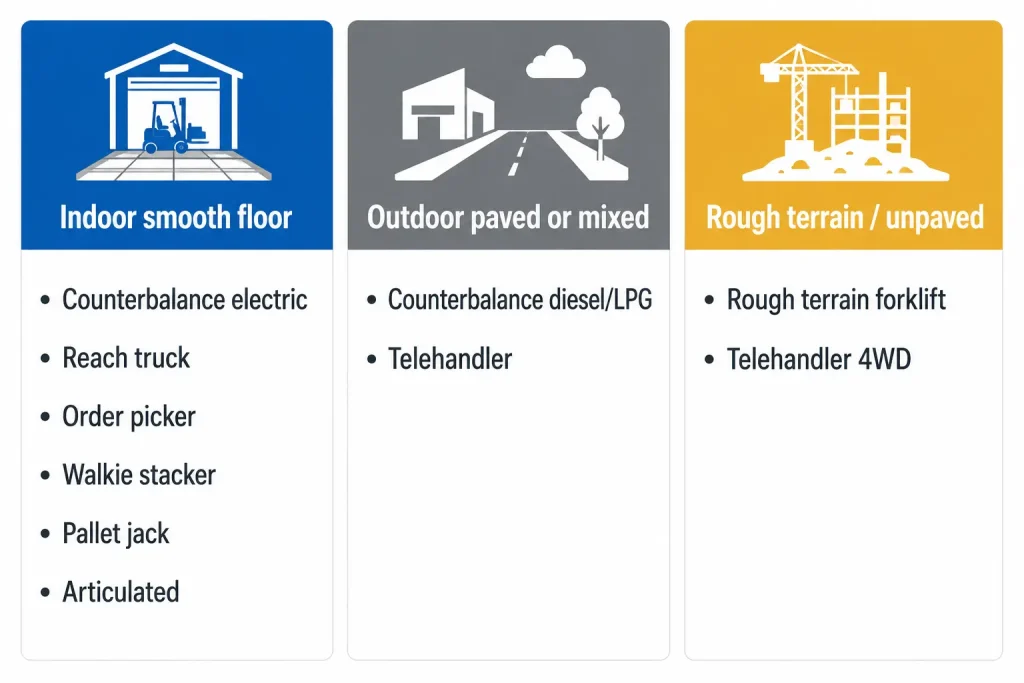
With so many forklift types available, a systematic approach to selection prevents costly misspecification. The key questions to work through are:
What is the operating environment? Indoor smooth floor, outdoor paved, rough terrain, or very narrow aisle? This eliminates the majority of inappropriate options immediately.
What is the lift height required? Ground-level pallet transport requires a pallet jack. Stacking to 4 metres requires a walkie stacker or counterbalance. High-bay racking above 6 metres requires a reach truck. Placing loads on elevated structures requires a telehandler.
What is the load type? Standard palletised goods, long loads, individual items, or irregularly shaped materials? Each load type points toward specific forklift configurations.
What is the throughput? Low-frequency infrequent tasks may justify a simpler, lower-cost machine. High-throughput continuous operation requires machines optimised for the specific task and operator comfort over a full shift.
What is the fuel source requirement? Indoor food-grade or pharmaceutical environments require electric. Mixed indoor-outdoor with multi-shift requirements may favour LPG. Heavy outdoor use favours diesel.
Working through these questions systematically produces a specification that matches the actual operational demands. A practical step-by-step guide on how to work through the complete forklift selection process covers each of these factors in detail, with specific guidance on mast configuration, tyre type, and the buy-versus-rent decision.
For technical reference on forklift classifications, international safety standards, and the engineering principles underlying different forklift configurations, resources on industrial truck and forklift classification standards provide comprehensive background on how forklift types are defined and regulated across different jurisdictions.
Also read : Construction Equipment Names: A Complete Reference Guide
Find the Right Forklift for Your Operation
Understanding the full range of forklift types, from the versatile counterbalance and the high-reaching reach truck to the terrain-ready rough terrain forklift and the precision-handling order picker, gives operations managers, procurement teams, and site supervisors the knowledge to specify the right machine the first time.
The right forklift type, correctly specified and properly maintained, is a reliable and productive asset. The wrong type, however well maintained, creates ongoing operational friction, safety risk, and underperformance that accumulates across every shift.
RR Machinery offers a comprehensive range of forklifts for sale and rental, including diesel, electric, and LPG counterbalance models in a wide range of lifting capacities, all professionally maintained and supported by factory-certified technicians providing in-house and on-site service. Explore our full range of forklift solutions for sale and rental or contact our team for practical advice and a clear quotation matched to your specific operational requirements.

Thanks for the helpful breakdown of the different forklift types! The comparisons made it easy to understand which models fit specific needs from warehouse work to tough outdoor jobs. Great resource for anyone deciding what kind of forklift best suits their operation.
Excellent overview! The breakdown of counterbalance forklifts, reach trucks, rough-terrain forklifts, and other configurations highlights how important it is to match equipment to the job. The right forklift helps reduce downtime, improve safety, and maximize warehouse performance.