Walking onto an active construction site for the first time, or reviewing a project equipment schedule without a machinery background, can be disorienting. Dozens of machines operate simultaneously, each with a specific name, a specific function, and a specific reason for being there at that particular phase of the project. Getting the names wrong is more than a communication issue: it leads to incorrect equipment specifications, missed procurement deadlines, and costly substitutions when the wrong machine arrives on site.
This guide covers the essential construction equipment names used across building, civil engineering, earthworks, material handling, and elevated access operations. For each machine, we explain what it is, what it does, and the context in which it is typically deployed, giving project planners, site supervisors, procurement teams, and anyone new to the industry a reliable reference for the machines they will encounter most frequently in Singapore and across the region.
Earthmoving Equipment
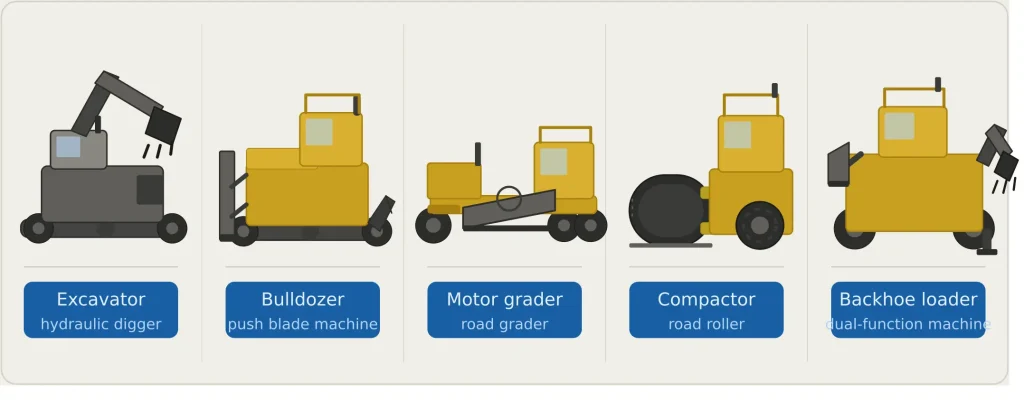
Earthmoving machines are among the most visible on any construction or civil engineering project. They move, shape, compact, and excavate the ground that everything else is built on.
Excavator
The excavator, sometimes called a digger, backhoe excavator, or hydraulic excavator, is the workhorse of any earthmoving operation. It consists of a rotating upper structure (the house) mounted on a tracked or wheeled undercarriage, with a boom, arm, and bucket attached to the front. The operator sits in the cab and controls all movements hydraulically.
Excavators are used for digging foundations, trenching for utilities, demolition, land clearing, and material loading. The type of bucket attached determines the specific task, from standard digging and trenching to grading, screening, and dredging. Understanding the range of excavator bucket types and their applications is essential for matching the machine to the task correctly.
Excavators are available in a wide range of sizes, from compact 1-tonne mini excavators for confined spaces to 100-tonne mining excavators for large-scale earthworks.
Bulldozer
A bulldozer is a large, tracked machine fitted with a wide steel blade at the front. The blade pushes large quantities of soil, sand, rubble, or other material across a surface. Bulldozers are used for land clearing, rough grading, pushing material into stockpiles, and backfilling large excavations.
Unlike an excavator, a bulldozer does not scoop material, it pushes it. Some models are fitted with a rear-mounted ripper attachment for breaking up compacted ground or soft rock before dozing.
Motor Grader
A motor grader, commonly called a grader or road grader, is a long machine with a large adjustable blade positioned between its front and rear axles. The blade can be angled and tilted to precise positions, allowing the grader to create flat, smooth, accurately profiled surfaces. Motor graders are essential for road construction, airstrip preparation, and any earthwork requiring a precise finished surface level.
Compactor (Road Roller)
A compactor, also called a road roller or vibratory roller, uses weight and vibration to compress soil, asphalt, gravel, or other fill materials. Compaction increases the density and load-bearing capacity of the ground, making it essential before laying foundations, road bases, or floor slabs. Compactors come in several configurations: smooth drum rollers for asphalt, padfoot rollers for cohesive soil, and pneumatic tyred rollers for granular material.
Skid Steer Loader
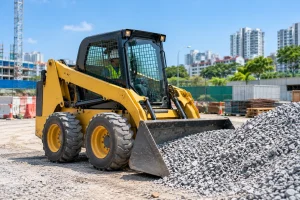
A skid steer loader is a compact, four-wheeled machine with lift arms that can accept a wide range of attachments, buckets, augers, pallet forks, trenching heads, and more. It steers by varying the speed of wheels on each side rather than by turning the wheels themselves, giving it a very tight turning radius. Skid steers are valued for working in confined spaces where larger machines cannot operate.
Backhoe Loader
A backhoe loader, often simply called a backhoe, combines two functions in one machine: a front-mounted loader bucket for material handling and loading, and a rear-mounted excavating arm for digging. It is one of the most versatile machines on smaller construction projects and is commonly used for utility installation, drainage work, and site preparation where both digging and material movement are required.
Also read : Types of Excavator Buckets and Their Uses Explained
Lifting and Crane Equipment
Lifting equipment raises materials, structural elements, and prefabricated components to height. These are among the most carefully regulated machines on any construction site.
Tower Crane
A tower crane is a fixed, tall crane permanently anchored to the ground (and often tied to the building structure as it rises) during the construction of high-rise buildings. It consists of a vertical mast, a horizontal jib from which loads are suspended, and a counter-jib on the opposite side carrying the counterweight. Tower cranes are the defining visual element of any major building project.
Mobile Crane
A mobile crane is a self-propelled crane mounted on a wheeled or tracked carrier, allowing it to travel between work locations on or off the site. Mobile cranes are used for lifting structural steel, precast concrete elements, heavy plant and equipment, and other loads that tower cranes cannot reach or that require the crane to move. They are deployed across construction, oil and gas, infrastructure, and industrial projects.
Crawler Crane
A crawler crane is a large crane mounted on tracked undercarriage, giving it exceptional stability and the ability to lift very heavy loads without the need for outriggers. Crawler cranes are used on the largest lifting operations, bridge construction, industrial plant installation, and offshore support work. For a comprehensive overview of how different crane types are matched to specific applications, detailed guides on types of cranes and their uses in modern projects cover the full range from tower to crawler to telescopic configurations.
Telescopic Crane (All-Terrain Crane)
A telescopic crane, also called an all-terrain crane or mobile telescopic crane, uses a boom that extends in sections like a telescope to achieve its working radius. All-terrain models combine the road mobility of a truck crane with the off-road capability of a crawler, making them the most versatile mobile crane type for mixed site conditions.
Overhead Crane (Gantry Crane)
An overhead crane, also called a gantry crane or bridge crane, runs along elevated rails mounted on the walls or columns of a building, allowing it to lift and move loads across the full floor area beneath it. Overhead cranes are permanent fixtures in factories, warehouses, steel fabrication plants, and heavy manufacturing facilities.
Aerial Work Platforms and Access Equipment
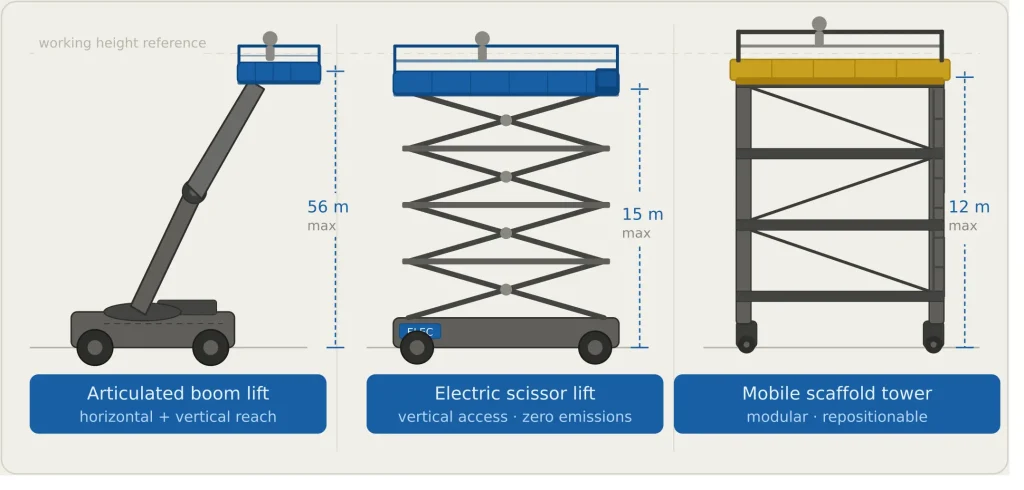
Aerial work platforms (AWPs) provide workers with elevated access to carry out tasks at height that cannot be safely reached from the ground.
Boom Lift
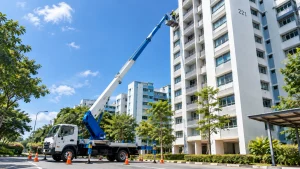
A boom lift is a type of mobile elevated work platform (MEWP) that uses an extendable or articulating boom arm to elevate a work platform to height. Unlike a scissor lift, a boom lift can reach outward horizontally as well as vertically, allowing access to areas that are not directly above the machine. Boom lifts are used in construction, maintenance, industrial, and infrastructure applications.
Two main types are commonly used: telescopic boom lifts for maximum reach in open environments, and articulated boom lifts (also called knuckle booms or cherry pickers) for navigating around obstacles on complex job sites. Both types are available for sale and rental and are among the most frequently specified access machines on Singapore construction sites.
Scissor Lift
A scissor lift is a type of aerial work platform that raises its platform vertically using a linked, folding cross-brace mechanism. Unlike boom lifts, scissor lifts move only straight up and down, making them best suited for work directly above the machine on flat, stable surfaces. Electric scissor lifts are widely used indoors, in warehouses, factories, retail fit-outs, and facilities maintenance, due to their zero emissions and non-marking tyres.
Scissor lifts reach platform heights of up to approximately 15 metres, and their platforms are large enough to accommodate multiple workers with tools and materials simultaneously. For projects involving both wide-area access and precision elevated work, understanding the differences between scissor lifts, boom lifts, and other construction lift types helps teams specify the right equipment for each phase.
Personnel Hoist (Construction Elevator)
A personnel hoist, also called a construction hoist, builder’s hoist, or construction elevator, is a temporary vertical transportation system installed on the exterior of a building under construction. It carries workers, tools, and materials between floors during the construction phase, before the building’s permanent lifts are installed and commissioned.
Mobile Scaffolding (Scaffold Tower)
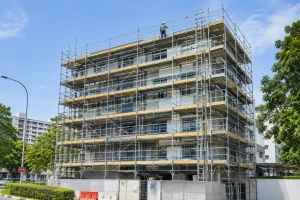
Mobile scaffolding, also called a scaffold tower or rolling scaffold, is a self-contained elevated working platform assembled from modular frames and mounted on lockable castor wheels. It provides a stable working surface at heights from 2 to 12 metres for maintenance, painting, electrical installation, and other tasks where a powered platform is unnecessary or cannot access the area.
Mobile scaffolding is widely used across Singapore in both construction and facilities management contexts, and is available for rental in flexible daily, weekly, and monthly terms for both short-duration and extended project requirements.
Material Handling Equipment
Material handling machines move, lift, and position goods, components, and raw materials across the site or within a facility.
Forklift
A forklift, also called a fork truck or lift truck, is a powered industrial vehicle with front-mounted forks that raise and lower to lift, transport, and stack palletised loads. Forklifts are available in diesel, LPG, gasoline, and electric configurations, and in a wide range of lifting capacities from under 1,000 kg to over 5,000 kg.
Forklifts are the primary material handling machine in warehouses, logistics centres, manufacturing facilities, and construction sites receiving palletised deliveries. Operators must hold a valid Forklift Operator Licence issued by Singapore’s Ministry of Manpower (MOM) to legally operate a forklift on any worksite.
Telehandler (Telescopic Handler)
A telehandler, also called a telescopic handler or reach forklift, combines the lifting capability of a forklift with the extended reach of a telescoping boom. It can lift loads to heights and distances that a standard forklift cannot reach, making it invaluable on construction sites for placing materials on scaffolding, into elevated formwork, or onto the upper floors of low-rise structures. Telehandlers can also accept a wide range of attachments including buckets, winches, and personnel baskets.
Pallet Jack (Pallet Truck)
A pallet jack, also called a pallet truck or pump truck, is a simple device for moving palletised loads short distances on flat, hard surfaces. Manual pallet jacks are hand-operated using a hydraulic pump handle. Electric pallet jacks use a battery-powered motor for propulsion. Neither type stacks loads vertically, for height, a forklift or reach truck is required. Understanding the distinction between these two types of material handling equipment is covered in detail in practical guides comparing forklift and pallet jack capabilities and use cases.
Concrete Mixer Truck
A concrete mixer truck, also called a ready-mix truck or transit mixer, transports freshly batched concrete from a batching plant to the construction site. The rotating drum keeps the concrete agitated during transit to prevent it from setting before it is poured. On site, the drum is reversed to discharge the concrete into a pump, a skip, or directly into the formwork.
Concrete Pump
A concrete pump transfers liquid concrete from the mixer truck to the exact location where it will be poured, often at height or in areas the truck cannot access. Boom pumps are mounted on a truck with an articulating arm that can reach high floors of a building under construction. Line pumps use a series of pipes and hoses to pump concrete horizontally or vertically across a site.
Also read : How Does a Generator Work? Principles, Components, and Types Explained
Compaction and Paving Equipment
Plate Compactor
A plate compactor, also called a vibrating plate or wacker plate, is a small, portable compaction machine used to compact granular soil, gravel, and asphalt in confined areas where a road roller cannot operate. It is commonly used in trench backfilling, pavement repair, and small-scale site preparation.
Asphalt Paver
An asphalt paver, also called a paving machine or screed machine, lays and partially compacts hot asphalt mix to a specified width, thickness, and profile as it moves forward. It works in conjunction with a road roller that follows behind to achieve full compaction of the laid surface.
Power and Temporary Works Equipment
Generator
A power generator converts mechanical energy from an internal combustion engine into electrical energy. Generators are the primary power source on construction sites not yet connected to the utility grid, and provide backup power for facilities where power continuity is critical. They range from compact 30 kVA portable units to heavy-duty industrial units exceeding 1,000 kVA.
Two important classifications govern generator selection: standby generators for backup-only use (rated for limited annual operating hours), and prime power generators for continuous site use with no grid connection. Selecting the wrong rating for the application is one of the most common and costly mistakes in construction power planning, and the distinction between these two types is explained in detail in practical guides covering standby and prime power generator ratings and applications.
Air Compressor
An air compressor pressurises air for powering pneumatic tools, jackhammers, nail guns, spray equipment, and sandblasters, as well as for tyre inflation, cleaning, and pneumatic concrete vibration. Portable diesel-powered air compressors are standard on construction sites, while electric compressors are used in workshops and enclosed facilities.
Dewatering Pump
A dewatering pump removes groundwater, rainwater, or surface water from excavations, trenches, basements, and other below-grade work areas to keep them dry and safe for construction activities. Submersible pumps, centrifugal pumps, and wellpoint systems are the main types used depending on the volume of water and the depth of the excavation.
Equipment Naming Conventions and Communication on Site
Understanding equipment names is not just about vocabulary, it directly affects procurement accuracy, safety communication, and project scheduling. When a project manager specifies a “boom lift” without clarifying articulated or telescopic, the wrong machine may arrive. When a site supervisor calls for a “roller” without specifying smooth drum, padfoot, or pneumatic, the compaction result may not meet specification.
In Singapore’s construction industry, equipment names are used in a mix of formal technical language (from manufacturer specifications and MOM regulations) and informal site terminology. “Cherry picker” is widely understood as an articulated boom lift. “Wacker plate” is universally understood as a plate compactor. Knowing both the formal name and the common site term is practically useful for communicating across different levels of a project team.
For technical reference on the broader classification of construction machinery and international naming standards, resources on construction equipment categories and engineering machinery provide useful background on how equipment is categorised across different industries and regulatory frameworks globally.
Also read : What Is Scaffolding in Construction? Types, Uses, and Key Components
Get the Right Construction Equipment for Your Project
Knowing the names of construction equipment is the foundation of effective project planning, procurement, and site management. Each machine on this list exists because it solves a specific problem, moving earth, lifting loads, providing access, generating power, or handling materials, more efficiently and safely than any alternative in its intended context.
Matching the right equipment to each phase of a project requires more than knowing the names. It requires understanding rated capacities, operating environments, operator requirements, and the practical differences between similar machines that serve overlapping but distinct purposes.
RR Machinery offers a comprehensive range of construction and industrial equipment for sale and rental across Singapore, including aerial work platforms, forklifts, mobile scaffolding, and power generators, all maintained to operational standard and supported by experienced technicians. Explore our full range of heavy machinery solutions for construction and industrial projects, or contact our team for practical advice and a clear quotation tailored to your project requirements.