
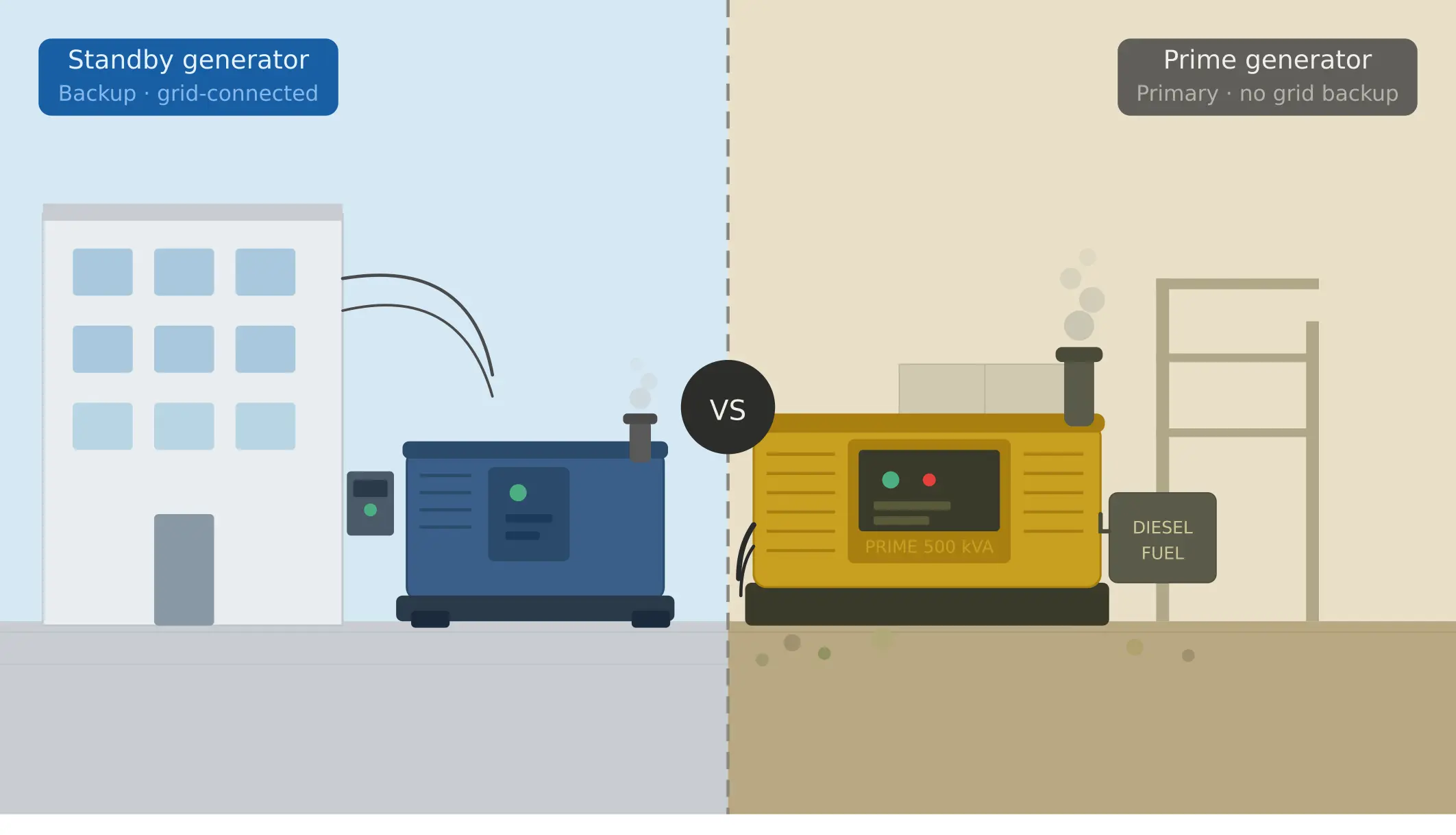
When businesses, contractors, and facility managers begin evaluating power generators, one of the first, and most consequential, decisions they face is the distinction between a standby generator and a prime power generator. On the surface, two generators of the same physical size and engine displacement can look nearly identical. Yet specifying the wrong rating for your application can lead to premature equipment failure, voided warranties, unsafe operating conditions, and significant unplanned costs.
The standby vs prime generator distinction is not a marketing category. It is an engineering classification that reflects fundamental differences in how a generator is designed, how its components are rated, how it is tested, and how long it can safely operate under load. Understanding this distinction clearly, before you commit to a purchase or a long-term rental agreement, is one of the most important steps in generator selection for any construction, industrial, commercial, or emergency power application.
This guide explains the full standby vs prime generator comparison: what the ratings mean, how they are determined, what applications each is suited for, and how to make the right choice for your specific operational requirements.
What Is a Standby Generator?
A standby generator, sometimes called an emergency standby generator or ESG, is designed to operate as a backup power source when the primary utility grid supply fails. Its entire design philosophy is built around the assumption that it will spend most of its life idle, starting only when the grid goes down and running until grid power is restored.
Because standby generators are engineered for infrequent, short-duration use, manufacturers allow their engines and alternators to be rated at a higher output relative to their physical size than an equivalent prime power unit. A standby generator runs at maximum capacity only during emergencies, the operating hours per year are low, thermal stress cycles are limited, and the equipment gets extended rest periods between uses.
International standards such as ISO 8528 and BS 7698 define standby power ratings precisely. Under these standards, a standby rating assumes the generator will run at 100% of its rated load for no more than 200 hours per year, with no planned maintenance interval at that load, because the assumption is that the generator will be serviced during the much longer idle periods between power outages.
Typical standby generator applications include:
- Commercial buildings and office towers as grid backup
- Hospitals and healthcare facilities for critical power continuity
- Data centres and server rooms
- Retail operations and cold storage facilities
- Residential estates and condominiums with backup power requirements
- Telecommunications infrastructure
In all of these applications, the generator is connected to the facility’s electrical system via an automatic transfer switch (ATS) or automatic mains failure (AMF) panel. The moment grid power fails, the ATS detects the loss, signals the generator to start, and transfers the load to the generator within seconds, without any manual intervention.
Also read : How Does a Generator Work? Principles, Components, and Types Explained
What Is a Prime Power Generator?
A prime power generator, also referred to as a continuous duty generator in some contexts, is designed to serve as the primary and often sole source of electrical power for an operation. It is built with the expectation that it will run continuously, at varying loads, for extended periods with no utility backup available.
The prime power rating reflects this sustained duty cycle. Under ISO 8528, a prime power rating assumes the generator will operate for an unlimited number of hours per year, with a variable load that averages no more than 70% of the rated output over any 24-hour period, and with planned maintenance intervals strictly adhered to. The 70% average load factor is critical, it provides thermal headroom for the engine and alternator to manage heat build-up during continuous operation without degrading components prematurely.
Because prime generators must sustain this continuous duty, their engines are typically derated relative to the same engine used in a standby configuration. This means a prime-rated generator of a given engine size will have a lower kVA output than a standby-rated generator using the same engine, not because it is less capable, but because it is conservatively rated to ensure long-term reliability under the conditions it will actually face.
Typical prime power generator applications include:
- Construction sites with no grid connection
- Remote industrial facilities, mining, oil and gas, offshore platforms
- Temporary power for major infrastructure projects
- Agricultural operations in areas without grid access
- Events and outdoor festivals with multi-day power requirements
- Developing market operations where grid power is unreliable or unavailable
For construction and infrastructure projects across Singapore and the region, prime power generators are the standard solution for sites that are not yet connected to the utility grid. The generator becomes the site’s power station for the duration of the project, sometimes months or years, making the prime power rating not just relevant but essential.
Standby vs Prime Generator: The Core Technical Differences
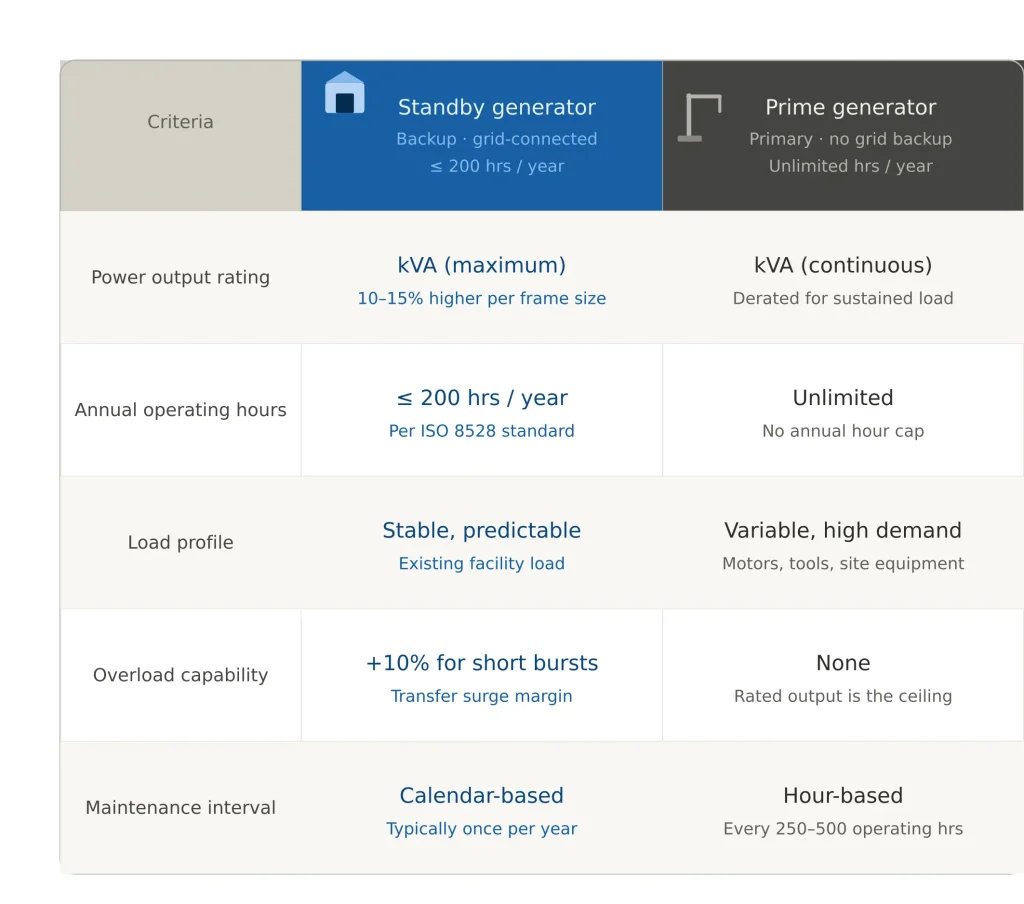
Understanding the specific technical differences between these two ratings helps explain why using the wrong type leads to equipment problems.
Power Output Rating
The most visible difference is in the rated power output. For a given engine and alternator combination, the standby rating will always be higher than the prime rating, typically by 10% to 15%. For example, a generator set that is rated at 500 kVA standby may be rated at 450 kVA prime using the same core components.
This difference exists because the standby rating assumes short-duration use at peak load, while the prime rating must be sustainable continuously over thousands of operating hours. Running a standby-rated generator at its full rated output continuously, as a prime power source, pushes its engine and alternator beyond the thermal limits they were designed for at that output level. The result is accelerated wear, overheating, and premature failure.
Annual Operating Hours
Standby ratings assume a maximum of approximately 200 hours of operation per year. Some manufacturers specify even lower annual hour limits, 100 to 150 hours, for standby-rated units, depending on engine configuration.
Prime power generators carry no annual hour limit. They are designed to run continuously, with the only limitation being the scheduled maintenance intervals specified by the manufacturer, typically every 250, 500, or 1,000 operating hours depending on the service item.
This difference has direct implications for total cost of ownership. A standby generator running 2,000 hours per year on a construction site is operating at ten times its designed duty cycle. Component fatigue, oil degradation, thermal cycling damage, and fuel system wear will accumulate far faster than the maintenance schedule anticipates, often resulting in a major overhaul or complete engine failure well before the expected service life.
Load Profile Assumptions
Standby generators are designed around the assumption of a relatively stable load, essentially whatever the facility was already drawing from the grid at the moment of the outage. They do not need to accommodate highly variable load cycles or frequent motor starting surges in the way a construction site generator does.
Prime power generators are designed explicitly for variable load profiles. Construction sites, in particular, present constantly changing electrical demands as different equipment, welders, compressors, hoists, lifts, lighting systems, cycles on and off throughout the working day. Prime generators are engineered to handle these fluctuations without voltage or frequency instability.
Overload Capability
Many standby generators include a 10% overload capability for short durations, a safety margin for the brief surge demand that occurs at the moment of transfer from grid to generator. Prime generators typically do not offer this overload margin, because they are already sized conservatively to sustain continuous operation at their rated output. The prime rating is the ceiling, not a nominal figure with headroom above it.
Maintenance Intervals
Because standby generators accumulate far fewer operating hours in normal use, their service intervals are often expressed in calendar time (e.g., annually) rather than operating hours. This is appropriate given their limited runtime, but it also means that when a standby generator is misused in a continuous-duty role, it rapidly outpaces its maintenance schedule, typically receiving the same annual service while accumulating what should be five or ten years’ worth of operating hours.
Prime generators are serviced on strict operating-hour schedules. This more rigorous maintenance cadence is essential for sustaining reliability over high annual hour accumulation, and it must be factored into the total cost of operating a prime generator on a long-duration project.
Also read : What Is Scaffolding in Construction? Types, Uses, and Key Components
Continuous Power Rating: A Third Classification
Beyond standby and prime, some generator specifications include a third rating: continuous power (also called COP, continuous operating power). This rating is even more conservative than the prime power rating and is used for applications where the generator must run at a constant, fixed load for an unlimited duration with no variability.
Continuous ratings are most relevant for grid-parallel or baseload power generation applications, industrial facilities running a fixed process load around the clock. For most construction, commercial, and industrial standby applications in Singapore, the distinction between prime and continuous is less important than the standby vs prime distinction, but it is worth understanding when evaluating generator specifications.
The Real-World Cost of Getting This Wrong
The consequences of mismatching generator rating to application are well documented in the industry and are a frequent cause of costly equipment problems on construction and industrial projects.
Overloading a standby unit in prime duty is the most common mistake. It typically manifests as:
- Elevated exhaust temperatures and visible black smoke under sustained load
- Increased oil consumption and fouling
- Shortened service intervals and more frequent filter replacements
- Coolant temperature warnings and potential overheating shutdowns
- Alternator winding degradation from sustained thermal overload
- Ultimately, catastrophic engine or alternator failure before the end of the expected service life
Oversizing a prime unit for a simple standby application is a less dangerous but still costly mistake. Diesel generators running consistently below 30% of their rated load are prone to wet stacking, a condition where unburnt fuel residue accumulates in the exhaust system due to incomplete combustion at low loads. Wet stacking increases fuel consumption, generates excessive smoke, and can cause engine damage if left unaddressed.
Both errors are avoidable with proper generator selection, which begins with an accurate understanding of the application, the expected operating hours per year, and the load profile the generator will face. This principle applies broadly across all categories of heavy equipment: matching rated capacity to real operational demand is as critical for generators as it is when selecting boom lifts, forklifts, or scissor lifts for a construction project.
How to Choose Between Standby and Prime
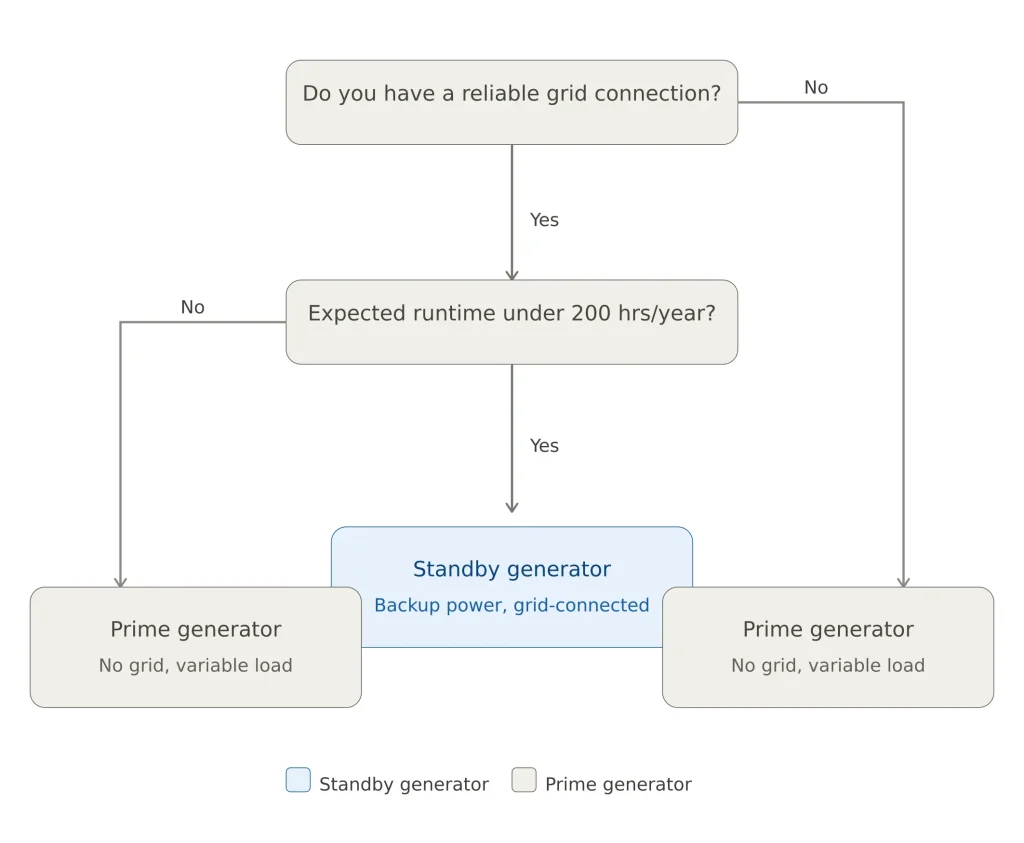
A clear decision framework helps simplify the standby vs prime generator choice for most applications.
Choose a standby generator when:
- Your facility has a reliable utility grid connection and needs backup power only during outages
- The generator is expected to run fewer than 200 hours per year
- The load is relatively stable and predictable (building services, HVAC, lighting, IT infrastructure)
- An automatic transfer switch will manage the transition between grid and generator automatically
- The generator will be installed in a permanent location and serviced on a calendar schedule
Choose a prime power generator when:
- There is no grid connection at the site, the generator is the primary and only power source
- The generator will run more than 500 hours per year
- The load is variable, motors, compressors, welding equipment, construction machinery
- The project duration extends beyond a few weeks
- The generator will be operated continuously through working shifts
- The application is a construction site, remote facility, mining operation, or outdoor event
If your operation falls into a grey area, for example, a facility with an unreliable grid that experiences frequent and extended outages, the prime power rating is almost always the safer choice. The cost difference between a standby-rated and a prime-rated unit of similar output is modest compared to the cost of an engine rebuild caused by sustained overloading.
For a deeper understanding of how different types of power equipment are selected and sized for construction and industrial operations, insights from heavy equipment planning and site power management provide useful context on matching equipment ratings to project demands.
Fuel Efficiency and Running Costs: Standby vs Prime
Running costs over the life of a generator project are often underestimated. The two most significant ongoing costs are fuel and maintenance.
Fuel consumption is closely related to load. Both standby and prime generators consume fuel proportional to the load they carry, a generator running at 50% load consumes roughly 50–60% of the fuel it would use at full load, depending on engine design. Prime generators are typically designed with fuel efficiency at partial load as a key performance parameter, since they spend so much of their life at variable loads below the maximum.
Maintenance costs for prime generators are higher on an annual basis than for standby units, not because prime units are less reliable, but because they accumulate far more operating hours and therefore reach service intervals more frequently. Budget planning for prime generator projects should account for oil changes every 250–500 hours, filter replacements, coolant service, injector cleaning, and periodic load bank testing.
For long-duration construction projects, generator rental with a full-service maintenance agreement is often more cost-effective than outright purchase, it eliminates capital outlay, includes scheduled servicing, and typically covers breakdown response. Working with an experienced equipment provider ensures that the generator delivered to your site is correctly rated, properly serviced, and supported throughout the project duration.
Key Questions to Ask Before Specifying a Generator
Whether you are purchasing or renting, these questions help ensure the right generator rating is selected:
- How many hours per year will the generator operate?
- Is there a utility grid connection, or is the generator the sole power source?
- What is the peak load demand, and what is the average sustained load?
- Are there large motors or compressors that will create starting surge demands?
- Will the generator run continuously through shifts, or only during specific operating windows?
- What is the project or facility’s expected operational duration?
- Does the application require automatic transfer switching (ATS/AMF)?
Answering these questions accurately, ideally with the support of an equipment specialist who can review your power distribution layout and load schedule, is the foundation of a good generator specification. For technical reference on generator rating standards and the engineering principles behind power output classifications, resources on electrical generator standards and industrial power systems provide useful background on how ISO ratings are determined and applied.
Also read : Parts of a Crane: Key Components and How They Work
Get the Right Generator Rating for Your Project
The standby vs prime generator distinction is one of the most important, and most frequently misunderstood, decisions in generator selection. Choosing the wrong rating creates a mismatch between what the machine was engineered to sustain and the demands placed on it, with consequences that accumulate silently until they result in costly failure. The right specification begins with understanding exactly how the generator will be used, and selecting a rating that genuinely matches those conditions.
RR Machinery offers a comprehensive range of power generators for sale and rental across Singapore, covering both standby and prime power configurations from 30 kVA to 1,000+ kVA. Every unit is professionally tested, correctly rated for its application, and supported by experienced technicians providing installation, scheduled servicing, and 24/7 breakdown assistance.
Explore our full range of generator solutions for sale and rental, or contact our team for a detailed recommendation and quotation tailored to your specific power requirements and project duration.