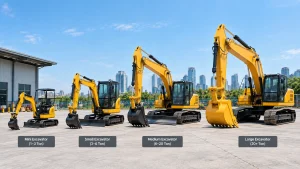
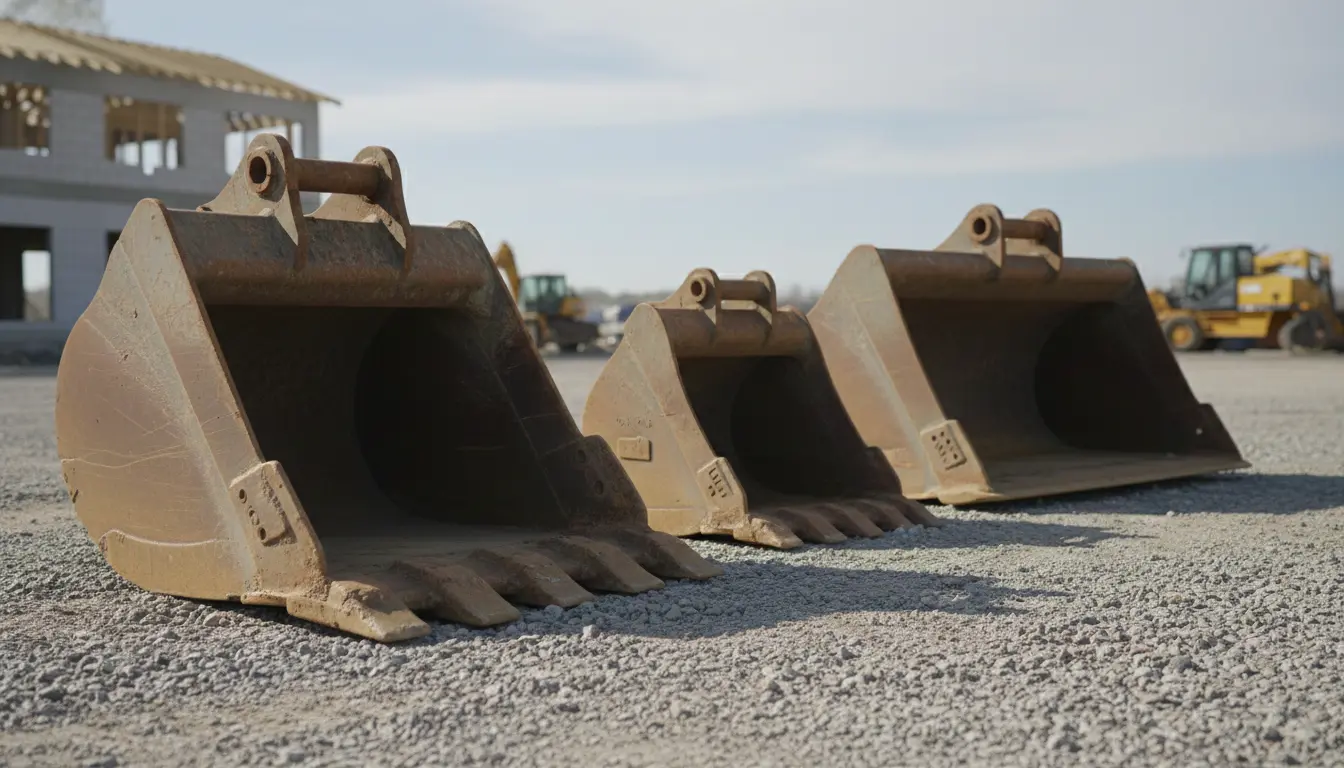
Excavators are among the most versatile machines on any construction, mining, or civil engineering project. But the excavator itself is only part of the equation. The bucket attached to the end of the arm determines what the machine can actually do, and how efficiently it can do it. Selecting the wrong bucket type for a given task does not just slow down the work. It increases wear on the attachment, strains the machine’s hydraulic system, raises fuel consumption, and can compromise the quality of the finished result.
Understanding the different types of excavator buckets, what each one is designed for, how it is constructed, and which ground conditions or materials it handles best, is essential knowledge for project managers, site supervisors, plant operators, and equipment planners. This guide covers all the main excavator bucket types used in construction and industrial operations, with practical guidance on how to match the right bucket to the right task.
Why Bucket Selection Matters
An excavator bucket is not a generic tool. Each type is engineered with a specific geometry, tooth configuration, material thickness, and capacity that optimises it for a particular range of tasks and ground conditions. A bucket designed for soft soil will wear rapidly in rocky ground. A heavy-duty rock bucket used in loose sand is carrying unnecessary weight and reducing the machine’s effective payload per cycle.
Beyond wear and efficiency, the wrong bucket can also affect the quality of work. A grading bucket used for deep trenching will not achieve the clean vertical walls a contractor needs. A trenching bucket used for grading will leave an uneven finish that requires additional remediation. Just as selecting the right type of lifting and access equipment for a project improves both safety and efficiency, matching the excavator bucket to the task is a fundamental part of effective equipment planning.
Also read : Forklift vs Pallet Jack: Differences, Uses, and How to Choose
Main Types of Excavator Buckets
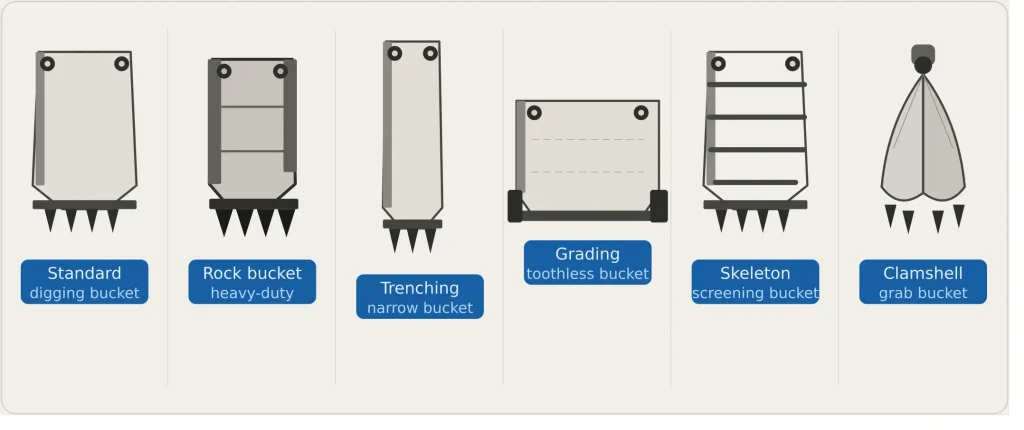
Standard Digging Bucket (General Purpose Bucket)
The standard digging bucket, sometimes called a general purpose bucket or GP bucket, is the most common excavator attachment. It is a curved, wide-mouthed bucket fitted with replaceable digging teeth along its cutting edge, designed to penetrate and scoop loose to medium-density soil, clay, and mixed material.
Standard digging buckets are available in a wide range of widths and capacities to suit different excavator sizes and trench dimensions. The teeth are replaceable, allowing the cutting edge to be restored as they wear without replacing the entire bucket. Most excavators arrive on site with a standard digging bucket as their default attachment.
Best suited for: General excavation, topsoil removal, foundation digging, trench cutting in soft to medium ground, material loading.
Not suited for: Hard rock, heavily compacted ground, clean grading, or material separation.
Heavy-Duty Rock Bucket
The heavy-duty rock bucket is built for the most demanding digging conditions, hard rock, heavily compacted soil, broken concrete, and abrasive materials. Compared to a standard bucket, it features thicker steel plate construction, reinforced side cutters, a stronger back wall, and heavy-duty teeth with a more aggressive tooth pattern designed to fracture and penetrate hard material.
Rock buckets are typically narrower and smaller in capacity than standard buckets of the same excavator class, because the density of the material being dug means each bucket load is heavier. Attempting to use a standard bucket in rock conditions causes rapid wear, structural damage, and hydraulic overloading.
Best suited for: Quarrying, mining, hard rock excavation, breaking and loading blasted rock, demolition material handling, heavily compacted ground.
Not suited for: Soft soil or loose material, where the extra weight of the bucket reduces payload efficiency unnecessarily.
Trenching Bucket (Narrow Bucket)
A trenching bucket is a narrow, deep-profile bucket specifically designed to excavate clean, precise trenches for pipelines, cables, drainage systems, and utility infrastructure. Its narrow width, often between 300 mm and 600 mm, allows it to cut a well-defined trench with minimal disturbance to the surrounding ground.
Trenching buckets typically have smooth side plates and minimal tooth projection to produce clean trench walls. Some configurations use a flat cutting edge rather than teeth, particularly for work in softer ground where precise wall definition is more important than penetration force.
Best suited for: Pipeline installation, cable laying, drainage trenching, utility infrastructure, narrow foundation excavation.
Not suited for: Wide excavation, bulk material loading, or rock conditions where penetration resistance is high.
Grading Bucket (Ditching Bucket / Cleanup Bucket)
The grading bucket, also known as a ditching bucket or cleanup bucket, is a wide, flat-bottomed bucket with no teeth and a straight cutting edge. Its geometry is optimised for levelling, grading, and shaping surfaces rather than penetrating ground. The flat profile allows it to skim across a surface cleanly, pulling material into a smooth, even layer.
Grading buckets are wider than standard digging buckets of the same excavator class, giving them a broader sweep per pass. They are commonly used at the finishing stages of earthwork operations, after the bulk material has been moved by a digging bucket, to achieve the final surface profile required by the design.
Best suited for: Surface grading, slope shaping, ditch profiling, site cleanup, backfilling and compacting loose material, final earthwork finishing.
Not suited for: Penetrating or digging compacted ground, rock, or material that requires tooth force to break apart.
Skeleton Bucket (Screening Bucket)
A skeleton bucket, also called a screening bucket or riddle bucket, has an open-bar or grid construction rather than a solid back wall. As material is scooped, fine particles, soil, and debris fall through the gaps in the bars, leaving only oversized material, rocks, roots, rubble, or aggregate, retained in the bucket.
Skeleton buckets are widely used in land clearance, demolition, and recycling operations where separating fine from coarse material on site reduces the volume of material that needs to be transported off site. This can result in significant savings in haulage costs and landfill fees, as the retained fine soil can often be reused on site as fill or subbase material.
Best suited for: Land clearance, topsoil screening, demolition debris separation, aggregate sorting, recycling operations, root and rock separation.
Not suited for: Standard digging, trenching, grading, or any task requiring a solid bucket shell to retain fine material.
Clamshell Bucket
A clamshell bucket consists of two hinged halves that open and close like a clam shell, operated by the excavator’s hydraulic system. Unlike conventional digging buckets that cut material by rotating the arm, a clamshell drops vertically into loose material and closes its jaws to grab a load, then lifts vertically to deposit it.
Clamshell buckets are used primarily in foundation work, dredging, well sinking, and shaft excavation, anywhere the excavation is too deep or too confined for a conventional digging arm to reach. They are also common in marine and waterway projects for dredging sediment from riverbeds and harbour floors.
Best suited for: Deep shaft excavation, foundation caissons, dredging, river and harbour maintenance, grab loading of loose bulk material such as sand, gravel, and grain.
Not suited for: General digging, trenching, grading, or compacted ground conditions where jaw closure cannot penetrate the material.
Tilt Bucket
A tilt bucket is a general purpose or grading bucket mounted on a hydraulic tilt mechanism that allows the bucket to rotate laterally, typically up to 45 degrees in each direction, without the excavator needing to reposition. This tilt capability allows the operator to grade slopes, shape ditches at an angle, and work on irregular terrain without constantly moving the machine.
Tilt buckets significantly improve productivity on grading and finishing tasks where the required surface is not perpendicular to the machine’s axis. Without a tilt bucket, achieving a consistent battered slope or angled ditch profile requires repeated repositioning of the excavator, adding time and fuel consumption to the operation.
Best suited for: Slope grading, battered embankment finishing, angled ditch profiles, contour work on uneven terrain, precision grading tasks.
Not suited for: Heavy digging or rock work where the tilt mechanism adds unnecessary complexity and vulnerability.
Mud Bucket (Dredging Bucket)
A mud bucket, sometimes called a dredging bucket or swamp bucket, is a wide, smooth-sided bucket with no teeth and a solid floor, designed to scoop wet, soft, or waterlogged material without the load washing back out through gaps or teeth sockets. The bucket profile is typically shallower and wider than a standard bucket, maximising the volume of soft material captured per pass.
Mud buckets are used in drainage clearance, swamp land preparation, wetland construction, and any excavation involving saturated ground or standing water. Their smooth interior also makes them easier to clean between loads, reducing material buildup that would otherwise reduce effective capacity.
Best suited for: Wet ground excavation, drainage ditch clearance, swamp and wetland preparation, river bank maintenance, soft sediment removal.
Not suited for: Compacted or rocky ground, trenching, or any application requiring tooth penetration force.
Also read : Standby vs Prime Generator: Key Differences Explained
Ripper Bucket (Combination Bucket)
A ripper bucket combines a standard digging bucket with one or more hydraulically operated ripper tines attached to the back of the bucket. The operator can switch between digging with the bucket and ripping with the tines in a single pass, breaking up compacted ground, soft rock, or old asphalt before scooping the loosened material.
This combination reduces the need to change attachments between breaking and digging operations, improving cycle time and reducing downtime on mixed-condition sites. Ripper buckets are particularly useful in areas where ground conditions vary across the site, soft in some zones, compacted or semi-rock in others.
Best suited for: Mixed-condition sites with both soft and hard ground, asphalt and pavement removal, sub-surface root and debris removal, compacted clay breaking.
Not suited for: Pure grading, screening, or full hard-rock conditions where a dedicated rock bucket and separate breaker attachment are more appropriate.
Toothed vs Toothless Buckets: A Key Decision Point
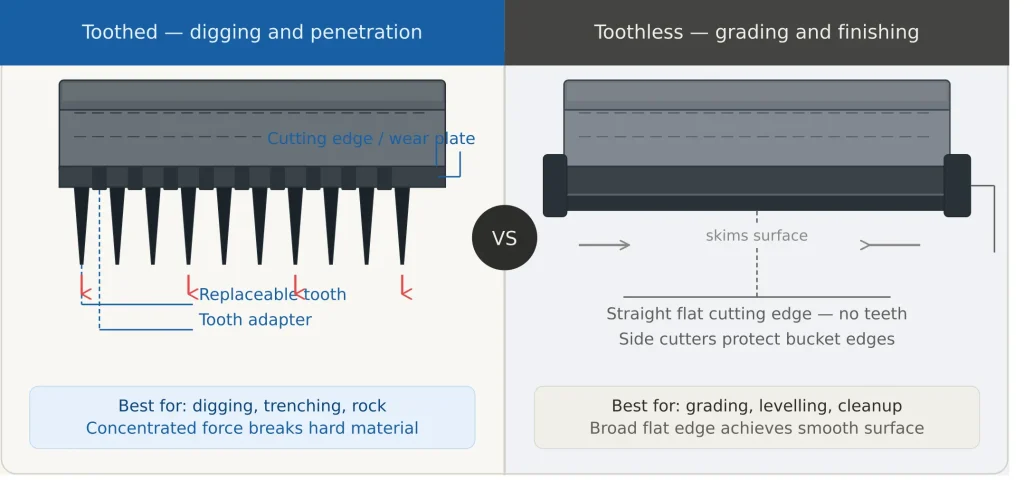
Across all bucket types, one of the most consistent decisions is whether to use a toothed or toothless (smooth edge) cutting configuration.
Toothed buckets use replaceable teeth along the cutting edge to penetrate and break material. They are the right choice whenever the task involves digging into compacted, cohesive, or resistant material. Teeth concentrate digging force at specific points, reducing the hydraulic pressure required to penetrate the ground.
Toothless buckets use a straight, flat cutting edge, sometimes with side cutters, to skim, grade, or scoop loose material without disturbing the surface below. They are the right choice for grading, finishing, and cleanup work where surface quality matters more than penetration force.
Many contractors carry both a toothed digging bucket and a toothless grading bucket for the same excavator, switching between them as the work progresses from bulk excavation to surface finishing, much the same way that operations involving both heavy material handling and precision placement require different equipment for different phases of the task.
How to Choose the Right Excavator Bucket
Selecting the correct bucket for a given project involves evaluating several factors simultaneously:
- Ground conditions
Is the material soft, medium, compacted, rocky, wet, or mixed? This is the single most important factor, it determines whether you need a standard, heavy-duty, mud, or skeleton bucket configuration.
Task type
Are you digging, trenching, grading, screening, or dredging? Each task has a bucket type optimised for it.
Trench or excavation width
The bucket width must match the required trench or excavation dimension. A bucket that is too wide wastes material removal and disturbs more ground than necessary. A bucket that is too narrow requires multiple passes to achieve the required opening.
Excavator size and hydraulic flow
Every bucket has a recommended excavator weight class and hydraulic flow range. Fitting an oversized bucket to a smaller machine overstresses the boom, arm, and hydraulic system. Fitting an undersized bucket to a large machine leaves performance on the table.
Bucket capacity
Capacity must be matched to the machine’s rated lift capacity at the working radius. A bucket that is too large will cause the machine to operate beyond its safe working limits when loaded with dense material.
Cycle time and productivity
On high-volume earthwork projects, bucket selection directly affects how many loads per hour the machine completes. A well-matched bucket improves cycle efficiency; a poorly matched one creates fatigue on the machine and the operator.
For guidance on broader equipment selection principles, including how matching rated capacity to task conditions applies across all categories of construction machinery, practical insights from heavy equipment planning guides provide useful context applicable to excavator bucket decisions as well.
For technical reference on excavator attachment engineering and international standards governing bucket design and load ratings, resources on excavation equipment and earthmoving machinery provide useful background on how bucket geometry, tooth configuration, and material specifications are determined.
Bucket Maintenance: Keeping Your Attachment in Working Condition
Regardless of bucket type, regular maintenance extends service life and maintains digging efficiency:
- Inspect teeth and cutting edges before each shift. Worn or missing teeth reduce penetration efficiency and increase fuel consumption. Replace teeth before they wear to the adapter, which is far more expensive to replace.
- Check side cutters for wear. Side cutters protect the bucket sides from abrasion and maintain trench width accuracy.
- Inspect welds and structural plates for cracks, particularly at high-stress points around the pin bores and cutting edge mounting.
- Lubricate pin and bush connections according to the manufacturer’s schedule to prevent seizure and accelerated wear.
- Remove compacted material from inside the bucket after each working session. Retained material adds dead weight, reduces effective capacity, and can cause corrosion in steel buckets over time.
Proper bucket maintenance is as important as machine maintenance in sustaining excavator productivity and controlling operating costs on long-duration projects.
Also read : What Is Scaffolding in Construction? Types, Uses, and Key Components
Get the Right Excavator and Lifting Equipment for Your Project
Understanding the types of excavator buckets, and how to match each one to the right ground condition, task type, and machine size, gives project teams a clear basis for improving productivity, reducing equipment wear, and controlling operating costs on any earthwork or construction project.
Whether you are planning a drainage project, a foundation excavation, a demolition operation, or large-scale earthworks, the right attachment selection is as important as the machine itself. Working with an experienced equipment provider ensures that your site has the right tools for every phase of the project, from bulk digging through to final grading and cleanup.
RR Machinery offers a comprehensive range of heavy machinery for sale and rental across Singapore, including equipment suited for construction, infrastructure, logistics, and industrial operations. Explore our full range of heavy machinery solutions or contact our team for practical advice and a clear quotation tailored to your project requirements.