

Choosing the right building materials is one of the most consequential decisions in any residential or commercial construction project. The materials selected determine not only the structural performance, durability, and cost of the finished building, they also determine how the construction process itself unfolds: what equipment is needed, how long each phase takes, what trades are required, and how much the project will cost to build and maintain over its lifetime.
In tropical construction environments, characterised by high humidity, frequent rainfall, and salt air in coastal locations, material selection carries additional weight. What performs well in temperate climates may corrode, crack, or deform under heat and moisture. What is practical on a large open site may be impossible to work with in a dense urban precinct where access is constrained and noise limits apply.
This guide covers the main structural and envelope materials used in house construction, with a practical assessment of each material’s properties, construction implications, equipment requirements, and long-term performance, giving developers, contractors, and project owners the information needed to make informed decisions before breaking ground.
Why Building Material Selection Affects the Entire Construction Process
Material selection is often treated as an architectural decision, something finalized during design and handed to the contractor to execute. In reality, it is a construction management decision with implications that run through every phase of the project, from site preparation and structural work through to finishing and handover.
The materials chosen determine :
What equipment is needed on site?
Precast concrete panels require tower cranes or mobile cranes for lifting and positioning. Structural steel frames require cranes with specific lifting capacities and reach. Masonry construction requires scaffolding for access at height. Timber framing can often be erected with smaller equipment, but still requires elevated access platforms for wall and roof work.
How long each phase takes?
In-situ concrete requires formwork, pouring, curing time, and striking, a process that adds days or weeks to each floor cycle. Precast and prefabricated systems compress on-site construction time significantly, but increase logistics and lifting complexity.
What skill trades are required?
Structural steel erection requires certified riggers and crane operators. Precast installation requires specialist fixing teams. Masonry requires bricklayers with experience in the specific block type being used.
Also read : Types of Scaffolding Materials: A Practical Guide
Main Types of Building Materials
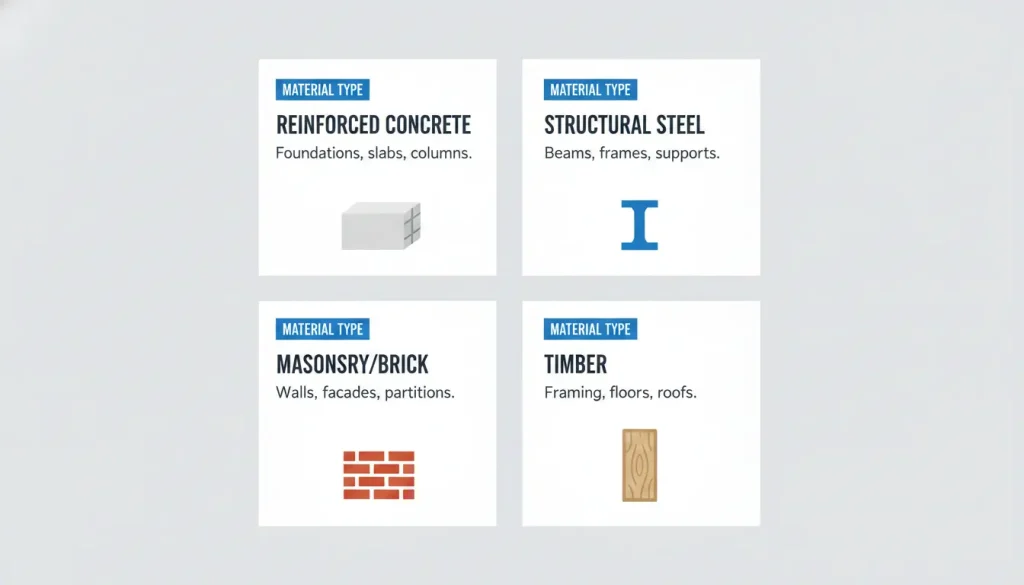
Reinforced Concrete
Reinforced concrete, steel-reinforced concrete, commonly abbreviated as RC, is the dominant structural material in modern construction. It combines the compressive strength of concrete with the tensile strength of embedded steel reinforcement bars (rebar) to create a composite material capable of handling the full range of structural loads in multi-storey buildings.
Concrete is used for foundations, ground beams, columns, floor slabs, walls, staircases, and roofs. Its versatility, it can be cast into almost any shape using formwork, makes it the default choice for complex structural geometries and for buildings where fire resistance, mass, and durability are priorities.
Structural performance
Concrete structures perform well under compression and, when properly reinforced, under bending and tension. They have excellent fire resistance, good sound insulation due to mass, and high thermal mass which moderates interior temperatures.
Durability in tropical climates
Properly designed and specified concrete performs well in humid tropical environments. Cover depth to reinforcement must be adequate to prevent carbonation and chloride-induced corrosion, a particular concern in coastal locations. Concrete that is poorly mixed, inadequately cured, or insufficiently covered is vulnerable to rebar corrosion and spalling over time.
Construction implications
In-situ concrete construction is labour and equipment intensive. Each floor cycle involves erecting formwork, placing reinforcement, pouring concrete, waiting for the concrete to gain sufficient strength, and striking the formwork, a cycle that typically takes one to two weeks per floor on a well-resourced site. Concrete pumps are used to place concrete at height. Tower cranes handle formwork panels, reinforcement cages, and other heavy components.
For the finishing phases of concrete construction, facade work, window installation, external painting, and maintenance access, mobile elevated work platforms and scaffolding systems provide the safe elevated access that workers need at each level of the building.
Precast Concrete
Precast concrete is concrete cast in a controlled factory environment and transported to site for installation. Panels, beams, columns, slabs, staircases, and facade elements are all commonly produced as precast components. Precast construction is extensively used in modern residential and commercial developments, particularly where programme speed, quality consistency, and reduced on-site labour are priorities.
Advantages over in-situ concrete
Factory production under controlled conditions produces more consistent quality than site-cast concrete. Production can proceed off-site while site preparation continues, compressing the overall project programme. On-site wet trades are reduced, improving cleanliness and safety. Labour requirements on site are lower.
Construction implications
Precast construction is highly crane-dependent. Every panel, beam, and slab unit must be lifted from the delivery vehicle, positioned precisely, and held in place while connections are made. Tower cranes are the standard lifting solution for multi-storey precast construction, sized to reach all parts of the building at the required lifting capacity. Mobile cranes are used for lower structures or for components that the tower crane cannot reach.
Correct crane selection, capacity, radius, height, and lifting speed, is one of the most critical planning decisions in a precast construction project. Understanding the different types of cranes and how they are selected for specific lifting tasks is essential knowledge for any project manager overseeing precast erection.
The logistics of receiving, storing, and sequencing precast deliveries also require careful planning. Forklift trucks and telehandlers are used to move components within the site storage area, and the sequence of crane picks must be coordinated with delivery schedules to avoid congestion and double handling.
Structural Steel
Structural steel, rolled sections including I-beams, columns, channels, and hollow sections, is used in commercial, industrial, and mixed-use construction where long spans, open floor plans, or rapid erection are priorities. In residential construction, structural steel is less common than concrete, but is used in hybrid structures where steel frames support concrete floor slabs, or in high-end bespoke residential projects with complex geometries.
Structural performance
Steel has an exceptional strength-to-weight ratio, it is far stronger per kilogram than concrete, allowing slender structural members and longer spans. Steel structures are highly ductile, meaning they deform significantly before failure, a characteristic that is valuable in seismic zones and gives early warning before structural collapse.
Durability in tropical climates
Steel’s primary vulnerability in humid, tropical environments is corrosion. Unprotected steel corrodes rapidly in high-humidity and salt-laden air. Structural steel must be adequately protected, through hot-dip galvanising, intumescent paint systems, or protective coating, and inspected regularly to ensure coating integrity is maintained.
Construction implications
Steel construction is fast. A structural steel frame can be erected significantly faster than an equivalent concrete structure, as there is no formwork, no curing time, and no waiting for strength to develop. Connections are made by bolting or welding on site.
Steel erection is crane-intensive. Columns and beams must be lifted, positioned, and held in place while connections are made. The sequence of erection must be carefully planned to maintain stability at every stage. Riggers and crane operators must be experienced in steel erection procedures, as the consequences of an incorrectly sequenced lift or a failed connection can be severe.
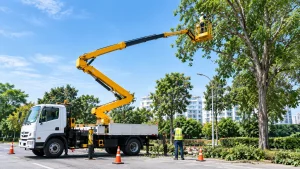
For work at height during steel erection and cladding installation, boom lifts provide the horizontal reach and elevation needed to access connection points and facade elements that cannot be safely reached from the structure itself.
Also read : Standby vs Prime Generator: Key Differences Explained
Masonry (Brick and Block)
Masonry, brick, concrete block, autoclaved aerated concrete (AAC) block, and other unit masonry products, is used primarily for non-structural wall construction in most modern multi-storey buildings. In most cases, the structural frame (concrete or steel) carries the loads, while masonry walls provide the envelope, partition walls, and acoustic and thermal performance.
Performance characteristics
Masonry walls offer good compressive strength, excellent fire resistance, good sound attenuation, and reasonable thermal mass. AAC block, a lightweight, highly porous aerated concrete product, is widely used in tropical construction for its combination of thermal insulation, ease of cutting and fixing, and lighter weight compared to dense concrete block.
Durability
Masonry is generally durable in tropical climates if properly detailed at joints and penetrations. The most common failure mode is water ingress at poorly detailed window reveals, sill junctions, and wall-to-frame interfaces, leading to dampness, mould, and in severe cases, corrosion of embedded fixings.
Construction implication
Masonry wall construction is labour-intensive and requires scaffolding for access at height. Unlike crane-lifted precast panels, masonry is built course by course by bricklayers working from a stable elevated platform. For multi-storey work, mobile scaffolding towers or fixed scaffold systems are required depending on the height and continuity of the work. As wall height increases, the scaffold must be raised in stages, a process that must be managed by a competent scaffolder to maintain safe working conditions at all times.
Timber
Timber is less commonly used as a primary structural material in tropical construction due to the climate’s impact on untreated wood, high humidity, termite risk, and the rapid deterioration of unprotected timber make it unsuitable for most applications without extensive treatment and maintenance.
However, engineered timber products, particularly cross-laminated timber (CLT) and glued-laminated timber (GLT or glulam), are attracting increasing interest globally as sustainable alternatives to concrete and steel for low-to-mid-rise construction. Engineered timber offers excellent strength-to-weight ratio, good seismic performance, and significantly lower embodied carbon than concrete or steel.
Construction implications
Engineered timber panels are factory-produced and delivered to site as finished elements, similar to precast concrete. They require crane lifting for installation, with similar planning considerations to precast construction. On-site cutting and trimming is minimised, reducing waste and site labour. The lighter weight of timber compared to concrete reduces foundation loads and can allow smaller cranes to be used for installation.
Comparing Materials: What Matters Most
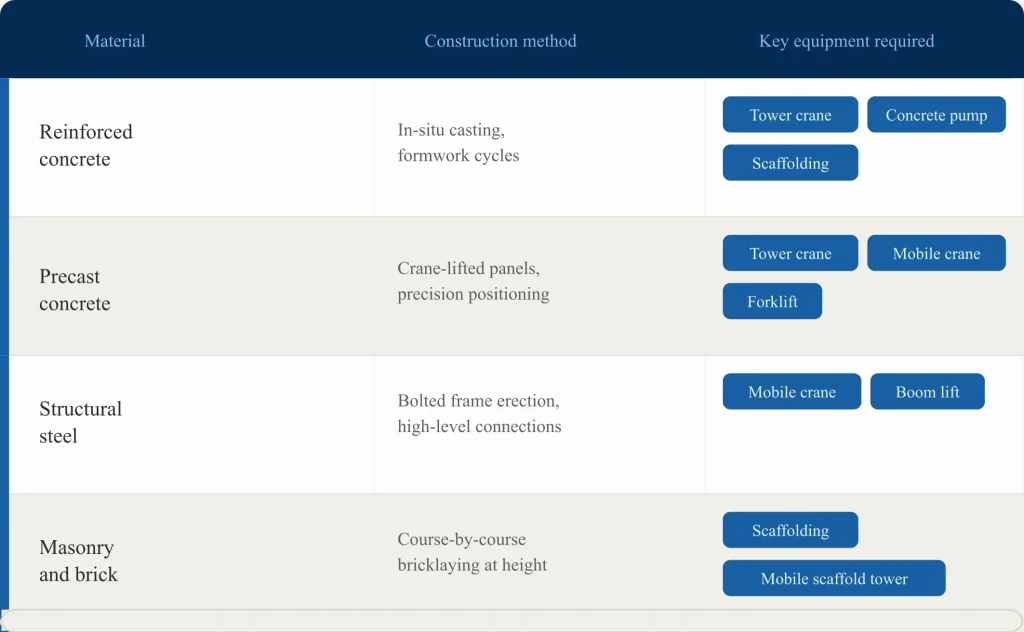
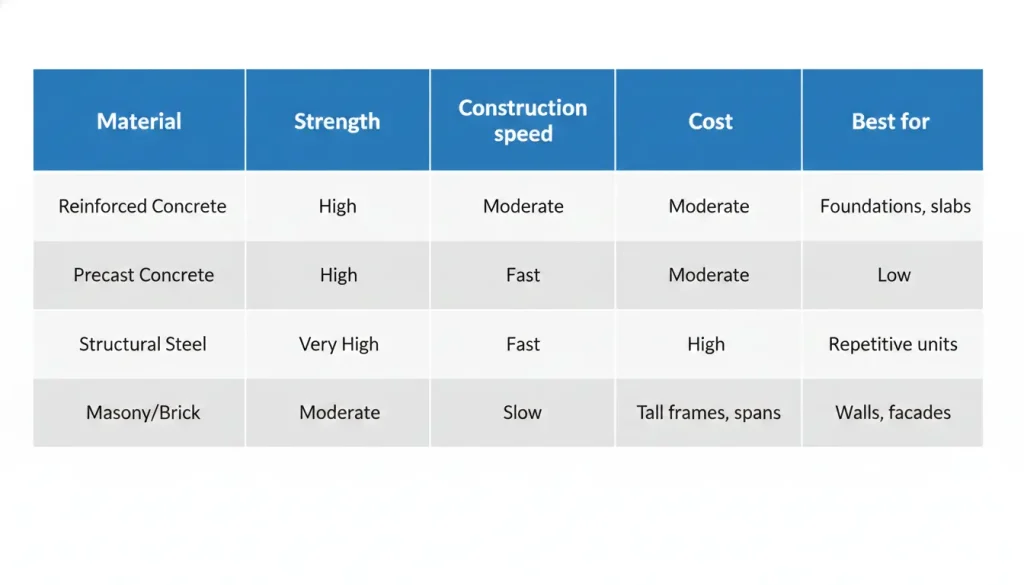
No single material is universally best. The right choice depends on a combination of factors specific to each project:
- Structural requirements
Height, span, load, and seismic performance all influence which material is structurally appropriate. Tall buildings are almost universally concrete or hybrid concrete-steel. Low-rise residential construction has more flexibility.
- Speed of construction
Precast concrete and structural steel offer the fastest site erection. In-situ concrete is the slowest. Masonry infill adds time after the frame is complete.
- Cost
In-situ concrete is generally the most cost-effective structural solution for standard residential construction. Precast reduces labour costs but adds logistics costs. Steel is typically more expensive than concrete for equivalent spans and loads.
- Sustainability
Embodied carbon is an increasing consideration in material selection. Steel and concrete both have significant embodied carbon, though both can incorporate recycled content. Engineered timber has the lowest embodied carbon of the mainstream structural options.
- Equipment implications
As noted throughout this guide, each material has specific equipment requirements. Projects that underestimate the crane capacity needed for precast installation, or the scaffolding requirements for masonry facade work, face programme delays and cost overruns. Working with experienced equipment suppliers who understand the construction process, not just the specifications, is critical to keeping projects on track.
For a broader understanding of how different types of material handling and lifting equipment are deployed across different construction methods, industry resources provide practical guidance on matching equipment to construction methodology.
For technical reference on building material properties, testing standards, and structural design principles, engineering resources on construction materials and building systems provide useful background on how material specifications are determined and applied in practice.
Also read : Forklift vs Pallet Jack: Differences, Uses, and How to Choose
Get the Right Equipment for Your Construction Project
The best material to build a house is the one that best matches the structural requirements, climate conditions, programme, budget, and construction methodology of your specific project. Concrete, steel, precast, masonry, and timber each have distinct advantages, and each places different demands on the construction process and the equipment needed to execute it safely and efficiently.
What every material choice has in common is this: the construction process requires reliable, correctly specified equipment, cranes for lifting, scaffolding for access, boom lifts for facade work, forklifts for material handling, and generators for temporary power. Getting the equipment right is as important as getting the material right.
RR Machinery offers a comprehensive range of construction equipment for sale and rental across Singapore, including mobile scaffolding, boom lifts, scissor lifts, forklifts, and power generators, all professionally maintained and supported by experienced technicians. Explore our full range of construction equipment solutions or contact our team for practical advice and a clear quotation tailored to your project requirements.

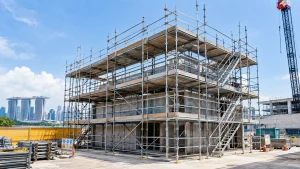
Choosing the right building materials is essential for a durable and cost-effective home. Combining quality materials with accurate construction estimating helps reduce waste, stay within budget, and ensure long-lasting results.