The forklift is the most widely used materials handling machine in warehousing, manufacturing, logistics, and construction. It lifts palletised loads, stacks them on racking, loads and unloads trucks, and moves heavy materials across facilities and sites with a speed and efficiency that no manual handling system can match. At the same time, it is one of the most consistently dangerous pieces of equipment in industrial and warehouse environments, forklift incidents account for a significant proportion of serious and fatal workplace injuries each year, and the majority of those incidents are preventable.
Operating a forklift correctly, not just mechanically, but with an understanding of why each procedure exists and what happens when it is not followed, is the difference between an operator who keeps their workplace safe and one who creates risks they may not even be aware of. This guide covers the complete process of driving a forklift: the pre-use checks that must be completed before the machine is started, the controls and their functions, the procedures for picking up, transporting, and depositing loads, the safety rules that apply throughout every operating session, and the specific hazards that forklift operators must be trained to recognise and manage.
Forklift Operator Certification
Before addressing the mechanics of how to drive a forklift, the most important point must be stated clearly: operating a forklift without appropriate training and certification is illegal in most jurisdictions and is a direct cause of preventable incidents.
Forklift operator certification is not a formality. It is the structured process through which operators learn not just which lever does what, but why load capacity varies with mast tilt and fork height, why the centre of gravity shifts when a load is elevated, why travelling with a raised load is one of the most dangerous things a forklift operator can do, and why the pre-use inspection is the single most important routine in the operator’s working day.
In most jurisdictions, forklift operator training and certification is governed by national workplace safety regulations. In Singapore, the Workplace Safety and Health Act and its subsidiary regulations require forklift operators to hold a valid Certificate of Competency (COC) issued by an accredited training provider. Operators must also be medically fit for the role, forklift operation requires good vision, adequate physical capability, and the absence of medical conditions that could affect operating performance.
The Workplace Safety and Health Council (WSH Council) publishes the regulatory framework and accredited training requirements for forklift operators in Singapore, the authoritative reference for certification requirements in the region.
This guide is a practical operational reference for trained and certified operators, and a preparation resource for those undertaking certification training. It is not a substitute for formal certified training.
Also read : Types of Pallet Jacks: A Complete Guide for Every Use
Types of Forklifts and Their Controls
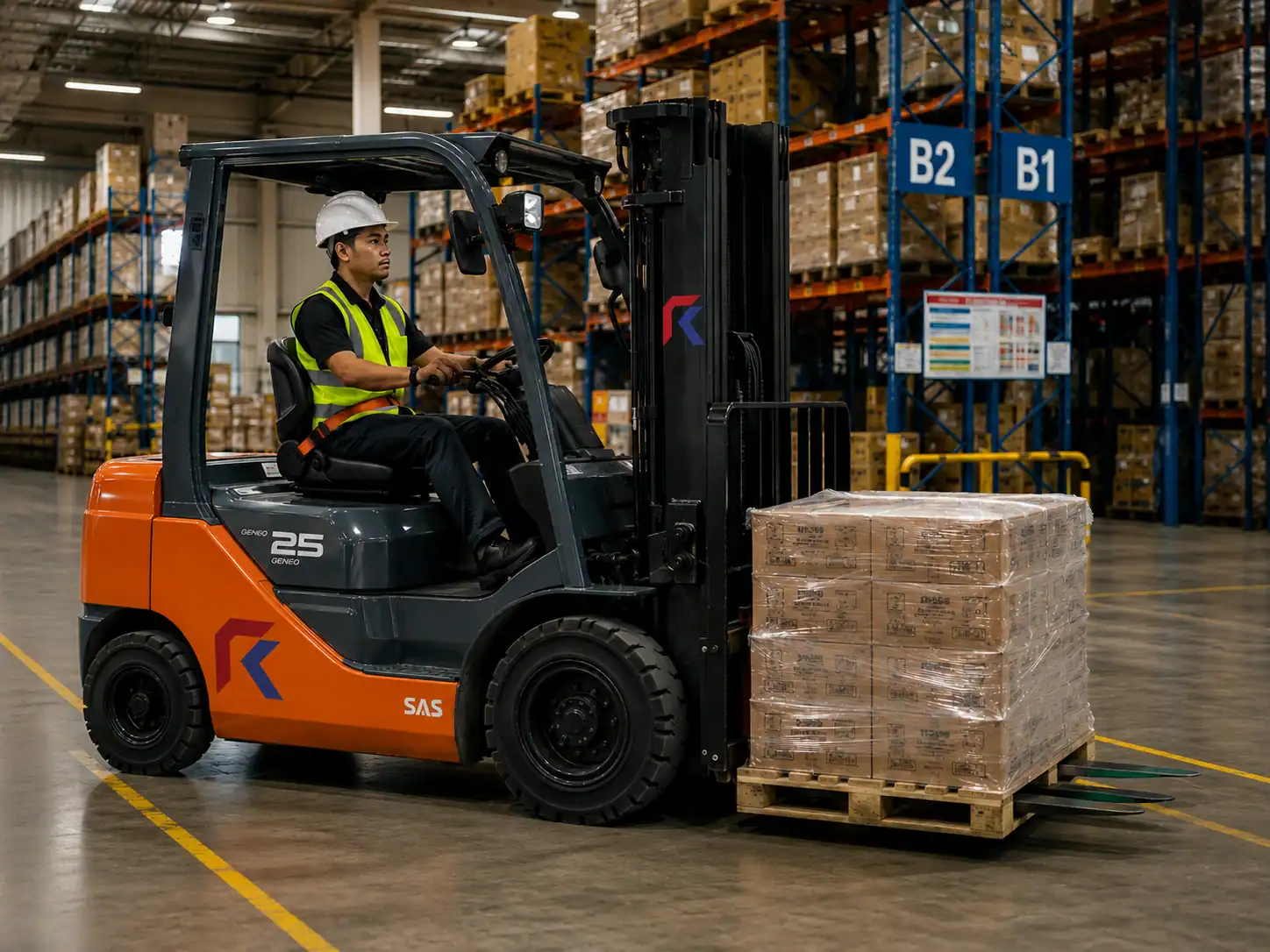
Before describing the operating procedure, it is important to note that forklifts are available in several configurations, counterbalance forklifts, reach trucks, order pickers, rough terrain forklifts, and telescopic handlers, and that the control layout varies between types and between manufacturers. This guide focuses on the counterbalance forklift, the most common type, with forks at the front, a counterweight at the rear, and a mast that raises and lowers the forks vertically.
The counterbalance forklift is the machine encountered in most warehouse, distribution, and construction site environments, and its controls are the baseline from which other forklift types differ. Once the counterbalance forklift’s controls and procedures are understood, the principles transfer to other types with appropriate type-specific training.
How to Drive a Forklift: The Operating Procedure
The following seven steps cover the complete operating procedure for a counterbalance forklift, from pre-use inspection before the first lift of the shift to correct shutdown at the end. Each step must be followed in sequence. Shortcuts in any step create conditions that the subsequent steps cannot compensate for.
Pre-Use Inspection
No forklift should be driven without a pre-use inspection completed by the operator before each shift. The pre-use inspection identifies defects that have developed since the last inspection, or since the machine was last serviced, and prevents those defects from causing incidents during operation. Skipping the pre-use inspection is not a time-saving measure, it is the most reliable way to operate an already defective machine without knowing it.
The pre-use inspection covers the following:
- Tyres
Check all tyres for adequate inflation (pneumatic tyres), cuts, chunking, and embedded objects. A damaged tyre on a forklift carrying a heavy load is a stability and control hazard. On solid rubber tyres, standard on most indoor warehouse forklifts, check for chunking, flat spots, and separation from the wheel rim.
- Forks
Inspect both forks for cracks, bends, and wear at the heel, the curved section at the base of the fork where it joins the carriage. A cracked or bent fork must be removed from service immediately. Also check that the fork locking pins are engaged and that both forks are at the same height on the carriage.
- Mast and carriage
Inspect the mast channels for damage, wear, and lubrication. Check that the carriage and the fork backrest extension are securely mounted. The fork backrest extension, the vertical plate behind the forks, prevents loads from sliding back toward the mast and must be present and secure at all times.
- Hydraulic system
Check for fluid leaks at the hydraulic cylinders, hoses, and fittings. Low hydraulic fluid causes slow or erratic mast operation. A hydraulic leak beneath the forklift or on the mast must be investigated and rectified before the machine is operated.
- Engine oil and fuel (internal combustion models)
Check the engine oil level on the dipstick. Check the fuel level, LPG cylinder weight, diesel gauge, or battery charge indicator on electric models. A forklift that runs out of fuel or battery charge during a shift causes operational disruption and, in the case of an LPG forklift, creates a cylinder change hazard if not managed correctly.
- Battery condition (electric models)
Check the battery charge level before starting the shift. If the battery is below the minimum charge level specified by the manufacturer, it must be charged before use. Operating an electric forklift on a low battery causes the machine to lose power progressively during the shift, which can happen at the worst possible moment, mid-lift, on a ramp, or with a load elevated.
- Lights, horn, and warning devices
Test all operational lights, the horn, and any reversing alarm or strobe. These devices protect pedestrians and other site users from forklift movements, non-functional warning devices must be repaired before the machine returns to service.
- Seatbelt and operator restraint
Confirm the seatbelt is present, undamaged, and latches correctly. The seatbelt must be worn at all times when operating the forklift. In an overturn incident, a belted operator stays in the protected space of the cab; an unbelted operator is ejected and is typically crushed by the overhead guard or the mast.
Record the inspection findings in the pre-use inspection log. Any defect that affects the safe operation of the machine must be reported to the supervisor and the machine must be taken out of service until the defect is rectified.
Mounting and Starting the Forklift
Mount the forklift using the steps and handholds provided, always maintain three points of contact when mounting or dismounting. Never jump onto or off a forklift.
Adjust the seat so that all controls are comfortably within reach and the operator’s back is supported. Adjust the mirrors if fitted. Fasten the seatbelt before touching any operating controls.
For internal combustion forklifts, confirm the parking brake is applied, the transmission is in neutral, and then start the engine. Allow the engine to warm up briefly, particularly in cool ambient conditions, before applying load to the hydraulic system.
For electric forklifts, insert the key or operator card, confirm the parking brake is applied, and power the machine on. Check that the battery indicator shows adequate charge for the shift.
Understanding the Controls
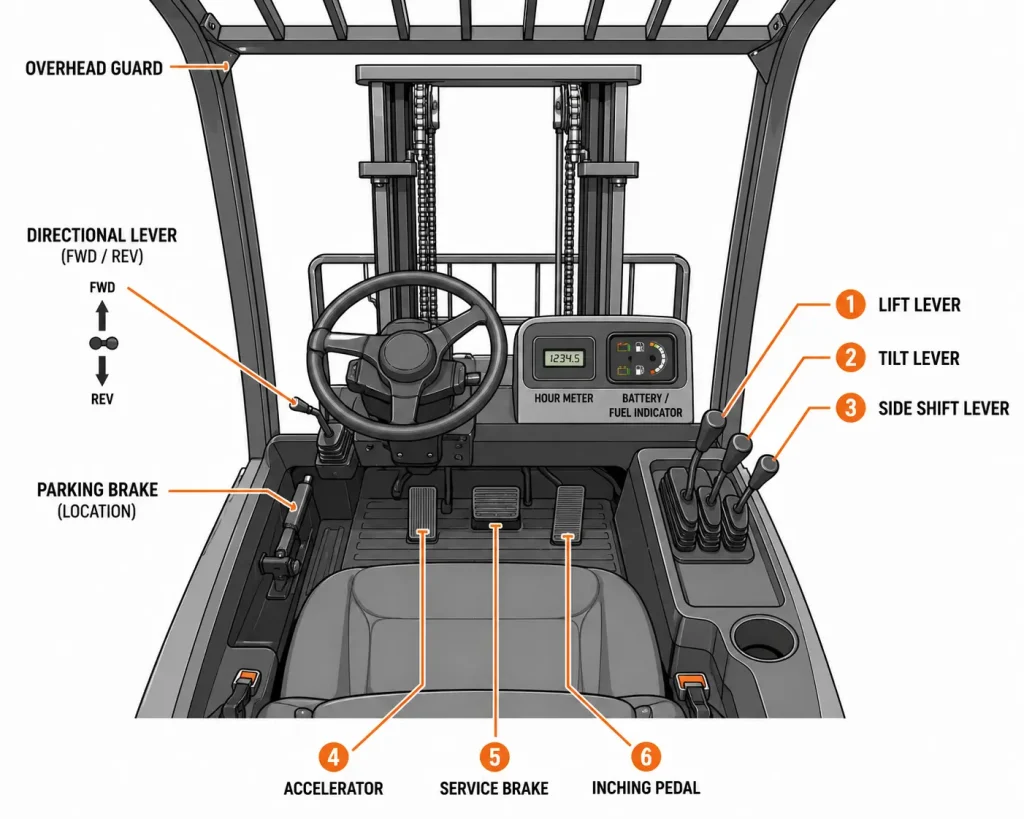
The counterbalance forklift’s primary controls are:
- Steering wheel
Controls the rear wheels, which steer the forklift. The rear-wheel steering of a forklift is fundamentally different from a car, the rear of the forklift swings outward when turning, and the turning radius is centred on the front axle. This rear-swing behaviour is responsible for many forklift pedestrian contact incidents when operators are unaware of the arc swept by the rear of the machine during a turn.
- Accelerator and brake pedals
The accelerator controls travel speed. The service brake decelerates and stops the machine. On most forklifts, the inching pedal, a combined clutch and brake pedal, allows precise, slow-speed manoeuvring near loads and racking by partially disengaging the drive while keeping the hydraulics operational.
- Directional control (forward/reverse lever or button)
Selects the direction of travel. Most forklifts have a lever or switch that selects forward or reverse. The machine must be at a complete stop before changing direction, moving the directional lever while the forklift is still travelling causes transmission shock and accelerated drivetrain wear.
- Lift lever
Controls the raising and lowering of the forks. Pushing the lever forward lowers the forks; pulling it back raises them. The rate of lowering is controlled by the degree of lever movement, fine control of the lever is required for precise fork positioning.
- Tilt lever
Controls the forward and backward tilt of the mast. Tilting the mast backward, racking the forks slightly upward at the tips, is used when travelling with a load to prevent the load from sliding forward off the forks. Tilting the mast forward, dumping, is used when depositing a load onto a surface or into a rack.
- Side shift lever (where fitted)
Controls the lateral movement of the carriage and forks, allowing the operator to align the forks with a pallet pocket without repositioning the whole machine. Side shift significantly reduces the number of machine movements required during picking and depositing operations.
- Parking brake
Applied whenever the operator leaves the seat. The parking brake must always be applied before the operator dismounts, a forklift left without the parking brake applied on any gradient will roll.
Also read : Aerial Lift vs Boom Lift: Differences and How to Choose
Picking Up a Load
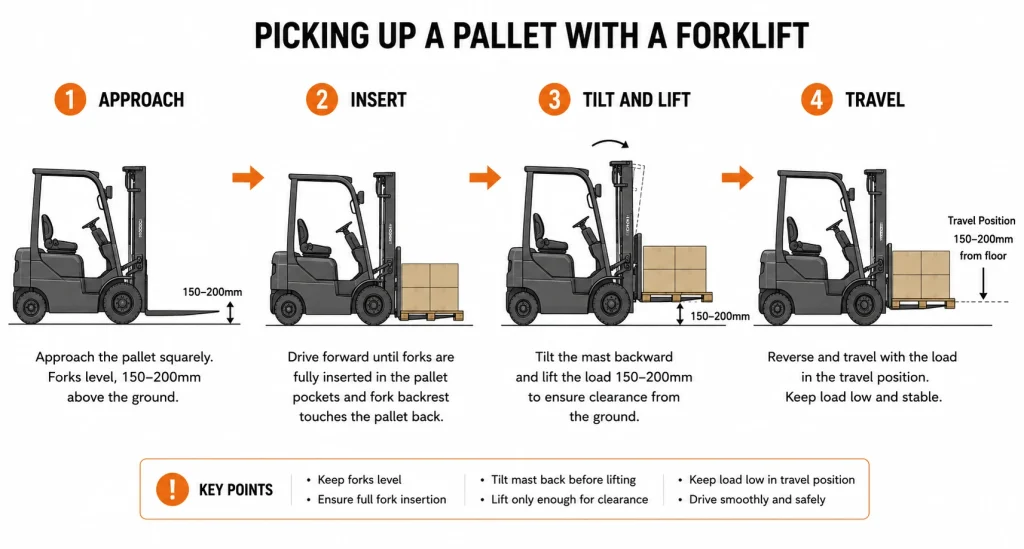
Approach the load slowly and in a straight line, with the forks level and approximately 150 to 200 millimetres above the floor, high enough to clear any floor irregularities but low enough to maintain stability.
Position the forks so they will enter the pallet pockets evenly, both forks centred on the pallet width. Misaligned forks, one fork bearing more load than the other, create lateral instability in the loaded carriage and can cause the load to tip.
Drive slowly forward into the pallet until the forks are fully inserted, the pallet back should contact or nearly contact the fork backrest extension. Partially inserted forks, tips only, dramatically reduce the effective load capacity and create a tipping hazard.
Tilt the mast slightly backward to secure the load against the fork backrest extension. Raise the forks just enough to clear the floor, typically 150 to 200 millimetres, and check that the load is stable on the forks before travelling.
Before travelling, confirm:
- The load is within the forklift’s rated capacity for the current mast height and load centre distance
- The forks are at the correct travel height, low enough for stability, high enough to clear floor obstacles
- The mast is tilted back to retain the load
- The view forward is not obstructed, if the load obscures forward visibility, travel in reverse with a banksman guiding if necessary
The rated capacity of a forklift decreases as the mast is raised and as the load centre distance increases, the horizontal distance from the face of the forks to the load’s centre of gravity. Operating beyond the rated capacity at the actual mast height and load centre is a leading cause of forklift overturn. The principles of load capacity management that apply to forklifts, understanding how capacity varies with configuration, are directly related to the load chart principles that apply to cranes and other lifting equipment, as covered in the guide to reading a crane load chart for safe capacity assessment.
Travelling with a Load
Travel with the forks in the low travel position, 150 to 200 millimetres above the floor, and the mast tilted back. Travelling with the forks elevated raises the forklift’s centre of gravity and dramatically reduces its stability against overturn, particularly during turning. A forklift carrying an elevated load on a turn is operating close to or beyond its stability limit.
Observe site speed limits, typically 8 to 16 kilometres per hour in warehouses and 5 kilometres per hour in pedestrian areas. Slow down for corners, blind spots, ramps, and doorways before entering, not after.
Sound the horn at every blind intersection, every doorway, and every area where pedestrians may be present but not visible. The horn is not a courtesy, it is a safety device that warns pedestrians of the forklift’s approach before contact is possible.
On ramps and gradients, always travel with the load on the uphill side, drive forward up a ramp and reverse down a ramp when carrying a load. This keeps the load between the forklift and the higher ground, preventing the load from sliding forward and the machine from tipping forward nose-down. Never turn on a ramp.
Maintain safe following distances from other forklifts and vehicles. A loaded forklift’s braking distance is longer than it appears, the load adds momentum that the brakes must dissipate.
Depositing a Load
Approach the deposit location, pallet position on the floor, racking bay, or truck deck, slowly and in a straight line, positioning the forklift squarely to the target location.
For floor deposits: drive forward until the load is directly above the target position. Lower the forks slowly to place the load on the floor. Tilt the mast slightly forward to release the fork tips from under the pallet. Reverse slowly and carefully to withdraw the forks from the pallet.
For racking deposits: approach the rack face at right angles. Raise the forks to the correct height for the target bay, raise slowly and stop at the correct level. Drive slowly forward until the load is over the rack beam. Lower the load onto the beam. Tilt the mast slightly forward to release the fork tips. Reverse slowly to withdraw the forks from the rack, then lower the forks to travel height before moving away from the rack face.
The view when depositing to elevated racking is often obscured by the load. Use the mirrors, slow down, and take time to confirm position before lowering. Rushing an elevated deposit is a leading cause of loads being dropped on racking structure, adjacent stock, or personnel below.
Parking and Shutdown
When the operating session is complete, or when the operator must leave the forklift for any reason, the machine must be shut down correctly:
- Park in a designated forklift parking area, away from pedestrian routes, fire exits, and emergency equipment
- Lower the forks fully to the floor
- Tilt the mast slightly forward so the fork tips rest flat on the floor
- Apply the parking brake
- Select neutral
- Switch off the engine or power
- Remove the key or operator card
- Dismount using the steps and handholds, maintain three points of contact
A forklift left with the forks elevated, even slightly, is a serious hazard to pedestrians who may walk beneath the forks without noticing them. Forks must always be lowered fully when the machine is unattended.
Key Safety Rules for Forklift Operations
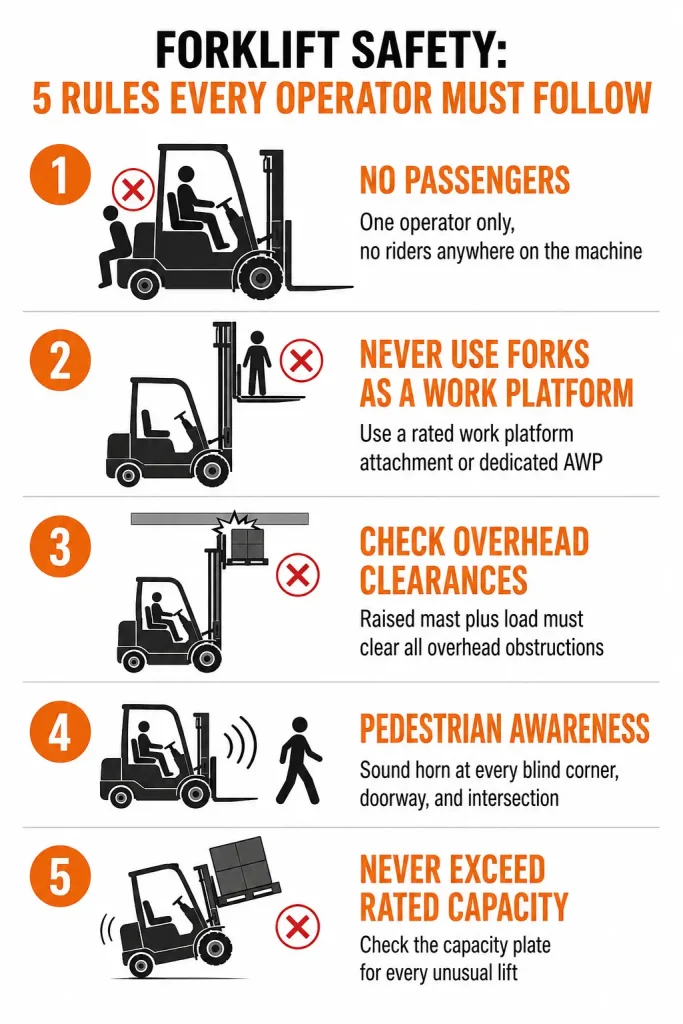
The following safety rules apply to every forklift operation in every environment. They are not optional and are not suspended by time pressure, familiarity, or the perception that a particular task is low-risk:
- Never carry passengers
The forklift is designed for one operator in the cab. Carrying a passenger on the forks, the counterweight, or any other part of the machine is prohibited, the passenger has no restraint and is at extreme risk in any incident.
- Never use the forks as a work platform
Standing on the forks to reach height, or placing a person in a pallet on the forks for elevation, is not a permitted working-at-height method. A purpose-built work platform attachment, a man-cage rated for the forklift’s capacity, is required for any personnel elevation task, and even then the forklift must remain stationary and the cage must be locked to the carriage. For working at height, a dedicated aerial work platform is always the safer and more appropriate solution, the full range of options is covered in the guide to what a scissor lift is and when to use one versus other aerial work platforms.
- Always check overhead clearances
Mast height when fully raised, plus the load height, must clear all overhead obstructions, racking, pipework, lighting, sprinkler heads, and doorway lintels. Striking an overhead sprinkler head with a raised mast in a warehouse can trigger the entire suppression system, a consequence entirely disproportionate to a moment of inattention.
- Maintain pedestrian awareness at all times
Pedestrians in forklift operating areas are the greatest single safety risk in warehouse and site environments. The forklift operator cannot always see pedestrians, particularly in blind spots, at the rear when reversing, and when carrying a load that obstructs forward visibility. Speed limits, exclusion zones, and pedestrian segregation are the systemic controls that reduce this risk. The operator’s individual responsibility is to travel at a speed at which the machine can be stopped within the visible clear distance at all times.
- Never exceed rated capacity
The forklift’s rated capacity is the maximum load it can safely lift at the standard load centre and mast height. Exceeding it risks forward tipping, the most common mechanism of serious forklift incidents. The rated capacity placard is on the machine, consult it before every unusual lift.
The full framework of safety requirements that applies to forklift operations, including operator certification, pre-use inspection, pedestrian segregation, and load management, sits within the broader heavy equipment safety requirements that govern all powered plant on construction sites and in industrial facilities, as set out in the practical guide to heavy equipment safety for construction and industrial operations.
Also read : Types of Bulldozers: A Complete Guide for Every Job
Operate with Competence, Operate with Care
A forklift in the hands of a trained, attentive, and procedure-following operator is a highly productive and safe materials handling machine. In the hands of an undertrained, complacent, or distracted operator, it is one of the most dangerous machines in the workplace. The procedures in this guide exist because each one was developed in response to real incidents, real loads dropped, real machines overturned, real people injured, and following them is not bureaucratic compliance but the application of lessons that cost others dearly.
RR Machinery provides a comprehensive range of materials handling and construction equipment for rental and sale, including forklifts, pallet jacks, boom lifts, scissor lifts, and supporting plant, all maintained to full operational standard and available with guidance from experienced equipment specialists. Explore our full range of construction and materials handling equipment solutions, or contact our team for practical advice and a clear quotation matched to your load requirements, operating environment, and site conditions.