How a Bulldozer Works
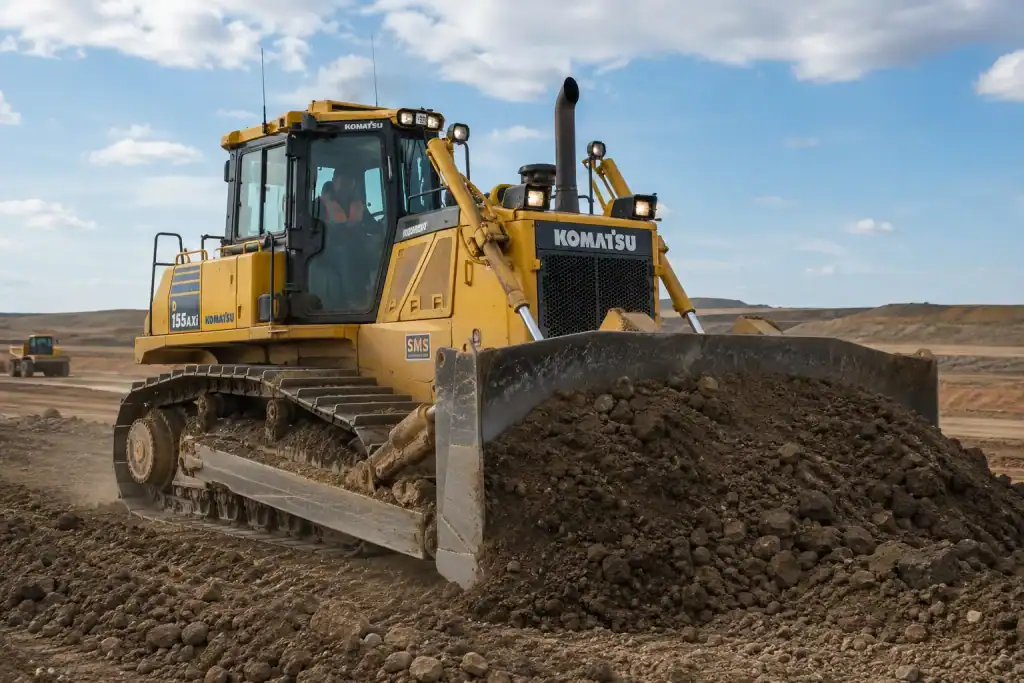
A bulldozer is a tracked or wheeled machine that moves material by pushing it with a blade mounted at the front of the machine. The blade is attached to the machine frame via push arms, structural arms that transmit the pushing force from the machine’s drive system to the blade, and is raised, lowered, tilted, and in some configurations angled hydraulically by the operator from the cab. As the bulldozer advances, the blade contacts the material surface at its cutting edge, the hardened steel lip at the bottom of the blade, and penetrates into the material. The material is pushed forward and upward, rolling in a controlled mass ahead of the blade. The operator controls blade height and angle to manage the volume of material carried in front of the blade and to shape the surface being formed. The bulldozer’s tractive effort, the horizontal force it can apply at the blade, is determined by the engine’s torque, the transmission’s gear reduction, and the grip available between the tracks and the ground. A large crawler bulldozer generates pushing forces that no other wheeled machine can approach, making it the most powerful ground-level material mover available in the earthmoving equipment family. Most bulldozers are also fitted with a rear ripper, one or more downward-pointing tines mounted on the rear of the machine that can be lowered hydraulically into the ground to break up compacted material, rock, and cemented soils before the blade pushes them. The ripper makes the bulldozer capable of working in material conditions that would be impossible for the blade alone, hard rock formation, heavily compacted road base, and cemented natural ground that no other single machine can both rip and push in the same operation.Also read : Types of Graders: How Each Works and When to Use One
Key Components of a Bulldozer
-
- Blade
The primary working component. Available in multiple configurations, straight, angling, universal, and semi-universal, each suited to different material types and task geometries. The blade’s cutting edge is the hardened steel strip at the bottom that penetrates the material. Blade wear plates and end bits are replaceable wear components that extend the blade’s service life.
-
- Push arms
The structural arms connecting the blade to the bulldozer’s main frame. Push arms transmit the full tractive force of the machine to the blade. They must be inspected regularly for cracks, deformation, and wear at the pivot points.
-
- Hydraulic tilt and lift cylinders
The cylinders that control blade height and blade tilt angle. On dozers with angling capability, additional hydraulic circuits control the blade angle relative to the direction of travel.
-
- Tracks and undercarriage
The crawler undercarriage distributes the machine’s weight over the full track contact length, providing low ground pressure and high traction. Track shoes, the individual steel pads that form the track, are available in different widths and configurations for different ground conditions.
-
- Final drives
The heavy-duty gearboxes at each end of the track frames that transmit power from the transmission to the sprocket wheels that drive the tracks. Final drives are high-stress components that require regular oil level checks and periodic oil changes.
-
- Rear ripper
One to five downward-pointing tines mounted on a hydraulically controlled beam at the rear of the machine. The ripper is lowered into the ground during ripping passes and raised for dozing passes. Multi-shank rippers cover a wider width; single-shank rippers concentrate force for penetrating harder material.
Blade Configurations
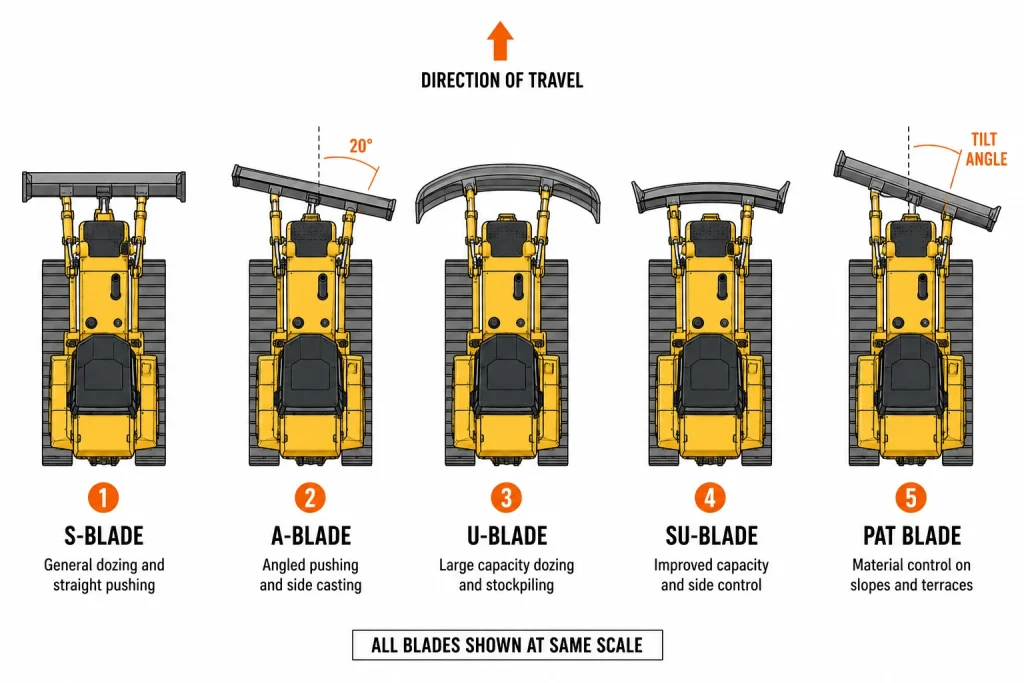 The blade configuration is one of the most operationally significant variables in bulldozer specification. Different blade types are optimised for different material conditions, different task geometries, and different production requirements.
-
- Straight blade (S-blade)
The simplest and most common blade configuration, a flat or slightly curved blade with no lateral angling capability and a relatively narrow width compared to the machine’s track gauge. The straight blade is best suited to fine grading, back-filling, and finish work where precision matters more than bulk production. Its inability to cast material to the side limits its productivity in bulk pushing, but its stiffness and controllability make it the preferred blade for grading applications.
-
- Angle blade (A-blade)
An angling blade can be set at an angle of up to 25 degrees to the direction of travel in either direction, allowing the pushed material to cast off to one side rather than accumulating ahead of the blade. The angle blade is best suited to side-casting, pushing material off an embankment edge, clearing a drainage channel, or moving material laterally without building up a pile in front of the machine. Its angling capability makes it productive for road construction and land clearing where side-casting is required.
-
- Universal blade (U-blade)
The universal blade is the widest and most curved blade configuration, its large curved profile and extended wings retain more material in front of the blade, maximising the volume pushed per pass. The U-blade is the highest-production configuration for bulk pushing of loose, light material, topsoil stripping, stockpile pushing, and reclamation fill spreading, where the goal is maximum volume moved per hour. It is less suited to rocky or cohesive material where the high resistance overloads the large blade.
-
- Semi-universal blade (SU-blade)
The semi-universal blade combines elements of the straight and universal configurations, wider than a straight blade with partial curved wings, providing good material retention without the full width and weight of a universal blade. The SU-blade is the most versatile general-purpose configuration, suited to a wide range of material types and applications including both bulk pushing and moderate grading work.
-
- PAT blade (Power Angle and Tilt)
The PAT blade, also called a six-way blade, can be angled, tilted, and raised independently in six axes of movement, controlled hydraulically from the cab without the operator leaving the seat. This full range of hydraulic adjustment makes the PAT blade exceptionally versatile for fine grading, slot dozing, and applications requiring frequent blade repositioning. PAT blades are standard on compact and medium dozers used in finishing and grading applications.
Also read : Heavy Equipment Safety: A Complete Site Guide
Types of Bulldozers
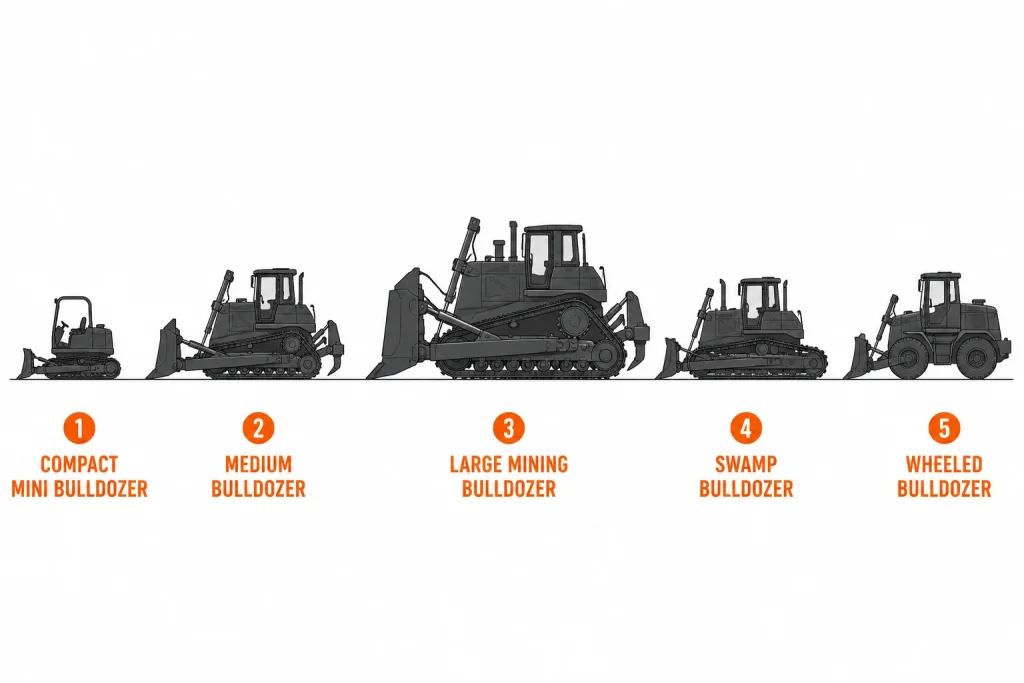 The bulldozer family covers a wide range of machine sizes, undercarriage configurations, and operational specialisations. Each type is designed for a specific scale of work, a specific ground condition category, or a specific operational environment.
-
-
Compact or Mini Bulldozer
-
The compact bulldozer, operating weight typically below 10 tonnes, is designed for confined sites, small-scale earthmoving, and applications where a full-size machine is too large or too heavy for the site constraints. Compact dozers are used in landscaping, small residential site development, orchard and vineyard land preparation, tight urban site clearance, and any application where the working area or the ground bearing capacity restricts the deployment of larger machines.
Their lower operating weight gives them a significantly lower ground pressure than larger dozers, making them suitable for ground conditions that would require specialised undercarriage equipment on a larger machine. Many compact dozers are fitted with rubber tracks rather than steel tracks, reducing ground disturbance on sensitive surfaces such as turf, compacted gravel, and finished subgrade.
-
-
Medium Bulldozer
-
The medium bulldozer, operating weight from 10 to 40 tonnes, is the most widely used dozer class across construction, civil engineering, and site development projects. It provides the combination of blade capacity, engine power, and ground capability that suits the majority of earthmoving tasks on standard construction sites: topsoil stripping, fill spreading, road formation pushing, embankment construction, and subgrade preparation.
Medium dozers are available with a full range of blade configurations, S, A, SU, U, and PAT blades, and with standard or wide track options for different ground conditions. They are the default specification for site earthmoving on projects from residential subdivision development to commercial infrastructure construction where the earthwork volumes justify a dedicated dozer rather than using an excavator or loader for pushing.
On construction projects where medium dozers work alongside excavators, loaders, and motor graders in a coordinated earthmoving programme, the sequencing and spatial coordination of plant is a critical site management task. The principles of coordinating multiple plant types on a single site, managing routes, exclusion zones, and task sequencing to maximise productivity and maintain safety, are covered in the guide to construction site planning and heavy plant coordination.
-
-
Large Bulldozer
-
The large bulldozer, operating weight from 40 to over 100 tonnes, is purpose-built for high-production earthmoving on major civil projects, large-scale mining operations, and land reclamation works where the daily material volumes are measured in tens of thousands of cubic metres. Large dozers carry massive blade loads, U-blades on the largest models can hold over 40 cubic metres of material, and their engine outputs exceed 700 horsepower on the biggest production models.
Large bulldozers are the primary production tool in open-cut coal mining, where they push blasted overburden to the spoil pile, and in large embankment dam construction, where they spread and compact massive fill volumes. Their sheer size and weight create significant ground bearing demands, deploying a large dozer on inadequate ground risks bogging the machine and causing significant site disruption.
The relationship between large dozer operations and ground conditions is directly relevant to the same ground bearing assessment principles that apply to all heavy plant, including the crane outrigger loading assessments discussed in guidance on lifting equipment safety and ground bearing capacity for heavy construction plant.
-
-
Swamp or Wetland Bulldozer
-
The swamp bulldozer is a specialist variant configured specifically for operation on soft, waterlogged, or swampy ground where a standard crawler dozer would sink and become immobilised. Its distinguishing feature is its extremely wide, low-ground-pressure track configuration, swamp tracks are significantly wider than standard tracks, distributing the machine’s weight over a much larger contact area.
Swamp dozers are used for land reclamation on soft coastal or riverine ground, for working in mangrove and wetland environments, for pipeline construction through soft lowland terrain, and for initial site preparation on waterlogged sites before drainage and ground improvement allows standard plant to access. Their wide tracks make them slow on firm ground, and they are typically brought onto site specifically for the soft ground phase and then replaced with standard dozers as ground conditions improve.
-
-
Wheeled Bulldozer
-
The wheeled bulldozer mounts the standard dozer blade and push arm configuration on a rubber-tyred wheeled chassis rather than a crawler undercarriage. The wheeled configuration provides significantly higher travel speeds than crawler dozers, up to 40 kilometres per hour on road, and eliminates the track damage concern on paved or compacted surfaces.
Wheeled bulldozers are suited to applications where the dozer must travel long distances between push areas, where the working surface must not be damaged by tracks, and where the relatively short duration of pushing at any single location makes the high travel speed of a wheeled machine more productive than a slower crawler. They are widely used in port and terminal operations, large flat site development, and airport construction where long travel distances between work faces make crawler dozers inefficient.
The trade-off is reduced pushing force relative to an equivalent crawler dozer. Without track grip, the wheeled dozer cannot generate the same tractive effort as a crawler machine of equivalent weight, limiting its productivity in heavy or cohesive material. For applications primarily involving loose or granular material on flat ground with long travel distances, the wheeled configuration is more productive; for heavy material, steep gradients, or soft ground, the crawler remains superior.
Bulldozer vs Other Earthmoving Plant
The bulldozer’s place in the earthmoving equipment family is defined by its unique capability for high-force horizontal pushing at ground level. Understanding when a bulldozer is more appropriate than an excavator, a front end loader, or a motor grader is essential for effective plant selection.-
- Bulldozer vs excavator
The bulldozer pushes material across the surface without lifting it, it is most productive for bulk movement of loose material over short distances on the same level. The excavator digs and lifts, it is most productive for breaking into undisturbed ground, excavating below grade, and loading trucks. For a detailed comparison of how these two machines complement each other in an earthmoving programme, the practical guide to bulldozer vs excavator differences and application on construction sites covers every operational dimension of the choice.
-
- Bulldozer vs front end loader
Both machines move material across the surface, but through fundamentally different mechanisms. The bulldozer pushes material in a rolling mass ahead of its blade, it cannot lift material above ground level or load it into a truck. The front end loader scoops material into a bucket and carries it, it is more productive for loading trucks and for moving material to precise deposit locations. On sites where both functions are needed, a bulldozer and a loader typically work together: the dozer pushes material to a stockpile position, and the loader loads it into trucks. The operational capabilities of the front end loader and how it coordinates with bulldozer operations in a site earthmoving programme are covered in the complete guide to front end loaders and their application in construction and mining.
-
- Bulldozer vs motor grader
The motor grader achieves precision surface profiling that the bulldozer’s blade geometry cannot match to the same tolerance. For bulk pushing and rough grading, the bulldozer is faster and more powerful. For finish grading to a design cross-section and drainage gradient, the motor grader is the correct tool. In practice, the bulldozer performs the bulk earthwork and rough grade, and the motor grader follows to achieve the finish grade, a standard production sequence on road construction and site development projects.
Choosing the Right Bulldozer Type
The correct bulldozer type for any application is determined by the intersection of five key variables:-
- Material volume and push distance
Small volumes over short distances, compact dozer. Large volumes over medium distances, medium dozer. Very large volumes with production requirements measured in thousands of cubic metres per day, large dozer.
-
- Ground conditions
Firm, stable ground, standard steel tracks. Soft or waterlogged ground, wide track or swamp configuration. Sensitive finished surfaces, rubber tracks. Long travel distances on road or hardstanding, wheeled dozer.
-
- Material hardness
Loose or recently placed fill, blade only. Compacted natural ground, blade with scarifier. Hard rock or heavily cemented material, rear ripper essential.
-
- Task geometry
Bulk pushing in one direction, U-blade or SU-blade. Side-casting or angled pushing, angle blade. Fine grading and finishing, PAT blade or straight blade.
-
- Site constraints
Confined access, weight restrictions, sensitive surfaces, compact dozer with rubber tracks. Open large site with no constraints, full-size crawler dozer matched to production requirement.
Understanding how the bulldozer fits into the broader earthmoving equipment fleet, and how it coordinates with excavators, graders, loaders, and compactors in a production sequence, is part of the wider knowledge of construction plant selection and site management that covers all categories of earthmoving equipment, as discussed in the guide to types of excavators and their application alongside other earthmoving plant.Also read : What Is Mobile Scaffolding? Types, Uses and Safety
The Machine That Builds the Ground
Before a building rises, before a road is paved, before a dam is filled, the ground must be prepared. That preparation begins with the bulldozer. It strips the topsoil, pushes the bulk fill, rips the hard ground, and shapes the rough formation that every subsequent phase of the project builds on. No other machine applies the same combination of pushing force, ground capability, and operational simplicity to the task of moving earth at scale. Selecting the right bulldozer type, the right size, the right blade, the right track configuration for the material, the ground, and the production requirement, determines whether the earthmoving phase meets its programme or becomes the bottleneck that delays everything downstream. RR Machinery provides a comprehensive range of construction and earthmoving equipment for sale and rental, including bulldozers, excavators, motor graders, front end loaders, and supporting plant, all maintained to full operational standard and supported by experienced equipment specialists. Explore our full range of earthmoving and construction equipment solutions, or contact our team for practical advice and a clear quotation matched to your site conditions, material volumes, and project programme.