The excavator is the most versatile piece of earthmoving equipment on a construction site. It digs foundations, trenches, and drainage channels. It demolishes structures, lifts materials, drives piles, and grades slopes. It works in rivers, on steep hillsides, inside buildings, and in locations that no other earthmoving machine can access. Its combination of a rotating superstructure, a hydraulic arm, and an interchangeable attachment system makes it capable of more distinct tasks than any other single category of construction plant.
But “excavator” is not a single machine, it is a family of machines, each designed around a different set of operational priorities. A crawler excavator built for deep foundation work on a large civil project shares almost nothing in operational terms with a compact mini excavator working inside a domestic extension or a long-reach excavator dredging a river channel. The undercarriage, the boom configuration, the counterweight, the cab, and the attachment range differ significantly between types, and so do the site conditions, ground requirements, and logistical constraints that determine when each type is the right choice.
For project managers, site engineers, plant managers, and equipment planners, understanding the principal types of excavator, what each one is built for, how it works, and what its limitations are, is essential for correct equipment selection on any project involving earthmoving, demolition, or ground engineering.
How an Excavator Works
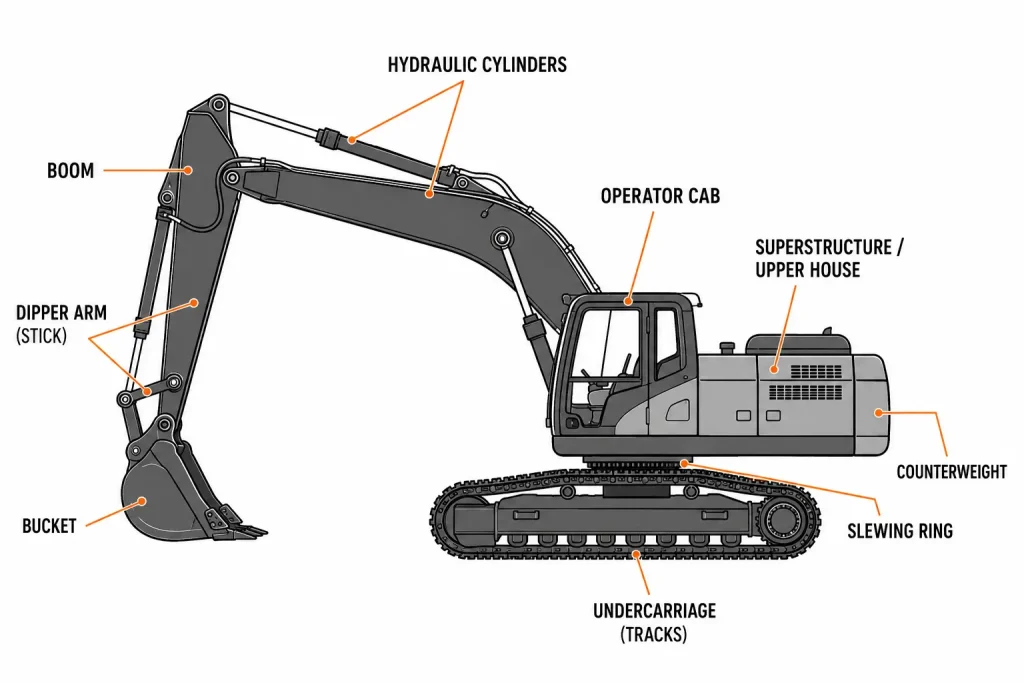
Before examining individual types, it is worth establishing the operating principle common to all excavators. Every excavator consists of three main assemblies: the undercarriage, the superstructure, and the working arm.
The undercarriage provides ground support and mobility. On crawler excavators, the undercarriage carries rubber or steel tracks; on wheeled excavators, it carries axles and tyres. The undercarriage is the machine’s connection to the ground and determines its ground pressure, mobility on different surfaces, and travel speed.
The superstructure, also called the upper structure or house, rotates 360 degrees on a slewing ring mounted on the undercarriage. It carries the engine, hydraulic system, counterweight, and operator’s cab. The ability to rotate the superstructure independently of the undercarriage, positioning the working arm in any direction without moving the machine, is what gives the excavator its operational flexibility.
The working arm consists of the boom, the primary structural arm pinned to the superstructure, and the dipper or stick, which is pinned to the end of the boom. The bucket or attachment is pinned to the end of the dipper. Hydraulic cylinders acting on each element of the arm provide the force for digging, lifting, and placing. The combination of boom, dipper, and bucket geometry determines the excavator’s reach, digging depth, and dump height.
This three-assembly configuration is shared by every excavator type, what differs between types is the form each assembly takes, and the operational capabilities that result.
Also read : How to Build Scaffolding: A Step-by-Step Site Guide
Types of Excavators
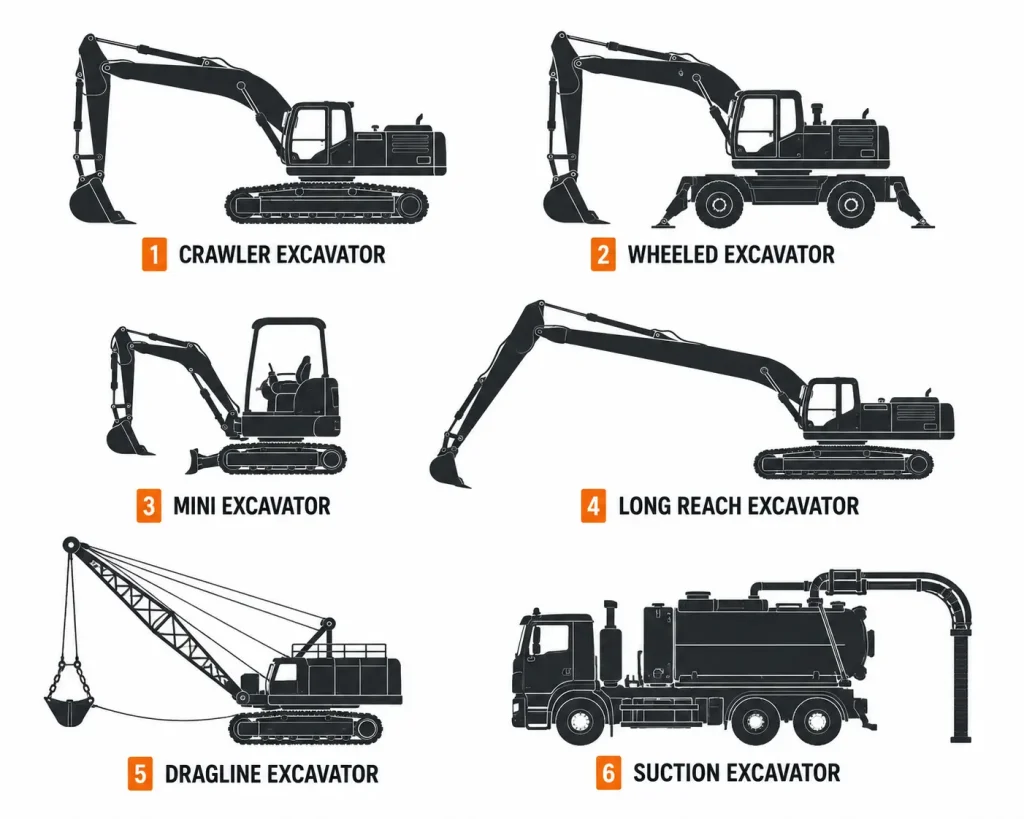
The excavator family covers a wide range of machine sizes, undercarriage configurations, boom types, and specialist variants. Each type has been developed to address a specific set of operational requirements that general-purpose machines cannot meet as effectively.
Crawler Excavator
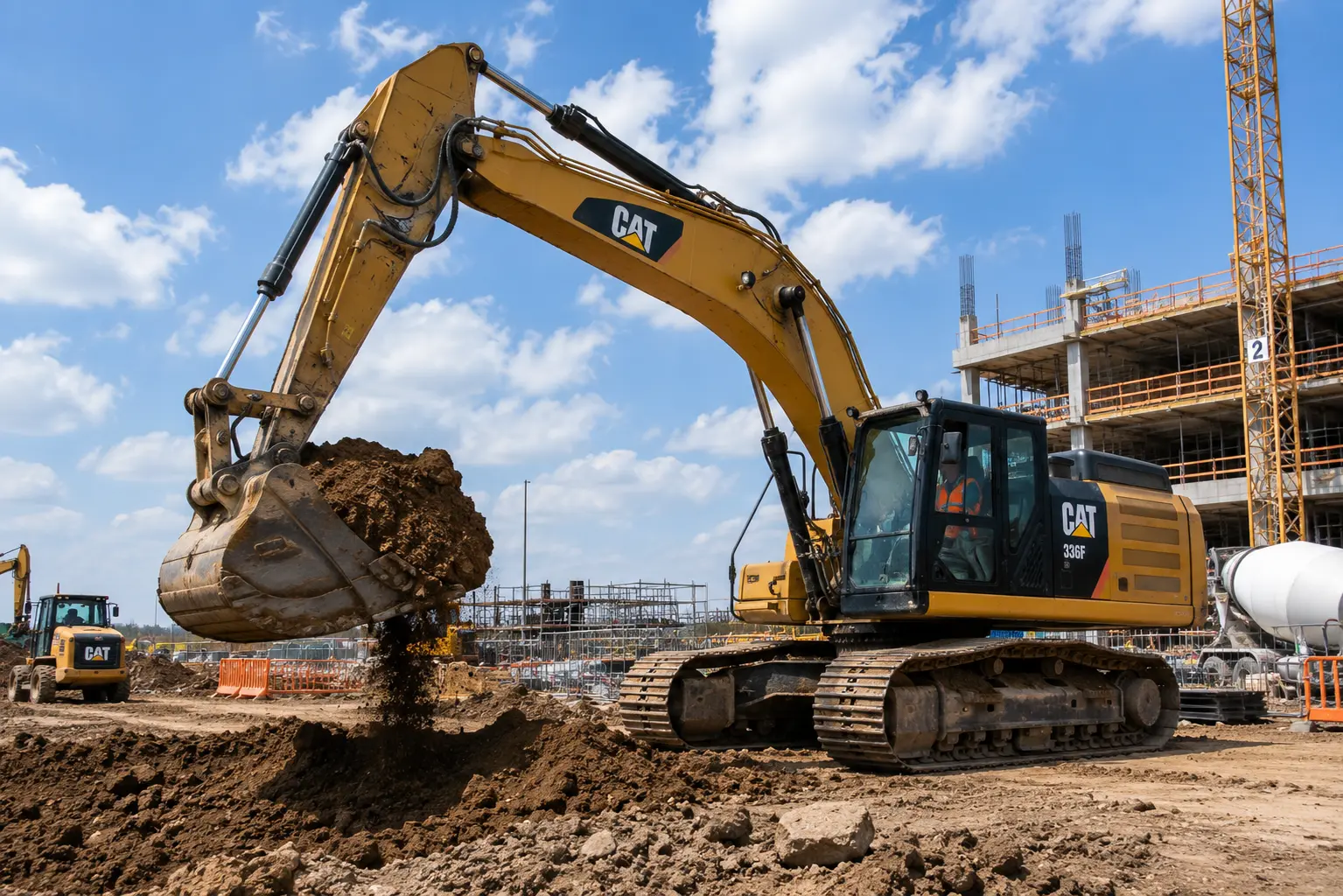
The crawler excavator, also called a tracked excavator, is the most common and most widely recognised excavator type. Its undercarriage carries rubber or steel tracks driven by hydraulic motors, providing the traction, stability, and low ground pressure that allow it to operate on soft, uneven, or sloped terrain where wheeled plant cannot safely work.
Crawler excavators are available across an enormous size range, from compact 1-tonne machines to large mining excavators exceeding 800 tonnes, but the machines most commonly encountered on construction sites fall in the 5 to 50 tonne operating weight range. In this range, the crawler excavator is the default choice for bulk earthmoving, foundation excavation, trench digging, slope cutting, and general site clearance on projects where the machine will remain on site for an extended period.
The tracks that give the crawler excavator its ground capability also impose its primary limitation: it cannot travel on public roads without causing damage to the road surface, and it must be transported between sites on a low-loader trailer. For projects involving frequent moves between sites, or for applications where road travel between work locations is required, this transport overhead is a significant operational cost.
Ground pressure is a critical performance parameter for crawler excavators on soft or waterlogged ground. Wide track shoes distribute the machine’s weight over a larger contact area, reducing ground pressure, but even with wide tracks, heavy crawler excavators can become stuck on very soft or saturated ground. The same ground bearing assessment principles that apply to crane positions and scaffold base loads apply to crawler excavator operating positions on poor ground, as detailed in guidance on lifting equipment safety and ground assessment for heavy plant operations.
Wheeled Excavator
The wheeled excavator mounts the standard excavator superstructure and working arm on a rubber-tyred axle undercarriage rather than tracks. This gives it the road mobility that crawler excavators lack, wheeled excavators can travel on public roads at speeds of up to 35 kilometres per hour, moving between work locations without requiring a low-loader.
Wheeled excavators are the standard choice for utility and infrastructure work in urban environments, water main replacement, gas pipe installation, cable ducting, road drainage, where the machine must move frequently between excavation points along a road corridor, often travelling on the road surface between locations. The road mobility eliminates the transport cost and scheduling overhead of moving a tracked machine by low-loader for each individual dig.
The trade-off for road mobility is reduced stability and higher ground pressure compared to a tracked machine of similar weight. Most wheeled excavators are fitted with outriggers, extendable stabiliser legs that deploy from the undercarriage before digging begins, widening the stability footprint and reducing the load on the tyres. Even with outriggers deployed, the wheeled excavator’s digging forces and reach are typically somewhat lower than an equivalent crawler machine.
On soft or rough terrain, the wheeled excavator’s tyre-based undercarriage reaches its limits more quickly than a crawler’s tracks. For work in confined urban sites on firm ground, the wheeled excavator’s combination of road mobility, adequate digging performance, and compact footprint makes it the most practical and economical choice.
Mini Excavator
The mini excavator, also called a compact excavator or micro excavator, depending on its size, covers the operating weight range from approximately 0.8 to 8 tonnes. Within that range, it is the most widely used excavator type for applications where access is restricted, ground bearing capacity is limited, or the scale of work does not justify a full-size machine.
The defining characteristic of the mini excavator is its compact footprint. The narrowest mini excavators can pass through a standard doorway, some models retract their undercarriage width to as little as 700 mm for access through restricted openings, then extend back to full width for operation. This makes the mini excavator the only practical excavator choice for work inside existing buildings, in rear gardens accessible only through a house, in narrow urban alleys, or in any location where a full-size machine simply cannot fit.
Mini excavators are typically fitted with a zero tail swing or reduced tail swing superstructure, the counterweight does not protrude beyond the track width when the superstructure rotates, allowing the machine to swing freely in confined spaces without the counterweight striking adjacent walls, fences, or structures. This zero tail swing design is a critical feature for confined site work and distinguishes purpose-built mini excavators from simply small versions of standard machines.
The compact size and low weight of mini excavators also makes them suitable for use on floors, decks, and structures where the ground bearing capacity or structural capacity would not support a larger machine. Mini excavators are widely used in basement excavation, underpinning, service trench work in occupied buildings, landscaping, and any application combining restricted access with excavation requirements.
Also read : Boom Lift vs Cherry Picker: Key Differences Explained
Long Reach Excavator
The long reach excavator modifies the standard boom and dipper configuration to achieve exceptional horizontal reach, typically between 15 and 25 metres from the machine’s centre, at the cost of digging force and lifting capacity. The extended boom sections are longer and more slender than a standard excavator’s, positioning the bucket at a far greater distance from the machine.
Long reach excavators are used where the excavation or material handling location is inaccessible to a standard machine positioned at the work face, river dredging and channel maintenance where the machine must operate from the bank rather than entering the water, slope stabilisation where the machine cannot safely descend to the working face, demolition of structures over water or in locations where machine access is restricted, and harbour or coastal maintenance work.
The long reach configuration significantly reduces the machine’s bucket breakout force and its safe lifting capacity at reach. The machine must be carefully positioned on firm, level ground, the extended boom creates high overturning moments that a standard undercarriage must resist at the base. Load charts for long reach configurations must be consulted before any lifting operation, applying the same principles used in reading capacity charts for mobile cranes, an approach detailed in guidance on how to read a crane load chart for safe lifting and capacity assessment.
Dragline Excavator
The dragline excavator is a large, specialist machine that operates on a fundamentally different principle from hydraulic excavators. Instead of a hydraulic arm pushing and pulling a bucket, the dragline uses a long lattice boom and a hanging bucket suspended on wire ropes. The bucket is cast forward by the boom, falls under gravity, and is dragged back toward the machine by a drag rope, filling with material as it is pulled across the surface.
Dragline excavators are used for large-scale earthmoving operations where the machine must move large volumes of soft material, overburden removal in open-cut mining, large drainage channel excavation, land reclamation, and dam construction. The dragline’s reach, determined by the length of its lattice boom, can exceed 100 metres on the largest machines, far beyond what any hydraulic excavator can achieve.
The dragline’s size, its lattice boom, and its walking or crawler undercarriage make it a site-specific machine, it is assembled on site and does not travel between projects. On major infrastructure projects such as large drainage schemes and mining operations in the region, the dragline remains the most economical solution for moving very large volumes of soft material at long reach, where no hydraulic excavator can match its production rate.
Suction Excavator
The suction excavator, also called a vacuum excavator or hydro excavator, uses pressurised water or air to break up the ground and a powerful vacuum system to lift the resulting slurry or spoil into a debris tank on the vehicle. It is not a hydraulic excavator in the conventional sense but is categorised as an excavation machine because its primary function is ground removal.
Suction excavators are the standard choice for excavation in locations where conventional mechanical excavation would damage buried services, gas pipes, electricity cables, water mains, fibre optic cables. The suction process exposes buried services without the risk of strike that mechanical bucket excavation carries. For utility infrastructure work in congested urban environments, where the density of buried services makes mechanical excavation too risky, the suction excavator has become an essential site tool.
Skid Steer Excavator and Backhoe Loader
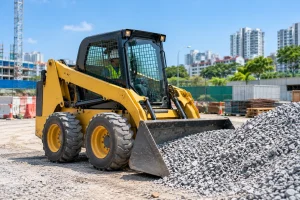
The skid steer loader fitted with an excavator attachment, and the backhoe loader, a machine with a loader bucket at the front and a digging arm at the rear, both perform excavation functions on construction sites, and are often referred to informally as excavators. Strictly, neither is an excavator in the same sense as the machines described above: the skid steer is a loader with an attachment, and the backhoe loader is a dual-function machine rather than a dedicated excavator.
Both are practical tools for small-scale excavation on sites where a dedicated excavator is not justified, residential groundworks, agricultural drainage, small utility connections, and general site maintenance. The backhoe loader’s combination of front loading and rear digging capability makes it particularly versatile on small sites where multiple functions must be performed by a single machine.
Excavator Attachments and Their Applications
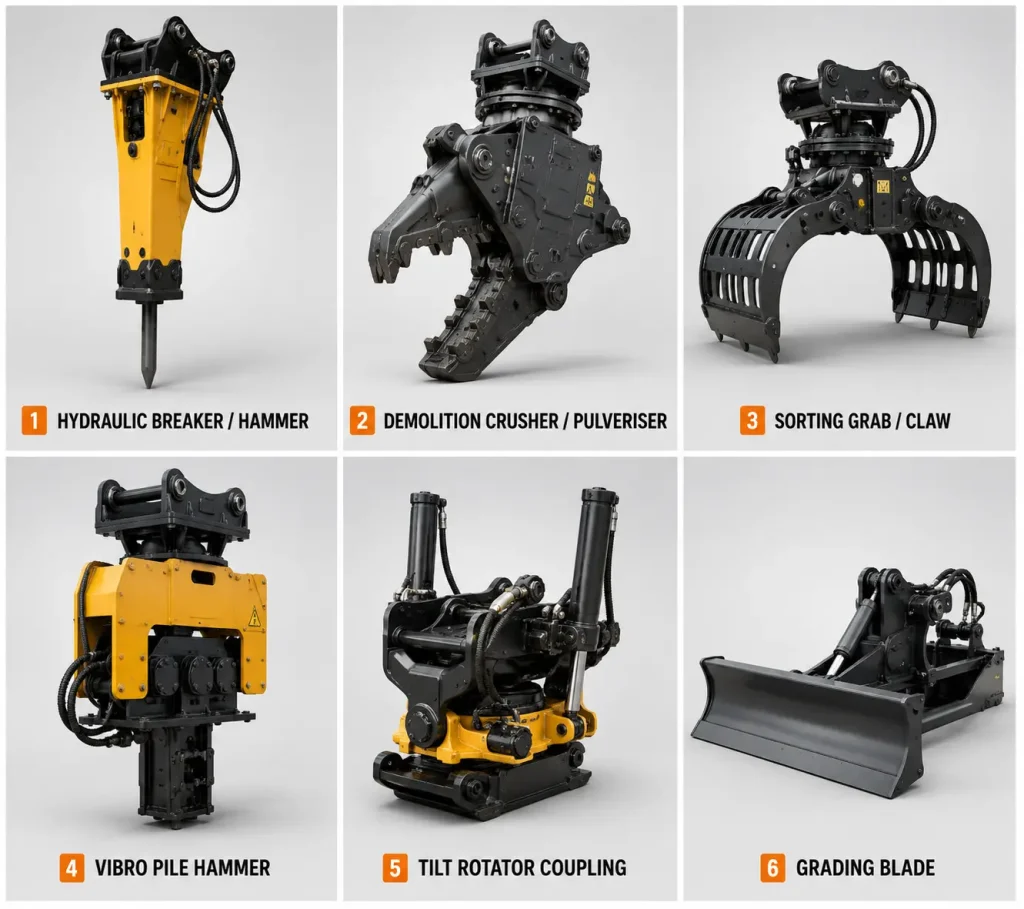
The excavator’s value as a multipurpose site machine is amplified by its attachment system. The same machine that digs with a bucket can be fitted with alternative attachments to perform fundamentally different tasks, without the cost and logistics of bringing in separate specialist plant.
- Hydraulic breaker
Replaces the bucket with a percussive chisel for breaking reinforced concrete, rock, and hard ground. Used in demolition, road breaking, and rock excavation where a bucket cannot penetrate the material.
- Crusher or pulveriser
A jaw-type attachment that crushes concrete structures, enabling demolition and size reduction in a single operation. Used in building demolition and concrete recycling.
- Sorting or demolition grab
A claw attachment for handling and sorting demolition debris, placing precast concrete elements, and handling large irregular materials.
- Vibro hammer or hydraulic pile driver
Replaces the bucket with a pile driving or extraction tool. The excavator becomes a piling machine capable of driving sheet piles, H-piles, or tube piles, a function relevant to many of the foundation types used in building and civil construction, as described in the guide to types of pile foundation and when each is applied.
- Tilt rotator
A coupling device that allows the bucket or attachment to tilt and rotate independently of the dipper arm, giving the operator far greater control over bucket position without repositioning the machine. Reduces machine movements and improves productivity on complex excavation tasks.
- Grading blade
A flat blade fitted in place of the bucket for grading and levelling. Used for final trim of formation levels, slope grading, and site preparation.
The choice of attachment must match not only the task but the excavator’s hydraulic flow and pressure output. High-flow attachments, breakers, crushers, tilt rotators, require auxiliary hydraulic circuits at the correct flow rate. Fitting an attachment with a flow requirement that exceeds the excavator’s output, or using an attachment on an excavator without the correct hydraulic circuit, can damage both the attachment and the machine.
Choosing the Right Excavator Type
The correct excavator for any project is determined by the intersection of five key variables:
- Access constraints
Can a full-size machine reach the work location, or is access restricted by width, headroom, or structural capacity? If access is restricted, a mini excavator or wheeled excavator may be the only viable option.
- Ground conditions
Is the ground firm enough for a wheeled machine, or do soft or uneven conditions require a tracked undercarriage? Is the ground bearing capacity sufficient for the machine’s operating weight and the loads it will impose during digging?
- Required reach and depth
Does the work require standard reach, or is the excavation location offset from where the machine can be positioned, requiring a long reach configuration?
- Volume and duration of work
Is the volume of work sufficient to justify mobilising a large crawler excavator, or is a smaller machine more economical for the scope of work involved?
- Road mobility requirement
Will the machine need to travel between multiple locations on public roads, or will it remain on a single site for the duration of the project?
For projects where excavation must be coordinated with crane lifts, piling, concrete placement, and other plant operations, the site layout and the management of plant movements and exclusion zones becomes a critical planning task, one covered in practical guidance on construction site planning and the coordination of heavy plant on active sites.
Also read : Rough Terrain Crane: How It Works and When to Use It
The Right Excavator for Every Site and Task
No single excavator type is the best choice for all applications. The crawler excavator’s ground capability and digging power make it the default choice for large earthmoving operations, but it cannot match the mini excavator’s access in confined spaces, the wheeled excavator’s road mobility, or the long reach excavator’s ability to work at distance from the machine’s position. Each type occupies a defined operational niche, and the correct selection is the one whose capabilities most closely match the specific demands of the project.
RR Machinery provides a comprehensive range of construction and earthmoving equipment for sale and rental, including excavators, bulldozers, forklifts, boom lifts, and power generation solutions, all maintained to full operational standard and supported by experienced equipment specialists. Explore our full range of construction and earthmoving equipment solutions, or contact our team for practical advice and a clear quotation matched to your site conditions, access requirements, and project scope.