What Is a Front End Loader?
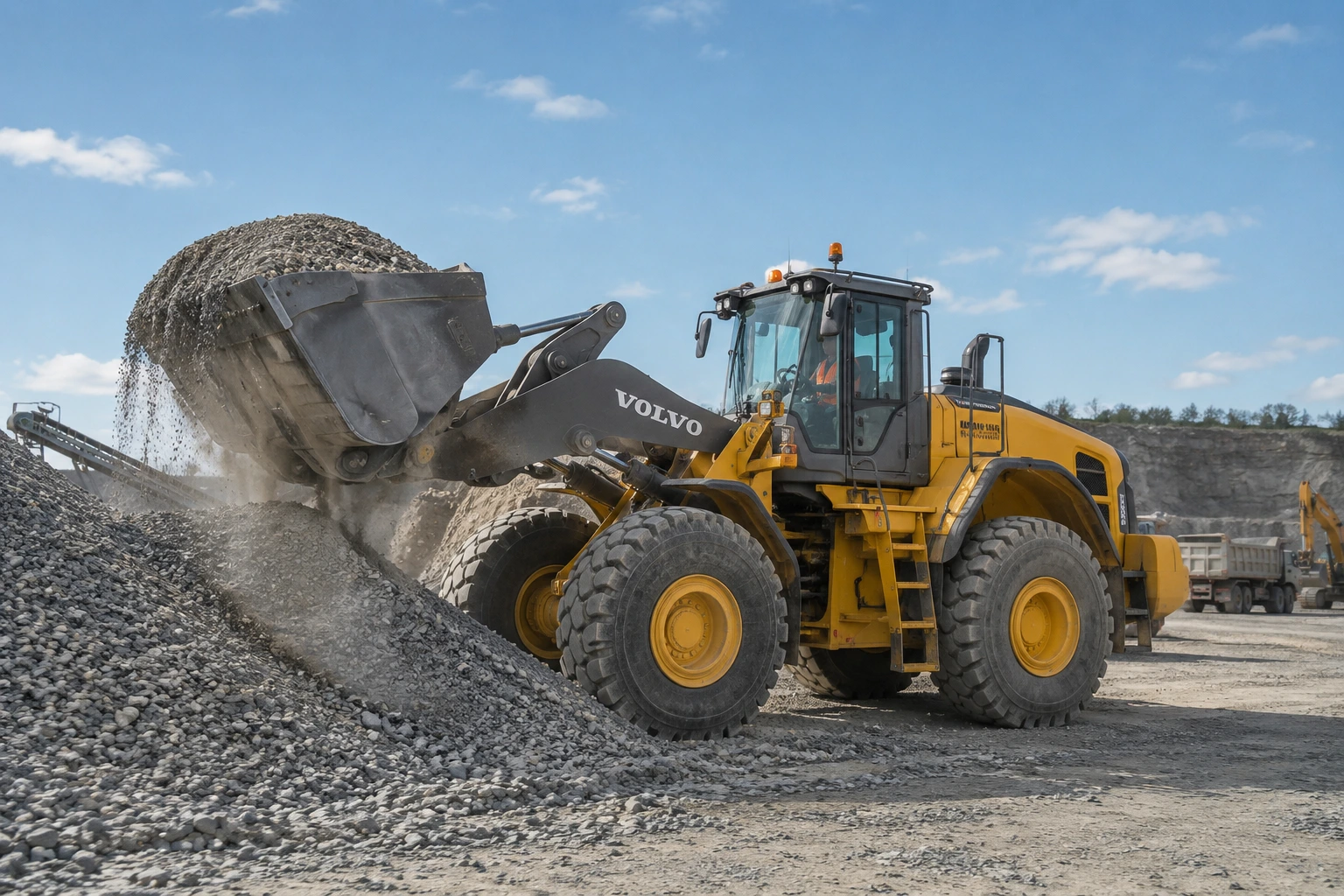
A front end loader, also called a wheel loader, bucket loader, or payloader, is a heavy equipment machine that uses a large hydraulically operated bucket mounted on the front of the machine to scoop, lift, carry, and deposit bulk material. The bucket is attached to a pair of arms, called lift arms or boom arms, that extend from the front of the machine and are raised and lowered hydraulically. The bucket itself tilts forward and back on the lift arms, controlled by a separate set of hydraulic cylinders, allowing the operator to curl the bucket to retain material during travel and to dump the load at the destination. The front end loader is self-propelled on large rubber tyres, typically four large-diameter tyres of equal or similar size, giving it good ground clearance, adequate traction on firm ground, and the ability to travel at road speeds between work locations on site. Most loaders are articulated, the front and rear sections of the machine are connected by a central pivot joint, allowing the front and rear to steer independently. This articulated steering gives the loader a tight turning radius relative to its size, enabling it to manoeuvre in the confined areas of a quarry face, a stockpile, or a loading dock without the long reversing manoeuvres that a rigid-frame machine would require. The loader’s operating cycle is simple and highly repetitive: drive forward into the material pile to fill the bucket, reverse to pull the bucket clear, travel to the dump point, raise the bucket and tip the load, then return to the pile. This cycle can be completed in under a minute on a well-managed site, making the front end loader one of the highest-productivity machines available for loading trucks, feeding crushers, building stockpiles, and clearing material from open areas.Also read : Types of Graders: How Each Works and When to Use One
Key Components of a Front End Loader
-
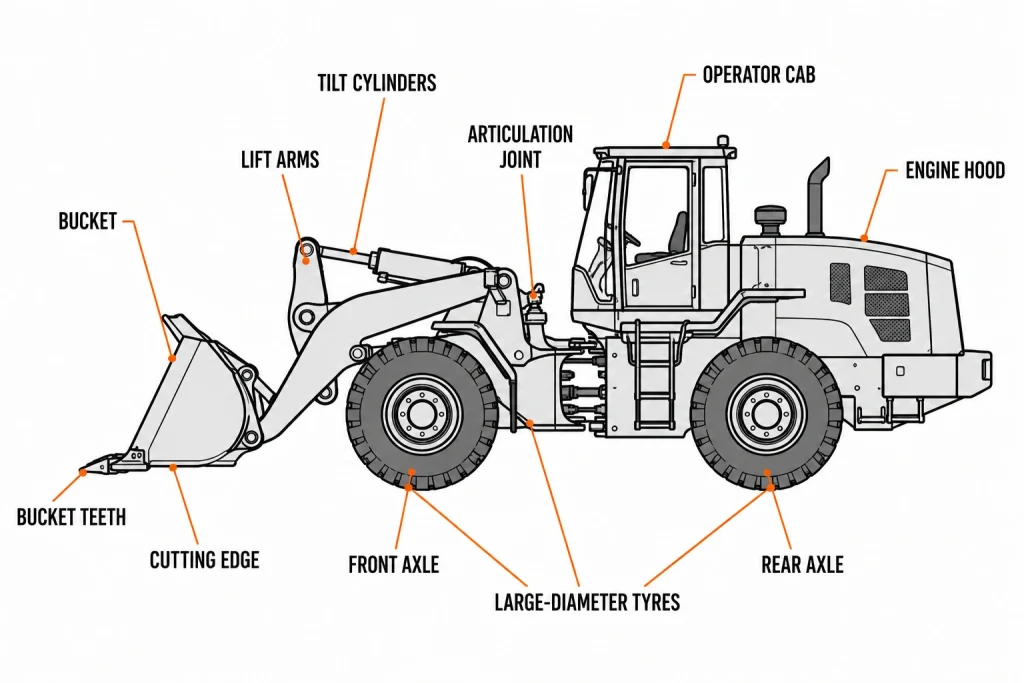
- Bucket
The primary working attachment. Standard loader buckets are available in widths from approximately 2.0 to 5.0 metres and in capacities from less than 1 cubic metre on compact models to over 20 cubic metres on the largest mining loaders. The bucket’s cutting edge, the hardened steel lip at the bottom of the bucket, penetrates the material pile during the loading pass. Bucket teeth are fitted to some configurations to improve penetration into harder materials.
-
- Lift arms
The structural arms that connect the bucket to the machine frame. The lift arms are raised and lowered by hydraulic cylinders, controlling the bucket height from ground level to full dump height. Lift arm geometry determines the loader’s maximum dump height and its reach at full height, both critical parameters for loading trucks and feeding elevated hoppers.
-
- Tilt cylinders
The hydraulic cylinders that control bucket tilt, curling the bucket back to retain material during travel and tilting it forward to dump the load. The tilt force of these cylinders determines the loader’s ability to penetrate hard or compacted material.
-
- Articulation joint
The central pivot that connects the front and rear frames of the machine. The articulation angle, typically ±40 degrees, determines the machine’s minimum turning radius. The articulation joint is a high-stress component subject to significant wear and must be regularly inspected and maintained.
-
- Powershift transmission
Most wheel loaders use a powershift or torque converter transmission that allows the operator to change between forward and reverse without using a clutch, enabling the rapid direction changes of the loading cycle without transmission damage. The transmission’s ability to handle continuous forward-reverse cycling is a key durability requirement for loader transmissions in high-cycle applications.
-
- Tyres
The loader’s tyres must be matched to the operating surface and the load. Rock-service tyres with reinforced sidewalls are specified for quarry and construction site use where tyre damage from sharp material is a risk. Smooth-tread or block-tread tyres are used on soft or muddy ground. Tyre management, monitoring wear, inflation pressure, and damage, is one of the highest ongoing maintenance costs in loader operations.
Types of Front End Loaders
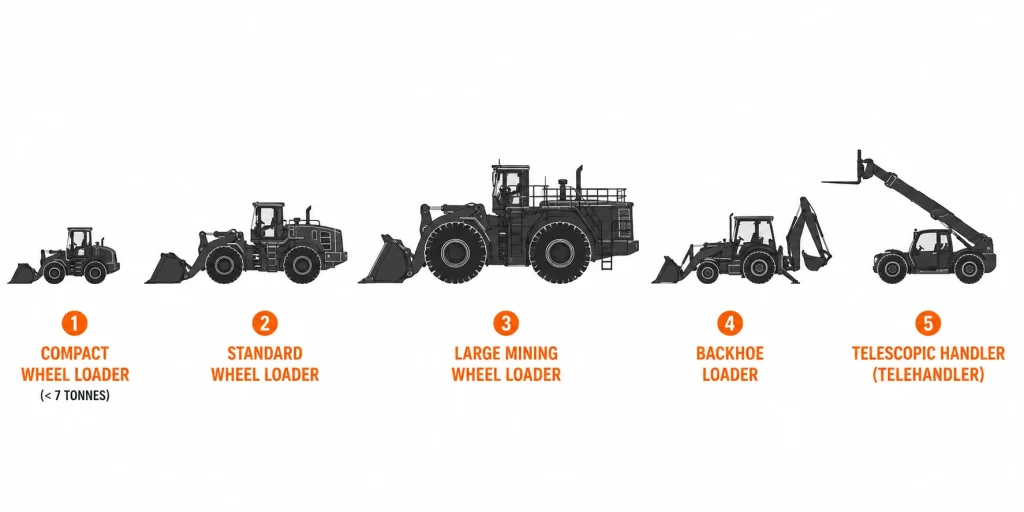 The front end loader family covers a wide range of machine sizes, configurations, and specialisations. Each type is optimised for a different scale of operation, a different material, or a different site environment.
-
-
Compact Wheel Loader
-
The compact wheel loader, operating weight typically below 7 tonnes, bucket capacity below 1 cubic metre, is designed for confined sites where a full-size loader cannot manoeuvre and where the volume of material to be handled does not justify a larger machine. Compact loaders are widely used in landscaping, small construction projects, municipal maintenance, road repair operations, and agricultural applications.
Their compact dimensions, typically less than 2.0 metres wide, allow them to work in spaces inaccessible to standard loaders. Many compact models are fitted with a universal quick-coupler that accepts a wide range of attachments, buckets, forks, sweepers, snow blades, making them genuinely multipurpose machines on small sites.
Compact loaders are sometimes confused with skid steer loaders, a related but distinct machine type in which the machine steers by running the wheels on one side faster than the other, rather than by articulation. Skid steer loaders are more manoeuvrable in very tight spaces but less stable under load and less comfortable for the operator over extended shifts.
-
-
Standard Wheel Loader
-
The standard wheel loader, operating weight from approximately 8 to 30 tonnes, bucket capacity from 1.5 to 5 cubic metres, is the most widely used loader configuration across construction, quarrying, recycling, and municipal operations. It is the machine most people picture when they hear “front end loader”, a mid-size articulated machine on four large tyres, with a bucket capable of loading a standard articulated dump truck in three to four passes.
Standard wheel loaders are the default choice for loading trucks on construction sites, moving aggregates in quarries and concrete plants, handling recycled materials at transfer stations, and managing stockpiles at ports and distribution yards. Their combination of bucket capacity, travel speed, and fuel efficiency makes them highly productive in the loading cycle at costs that justify their deployment on projects of any significant duration.
On construction sites where the loader must work alongside excavators, bulldozers, and motor graders in a coordinated earthmoving programme, understanding how each machine contributes to the overall production cycle, and how they are sequenced to avoid conflicts and maximise output, is central to effective construction site planning and heavy plant coordination on civil projects.
-
-
Large and Mining Wheel Loader
-
The large wheel loader, operating weight from 30 to over 100 tonnes, bucket capacity from 5 to 20-plus cubic metres, is purpose-built for high-production mining, quarrying, and port operations where the daily material volumes and the size of haul trucks require a loading machine of correspondingly large capacity.
Large mining loaders can fill a 100-tonne articulated haul truck in three to four passes, matching the loading rate to the truck cycle time and maximising fleet productivity. Their tyres alone may exceed 3.5 metres in diameter, and their operating weight on poor ground creates significant ground bearing demands that must be assessed before deployment in the same way as any other heavy plant.
The capital and operating cost of a large mining loader is substantial, these machines represent a significant investment decision that is justified only by sustained high-production operation. For projects where the production requirement is below the level that justifies a large loader, a standard wheel loader or a fleet of smaller machines is more economical.
-
-
Backhoe Loader
-
The backhoe loader is a dual-function machine, it combines a front-mounted loader bucket with a rear-mounted excavator arm. The front bucket performs the same loading and material-moving functions as a standard wheel loader at a smaller scale. The rear arm digs, trenches, and places material with the precision of an excavator. The combination in a single machine is highly practical for small construction projects, utility work, and municipal operations where both functions are needed but neither justifies a dedicated machine.
The backhoe loader’s versatility comes at the cost of compromise in both functions: the front bucket is smaller and less productive than a dedicated loader’s, and the rear excavator arm has less digging force and reach than a dedicated crawler excavator. For operations where either function is the primary activity for most of the working day, a dedicated loader or excavator is more productive and more economical. For operations where both functions are needed in roughly equal measure, the backhoe loader’s dual capability in a single machine is its decisive advantage.
-
-
Telescopic Handler (Telehandler)
-
The telescopic handler, also called a telehandler or reach forklift, is a hybrid machine that combines the rough terrain mobility of a wheel loader with a telescoping boom that extends forward and upward, carrying a fork attachment or a bucket. Unlike a standard loader’s fixed lift arms, the telescoping boom reaches forward beyond the machine’s wheelbase, enabling the telehandler to place loads at height and at horizontal distance, onto scaffolding platforms, into upper-floor openings, or over obstacles, that a standard loader cannot reach.
Telehandlers are widely used in construction for placing materials at height, delivering blocks, timber, and other materials to upper floors of a building under construction, and in agriculture for handling bales and loading trailers. Their combination of rough terrain capability, lifting height, and forward reach fills a gap between the standard wheel loader and the aerial work platform family that neither type alone addresses.
The telehandler’s lifting capability makes it a versatile site machine, but its use for lifting operations must be managed with the same rigour as any other lifting task, the operator must be trained for the lifting function as well as the driving function, and loads must be within the machine’s rated capacity at the relevant boom extension and angle. The principles of safe lifting capacity assessment apply to telehandler operations in the same way they apply to crane and excavator lifting operations, as set out in guidance on how to read a crane load chart for safe capacity assessment.
Front End Loader vs Excavator and Bulldozer
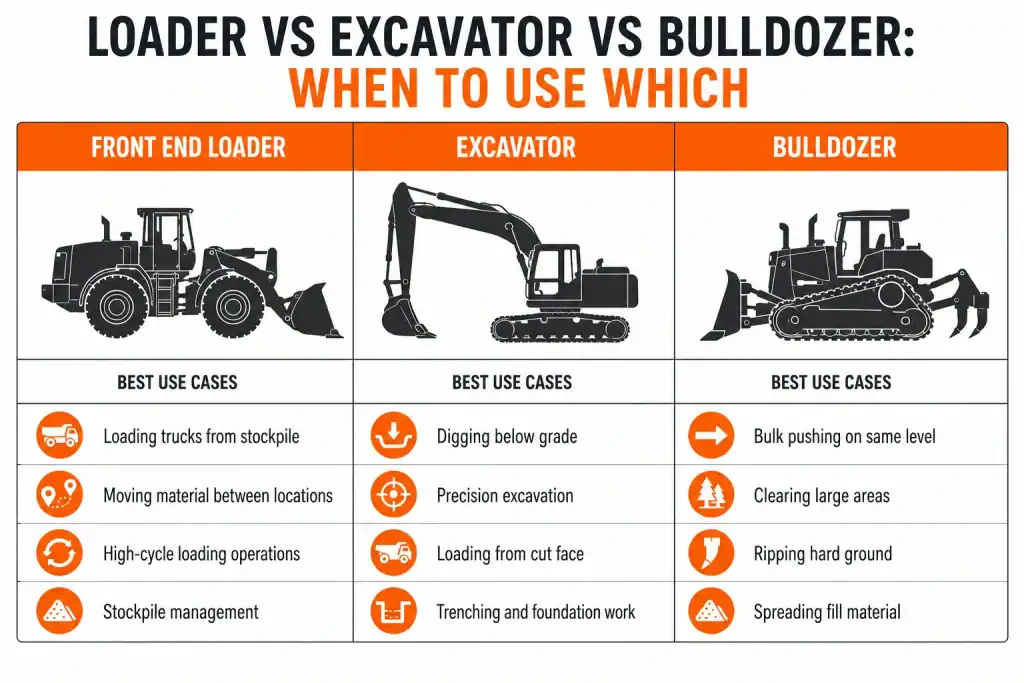 The front end loader is frequently deployed alongside, and sometimes in place of, excavators and bulldozers on construction and earthmoving sites. Understanding when each machine is the more appropriate choice prevents both underperformance and unnecessary cost.
Front end loader vs excavator
The loader is more productive than an excavator for loading trucks from a prepared stockpile or a material pile at surface level, its travel speed, bucket capacity, and rapid cycle time give it a higher loading rate per hour in favourable conditions. The excavator is more productive for breaking into undisturbed ground, excavating below grade, loading trucks from a cut face, and handling material in confined or geometrically complex positions. For a detailed comparison of excavator types and their capabilities relative to other earthmoving plant, the complete guide to types of excavators and their application on construction sites covers every variant in operational detail.
Front end loader vs bulldozer
The bulldozer pushes material, it applies horizontal force to move material across the ground surface without lifting it. The loader scoops material, it picks material up, carries it in the bucket, and deposits it at a specific location. The bulldozer is more productive for bulk pushing over short distances on the same surface level. The loader is more productive when material must be loaded into a truck, deposited at a precise point, or moved between locations where the bulldozer’s linear pushing action is not practical. The operational differences between bulldozers and loaders, and how they are coordinated in an earthmoving programme, are directly related to the comparison covered in the practical guide to bulldozer vs excavator differences and when to use each.
Also read : What Is Mobile Scaffolding? Types, Uses and Safety
Front End Loader Attachments
The front end loader’s hydraulic quick-coupler system allows the standard bucket to be replaced with alternative attachments that extend the machine’s capability to a wide range of material handling tasks:-
- Pallet forks
Replace the bucket with a set of forks for handling palletised loads, blocks, timber packs, and other unitised materials. The loader becomes a large rough terrain forklift, productive for site logistics and materials distribution on construction sites where the volume and weight of materials exceeds the capability of smaller forklifts.
-
- High-tipping bucket
A bucket with a tipping mechanism that allows the load to be dumped at a higher elevation than a standard bucket tip, useful for feeding elevated hoppers, conveyor infeeds, and processing plant intake points.
-
- Grapple bucket
A bucket fitted with hydraulic tines that close over the load, allowing the machine to handle irregular, loose, or bulky material, demolition debris, scrap, timber, and mixed waste, that a standard open bucket cannot retain.
-
- Snow blade or push blade
A wide blade fitted in place of the bucket for snow clearing and light pushing operations. Extends the loader’s usefulness in winter maintenance applications.
-
- Sweeper
A rotary sweeping brush that mounts in place of the bucket for road and yard cleaning, collecting dust, debris, and loose material from paved surfaces.
Safety Requirements for Front End Loader Operations
Front end loader operations carry the same fundamental safety obligations as all heavy equipment on construction and industrial sites. All operators must hold current certification for the machine category. Pre-use inspection must be completed before each shift. Ground conditions must be assessed before the machine is positioned, particularly near excavation edges, embankments, and areas of recently disturbed or filled ground. The loader’s blind spots, the areas around and behind the machine that the operator cannot see from the cab, are a consistent cause of pedestrian contact incidents. All loader operations on sites with pedestrian presence must include: A confirmed exclusion zone around the machine’s operating area, physically marked and enforced. A banksman or traffic marshal where the loader must operate in proximity to pedestrians or other plant. Reversing alarms and camera systems on the machine, now standard on most modern loaders but must be confirmed operational during pre-use inspection. Speed limits for loaders travelling on site roads must be established and enforced. A loaded loader travelling at unrestricted speed on a site road represents a significant hazard to other site users, particularly at blind corners, site entrance points, and areas shared with pedestrian traffic. The full framework of heavy equipment safety requirements, including exclusion zones, operator competency, ground assessment, and plant-pedestrian segregation, that applies to front end loaders is covered in practical guidance on heavy equipment safety and site plant management for construction operations.Also read : How to Choose a Generator: A Practical Buyer’s Guide
The Loader That Builds the Site
The front end loader does not make headlines in the way that long-span bridges or tall cranes do. It does not perform the most technically demanding operations on a construction project. What it does, consistently, productively, and on every site where bulk material must be moved, is the unglamorous but essential work of keeping material flowing: loading the trucks, filling the hoppers, building the stockpiles, and clearing the areas that every other phase of the project depends on. Selecting the right loader type, the right size, the right configuration, the right attachments for the material and the site, is the difference between a materials handling operation that meets its programme and one that becomes a bottleneck. RR Machinery provides a comprehensive range of construction and earthmoving equipment for sale and rental, including wheel loaders, excavators, bulldozers, motor graders, and supporting plant, all maintained to full operational standard and supported by experienced equipment specialists. Explore our full range of earthmoving and construction equipment solutions, or contact our team for practical advice and a clear quotation matched to your site conditions, material volumes, and project programme.