Choosing a boom lift looks simple until the machine arrives. A unit that reaches the right height may not clear the canopy in front of the facade, a powerful diesel model may be banned from the indoor atrium where the work is, or a machine that suits the task may be too wide for the only gate onto site. Each of these mistakes costs time, money, and sometimes a second delivery.
The right boom lift comes from matching the machine to three things: the work itself, the site it has to operate on, and the schedule it has to fit into. This guide walks through the eight factors that decide the choice, explains when each type of boom lift makes sense, covers the common mistakes, and sets out the details to have ready before you book.
Start With the Work, Not the Machine
It is tempting to start by picking a model, but the most reliable approach is to describe the job first. Where exactly is the work, how high and how far from the base is it, what obstacles stand between the machine and the work area, how many people will be on the platform, and what tools or materials will they carry? How long will the work take, and will it move around the site?
Writing these answers down, even roughly, turns a vague request into a clear specification. It also makes conversations with a rental supplier faster and more accurate, because every recommendation can be checked against the same list. If you are new to how these machines move and position their platform, a quick look at how a boom lift works makes the factors below easier to follow.
The Eight Factors That Decide the Right Boom Lift
Each of the following factors can rule a machine in or out. Working through them in order usually narrows the choice to one or two suitable options.
Working Height
Start with the highest point the workers need to reach. Manufacturers usually quote both platform height, the height of the platform floor, and working height, which adds an allowance for the reach of a standing person. Make sure you compare like with like, and choose a machine whose rating comfortably covers the job rather than one that only just reaches it.
A margin matters because the machine may not be able to park directly beneath the work point, and uneven ground or obstacles can reduce the height that is usable in practice. The typical height ranges for different machines are covered in our guide to boom lift sizes.
Horizontal Outreach and Obstacles
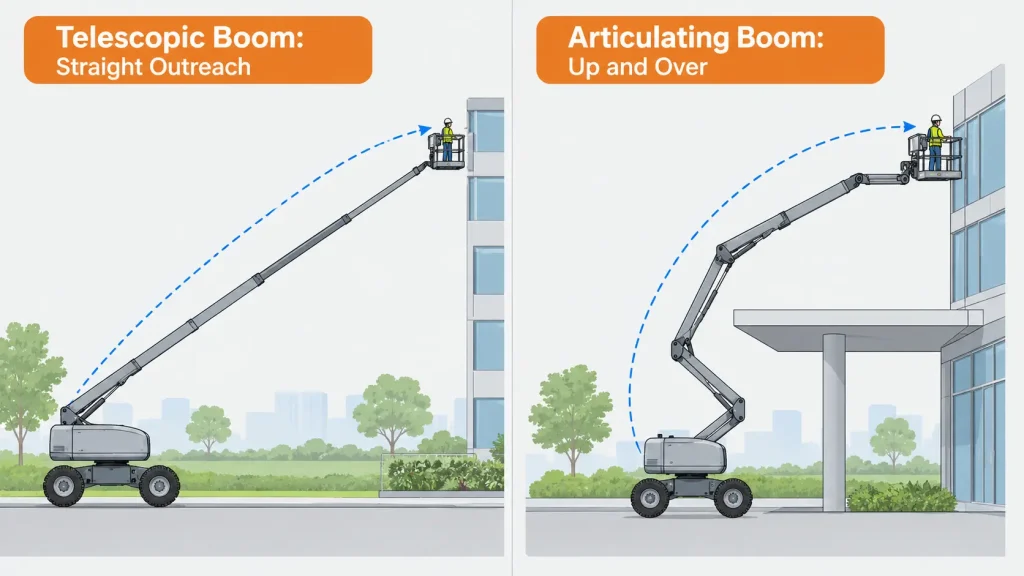
Height is only half of the reach question. If the machine cannot park right next to the work, it will need horizontal outreach to get the platform across the gap, for example over a landscaped area, a canopy, or a row of parked vehicles.
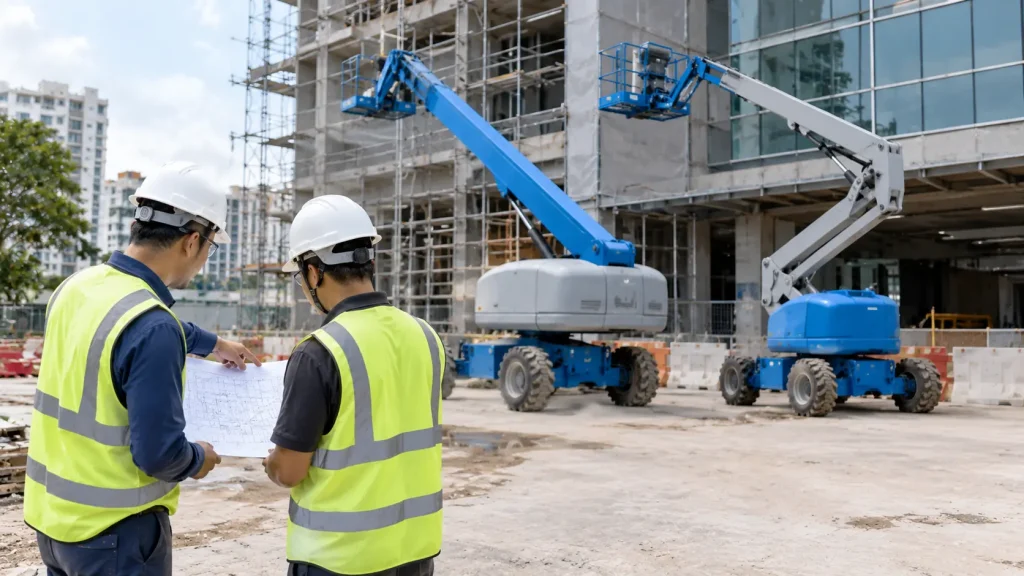
Obstacles also decide the type of boom. Telescopic booms extend in a straight line and offer the greatest outreach, which suits open sites. Articulating booms bend at one or more joints, letting the platform go up and over obstacles or into tight spaces, which is why an articulating boom lift is often the better choice around buildings, structures, and plant rooms.
Platform Capacity
Add up the weight of everyone who will be on the platform, plus their tools and any materials, and compare it with the machine’s rated platform capacity. Some boom lifts have more than one rating, with a higher capacity available only within a restricted range of movement, so check which rating applies to the way you plan to use the machine.
Overloading is one of the most common causes of boom lift incidents, and the rules for staying within the limit are explained in our guide to boom lift weight limits. If the job involves heavy materials rather than people and tools, a different machine, such as a telehandler or crane, may be the better tool.
Power Source and Indoor or Outdoor Use
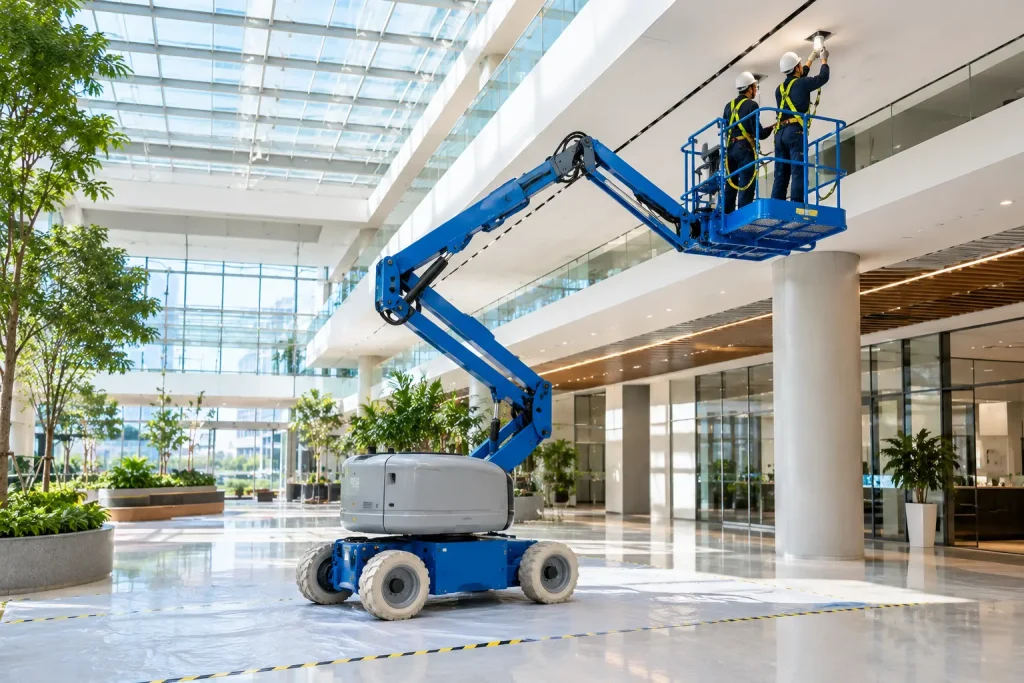
Electric boom lifts are quiet and produce no exhaust, so they suit indoor work, enclosed spaces, and sites with noise restrictions, and they are often fitted with non marking tyres to protect finished floors. Diesel machines have the power and endurance for long outdoor shifts and rough ground. Hybrid models combine both, switching to electric indoors and diesel outdoors.
Ask where the machine will spend most of its time, and whether there is a convenient place to charge electric units overnight. A machine that must move between indoor and outdoor areas during the job is a strong case for a hybrid.
Ground Conditions
The ground under the machine matters as much as the height above it. Slab and paved surfaces suit standard two wheel drive machines, while soft, uneven, or unpaved ground calls for rough terrain models with four wheel drive, oscillating axles, and suitable tyres.
Check the slope of the ground as well, since every machine has a limit on the gradient it can travel and operate on. Where the ground is uncertain, ask whether ground mats or other measures are needed to spread the load.
Site Access, Footprint, and Floor Loading
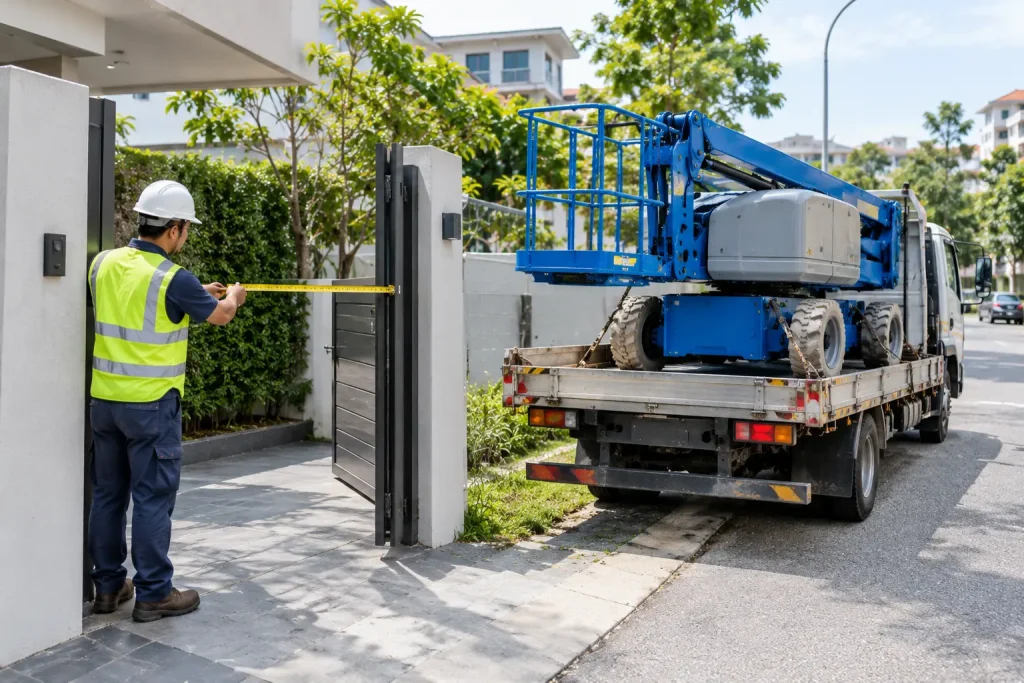
A boom lift has to reach the work area before it can do anything. Measure gates, doorways, ramps, and gaps between buildings, and check overhead clearance along the route. Narrow and compact machines are available for tight sites, and machines with reduced tail swing are easier to use beside walls and traffic.
Indoors or on suspended slabs, the weight of the machine and the load it places on each wheel must be within what the floor can carry. If you are working on an upper floor, a basement roof, or a raised deck, confirm the floor loading capacity with the building’s engineer before booking.
Weather and Wind Exposure
Outdoor work at height is affected by wind, which is stronger at the platform than at ground level. Every boom lift has a maximum rated wind speed, and machines rated for indoor use only must not be used outside at all. For exposed sites, tall structures, and coastal areas, choose a machine rated for outdoor use and plan for days when the work may have to stop.
Singapore’s frequent thunderstorms and sudden squalls make this a practical concern, not a theoretical one, so build some flexibility into the schedule for weather delays.
Duration and Transport
How long the machine is needed affects both cost and the type of arrangement that makes sense, from a single day to a long term hire spread across project phases. Transport matters too. Large self propelled machines arrive on a truck or low loader, so the delivery route and unloading area must suit a heavy vehicle.
For small jobs across several nearby locations, a towable boom lift can be moved behind a suitable vehicle without arranging a separate delivery each time, which can save time and money on short, scattered tasks.
Telescopic, Articulating, or Towable?
Once the eight factors are clear, the type of boom lift usually picks itself. Telescopic booms suit open sites where the greatest height and outreach are needed with few obstacles in the way. Articulating booms suit work around buildings, structures, and congested areas, where the platform has to go up and over or reach into tight spots. Towable booms suit light, short jobs at several locations, especially where moving a large machine would be impractical.
Within each type, there are further options such as compact models, rough terrain versions, and electric or hybrid power, so it is worth comparing the full range before deciding.
Also read: Types of Boom Lifts: Which One Does Your Job Need?
When a Boom Lift Is Not the Right Choice
Sometimes the honest answer is that a different machine would do the job better. If the work is directly overhead on level ground, such as ceilings, lighting, or overhead services, a scissor lift offers a larger, more stable platform at a lower cost. If several workers need long term access to the same area, mobile scaffolding may be more practical. For work along roads where the machine must move frequently, a vehicle mounted cherry picker can be faster to set up.
Comparing the options against the same job description makes the choice straightforward, and the most common comparison is covered below.
Also read: Boom Lift vs Scissor Lift: Which One Should You Choose?
Common Mistakes When Choosing a Boom Lift
Most poor choices come from a small number of avoidable mistakes:
- Choosing by platform height when the job needs working height, or the other way round
- Ignoring outreach, so the machine reaches the height but not the work point
- Forgetting the weight of tools and materials when checking platform capacity
- Booking a diesel machine for indoor work, or an indoor only machine for outdoor work
- Not measuring gates, doorways, and overhead clearance on the access route
- Overlooking floor loading on slabs, decks, and upper floors
- Assuming the weather will cooperate on an exposed site
A few minutes spent checking each of these before booking avoids most delays and second deliveries.
Operators, Training, and Safety Checks
The right machine still depends on the right people. Operators should be trained and familiar with the specific type and model they will use, and a supervisor should confirm that the machine, the site, and the work plan all match before work begins. Recognised training schemes, such as those from IPAF, set out the skills operators need for different categories of machine.
Every shift should start with a pre use inspection and a check of the work area, including ground conditions, overhead hazards, and exclusion zones. Singapore’s Ministry of Manpower publishes detailed Workplace Safety and Health guidance covering work at height and the safe use of aerial work platforms. A practical walkthrough of safe operation, from checks before use through to shutdown, is available below.
Also read: How to Operate a Boom Lift Safely: A Step-by-Step Guide
Boom Lift Rental in Singapore
The fastest way to the right machine is to share the details that the eight factors depend on. When you contact the team, it helps to have the working height and outreach needed, any obstacles between the machine and the work, the number of people and the weight of tools and materials on the platform, whether the work is indoors or outdoors, the ground and access conditions, and how long you expect to need the machine. With these details, a suitable model can be recommended from the start rather than adjusted after delivery.
RR Machinery Pte Ltd offers an extensive range of boom lifts for indoor and outdoor work at height, backed by factory certified technicians and full servicing support. Contact us today for expert advice on the right machine and a quote tailored to your project.