Asking “what size boom lift do I need” is really asking three separate questions at once, how high does the platform need to reach, how far out does it need to extend, and how much weight does the platform need to carry. Boom lifts are manufactured across a wide range of sizes to answer these three questions differently, from compact machines built for indoor ceiling work to massive units capable of reaching well over 50 metres on major industrial projects.
This guide breaks boom lift sizing down into three practical size classes, compact, mid-size, and large, covering the typical working height, outreach, and platform capacity in each category, along with the tasks each size class is actually built for.
What Determines Boom Lift Size?
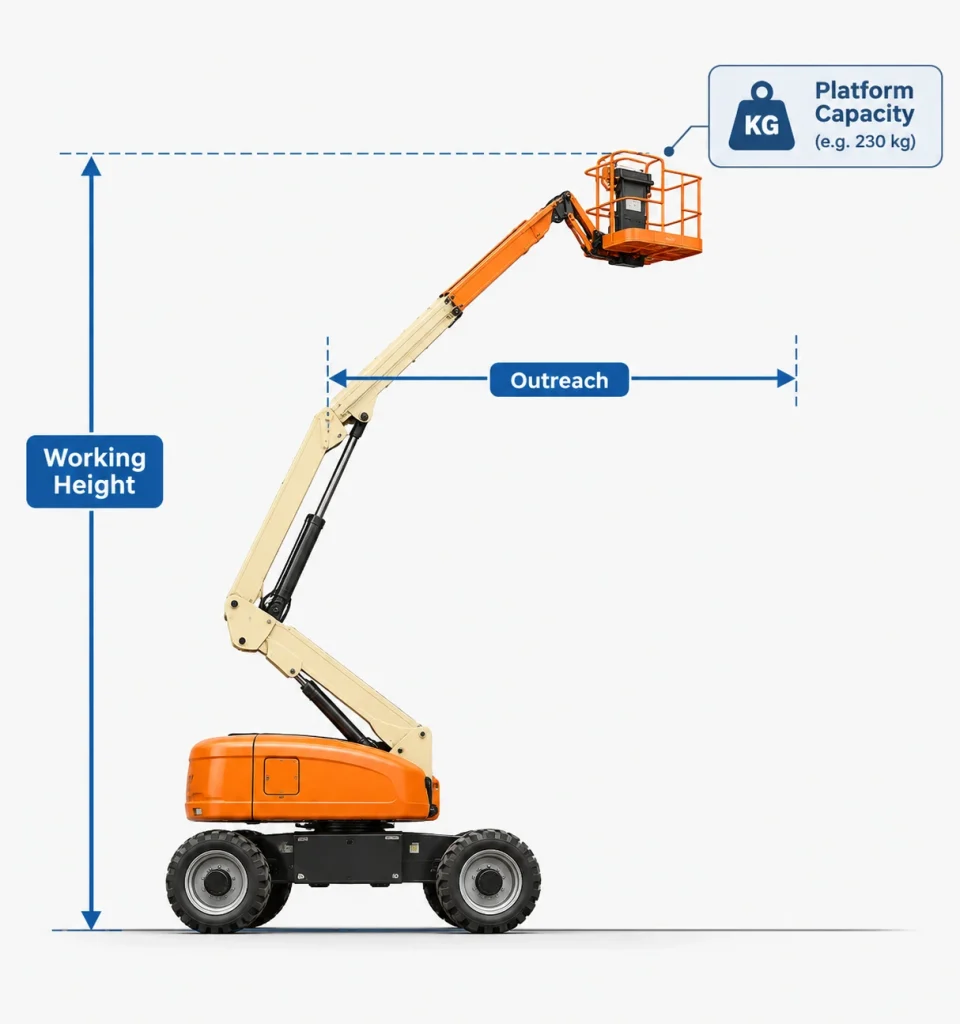
Three dimensions define a boom lift’s size in practice: working height, the maximum vertical reach from the ground to the platform floor; horizontal outreach, how far the platform can extend sideways from the machine’s base; and platform capacity, how much combined weight of workers, tools, and materials the platform can safely carry. These three figures do not scale together in a fixed ratio, a taller machine does not automatically mean proportionally greater outreach or capacity, which is why size needs to be assessed across all three dimensions rather than height alone.
Manufacturers publish these three figures on a machine’s data plate and specification sheet, typically alongside a capacity chart showing how platform capacity changes as the boom extends to its full outreach at a given height. Reading these figures together, rather than focusing on working height as a single headline number, is what actually determines whether a specific boom lift can complete a specific task, since a machine with an impressive maximum height but limited outreach may still be unable to reach a point positioned some distance to the side of where it can be positioned on the ground.
Size also applies across both major boom lift designs, articulating and telescopic, a distinction covered separately below, since a compact, mid-size, or large classification exists within each design type rather than describing a single product line.
Also read: Types of Boom Lifts: Which One Does Your Job Need?
Compact Boom Lifts
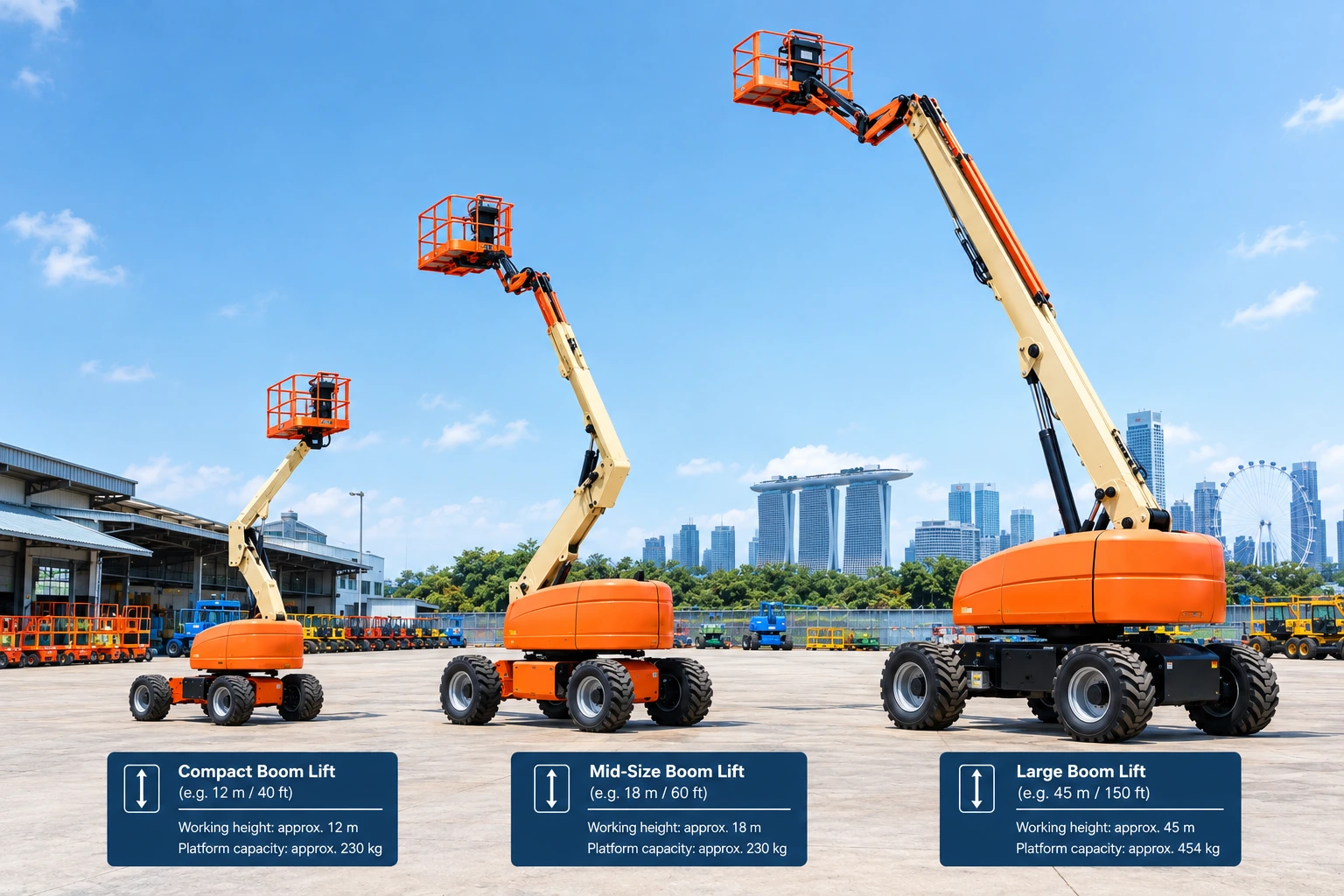
Compact boom lifts sit at the smaller end of the size range, prioritising manoeuvrability and a reduced footprint over maximum height and capacity.
Typical Specifications
Compact boom lifts typically offer working heights from around 10 to 18 metres, with outreach generally in the range of 4 to 8 metres and platform capacities suited to one or two workers with hand tools rather than heavy materials. Many compact models are also designed with a narrower overall width and reduced weight, allowing them to travel through standard doorways and operate on floors that could not support a larger machine.
Best Applications
Compact boom lifts suit indoor maintenance, retail and warehouse fit-outs, and residential or light commercial construction, where confined access and lower ceiling heights make a smaller machine the only practical option. Their reduced size also makes them easier to transport between sites without specialised low-loader trailers, a genuine logistical advantage for contractors moving equipment frequently between smaller jobs.
Mid-Size Boom Lifts
Mid-size boom lifts represent the most commonly specified category for general construction work, balancing genuine working height and outreach against a footprint that remains practical for most active job sites.
Typical Specifications
Mid-size boom lifts typically deliver working heights from around 18 to 34 metres, with outreach in the range of 10 to 18 metres and platform capacities generally supporting two workers along with a reasonable load of tools and materials. This range covers the majority of general construction, façade, and building maintenance tasks where a compact machine’s reach would be insufficient but a large machine’s scale would be unnecessary.
Best Applications
Mid-size boom lifts are the standard choice for commercial construction, building maintenance, signage installation, and general trade work at height, where the combination of solid reach and manageable site footprint fits the widest range of everyday tasks. Detailed guidance on the mechanical specifications of one common configuration within this range is available below, useful for understanding how a specific machine’s rated figures translate to real task suitability.
Also read: Articulating Boom Lift: How It Works, Uses, and When to Choose One
Large Boom Lifts
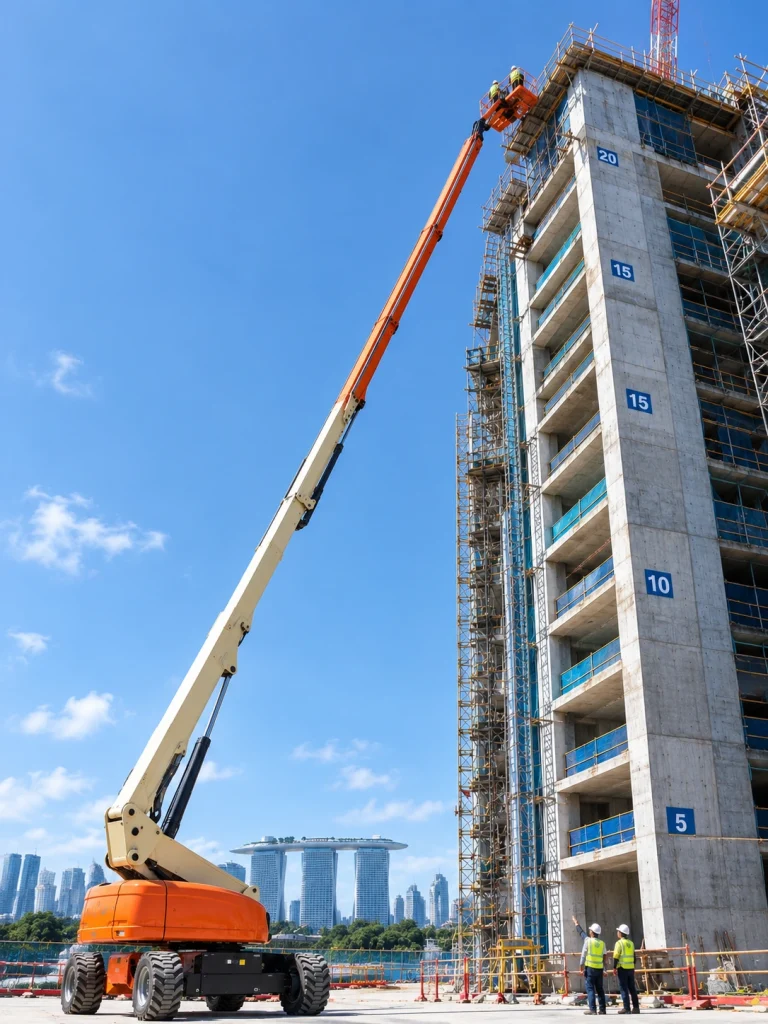
Large boom lifts push working height and outreach well beyond what mid-size machines offer, built for major infrastructure, industrial, and high-rise projects where extreme reach is the primary requirement. These machines represent a genuinely different category of equipment specification rather than simply a scaled-up version of a mid-size unit, since their size introduces logistical and site-planning considerations that smaller machines rarely encounter.
Typical Specifications
Large boom lifts commonly reach working heights of 34 metres and beyond, with some specialised models exceeding 50 metres, paired with outreach that can extend past 20 metres depending on the specific model and boom configuration. Platform capacities at this scale often support multiple workers along with heavier equipment, though maximum capacity typically decreases at full height and outreach, a relationship covered in detail below.
Also read: Boom Lift Weight Limit: Capacity Explained
Best Applications
Large boom lifts are specified for high-rise construction and maintenance, major industrial facilities, stadium and infrastructure projects, and any task where the working height genuinely exceeds what a mid-size machine could reach. Their scale also means considerably more careful site planning, ground bearing capacity, transport logistics, and clearance all become more demanding considerations at this end of the size range compared to smaller machines. Operators of large boom lifts also typically require more advanced certification and experience than compact or mid-size equivalents, given the greater consequences of a misjudged manoeuvre at extreme height and outreach, and confirming operator qualification for the specific machine class remains an essential step before mobilising equipment of this scale to a site.
Matching Boom Lift Size to the Task
Selecting the right size starts with the actual task requirements, confirmed working height and outreach to the furthest point that needs to be accessed, rather than defaulting to whichever size feels safely oversized. Oversizing a boom lift beyond what a task genuinely requires adds unnecessary cost and site footprint without a corresponding safety or productivity benefit, while undersizing risks a machine that simply cannot complete the task safely at all.
Site conditions matter just as much as the task itself, ground bearing capacity, overhead clearance, and access width all need to be checked against a specific machine’s footprint and weight, not just its reach figures, before a size is finalised for a project. A larger boom lift also carries a proportionally heavier transport and mobilisation cost, since moving a large machine between sites often requires a low-loader trailer and, in some cases, permits or escort arrangements that a compact or mid-size machine would never need, a genuine practical cost that should factor into the sizing decision alongside the task’s technical requirements.
Size vs Type: Why Both Matter Together
Size and design type are two separate decisions that need to be made together rather than in isolation, since the right size within the wrong type, or the right type in the wrong size, both leave a task poorly served.
An articulating boom lift’s jointed reach and a telescopic boom lift’s straight-line extension solve different access problems, a mechanical distinction explained in our guide to how boom lifts work, and this design choice needs to be layered on top of the size decision covered in this guide, not treated as a separate, unrelated question. Confirming both the correct size class and the correct design type against the specific task is what ultimately determines whether a boom lift is genuinely fit for purpose. Further general technical background on aerial work platform classification is available through Wikipedia’s overview of aerial work platforms.
Finding the Right Fit for Your Project
Boom lift size comes down to matching working height, outreach, and platform capacity to the actual demands of a task, across compact, mid-size, and large categories that each suit a distinct range of applications. Getting this decision right from the outset avoids the cost of an oversized machine or the safety risk of one that cannot genuinely reach the work.
RR Machinery Pte Ltd offers an extensive range of boom lifts across every size class, backed by factory-certified technicians and full servicing support. Contact us today for expert advice on the right boom lift size and configuration for your project.