Every construction site and agricultural operation involves a recurring challenge: moving materials not just across the ground surface, but upward, to upper floors of a building under construction, onto scaffold platforms, into storage positions on racking, or over obstacles that ground-level plant cannot clear. The forklift lifts and places materials at ground level and on low racking. The crane lifts to great heights but requires significant setup and a certified lift plan for every operation. Between these two solutions sits a machine that provides reach and height capability without the complexity of crane operations and without the ground-level limitation of the conventional forklift: the telehandler.
The telehandler, also called a telescopic handler, reach forklift, or telescopic forklift, is one of the most versatile machines available in construction, agriculture, and materials handling. Its combination of a telescoping boom, a quick-coupler attachment system, a rough terrain undercarriage, and an operator cab that provides good visibility in all working directions gives it a range of capability that few other single machines can match. Understanding what a telehandler is, how it works, what types are available, and when it is the right machine for the task is practical knowledge for site managers, equipment planners, and anyone responsible for materials movement on a construction or agricultural project.
What Is a Telehandler?
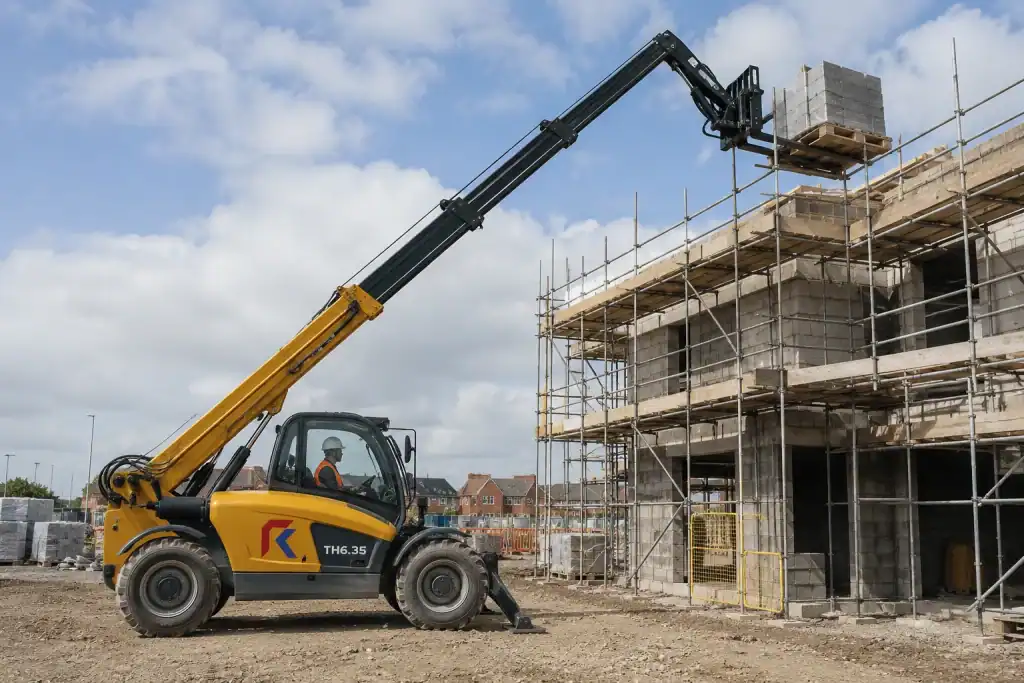
A telehandler is a self-propelled, rough terrain machine that uses a telescoping boom, an extendable arm that extends forward and upward from the machine’s body, to lift, carry, and place materials at height and at forward reach. Unlike a standard forklift, whose mast rises vertically above a fixed wheelbase, the telehandler’s boom extends outward and upward at an angle, allowing the attachment at the boom tip to be positioned at a combination of height and horizontal reach that a vertical-mast forklift cannot achieve.
The telehandler is built on a four-wheel-drive, four-wheel-steer rough terrain chassis, typically on large pneumatic tyres, that gives it the ground capability to operate on unpaved, uneven, and soft ground. This rough terrain mobility, combined with the boom’s reach and height capability, makes the telehandler uniquely suited to construction sites where ground conditions are variable, where materials must be placed at height, and where a conventional forklift on smooth indoor tyres cannot safely operate.
The boom tip carries a quick-coupler attachment system that accepts a range of interchangeable attachments, a pallet fork for handling palletised materials, a bucket for loose material, a lifting hook for crane-type operations, a work platform for personnel access, and specialist attachments for specific industries. This attachment versatility transforms the telehandler from a single-function machine into a multipurpose site tool that performs the work of several separate machines.
Also read : Front End Loader: How It Works and When to Use One
How Does a Telehandler Work?
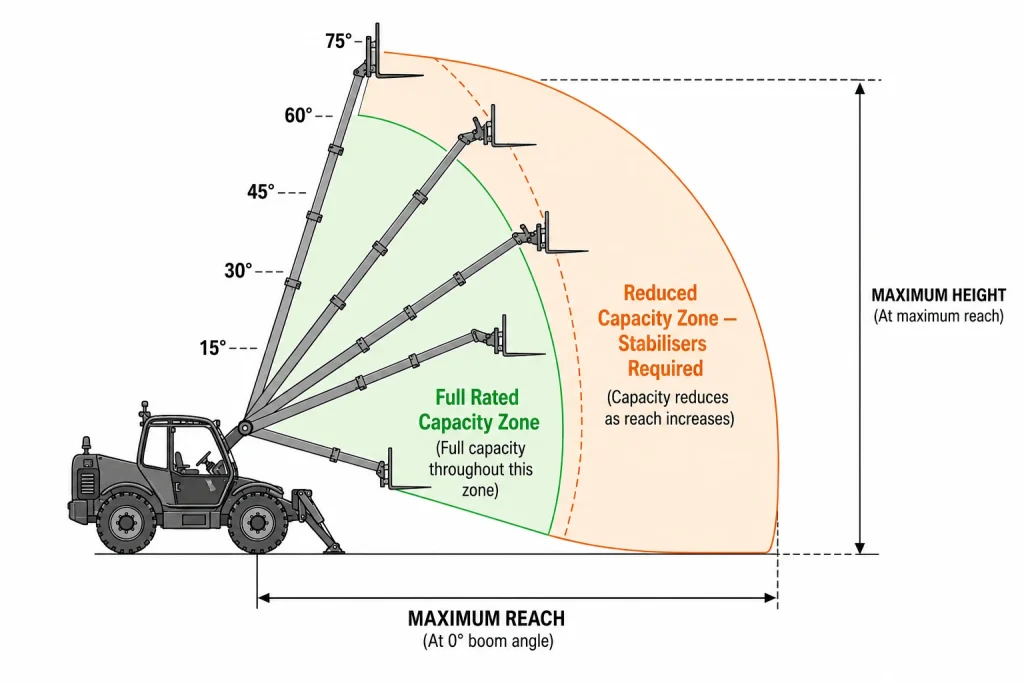
The telehandler’s boom is hydraulically operated. Two sets of hydraulic cylinders control the two primary boom movements: the lift cylinders raise and lower the entire boom assembly from its pivot point on the machine body, changing the boom angle and therefore the height of the attachment; and the extension cylinders telescope the inner boom sections outward from the outer sections, extending the boom’s reach and changing the distance of the attachment from the machine.
By combining boom angle and boom extension, the operator can position the attachment at any point within the machine’s rated working envelope, a three-dimensional space defined by the maximum boom angle, the maximum extension, and the load capacity at each combination of angle and extension. As with a crane, the telehandler’s rated load capacity decreases as the boom is extended further and as the combination of height and reach moves the load further from the machine’s centre of gravity.
The attachment at the boom tip is mounted on a self-levelling carriage, a hydraulically controlled mechanism that keeps the attachment horizontal regardless of boom angle or extension. This automatic levelling ensures that a pallet fork attachment keeps the forks horizontal as the boom is raised and extended, preventing palletised loads from sliding off the forks as the boom angle changes.
Most telehandlers are also fitted with stabiliser legs, outrigger jacks that extend from the machine’s sides and lower to the ground before lifting operations at maximum reach or maximum height. The stabilisers increase the machine’s stability footprint beyond the tyre track width, enabling heavier loads to be placed at greater reach than the machine’s tyres alone could support. Lifting at maximum reach without stabilisers deployed, where stabilisers are specified in the load chart, is a serious safety violation.
Key Components of a Telehandler
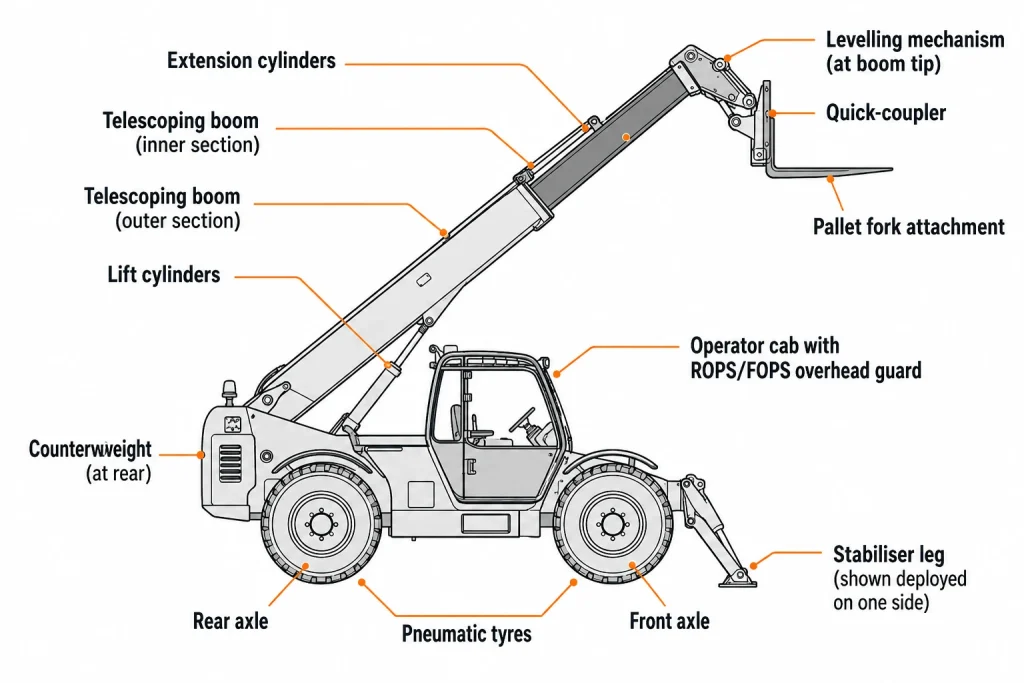
- Telescoping boom
The primary structural component. Typically two to four nested boom sections that extend and retract hydraulically. Boom length when fully extended determines the machine’s maximum reach and maximum height capability. The boom must be inspected regularly for cracks, deformation at the extension sections, and hydraulic cylinder condition.
- Lift cylinders
The large hydraulic cylinders that raise and lower the boom assembly from its pivot point. Lift cylinder condition, freedom from leaks and smooth operation throughout the full travel, must be confirmed at every pre-use inspection.
- Extension cylinders
The hydraulic cylinders inside the boom that telescope the inner sections outward. Extension cylinder synchronisation, ensuring both sides extend evenly, is a maintenance item that affects load stability and boom geometry.
- Levelling mechanism
The self-levelling carriage at the boom tip that maintains attachment orientation. A fault in the levelling mechanism causes the attachment to tilt with boom angle changes, creating a load stability hazard.
- Quick-coupler
The hydraulic or mechanical coupling at the boom tip that allows attachments to be changed without tools. The quick-coupler must be confirmed locked and secure before any lift or material handling operation, a coupler that releases under load drops the attachment and its load.
- Stabiliser legs
Extendable outrigger jacks fitted to the lower chassis. Must be deployed and confirmed in contact with the ground before any operation requiring their use per the load chart.
- Four-wheel-drive undercarriage
All four wheels are driven, providing traction on soft and uneven ground. Four-wheel steering, available on most telehandlers, enables crab steering (all four wheels turning in the same direction for lateral movement) and tight turning radius operation in confined sites.
- Operator cab
A ROPS/FOPS-certified cab providing rollover and falling object protection. The cab typically provides good forward and upward visibility for boom operations and includes a load moment indicator, an instrument that displays the machine’s current load relative to its rated capacity at the current boom configuration, and warns the operator when capacity limits are approached.
Types of Telehandlers
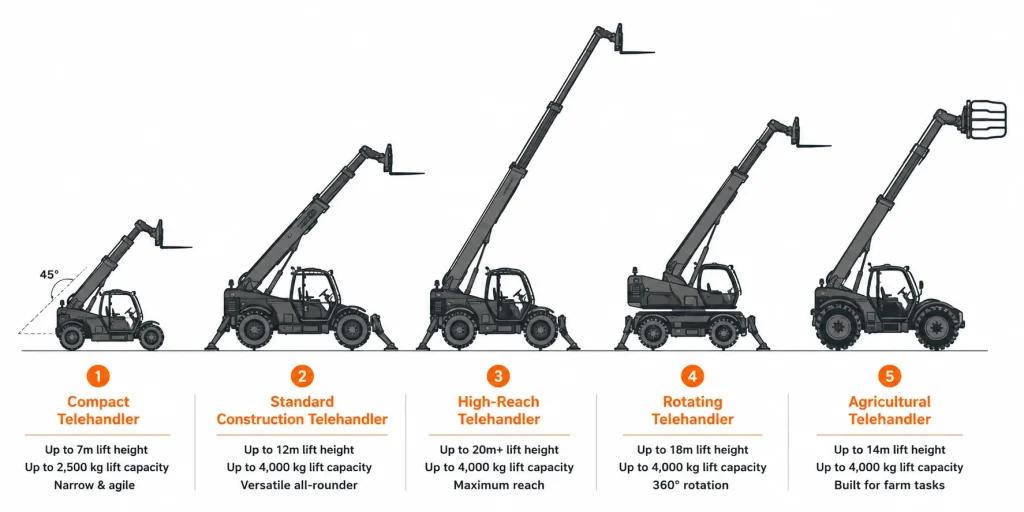
The telehandler family covers a range of machine sizes, boom configurations, and specialised variants, each suited to a different scale of operation or a specific industry requirement.
Compact Telehandler
The compact telehandler, operating weight typically below 6 tonnes, maximum lift height from 4 to 7 metres, is designed for confined sites, urban construction, and applications where access constraints prevent a full-size machine from operating. Compact models are narrower and shorter than standard telehandlers, allowing them to work through restricted access points, in tight urban back-of-house areas, and on sites where the ground bearing capacity cannot support a heavier machine.
Compact telehandlers are widely used in residential construction, interior refurbishment of multi-storey buildings, and facilities management where materials must be moved in restricted spaces that a standard machine cannot reach. Despite their smaller size, compact telehandlers are genuine rough terrain machines, their four-wheel-drive undercarriages operate on the same range of ground conditions as larger models.
Standard Construction Telehandler
The standard construction telehandler, operating weight from 6 to 12 tonnes, maximum lift height from 6 to 12 metres, is the most widely specified telehandler type on commercial and civil construction projects. It provides the combination of lift height, reach, load capacity, and rough terrain capability that suits the majority of construction site materials handling tasks: placing blockwork pallets on scaffold platforms, lifting steelwork to upper floor slab level, distributing materials across a large site, and loading and unloading delivery vehicles.
Standard construction telehandlers typically lift rated capacities of 2,500 to 4,000 kilograms at minimum reach, with capacity reducing progressively as the boom is extended. Maximum lift heights of 6 to 12 metres cover the typical multi-storey building construction envelope where materials must be placed floor by floor as the structure rises.
On construction sites where telehandlers operate alongside excavators, bulldozers, cranes, and mobile elevated work platforms, plant coordination and the management of machine movement routes and exclusion zones is a critical site management requirement. The principles of coordinating multiple plant types on an active site are covered in the guide to construction site planning and heavy plant coordination.
High-Reach Telehandler
The high-reach telehandler, maximum lift height from 14 to over 20 metres, extends the machine’s vertical reach into the range previously occupied only by mobile cranes for construction site materials placement. High-reach models are used on large multi-storey building projects where materials must be placed at significant height, above 12 metres, without the complexity of a tower crane or the setup time of a mobile crane for each individual lift.
The high-reach telehandler does not replace the crane for complex rigging operations, tandem lifts, or very heavy loads. It complements the crane by handling the high-volume, repetitive materials placement tasks, block pallets, timber, formwork, and building materials, that consume a disproportionate share of crane time on a large construction project when no alternative lifting solution is available.
Rotating Telehandler
The rotating telehandler adds 360-degree superstructure rotation to the standard telehandler’s telescoping boom capability. The rotating superstructure, carrying the boom, the operator cab, and the counterweight, can slew in a full circle independently of the undercarriage, allowing the machine to place materials in any direction without repositioning the chassis.
This 360-degree slewing capability brings the rotating telehandler’s operational flexibility close to that of a mobile crane, it can pick material from one side of the machine and place it on the other without moving, while retaining the rough terrain mobility, the quick-coupler attachment system, and the self-propelled site mobility that crane operations lack. Rotating telehandlers are used for applications that require both the reach and the slewing coverage of a crane and the rough terrain mobility and attachment versatility of a standard telehandler.
Agricultural Telehandler
The agricultural telehandler is configured specifically for farming applications, handling round and square bales, loading trailers, moving grain and silage with bucket attachments, and servicing livestock facilities where materials must be placed at height or at forward reach in confined building environments.
Agricultural models typically have longer boom configurations optimised for bale handling reach, wider tyres for operation on soft agricultural ground, and attachment ranges specific to farm applications. The underlying machine architecture is identical to construction telehandlers, four-wheel drive, telescoping boom, quick-coupler, but the specification and attachment library are tuned to agricultural rather than construction requirements.
Telehandler vs Forklift
The telehandler and the forklift are both materials handling machines that lift and place palletised loads, but they differ significantly in ground capability, height and reach, attachment versatility, and stability characteristics. A standard forklift suits smooth, level surfaces and working heights up to around 6 metres, while a telehandler’s rough terrain mobility and telescoping boom extend that capability to uneven ground and heights of up to 20 metres that no standard forklift can reach.
A complete breakdown of these differences, covering ground conditions, height and reach, versatility, and stability in detail, is available below.
Also read : Telehandler vs Forklift: Key Differences Explained
Telehandler vs Crane
For lifting operations, the telehandler and the mobile crane serve different points on the capacity and complexity spectrum. A telehandler fitted with a hook attachment can perform crane-type lifts within its rated capacity, typically up to 3 to 5 tonnes at short reach, offering a faster and more economical solution than mobilising a mobile crane for lifts within that range. Beyond that capacity, or for lifts requiring precise positioning at long radius or a formal engineered lift plan, a dedicated mobile crane remains the correct solution.
A complete comparison of capacity, mobility, cost, and certification requirements between the two machine types is available below. When a telehandler is used for crane-type lifting with a hook attachment, the operation is classified as a lifting operation in most jurisdictions, requiring a lift plan and compliance with the load chart for the hook configuration, principles explained in How to Read a Crane Load Chart: A Clear Guide.
Also read : Telehandler vs Crane: Which One Does Your Site Need
Safety Requirements for Telehandler Operations
- Operator certification
Telehandler operators must hold current certification for the machine category. In most jurisdictions, this means completion of an accredited telehandler operator training course, separate from and in addition to forklift certification, because the telehandler’s stability characteristics, load chart requirements, and attachment system differ significantly from a standard forklift.
- Pre-use inspection
Every telehandler must be inspected before each shift. The inspection covers the boom structure, the hydraulic system, the levelling mechanism, the quick-coupler condition, the stabiliser legs, the tyres, and the load moment indicator. Any defect must be rectified before the machine is operated.
- Load chart compliance
The telehandler’s rated capacity at any combination of boom angle and extension must be confirmed from the load chart before every lift. The load moment indicator provides a real-time warning when capacity is approached, but the indicator is a safety net, not a substitute for pre-lift load chart verification.
- Stabiliser deployment
Stabilisers must be deployed and confirmed in firm ground contact before any lift that the load chart specifies requires their use. Lifting at maximum reach or maximum height without stabilisers, when the load chart requires them, risks machine overturn.
- Ground assessment
The ground beneath the tyres and stabiliser feet must be assessed for bearing capacity before the machine is positioned. On soft or uncertain ground, spreader pads beneath the stabiliser feet distribute the reaction load over a larger area. The principles of ground assessment for telehandler operations are consistent with those applied to all heavy plant, as covered in guidance on lifting equipment safety and ground bearing capacity assessment for construction plant.
- Exclusion zones
A ground-level exclusion zone must be maintained beneath any elevated load and around the machine’s operating radius throughout the lift. No person should stand beneath a suspended or elevated load at any time.
The International Powered Access Federation (IPAF) publishes guidance on the safe use of telehandlers used as work platforms, applicable when a personnel work platform attachment is fitted to the boom tip, including the additional safety requirements that apply to personnel elevation operations.
Singapore’s Ministry of Manpower similarly publishes Workplace Safety and Health guidance covering operator training, lifting operations, and plant safety standards that apply directly to telehandler use on local construction and agricultural sites.
The Machine That Bridges the Gap
The telehandler occupies a unique and increasingly important position in the construction equipment family. It is not a forklift, it goes where forklifts cannot and reaches where forklifts cannot. It is not a crane, it does not have the capacity or the operational certification complexity of a crane. What it is, uniquely, is a machine that bridges the gap between the two: providing practical, economical, and operationally simple lifting and placement capability at the heights and on the ground conditions that construction and agricultural sites demand.
RR Machinery provides a comprehensive range of construction and materials handling equipment for sale and rental, including telehandlers, forklifts, boom lifts, scissor lifts, and supporting plant, all maintained to full operational standard and supported by experienced equipment specialists. Explore our full range of construction and materials handling equipment solutions, or contact our team for practical advice and a clear quotation matched to your lift heights, site conditions, and project requirements.