Road construction is one of the most equipment-intensive activities in civil engineering. Building a road from raw ground to a finished trafficked surface requires a sequence of distinct operations, clearing, earthworks, drainage, subgrade preparation, base course construction, and pavement, and each operation requires a different category of plant matched to its specific task. No single machine builds a road. A coordinated fleet of equipment, correctly selected and sequenced, does.
For project planners, procurement managers, site engineers, and plant coordinators, understanding the full list of road construction equipment, what each machine is, what function it performs in the road building sequence, and when in the programme it is deployed, is essential for building an accurate plant schedule, a realistic budget, and a programme that sequences equipment to avoid conflicts and maximise productivity.
This guide covers every category of machine used in road construction: the clearing and demolition plant that prepares the corridor, the earthmoving fleet that builds the formation, the drainage and utilities plant, the base course and pavement equipment, and the compaction and finishing machines that bring the road surface to its designed specification. For each category, the key machine types are identified along with their function in the road building sequence.
Road Construction Phases and Equipment Overview
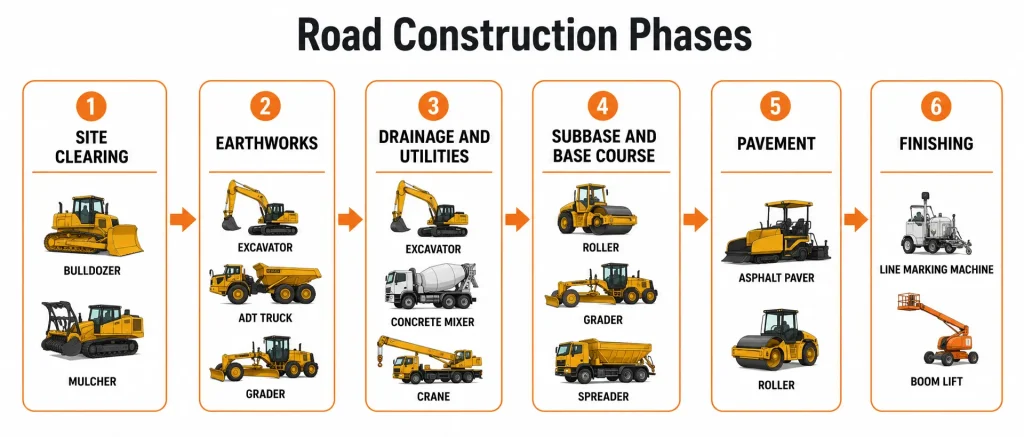
Road construction proceeds in a defined sequence of phases, each phase depends on the preceding one being completed to specification, and each phase requires a different category of plant. The six phases covered in this guide are: site clearing and preparation, earthworks, drainage and utilities, subbase and base course construction, pavement construction, and finishing and ancillary works.
Understanding which machines are deployed at each phase, and why, is the foundation of an accurate plant schedule and a realistic construction programme.
Also read : Front End Loader: How It Works and When to Use One
Site Clearing and Preparation Equipment
Before any earthmoving begins, the road corridor must be cleared of vegetation, existing structures, underground services, and any obstructions that would interfere with the formation earthworks.
Bulldozer
The bulldozer is the primary machine for site clearing on new road alignments. Its wide blade pushes trees, shrubs, root masses, topsoil, and surface debris ahead of the machine, clearing the corridor in progressive parallel passes. On alignments through established vegetation, the bulldozer works first, clearing the surface, before any other earthmoving plant enters the corridor.
Bulldozers fitted with a rear ripper can also break up surface rock and compacted soil during the clearing phase, preparing hard ground for the earthworks that follow. The full range of bulldozer configurations, blade types, undercarriage options, and size categories suited to different clearing tasks, is covered in the complete guide to types of bulldozers and their application on construction sites.
Mulcher and Vegetation Clearing Equipment
On alignments through dense bush, forest, or vegetation with large root masses, specialist mulching machines, rotary drum mulchers or disc mulchers mounted on excavator arms or dedicated carriers, shred vegetation in place rather than pushing it. Mulching reduces the volume of cleared material dramatically compared to windrow pushing, making it the preferred method where vegetation disposal is logistically difficult.
Demolition Equipment
Where the road alignment passes through existing developed areas, demolition of existing structures, buildings, pavements, culverts, walls, is required before earthworks begin. Hydraulic breakers, demolition grabs, and concrete crushers mounted on excavators are the standard tools for this phase. Demolished material must be classified, recyclable material separated for reuse as road base or fill, contaminated material disposed of to a licensed facility.
Earthworks Equipment
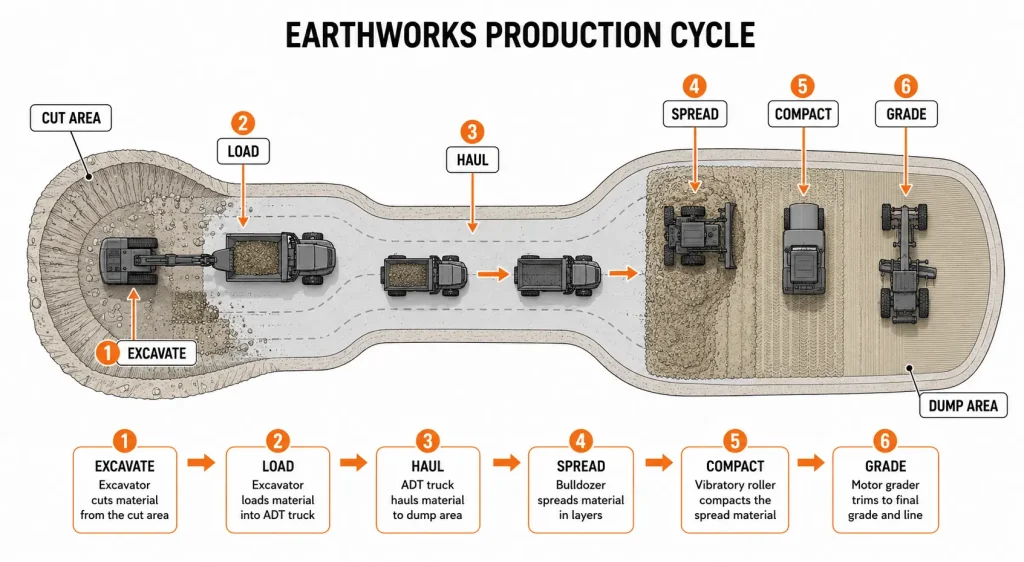
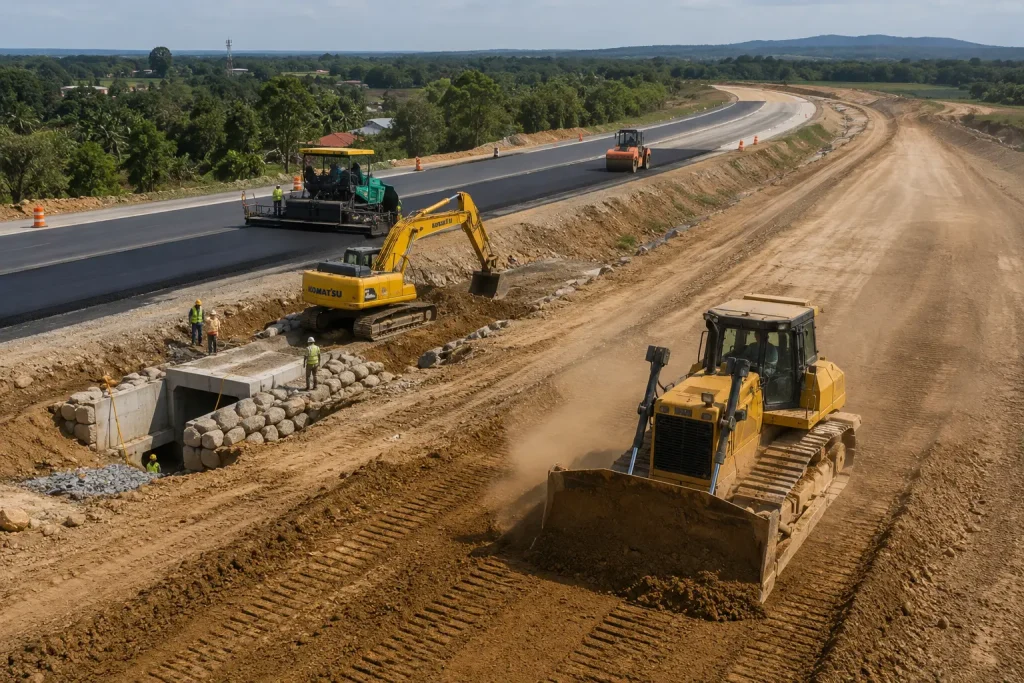
Earthworks, the cut and fill operations that shape the road formation from raw ground to the design subgrade level, are the most plant-intensive phase of road construction. The earthworks fleet typically includes multiple machine types operating simultaneously in coordinated sequences.
Excavator
The excavator is the most versatile machine in the earthworks fleet. It cuts material from high points on the alignment, loads cut material into trucks for transport to fill areas, breaks hard rock and compacted material with hydraulic breakers, excavates drainage structures and culvert foundations, and trims formation batters and slopes to the design geometry.
Crawler excavators are the standard specification for road earthworks, their tracked undercarriage provides the ground stability needed for cutting slopes and working on soft or disturbed formation material. For confined situations such as culvert excavations and drainage trench work, compact excavators provide access in spaces that a standard machine cannot reach. The full range of excavator configurations suited to road earthworks, including crawler, wheeled, long reach, and compact variants, is covered in the complete guide to types of excavators and their application in civil construction.
Bulldozer
In the earthworks phase, the bulldozer’s role shifts from clearing to pushing and spreading. Cut material delivered by trucks to fill areas must be spread in layers, the bulldozer pushes and spreads the delivered fill, distributing it evenly across the fill zone in layers appropriate to the compaction equipment’s operating layer thickness. On long cut sections where material must be pushed directly from the cut to the fill without truck haulage, the bulldozer performs the bulk push.
Motor Grader
The motor grader enters the earthworks sequence for subgrade shaping, bringing the roughly placed fill and cut material to its design level, cross-section, and drainage gradient. After the bulldozer has spread fill in bulk and the compaction rollers have achieved the specified density in each layer, the motor grader trims the surface to the design cross-section and drainage falls.
The motor grader is also used for maintaining haul roads throughout the earthworks phase, keeping the surface smooth, correctly profiled, and free of the ruts and berms that heavily loaded haul trucks create. Haul road maintenance is a significant contributor to earthworks productivity, a poorly maintained haul road increases rolling resistance, raises truck fuel consumption and tyre wear, and reduces haul truck speed and payload capacity. The full operational capabilities of motor graders in road construction, including blade configurations and grade control systems, are covered in the guide to types of graders and their role in road and site construction.
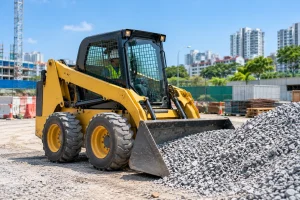
Front End Loader
The front end loader is used in the earthworks phase for loading trucks from material stockpiles, feeding plant, crushers, screens, mixing plants, and moving material between locations on the site where the excavator’s reach or the bulldozer’s linear pushing action is not the most efficient tool. At batch plants and aggregate processing areas, the loader is the primary machine for feeding raw material and handling processed aggregate.
Articulated Dump Truck
The articulated dump truck (ADT), a large off-road haul vehicle with an articulated steering joint between the cab and the body, carries cut material from excavation areas to fill zones or to spoil disposal. ADTs are the standard haul vehicle for road earthworks because their articulated steering and differential locking systems give them the manoeuvrability and traction needed to operate on the unpaved, soft, and steeply graded haul roads that characterise an active earthworks site.
ADT fleet size is determined by the excavator or dozer production rate, the haul fleet must be sized so that each excavator has trucks available to load without waiting, while minimising the number of trucks sitting idle at the dump point. Matching haul truck fleet size to excavator production rate is a core element of earthworks productivity planning.
Scraper
The scraper is a specialist earthmoving machine that cuts, carries, and deposits material in a single self-contained operation, eliminating the need for separate loading and hauling equipment for certain cut-to-fill operations. Scrapers are most productive on long, relatively flat push distances, typically 200 to 1,500 metres, where the material is soft enough for the scraper bowl to fill in a single cutting pass.
On large road projects with suitable material and haul distances, scrapers can achieve lower cost per cubic metre than excavator-and-truck combinations. On projects with hard material, steep grades, or short haul distances, scrapers are less competitive.
Drainage and Utilities Equipment
Road drainage construction, culverts, side drains, table drains, and stormwater systems, runs concurrently with and following the formation earthworks. This phase requires a combination of excavation, concrete, and pipe-laying plant.
Excavator with Trenching Bucket
Drainage trench excavation uses the same crawler excavators as the earthworks phase, fitted with narrower trenching buckets sized to the trench width required for the drainage structure being installed. Culvert foundation excavation, side drain shaping, and stormwater pipe trench work are all carried out with the excavator.
Concrete Equipment
Concrete culverts, headwalls, and in-situ concrete channel linings require concrete mixing, delivery, and placement equipment. On large road projects, a site concrete batch plant delivers truck-mixed concrete to the pour location. On smaller projects, truck-mounted concrete mixers supply ready-mix concrete. Concrete pumps are used where the pour location is inaccessible to a truck or where the volume and rate of concrete placement requires pump delivery for quality control.
Pipe-Laying Equipment
Large diameter culvert pipes, precast concrete, corrugated steel, or HDPE, require lifting equipment for placement. A crane or excavator fitted with lifting gear places the pipe sections in the prepared trench and aligns them for jointing. For very large culverts, box culverts, precast arch units, a mobile crane is typically required for the lift weights and the precision placement needed.
Also read : Heavy Equipment Safety: A Complete Site Guide
Subbase and Base Course Equipment
Once the subgrade is compacted to specification and the drainage is in place, the road pavement structure is built up in layers, subbase, base course, and wearing course, each requiring specific plant for placement, spreading, and compaction.
Aggregate Spreader and Grader
Granular subbase and base course material, crushed rock, gravel, or stabilised material, is delivered to site by truck and spread in even layers. The motor grader spreads and profiles the material to the design thickness and cross-section before compaction. On major projects with strict layer thickness tolerances, purpose-built aggregate spreader boxes towed behind the grader or self-propelled aggregate spreaders achieve more consistent layer thickness than grader spreading alone.
Soil Stabilisation Equipment
Where the subgrade or subbase material does not meet the design specification in its natural state, insufficient bearing capacity, excessive plasticity, or high moisture content, stabilisation with cementitious binders, lime, or bituminous stabilisers can improve its engineering properties in place. Soil stabilisation trains, comprising a stabiliser/recycler machine that mixes the binder into the existing material, followed by a grader and compaction rollers, process the subgrade or base course in a single production pass, eliminating the need to remove and replace unsuitable material.
Compaction Rollers
Compaction equipment is used at every layer of the road pavement structure, subgrade, subbase, base course, and asphalt wearing course, and is arguably the most critical category of equipment for road quality. Under-compacted layers settle under traffic, causing rutting, cracking, and accelerated pavement deterioration.
- Vibratory smooth drum roller
The standard compaction machine for granular fill, crushed rock subbase, and base course. The vibrating drum applies dynamic impact loads to the granular material, achieving high density in fewer passes than a static roller. Available in single drum (with rubber tyres at the rear) and tandem drum configurations.
- Pneumatic tyre roller
Uses multiple rubber tyres in a staggered pattern to knead and compact granular material and asphalt, particularly effective for achieving surface sealing and uniform mat density in asphalt layers. Standard specification for intermediate rolling of asphalt.
- Padfoot or sheepsfoot roller
A vibratory drum fitted with projecting pads rather than a smooth surface, the pads penetrate into cohesive or clay fill, achieving higher density at depth in clay subgrade layers that a smooth drum roller cannot effectively compact. The standard compaction machine for cohesive subgrade material.
Pavement Construction Equipment
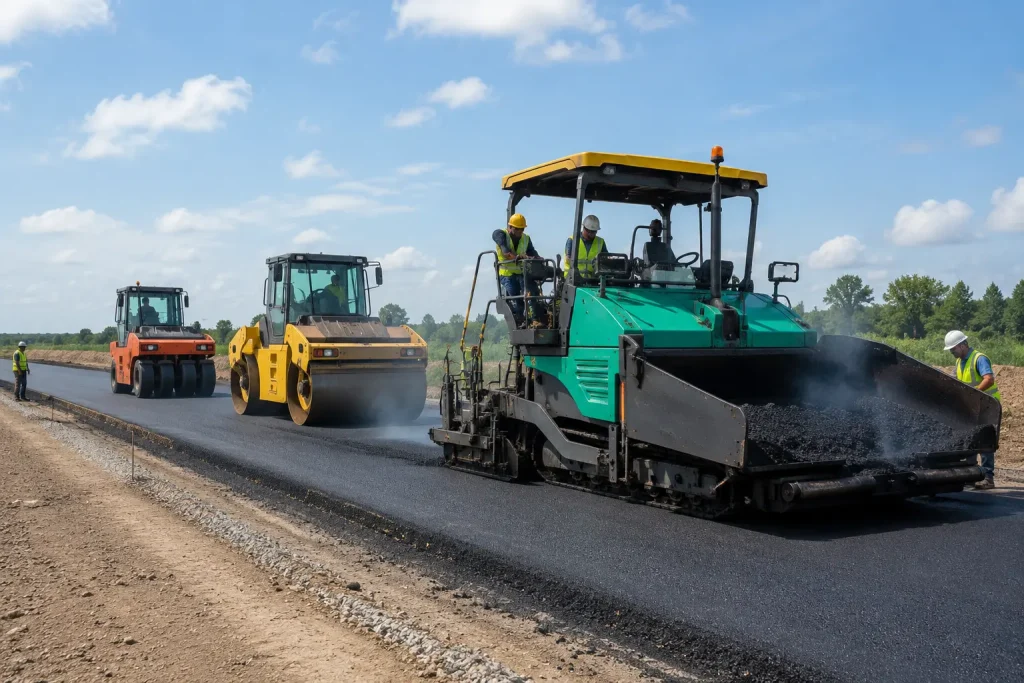
The wearing surface of the road, asphalt concrete, or in some cases cement concrete, requires specialist plant for mixing, delivery, placing, and finishing.
Asphalt Paving Machine (Paver)
The asphalt paver is the machine that places the hot mix asphalt in a continuous, even mat at the design thickness and width. It receives asphalt delivered by truck at its hopper, conveys the material to the screed at the rear of the machine, and the screed strikes off and pre-compacts the asphalt mat as the paver advances. The screed’s width can be extended or contracted to match the paving lane width.
Paver operation requires a continuous supply of hot mix asphalt from the asphalt batch plant, any interruption to the asphalt supply that causes the paver to stop creates a transverse joint in the mat, which is a potential point of weakness and water ingress in the finished pavement. Plant schedule coordination between the asphalt plant and the paving train is therefore a critical element of asphalt paving project management.
Asphalt Batch Plant
The asphalt batch plant, or drum mix plant, heats and dries aggregate, mixes it with bitumen binder at the specified proportions, and produces hot mix asphalt for delivery to the paver. Plant capacity must be matched to the paving production rate to ensure a continuous supply without gaps. Large road projects typically require a dedicated asphalt plant positioned on or near the site.
Road Roller
Following the paver, a train of rollers achieves the final compaction density and surface regularity of the asphalt mat. The rolling sequence, breakdown rolling with a heavy vibratory roller immediately behind the paver while the asphalt is hot, intermediate rolling with a pneumatic tyre roller, and finish rolling with a tandem static roller, is specified in the pavement design and must be completed within the asphalt’s working temperature window before it cools below the minimum compaction temperature.
Finishing and Ancillary Equipment
The final phase of road construction covers the items that complete the road corridor, line marking, signage, lighting, barriers, and landscaping.
Line Marking Machine
Road line marking machines apply thermoplastic or paint markings at speed, lane lines, edge lines, stop lines, arrows, and crossings, to the completed pavement surface. Truck-mounted machines cover long lengths of carriageway efficiently.
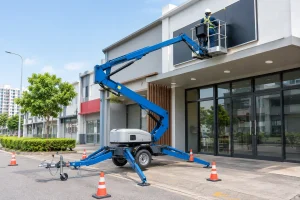
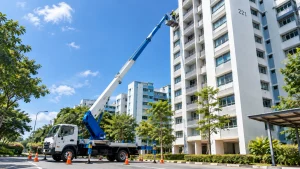
Boom Lift and Scissor Lift
Installation of roadside lighting columns, overhead sign gantries, and traffic signal infrastructure requires working at height. Boom lifts and cherry pickers are the standard access equipment for this phase, positioning electricians and installation crews at the top of lighting columns and sign structures without the overhead of traditional scaffolding. The full range of aerial work platforms suited to infrastructure installation work, including vehicle-mounted cherry pickers for road-based access, is covered in the guide to boom lifts, cherry pickers, and choosing the right aerial work platform.
Plant Coordination and Site Management
A road construction project deploys all of these equipment categories simultaneously across a linear site that may extend for kilometres. Coordinating the movement of excavators, haul trucks, rollers, graders, and pavers, managing their haul routes, their working zones, their refuelling and servicing, and their interaction with any traffic that must be maintained on or adjacent to the alignment, is one of the most demanding site management challenges in civil construction.
A well-structured plant schedule sequences each equipment category to arrive on site when its phase of work is required, avoids conflicts between machine types working in overlapping areas, and ensures that the haul truck fleet is matched to the production rate of the excavation and loading plant. The principles of plant coordination and site planning that underpin an effective road construction programme are covered in the guide to construction site planning and the management of heavy plant on civil projects.
Road construction also involves significant power requirements, generators for site facilities, batch plants, and lighting on night shift operations. Correct generator sizing for a road construction site, matching the kVA output to the aggregate demand of all connected loads, is part of the site services planning that begins before plant mobilisation. The systematic approach to generator load calculation for construction operations is covered in the practical guide to how to calculate generator load for construction sites.
The Permanent International Association of Road Congresses (PIARC) publishes technical guidance on road construction standards, equipment specifications, and quality management for road infrastructure, a reference source for project engineers and planners working on major road construction programmes.
Also read : What Size Generator Do I Need? A Practical Sizing Guide
The Right Equipment for Every Phase
Road construction is a sequential, interdependent process. Each phase of work depends on the preceding phase being completed to specification, the pavement cannot be built on a poorly compacted formation, and the asphalt cannot be placed on an incorrectly profiled base course. The equipment that serves each phase must be correctly specified, correctly operated, and correctly sequenced to deliver a finished road that meets its design life and performance requirements.
RR Machinery provides a comprehensive range of construction and earthmoving equipment for sale and rental, including excavators, bulldozers, motor graders, compactors, boom lifts, scissor lifts, and power generators, all maintained to full operational standard and supported by experienced equipment specialists. Explore our full range of construction and heavy equipment solutions for road and civil projects, or contact our team for practical advice on plant selection, fleet sizing, and a clear quotation matched to your road construction programme.