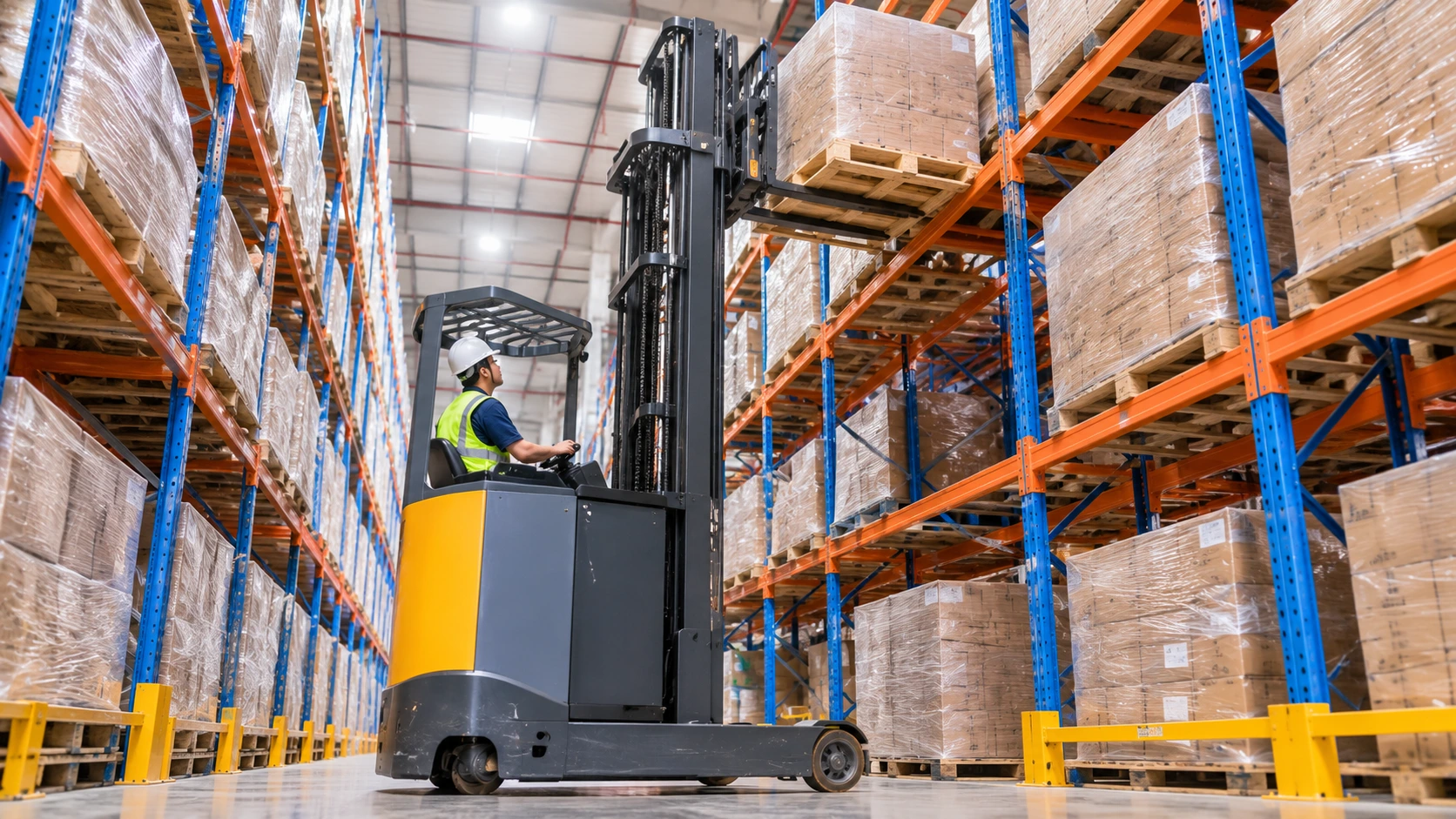
A reach truck forklift is an electric warehouse forklift built to lift pallets high into racking while working in narrow aisles. Instead of driving forward into the rack like a conventional forklift, it stops at the rack face and extends its forks or mast forward to place or retrieve the load. Two stabilising legs at the front, called outriggers or baselegs, carry the machine’s balance, so it does not need a large counterweight at the back.
That combination of compact size, high lift, and forward reach is what makes reach trucks so common in warehouses and distribution centres. They allow storage to go higher and aisles to be narrower, which fits more pallets into the same building. This guide explains how a reach truck works, its main parts, the different types, why its lifting capacity changes with height, where it fits best, and how to operate it safely.
How a Reach Truck Works
A conventional counterbalance forklift balances its load with a heavy weight at the rear and has to drive right up to the rack to set a pallet down. A reach truck works differently. Its load and its battery sit between or close to the outrigger legs at the front, so the machine stays stable without a large counterweight and can be much shorter.
When the operator reaches the rack, the truck stops and the reach mechanism moves the forks forward, beyond the outriggers, to place the pallet on the beam. Once the pallet is lowered, the forks retract back into the truck’s footprint, and the operator can lower the mast and travel with the load held securely between the legs. Because the truck turns in a small space and does not need room to drive into the rack, it can work in aisles that are too narrow for a counterbalance forklift.
The two machines are often compared directly, and the full set of differences in capacity, aisle width, floor conditions, and typical uses is explained below.
The Main Parts of a Reach Truck
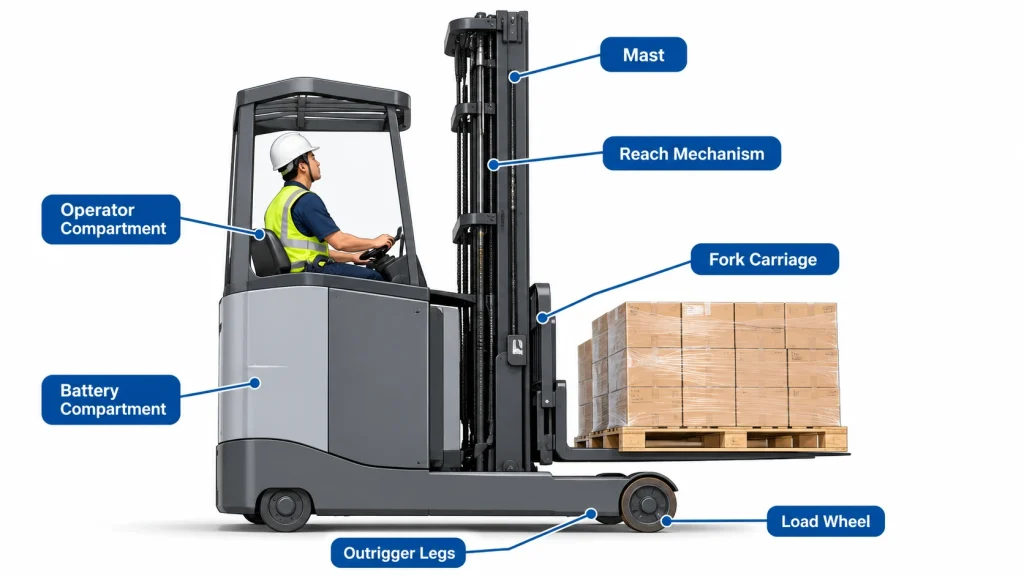
Reach trucks share many components with other forklifts, but a few parts are unique to their design. A broader explanation of the components common to all forklifts is available in our guide to the parts of a forklift.
Outriggers. Two fixed legs at the front of the truck, each with a load wheel, that extend under the load and provide stability. They are what allow the truck to lift high without a large rear counterweight.
Reach mechanism. The system that moves the forks forward. On a pantograph reach truck, a scissor linkage pushes the fork carriage out from the mast. On a moving mast reach truck, the entire mast rolls forward along tracks in the outriggers.
Mast. A tall, usually multi stage mast that lifts the forks to the upper levels of the racking. Reach truck masts are designed for high lifts while staying stable and visible to the operator.
Fork carriage with tilt and side shift. The carriage can tilt the forks slightly to secure the load and shift sideways to line the pallet up precisely with the rack without moving the whole truck.
Battery. A large traction battery, often housed under or beside the operator compartment, which also contributes to the truck’s balance.
Operator compartment. The operator either stands or sits, usually turned sideways to the direction of travel, so they can look both forward and backward along the aisle without twisting.
Height and camera aids. Many modern reach trucks include height indicators, height preselection, or fork cameras that help the operator place loads accurately at upper levels where the forks are hard to see.
Main Types of Reach Trucks
Reach trucks come in several variations, each suited to a different way of storing goods.
Stand up reach truck. The operator stands in a compact compartment, making it easy to step on and off for frequent short tasks. Stand up models are common in busy warehouses where operators often leave the truck to check labels or adjust loads.
Sit down reach truck. The operator sits, which is more comfortable for long shifts with continuous travel and lifting. Sit down models are popular for put away and retrieval work over long periods.
Double deep reach truck. Fitted with an extended reach mechanism that can place and retrieve pallets two deep in the rack. Double deep racking increases storage density, at the cost of slower access to the rear pallets.
Multi directional reach truck. Able to travel sideways as well as forward and backward, which allows it to carry long loads such as pipes, timber, and panels along narrow aisles.
Reach trucks also belong to a wider family of narrow aisle trucks, which is explained in our guide to the different classes of forklifts.
Why Capacity Changes With Height
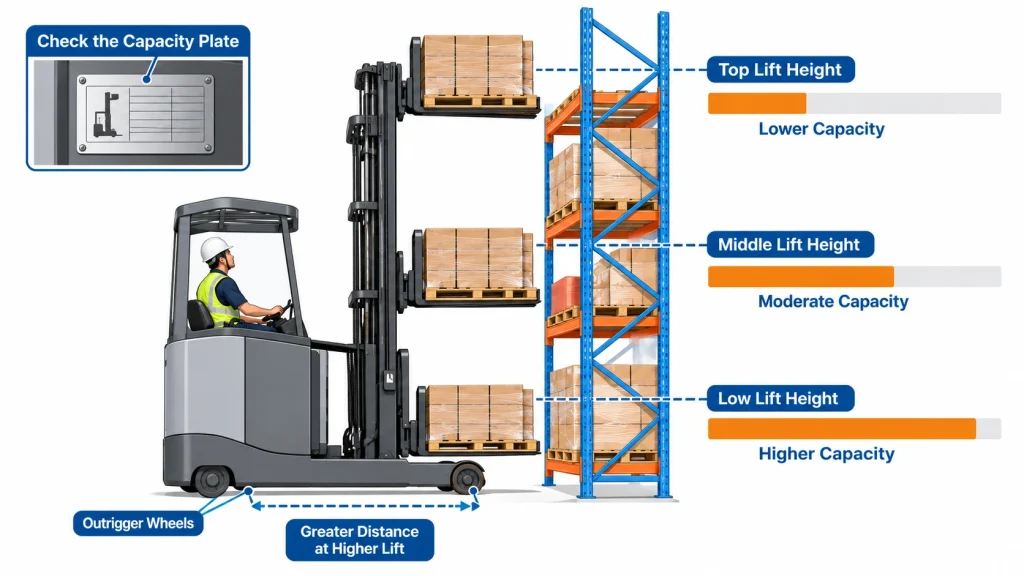
Every reach truck has a rated capacity, but that figure applies only at lower lift heights and with the load centred correctly on the forks. As the forks rise and extend forward, the load moves further from the truck’s stability base, and the safe capacity at that height, often called the residual capacity, becomes lower.
The truck’s capacity plate shows how much it can safely lift at different heights and load centres, and operators must check it rather than relying on the headline figure. A pallet that is safe to lift at a low level may be too heavy to place on the top beam. Long, bulky, or uneven loads, and attachments fitted to the carriage, also reduce the safe capacity, because they shift the centre of the load further forward.
Where Reach Trucks Work Best
Reach trucks are at their best in indoor warehouses with smooth, level floors and tall racking. Typical applications include:
- Put away and retrieval in high bay pallet racking
- Narrow aisle warehouses where space is at a premium
- Distribution centres with high volumes of pallet moves
- Cold storage, where compact electric trucks make the most of expensive chilled space
- Retail and wholesale stockrooms with tall shelving
They are less suited to outdoor work, rough or uneven ground, ramps, and loading trucks directly at a dock, where their small load wheels and low ground clearance become a disadvantage. In those areas, a counterbalance forklift is usually the better choice, and how that design works is explained below.
Also read: Counterbalance Forklift: How It Works and When to Use It
Floor and Racking Requirements
Because reach trucks lift so high, small imperfections at ground level become large movements at the top of the mast. Floors in reach truck aisles need to be flat, level, and in good condition, without cracks, potholes, or debris that could unsettle the truck.
The racking must also suit the truck. Aisle widths, beam heights, and the clearance above the top beam need to match the truck’s turning space, lift height, and collapsed mast height, and the racking should be inspected regularly for damage. Planning the truck and the racking together, rather than separately, avoids costly mismatches. The broader factors involved in choosing a forklift are covered in our guide on how to choose a forklift.
Operating a Reach Truck Safely
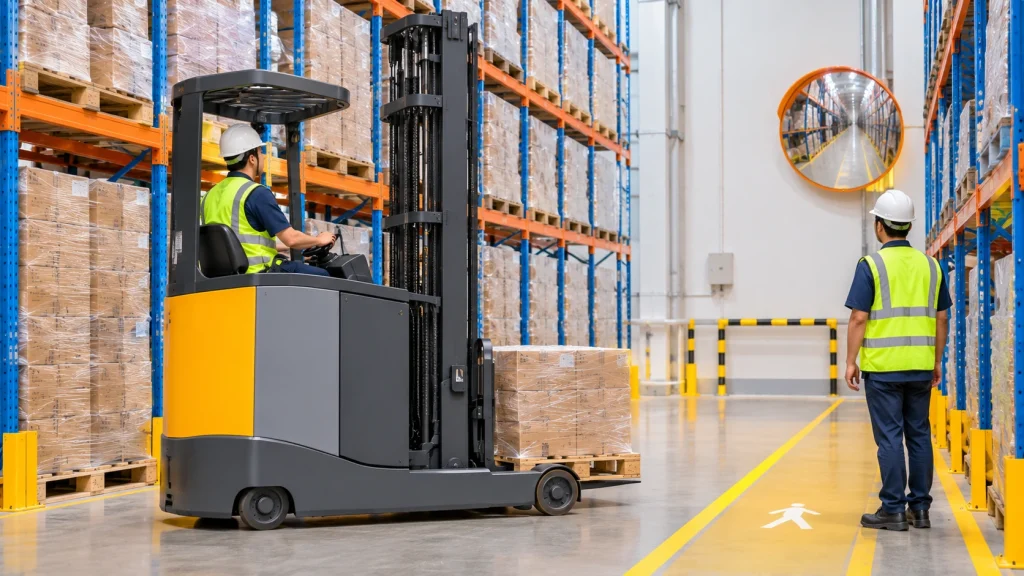
Reach trucks handle differently from counterbalance forklifts, so operators need training on the specific type. They steer from the rear, turn sharply, and carry loads high, so smooth control matters more than speed.
Before each shift, operators check the forks, chains, mast, reach mechanism, wheels, brakes, battery, and warning devices, and report any fault before the truck is used. In use, loads should be lifted and lowered only when the truck is stationary, carried low and retracted while travelling, and placed and retrieved squarely with the forks level. Operators should never exceed the residual capacity shown on the plate, never raise people on the forks, and always watch for pedestrians, especially at aisle ends.
Keeping the truck in good condition is part of operating it safely, and a regular routine is set out in our guide to forklift maintenance. Singapore’s Ministry of Manpower publishes detailed Workplace Safety and Health guidance covering forklift operation and warehouse safety, and further practical safety habits are covered below.
Also read: Forklift Safety Tips for Safe and Efficient Operations
Is a Reach Truck Right for Your Operation?
A reach truck is usually the right choice when most of the work is moving pallets in and out of racking indoors, the racking is tall, and floor space is limited. It is less suitable when the same truck must also load vehicles at the dock, work outdoors, or travel long distances across uneven ground.
Many warehouses use both: reach trucks working in the racked aisles and counterbalance forklifts handling the dock and yard. Thinking about where each pallet moves, from arrival to storage to dispatch, usually makes the right mix clear. Further general background on forklift design and history is available through Wikipedia’s overview of forklifts.
Forklift Rental for Warehouse Operations
Choosing the right truck starts with a clear picture of the work. When you contact the team, it helps to share the weight and size of your pallets, the height of your racking, the width of your aisles, the type of floor, whether the work includes dock loading, and how long you expect to need the machine. With these details, a suitable truck can be recommended from the start rather than adjusted after delivery.
RR Machinery Pte Ltd offers a diverse range of forklifts for rent for warehouses, factories, and construction sites across Singapore, backed by factory certified technicians and full servicing support. Contact us today to ask about the right truck for your operation.