Plumbing work comes down to a handful of jobs repeated in different settings: gripping and turning pipes and fittings, cutting pipe to length, joining and sealing connections, clearing blockages, and checking that the finished system holds pressure without leaking. Every plumbing tool exists to do one of those jobs well, and knowing which tool belongs to which job makes it much easier to build a kit, follow a tradesperson’s explanation, or choose the right equipment for a project.
This guide lists the essential plumbing tools by category, with the name of each tool and what it is used for. It starts with the tools most plumbers carry every day, then covers cutting, joining, drain clearing, measuring and testing, the heavier equipment used for plumbing on construction sites, and the safety gear that goes with the work.
The 10 Tools Most Plumbers Carry
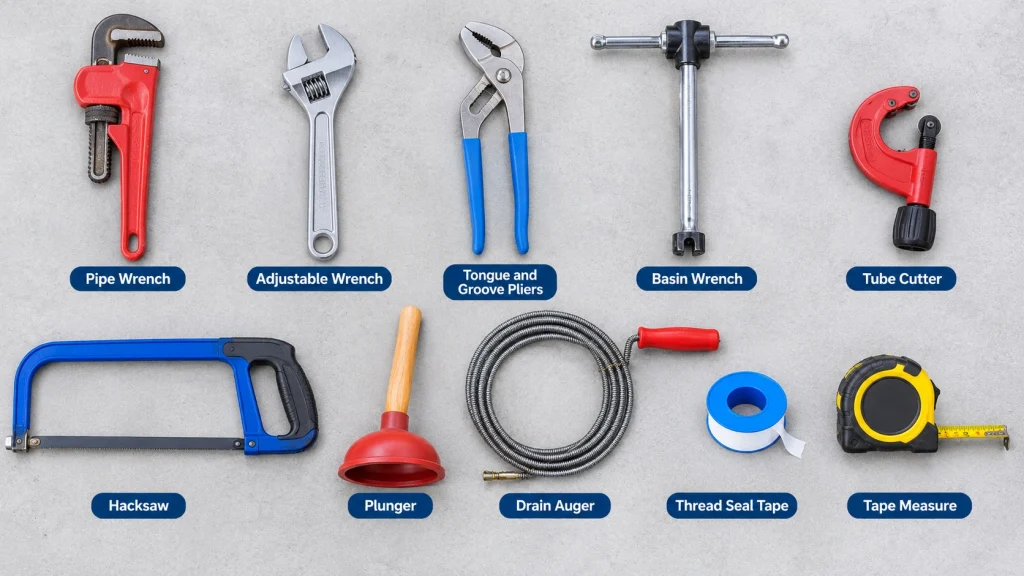
If you only need a short answer, these are the tools found in almost every plumber’s kit:
- Pipe wrench for gripping and turning threaded steel and iron pipe
- Adjustable wrench for nuts, compression fittings, and tap connectors
- Tongue and groove pliers for gripping fittings, nuts, and pipe of many sizes
- Basin wrench for reaching tap nuts behind and under sinks
- Tube cutter for clean, square cuts in copper pipe
- Hacksaw for cutting metal and plastic pipe where a cutter will not fit
- Plunger for clearing simple blockages in sinks and toilets
- Drain auger for reaching and breaking up blockages deeper in the pipe
- Thread seal tape for sealing threaded joints against leaks
- Tape measure for measuring pipe runs and marking cuts accurately
The sections below explain each of these in more detail, along with the other tools that complete a professional kit. Further general background on plumbing systems and how they work is available through Wikipedia’s overview of plumbing.
Wrenches and Gripping Tools
Gripping tools are the most used items in any plumbing kit, because almost every job involves loosening or tightening something.
Pipe wrench. A heavy, adjustable wrench with serrated jaws that bite into round pipe as force is applied. It is the standard tool for threaded steel and iron pipe and is usually used in pairs, one to hold the pipe and one to turn the fitting. Its teeth will mark soft or chrome surfaces, so it is not used on finished fixtures.
Adjustable wrench. A smooth jawed wrench that adjusts to fit nuts and flats of different sizes. It is used for compression fittings, tap connectors, and supply lines, where the flat jaws grip without damaging the nut.
Tongue and groove pliers. Also called water pump pliers, these have an adjustable pivot that lets the jaws open wide while staying parallel. They grip nuts, fittings, and small pipe quickly and are often the first tool a plumber reaches for.
Basin wrench. A long shaft with a pivoting, spring loaded jaw at the end, designed to reach the nuts that hold taps in place behind and under basins, where there is no room to swing an ordinary wrench.
Strap wrench. A handle with a rubber or fabric strap that wraps around pipe or a fitting and tightens as it turns. It grips polished, chrome, or plastic surfaces without scratching them.
Locking pliers. Pliers that clamp and lock in place, useful for holding a pipe or fitting steady while both hands work on another part of the job.
Pipe Cutting Tools
Clean, square cuts make strong joints, so plumbers use different cutting tools for different pipe materials.
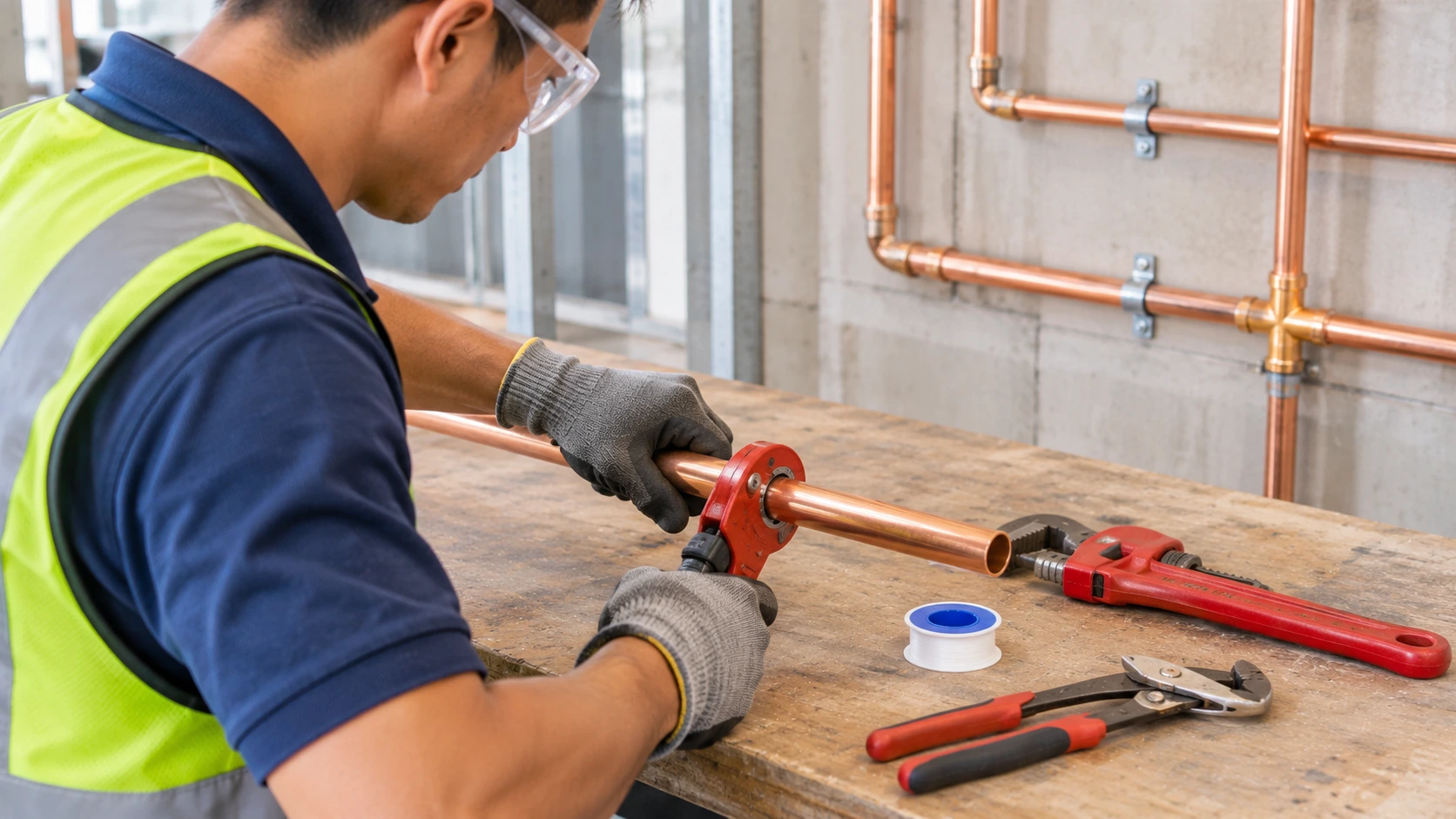
Tube cutter. A clamp with a sharp cutting wheel that is tightened gradually as it rotates around copper or other thin walled pipe. It produces a neat, square cut with no burrs on the outside, ready for soldering or a compression fitting. Mini versions fit into tight spaces between joists or behind fixtures.
Plastic pipe cutter. A ratcheting cutter with a sharp blade that slices through PVC, PEX, and other plastic pipe in a single squeeze, leaving a clean edge.
Hacksaw. A fine toothed saw that cuts metal and plastic pipe, threaded rod, and fixings. It is slower than a cutter but works on almost any material and in places where a cutter will not fit around the pipe.
Reciprocating saw. A powered saw used to cut through old pipe, cast iron, and fixings during demolition and renovation, especially where speed matters more than a perfect edge.
Deburring tool. A small reamer that removes the sharp burr left inside and outside a pipe after cutting. Deburring improves water flow and helps fittings seal properly.
Joining and Sealing Tools
Once pipe is cut, it has to be joined and sealed so the system holds water under pressure.
Thread seal tape. Often called PTFE or Teflon tape, this thin white tape is wrapped around male threads before assembly to fill gaps and prevent leaks. It is one of the cheapest and most used items in plumbing.
Pipe thread sealant. A paste applied to threads as an alternative or addition to tape, often used on larger threaded joints and gas fittings where it is approved for the purpose.
Soldering torch. A gas torch used to heat copper joints so solder flows into the fitting and creates a watertight seal. It is used together with flux, solder, and a cleaning brush or emery cloth to prepare the pipe.
Press fitting tool. A powered or manual tool that crimps special press fittings onto copper, stainless steel, or multilayer pipe, creating a sealed joint without heat. Press systems are widely used where hot work is restricted or speed is important.
PEX crimp or expansion tool. Tools that secure fittings onto flexible PEX pipe, either by crimping a ring around the joint or expanding the pipe end over the fitting.
Solvent cement and primer. Used to weld PVC pipe and fittings together chemically. The primer cleans and softens the surfaces, and the cement fuses them into a permanent joint.
Drain Clearing Tools
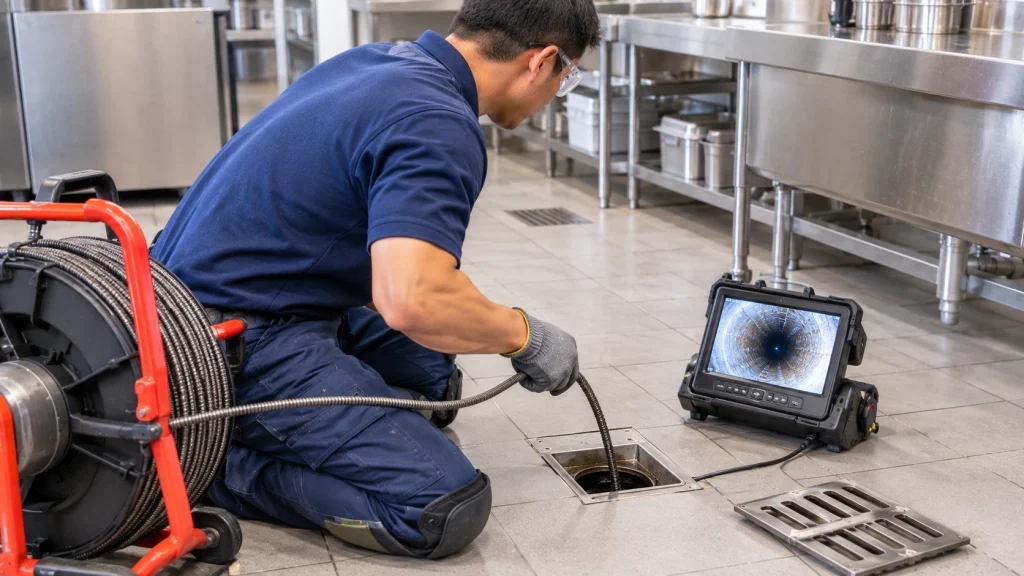
Blockages are among the most common plumbing problems, and the right tool depends on how far down the blockage sits.
Plunger. A cup plunger suits flat drains such as sinks and showers, while a flange plunger has an extra rubber sleeve that seals into a toilet outlet. Plungers clear simple blockages by pushing and pulling water through the pipe.
Drain auger. Also called a drain snake, this is a flexible steel cable that is fed into the drain and rotated to break up or retrieve a blockage. Hand augers suit household drains, while powered drum augers handle longer runs and tougher blockages.
Toilet auger. A short auger with a protective sleeve that reaches through the toilet trap without scratching the porcelain.
Drain inspection camera. A small waterproof camera on a flexible cable that shows the inside of the pipe on a screen, so plumbers can find blockages, cracks, root intrusion, and misaligned joints before deciding on a repair.
High pressure water jetter. A machine that sends a powerful jet of water through the drain to scour away grease, scale, and debris. Jetters are used for larger drains and for cleaning pipes thoroughly rather than just opening a path through a blockage.
Measuring, Marking, and Testing Tools
Accurate measuring and proper testing separate a neat, reliable installation from one that leaks or drains poorly.
Tape measure and marker. Used to measure pipe runs, mark cut lines, and set out fixture positions.
Spirit level. Used to check that pipes have the correct fall for drainage and that fixtures are installed level.
Pipe and cable detector. A handheld scanner that finds pipes, cables, and studs inside walls and floors before drilling or cutting, reducing the risk of damaging hidden services.
Pressure test pump and gauge. Used to pressurise a new or repaired water system and confirm that it holds pressure for the required period before walls and floors are closed up. Testing catches leaks while they are still easy to reach.
Moisture meter. Helps trace the source of a leak by measuring dampness in walls, floors, and ceilings.
Plumbing Tools Used on Construction Sites
On new buildings and larger projects, plumbing work goes well beyond hand tools. Pipework is installed on a bigger scale, often in concrete structures, at height, and below ground.
Pipe threading machine. A powered machine that cuts threads onto the ends of steel pipe quickly and consistently, used where large quantities of threaded pipe are installed.
Pipe bender. A manual or hydraulic tool that bends copper or steel pipe smoothly without kinking, reducing the number of fittings needed on a run.
Core drill. A drill with a hollow diamond tipped bit that cuts neat round holes through concrete walls and slabs for pipes to pass through. Core drilling is one of several concrete cutting methods explained in our guide on how to cut concrete.
Pipe laser. A laser that sets a precise line and gradient for underground drainage pipe, making sure gravity drains fall correctly along their whole length.
Excavation equipment. Underground drainage and water mains need trenches, which are usually dug with compact excavators sized to the depth and space available. The range of machines used for this kind of digging is covered below.
Also read: Types of Excavators for Construction and Earthmoving
Working at Height on Plumbing Installations
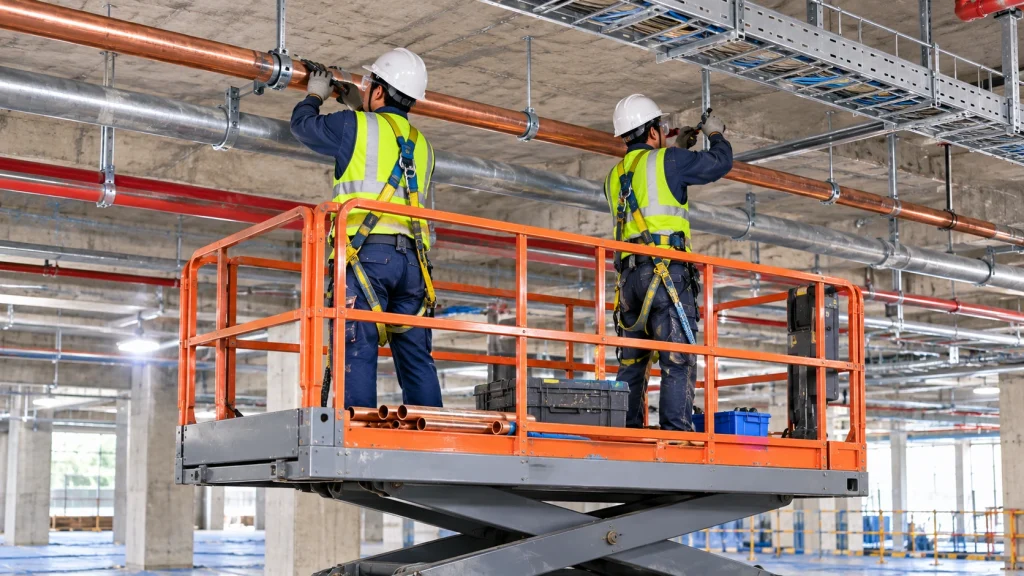
In commercial and high rise buildings, a large share of pipework runs at ceiling level, including water supply, drainage, sprinkler, and chilled water pipes hung from the slab above. Installing it safely needs a stable working platform that holds the plumber, the pipe, and the tools together.
For long runs across open floors, a scissor lift is often the most efficient option, since its wide platform can be repositioned quickly along the run, and the main designs are compared in our guide to types of scissor lifts. Where work is concentrated in one area or the floor cannot take a powered machine, mobile scaffolding towers provide a steady alternative. The differences between the two main powered platforms are explained below.
Also read: Boom Lift vs Scissor Lift: Which One Should You Choose?
Safety Gear That Belongs in Every Kit
Plumbing tools come with hazards of their own, so protective equipment is part of the kit rather than an extra.
Gloves protect against cuts from sharp pipe edges and burrs, and against contact with dirty water in drains. Safety glasses protect eyes when cutting, drilling, soldering, and working overhead. Knee pads make long periods working under sinks and on floors safer and more comfortable. Where soldering or other hot work is carried out, a fire extinguisher and a heat resistant mat protect nearby surfaces, and a hot work permit may be required on construction sites.
Working with drains and sewers also brings exposure to bacteria and, in confined spaces, to harmful gases, so the right respiratory protection and safe entry procedures matter. Singapore’s Ministry of Manpower publishes detailed Workplace Safety and Health guidance covering hot work, confined spaces, and safe work practices, and the principles for working safely above ground are covered below.
Access Equipment for Plumbing and Building Services Work
Overhead pipework goes faster and safer with the right access equipment. When you contact the team, it helps to share the ceiling height, the floor type and any loading limits, the width of doorways and corridors the machine must pass through, the length of the pipe runs, and how long you expect to need the equipment. With these details, a suitable scissor lift or scaffold tower can be recommended from the start.
RR Machinery Pte Ltd offers a wide range of scissor lifts for building services, fit out, and maintenance work across Singapore, backed by factory certified technicians and full servicing support. Contact us today for expert advice on the right access equipment and a quote tailored to your project.