Concrete is designed to be strong and durable, which is exactly what makes cutting it correctly such a genuinely technical task rather than something to approach with whatever tool happens to be on hand. Choosing the wrong saw, the wrong blade, or the wrong cutting method for a given job commonly results in a slower cut, a damaged blade, a poor-quality edge, or, in the worst cases, a serious safety incident.
This guide walks through the main methods used to cut concrete, how to choose between them, and the safety considerations, particularly around airborne silica dust, that every crew cutting concrete needs to take seriously regardless of which method is used.
Why Concrete Cutting Requires the Right Method
Concrete’s compressive strength comes from a mix of cement, aggregate, and often embedded steel reinforcement, all of which resist cutting in different ways and require different blade materials and cutting speeds to handle effectively. Attempting to cut concrete with an underpowered tool or an incorrectly specified blade typically results in excessive blade wear, overheating, and a ragged, imprecise cut line.
The right method depends on the specific job, a shallow control joint in a driveway calls for a very different approach than cutting a doorway opening through a structural wall, which is why concrete cutting is better understood as a family of related techniques rather than a single universal process.
Common Concrete Cutting Methods
Concrete cutting equipment ranges from small handheld tools suited to light, precise work through to large track-mounted saws built for cutting deep, structural sections, and choosing correctly between them depends heavily on the scale and location of the cut required.
Each method uses the same underlying principle, a diamond-embedded blade or wire abrading through the concrete rather than a traditional cutting edge slicing it, but the equipment built around that principle varies considerably in power, precision, and portability.
Handheld Saws and Angle Grinders
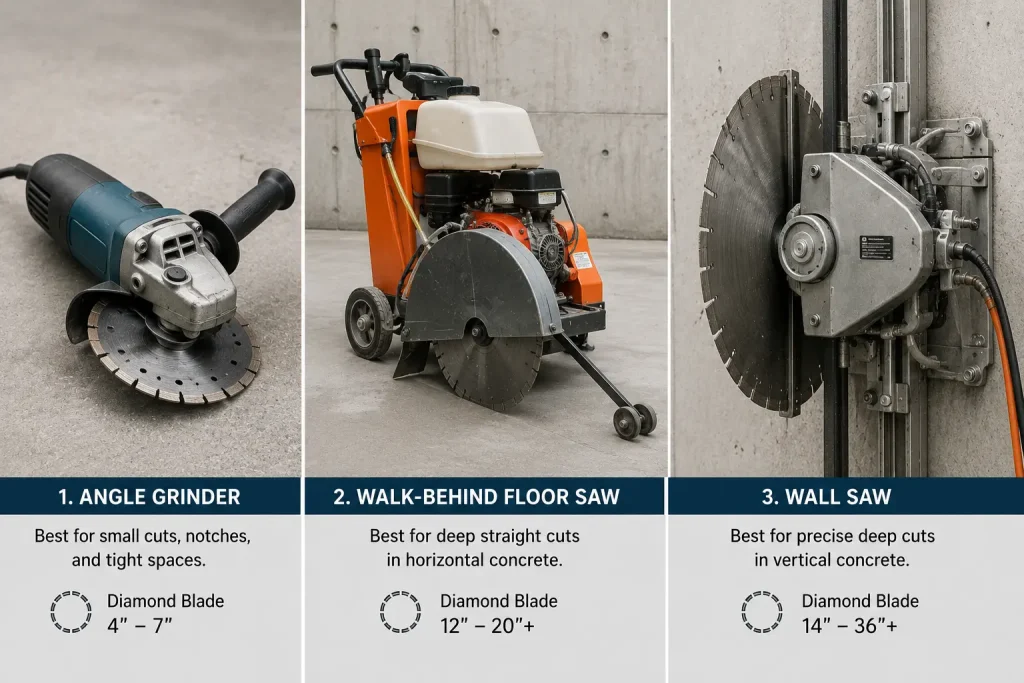
Handheld concrete saws and angle grinders fitted with diamond blades are the most portable and widely used tools for shallow cuts, control joints, and small openings, offering good manoeuvrability in tight or awkward spaces where larger equipment cannot reach. Their cutting depth is limited by blade size and the tool’s power, making them best suited to work up to roughly 100 to 150 millimetres deep depending on the specific model.
These tools are the standard choice for general contractors and smaller renovation jobs precisely because of their portability, but that same portability means they offer less stability and precision than larger equipment, requiring a steady, experienced hand for a clean, straight cut over any significant distance.
Walk-Behind Floor Saws
Walk-behind floor saws use a larger, more powerful blade mounted on a wheeled frame that the operator guides rather than fully supports by hand, allowing for deeper, straighter cuts across flat horizontal surfaces such as slabs and pavements. Their added weight and guided cutting path produce considerably more consistent, precise cuts than a handheld saw over long, straight runs.
These saws are the standard choice for cutting expansion joints, removing sections of a concrete slab, or preparing a trench line across a large flat area, where the combination of depth capability and straight-line accuracy outperforms what a handheld tool could achieve efficiently.
Wall Saws and Track-Mounted Saws
Wall saws run along a fixed track mounted directly onto the surface being cut, allowing for precise, deep vertical or horizontal cuts through walls, structural slabs, and other reinforced sections that handheld or walk-behind equipment cannot manage safely. Because the saw is mechanically guided along a fixed rail rather than held freehand, these systems can cut through significantly thicker, more heavily reinforced concrete with much greater accuracy.
Wall saws are typically specified for structural openings, doorways cut into load-bearing walls, or removing large sections of reinforced concrete, work where precision and depth capability matter more than portability or speed of setup.
Wet Cutting vs Dry Cutting
Beyond choosing the right saw, every concrete cutting job also requires a decision between wet and dry cutting, a choice that affects blade life, dust levels, and overall cutting speed.
Wet cutting introduces water directly at the blade during cutting, while dry cutting relies on the blade’s design and cutting speed alone without any water supply, and the right choice depends on the equipment, the job site, and the specific material being cut.
When to Use Wet Cutting
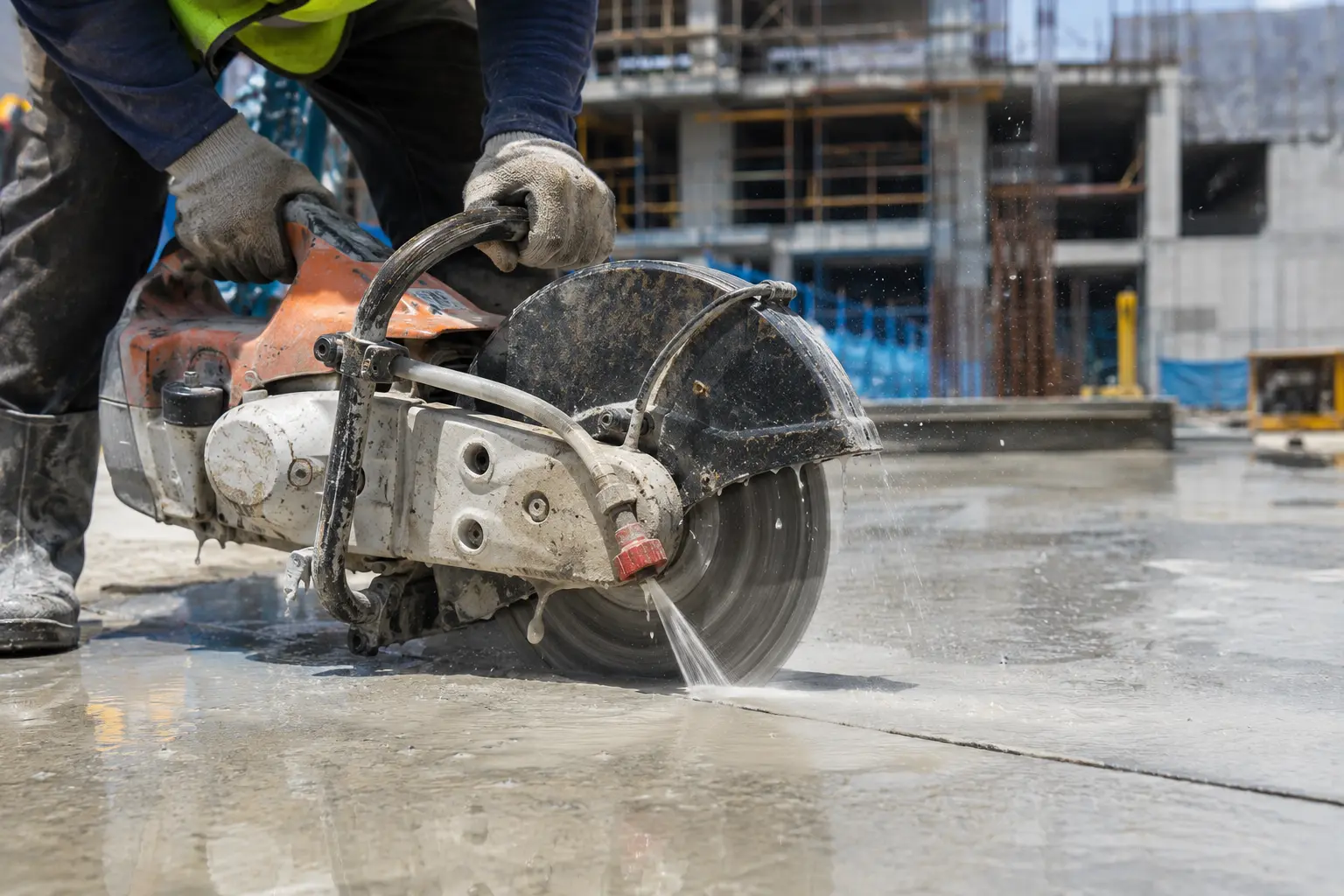
Wet cutting uses a continuous flow of water at the blade to cool it during operation, significantly extending blade life and, just as importantly, suppressing the vast majority of airborne dust generated during cutting. This makes wet cutting the preferred method whenever water supply and drainage are practical, particularly for larger jobs, deeper cuts, or extended cutting sessions where dust control matters most.
The trade-off is water and slurry runoff, a fine, abrasive by-product that needs to be managed and disposed of properly rather than allowed to drain into stormwater systems, which is a genuine environmental and site management consideration on most job sites.
When Dry Cutting Is Appropriate
Dry cutting is used where a water supply is impractical, indoors where water damage or slurry management would be problematic, or for shorter, shallower cuts where the reduced blade life is an acceptable trade-off for convenience. Dry-rated blades are specifically designed to tolerate the additional heat generated without water cooling, and using a wet-rated blade for dry cutting typically results in rapid, premature blade failure.
Dust control becomes considerably more important with dry cutting, since without water suppression, cutting concrete dry generates significant airborne dust that needs to be managed through other means, covered further in the safety section of this guide.
Powering Concrete Cutting Equipment On Site
Many concrete cutting jobs, particularly larger walk-behind and wall saws, require a reliable and adequately sized power supply, which is not always guaranteed on every job site, especially newer sites without an established grid connection.
On sites without mains power, or where existing power capacity is already committed to other equipment, a portable generator is often the practical solution for running cutting equipment reliably, and undersizing that generator relative to the saw’s actual power draw is a common and entirely avoidable cause of tripped equipment and lost productivity. Matching generator capacity correctly to the tools being run on a site is covered in detail in Generator for Construction Site: A Complete Guide, useful reading before mobilising cutting equipment to a site without confirmed power availability.
Also read: Generator for Construction Site: A Complete Guide
Silica Dust and Respiratory Safety
Cutting concrete releases crystalline silica dust, a genuine and well-documented occupational health hazard that deserves serious attention regardless of how small or routine a cutting job might seem.
Unlike many site hazards that carry an obvious, immediate risk, silica exposure causes cumulative, long-term lung damage, which makes it easy to underestimate on any single job even though repeated exposure over a career carries a substantial health risk.
Health Risks of Airborne Silica Dust
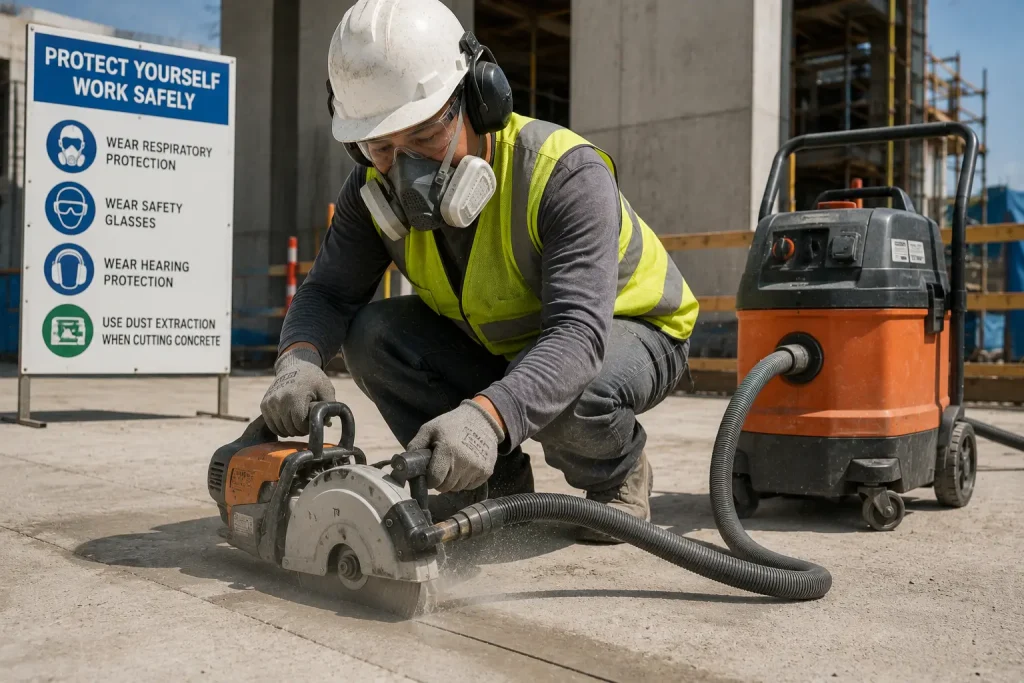
Respirable crystalline silica, released when concrete, stone, or masonry is cut, ground, or drilled, can cause silicosis, an incurable and progressive lung disease, along with an elevated risk of lung cancer and other respiratory conditions with repeated, unprotected exposure over time. Because the damage accumulates gradually and symptoms often appear only years after significant exposure, silica dust is frequently underestimated as a hazard compared to more immediately visible site risks.
This long latency period is precisely why consistent dust control on every job matters, rather than treating protective measures as optional on smaller or shorter cutting tasks where the immediate risk feels low.
Dust Control Methods
Wet cutting remains the single most effective control method, suppressing the vast majority of airborne dust at the point it is generated rather than relying on protective equipment alone to manage exposure after the fact. Where dry cutting is unavoidable, on-tool dust extraction systems connected to a suitably rated vacuum, combined with properly fitted respiratory protective equipment, are essential rather than optional additions.
Singapore’s Ministry of Manpower publishes detailed Workplace Safety and Health guidance covering exposure limits and control requirements for respirable dust in construction work, standards that apply directly to any concrete cutting task regardless of scale. Further technical background on the equipment and blade technology used in concrete cutting is available through Wikipedia’s overview of concrete saws.
A Practical Safety Checklist Before Cutting

Before starting any concrete cutting task, a few practical checks help avoid the most common causes of injury and equipment damage:
- Confirm the location of embedded reinforcement, electrical conduit, or utility lines before cutting, using scanning equipment where the layout is not already known
- Select a blade rated for the specific cutting method, wet or dry, and material being cut
- Confirm adequate power supply is available, checking generator capacity against the saw’s actual power draw if mains power is not accessible
- Set up wet cutting water supply and slurry management, or dry cutting dust extraction, before starting rather than partway through the job
- Fit appropriate personal protective equipment, including respiratory protection, eye protection, and hearing protection, before cutting begins
- Clear the area of other workers and establish a safe working zone around the cutting operation
A broader overview of how these individual precautions fit within a site’s overall safety management approach is covered in Heavy Equipment Safety: A Complete Site Guide.
Get the Right Power and Equipment Support
Cutting concrete safely and effectively comes down to matching the right method and blade to the job, managing wet or dry cutting conditions appropriately, and taking silica dust exposure seriously on every task regardless of scale. Reliable power on site is just as essential to getting this right as the saw itself, particularly on sites without an established grid connection.
RR Machinery Pte Ltd offers a wide selection of power generators suited to running concrete cutting equipment and other site tools reliably. Contact us today to find the right generator and equipment support for your next project.