Few factors determine a construction project’s success as directly as how well its costs are managed from the very first estimate through to final handover. A project can be completed on schedule and to specification and still be considered a failure if it blew through its budget along the way, which is why cost management is treated as a discipline in its own right rather than something that simply happens alongside the actual building work.
This guide walks through what cost management in construction actually involves, from early-stage estimating and budgeting, through tracking and control during the build, to the contingency planning and equipment strategies that keep a project’s finances on track when conditions inevitably change partway through.
What Is Cost Management in Construction?
Cost management in construction is the ongoing process of planning, estimating, tracking, and controlling a project’s costs from initial concept through to completion, with the goal of delivering the project within an approved budget while still meeting quality and schedule requirements.
It is a continuous discipline rather than a single task performed at the start of a project, since costs need to be actively monitored and adjusted for throughout construction as conditions change, materials fluctuate in price, and unexpected site issues arise. Effective cost management sits alongside broader project planning, since decisions made at the master planning and site planning stages directly shape what a project will ultimately cost to deliver.
Cost Estimating and Budgeting
Every construction project’s financial management begins with an estimate, a projection of what the work will cost before any of it has actually been carried out, which then forms the basis for the approved project budget.
The accuracy of this initial estimate has a disproportionate effect on the rest of the project, since a budget built on an unrealistic estimate creates cost pressure that no amount of careful tracking later on can fully correct.
Types of Cost Estimates
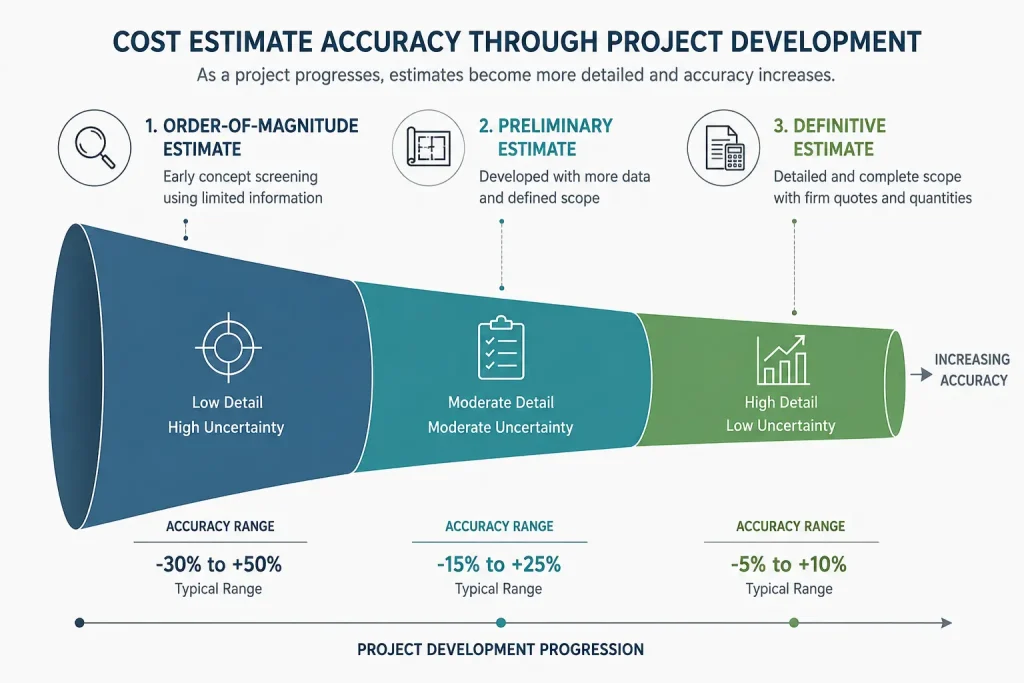
Construction estimates generally become more precise as a project moves through its planning stages, starting with a rough order-of-magnitude estimate based on similar past projects, refined into a more detailed preliminary estimate once design work progresses, and finalised into a definitive estimate once drawings and specifications are largely complete. Each stage serves a different purpose, early estimates support initial feasibility and financing decisions, while later, more detailed estimates form the basis for actual contract pricing and budget approval.
Understanding which type of estimate a given figure represents matters considerably, since treating an early, rough estimate as though it carries the same precision as a detailed final estimate is a common source of budget disappointment later in a project.
Building a Realistic Project Budget
A realistic budget accounts for direct costs, labor, materials, and equipment, as well as indirect costs such as site overheads, permits, and professional fees, along with an appropriate contingency allowance for the unknowns every project inevitably encounters. Budgets built without an adequate contingency allowance tend to look attractive during approval but consistently run into trouble once construction begins and unforeseen conditions or price changes emerge.
Equipment costs in particular deserve careful attention at the budgeting stage, since decisions about renting versus purchasing machinery, covered in more depth in Rent or Buy a Forklift? How to Decide for Your Business, can shift a significant portion of a project’s cost structure between upfront capital expense and ongoing operating cost depending on which approach is chosen.
Also read: What Is a Master Plan? Definition, Purpose & Process
Cost Tracking and Control During Construction
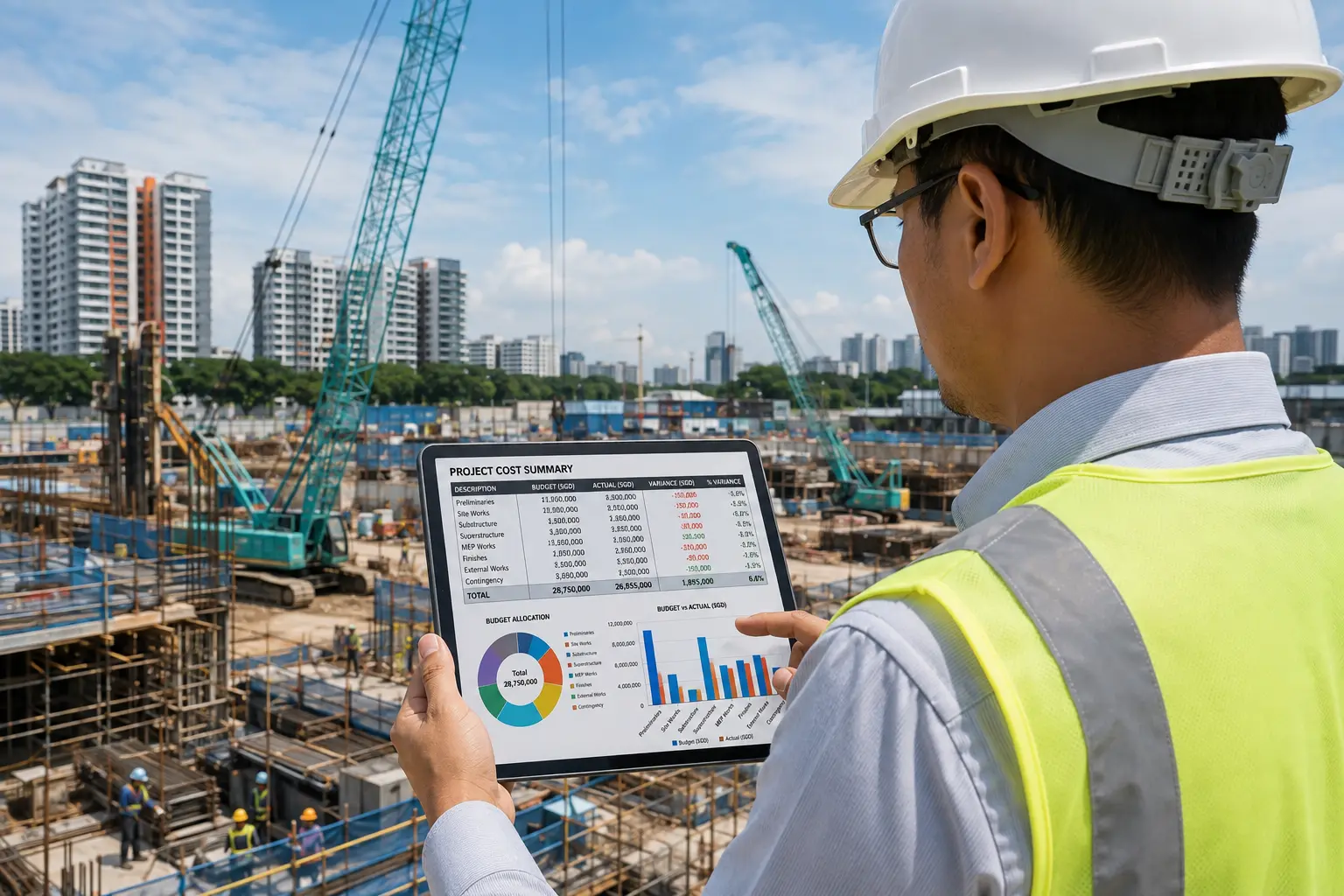
Once construction begins, cost management shifts from projection to active monitoring, comparing actual spending against the approved budget on an ongoing basis rather than waiting until a project’s completion to discover whether it stayed on track.
This ongoing tracking is what allows a project team to catch cost overruns early, while there is still time to adjust scope, sequencing, or procurement decisions, rather than discovering a budget shortfall only once it is too late to correct.
Monitoring Actual Costs Against Budget
Effective cost tracking compares actual expenditure against the budget at a detailed level, by cost category and project phase, rather than relying solely on a single overall running total that can mask problems in specific areas. Regular reporting intervals, typically weekly or monthly depending on project size, allow variances to be identified and investigated while the underlying cause is still fresh and addressable.
This granular tracking also makes it possible to distinguish between genuine cost overruns and simple timing differences, where costs were always going to be incurred but happened to fall in a different reporting period than originally planned, an important distinction for accurate financial reporting.
Common Causes of Cost Overruns
Cost overruns typically stem from a small set of recurring causes: scope changes requested after budget approval, inaccurate initial estimates, material price volatility, and productivity losses from delays, rework, or equipment downtime. Each of these causes tends to compound the others, a delay caused by equipment downtime, for example, often triggers additional costs through idle labor and extended site overheads on top of the direct repair cost itself.
A broader look at how these individual pressures show up across the construction industry, and the practical approaches businesses use to manage them, is available in Top Challenges in the Construction Industry and How to Overcome Them, which covers labor, material, and equipment cost pressures in further depth alongside the other operational challenges they connect to.
Also read: Top Challenges in the Construction Industry and How to Overcome Them
Contingency Planning
No construction budget, however carefully prepared, can predict every condition a project will actually encounter, which is why a contingency allowance is a standard and necessary part of responsible cost management rather than a sign of poor initial estimating.
Contingency is typically set as a percentage of total project cost, scaled to reflect the project’s complexity and the amount of design and site information available at the time the budget was approved, projects with more unknowns at the outset generally carry a higher contingency percentage. Drawing down contingency should be tracked just as carefully as the main budget, since a contingency allowance consumed early in a project leaves little buffer for issues that inevitably arise later, and a pattern of early, heavy contingency use is often an early warning sign that the underlying estimate was too optimistic from the start.
Equipment Cost Management Strategies
Equipment represents one of the largest and most controllable cost categories on most construction projects, making it a natural focus area for cost management efforts beyond general budgeting and tracking discipline.
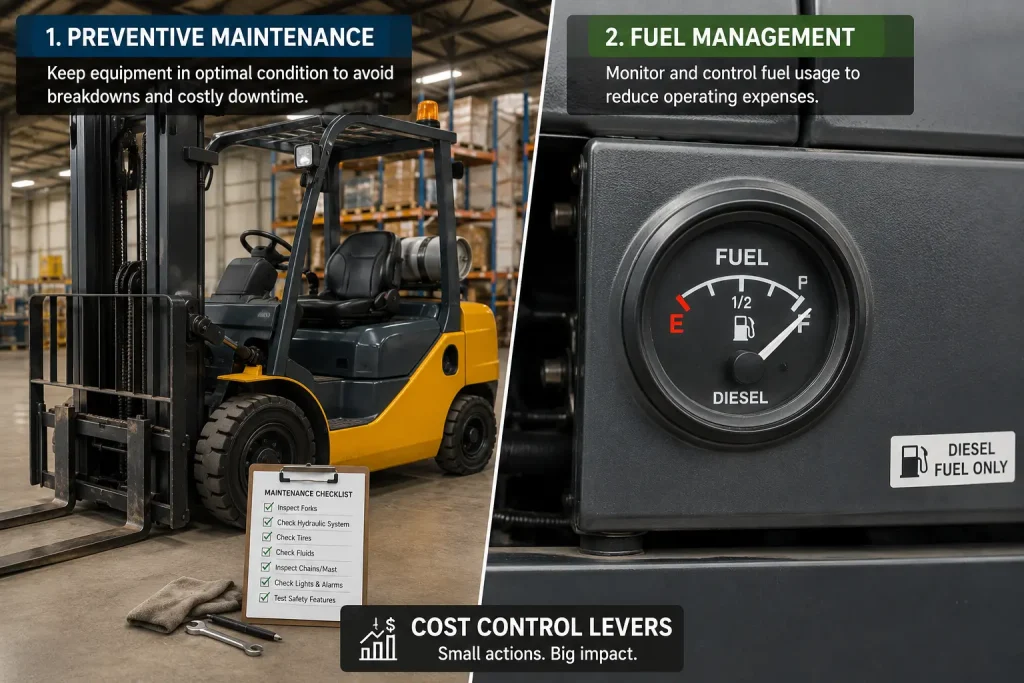
Unlike material costs, which are largely dictated by external markets, equipment costs respond directly to decisions a business makes about ownership structure, fuel management, and maintenance discipline, giving cost managers genuine leverage in this category.
Rent vs Buy Decisions
Choosing between renting and purchasing equipment has a direct, structural effect on how equipment costs appear in a project’s financials, shifting cost between a large upfront capital expense and a smaller, predictable recurring operating expense depending on which path is chosen. This decision should be revisited for each major equipment category on a project rather than applied as a blanket policy, since the right choice depends on expected utilisation, project duration, and the business’s broader fleet strategy.
Fuel and Energy Cost Control
Fuel is one of the most variable and closely watched cost categories in equipment-heavy construction work, and businesses that actively manage consumption, rather than treating it as an unavoidable fixed cost, can materially improve their overall cost position. Practical strategies for reducing fuel consumption across common equipment categories are set out in Fuel Saving Tips for Heavy Equipment Operations, while Electric vs Diesel Forklifts: Which One Should You Choose? covers how power source choice itself affects long-term running costs for specific equipment types.
Preventive Maintenance to Avoid Cost Overruns
Unplanned equipment downtime is one of the most expensive and avoidable cost overrun sources on a construction project, since the cost of a breakdown extends well beyond repair fees into idle labor and delayed dependent tasks. Structured maintenance routines, such as those covered in Forklift Maintenance Tips for Safe and Efficient Operation and Generator Maintenance Checklist: A Complete Site Guide, directly protect a project’s cost position by reducing the likelihood of exactly this kind of disruption.
Also read: Rent or Buy a Forklift? How to Decide for Your Business
Tools and Practices That Support Cost Management
Beyond process and discipline, a range of practical tools and habits make cost management considerably easier to sustain across a project’s full duration, particularly on larger or longer-running jobs.
Commonly used approaches include:
- Cost coding systems that categorise every expense against a standard breakdown structure, making variance analysis and reporting far more consistent across projects
- Regular cost reporting cycles, weekly or monthly depending on project scale, rather than ad hoc reviews triggered only when a problem is suspected
- Earned value tracking, comparing the value of work actually completed against both cost and schedule to give a more complete picture than cost tracking alone
- Change order controls, requiring formal approval and cost impact assessment before any scope change is implemented, preventing scope creep from silently eroding the budget
- Clear equipment logs tracking utilisation, fuel consumption, and maintenance history, supporting the kind of equipment cost decisions covered earlier in this guide
Further background on the formal estimating and cost control methodologies used across the construction and engineering professions is available through Wikipedia’s overview of cost estimation, useful additional context for teams formalising their own cost management processes.
Keep Your Project’s Costs Under Control
Cost management in construction is not a single task completed at the start of a project but a continuous discipline spanning estimating, budgeting, tracking, and equipment strategy from the first feasibility study through to final handover. Businesses that treat it this way, rather than as a one-time budgeting exercise, are consistently better positioned to absorb the cost pressures that construction projects inevitably encounter.
RR Machinery Pte Ltd supports Singapore’s construction and industrial sectors with reliable heavy machinery solutions and flexible rental and servicing options designed to help manage equipment costs effectively. Browse our complete heavy machinery services or contact our team today to discuss equipment strategies that fit your project’s budget.