Construction remains one of the most demanding industries to operate in, shaped by tight margins, unpredictable site conditions, and a workforce that is becoming harder to find in many markets. Even well-managed contractors and developers routinely run into the same handful of recurring obstacles, regardless of project size or location, and how a business responds to these obstacles often determines whether a project finishes on time and on budget.
This guide walks through the challenges that come up most consistently across the construction industry today, labor shortages, rising costs, project delays, safety pressures, equipment downtime, and sustainability demands, along with the practical approaches businesses are using to address each one.
Labor Shortages and Skilled Worker Shortfalls
A shortage of skilled labor remains one of the most persistent challenges facing construction businesses, affecting everything from project scheduling to the quality of work delivered on-site. This shortage is not a temporary blip but a structural shift in many markets, driven by an ageing workforce, fewer young workers entering trades, and strong competition for labor from other industries offering comparable pay with less physically demanding work.
Why the Construction Workforce Is Shrinking
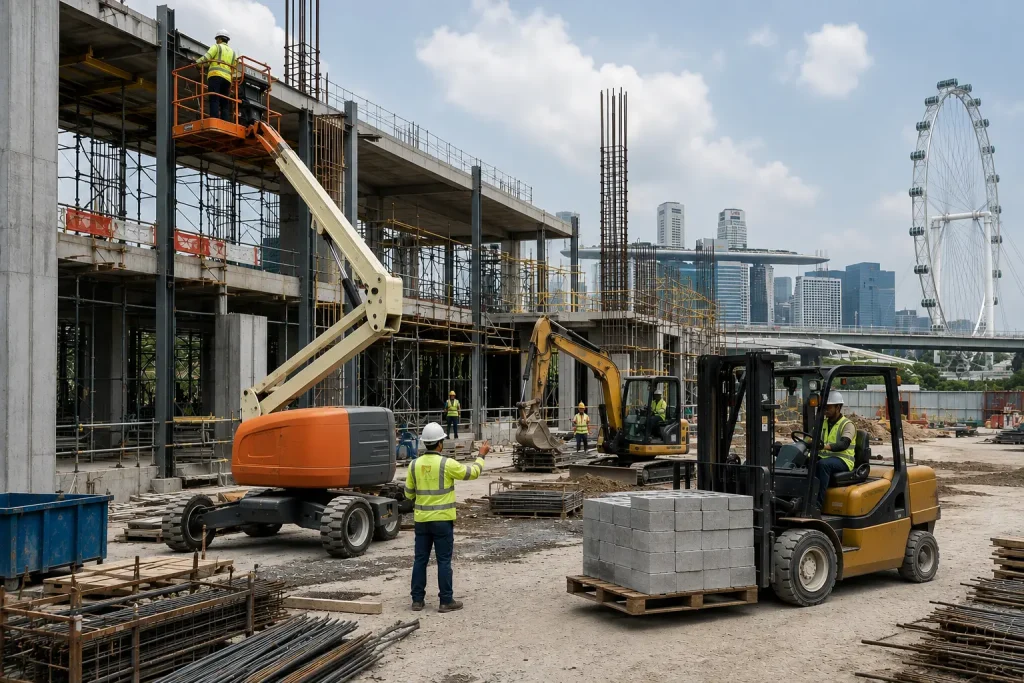
Many construction trades rely on a workforce that is retiring faster than it is being replaced, since fewer younger workers have historically entered manual trades compared to previous generations, a pattern seen across Singapore and many other developed construction markets. This demographic pressure is compounded by construction’s reputation for physically demanding work and variable job security, which makes it harder to compete for talent against industries offering more predictable hours and working conditions.
The shortage is not evenly distributed either, certain specialised trades and certified equipment operators are in particularly short supply, creating bottlenecks even on projects that otherwise have adequate general labor. This uneven distribution means a single missing skill set, such as a certified crane or aerial platform operator, can delay a project even when the broader workforce is sufficient.
How Equipment and Automation Help Offset Labor Gaps
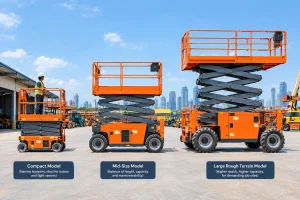
One practical response to labor shortages is investing in equipment that increases the output of each available worker, allowing a smaller crew to accomplish what previously required a larger team. Modern aerial work platforms and material handling equipment, for example, allow a single trained operator to complete tasks that would otherwise require multiple workers using ladders or manual handling methods.
Understanding how a specific piece of equipment’s mechanism actually increases productivity is useful context for justifying this kind of investment, covered in detail in How Does a Boom Lift Work? Mechanics & Components Explained, which explains how a single operator can safely and efficiently complete work that would otherwise need scaffolding and multiple workers to access.
Also read: How Does a Boom Lift Work? Mechanics & Components Explained
Rising Costs of Equipment, Materials, and Fuel
Cost pressure across nearly every input, materials, fuel, equipment, and labor, has made margin management considerably harder for construction businesses in recent years. Unlike labor shortages, which build gradually, cost pressures can shift quickly in response to fuel price volatility, supply chain disruption, or material shortages, forcing businesses to adapt their purchasing and equipment strategies more reactively than they might prefer. This challenge shows up across three distinct fronts at once, each requiring a different response.
Fuel and Energy Cost Volatility
Fuel represents a significant, recurring operating cost for any business running diesel-powered equipment, and price volatility makes budgeting for this expense considerably harder than for more stable cost categories. Businesses that actively manage fuel consumption, rather than treating it as a fixed, unavoidable cost, can meaningfully reduce their exposure to this volatility over time.
Practical fuel management strategies that apply across most heavy equipment categories are covered in Fuel Saving Tips for Heavy Equipment Operations, while businesses evaluating alternative power sources for specific equipment types can find further guidance in Electric vs Diesel Forklifts: Which One Should You Choose?, since shifting even part of a fleet to electric power can reduce exposure to fuel price swings considerably.
Rising Material Costs
Raw material prices, steel, concrete, timber, and copper wiring among them, have seen significant volatility in recent years, driven by global supply chain disruption and fluctuating demand across construction markets worldwide. Unlike equipment and fuel costs, which a business has some direct control over, material price swings are largely dictated by global markets, leaving contractors to manage the impact through contract terms, procurement timing, and contingency pricing rather than operational changes alone.
This volatility has made accurate project costing considerably harder, particularly for fixed-price contracts signed months before materials are actually procured, a risk that has pushed many contractors toward shorter procurement windows and more flexible pricing clauses.
Rent vs Buy as a Cost Management Strategy
Rising equipment prices have made the decision between renting and purchasing machinery more consequential than it once was, since the capital tied up in ownership carries greater opportunity cost when financing rates and equipment prices are both elevated. Renting shifts equipment costs from a large upfront capital expense to a predictable, scalable operating expense, which can be considerably easier to manage during periods of cost uncertainty.
A detailed breakdown of how this decision should be approached, including the specific cost, maintenance, and flexibility trade-offs involved, is available in Rent or Buy a Forklift? How to Decide for Your Business, a framework that applies to most categories of construction equipment facing similar cost pressure.
Also read: Rent or Buy a Forklift? How to Decide for Your Business
Project Delays and Poor Site Planning
Delays remain one of the most common and costly problems in construction, and while some causes are genuinely outside a contractor’s control, a significant share stem from planning gaps that could have been addressed earlier in a project’s life. Understanding where delays typically originate makes it easier to address the actual root cause, rather than simply absorbing the schedule impact and hoping subsequent phases can compensate for lost time.
Common Causes of Construction Delays
Weather, supply chain disruption, and permitting delays sit largely outside a contractor’s direct control, but poor site planning, unclear zoning status, inadequate equipment scheduling, and unresolved design coordination issues are frequently self-inflicted and avoidable with better upfront planning. Equipment availability gaps in particular cause disproportionate delays relative to their apparent size, since a single missing piece of machinery can halt an entire sequence of dependent tasks.
Delays also compound across a project’s schedule in ways that are easy to underestimate, a two-week delay in site clearing can push back every subsequent phase by more than two weeks once contractor availability and re-mobilisation time are factored in, making early-stage planning disproportionately valuable for protecting the overall schedule.
The Role of Master Planning and Site Planning
Many delays trace back to a mismatch between what a broader master plan permits and what a specific site plan actually proposes, an issue that surfaces only once detailed design work is already underway. Confirming a site’s current zoning and master plan status early, before committing significant design and planning resources, avoids the costly rework that follows when this mismatch is discovered late. The relationship between these two planning stages is explained in more depth in What Is a Master Plan? Definition, Purpose & Process, while the practical, site-specific planning process is covered in Construction Site Planning: A Complete Guide.
Also read: Construction Site Planning: A Complete Guide
Safety and Regulatory Compliance Pressures
Safety expectations across the construction industry have risen considerably, driven by stricter enforcement, greater public scrutiny, and a genuine industry-wide push to reduce the sector’s historically high injury rates. Meeting these rising expectations requires more than simply following minimum legal requirements, since genuinely safe sites tend to also be more productive ones, reducing the disruption and cost that follow from incidents, investigations, and work stoppages.
Regulatory bodies across most major construction markets have increased both the scope of safety requirements and the rigour of enforcement in recent years, raising the compliance burden for contractors operating multiple sites simultaneously. Singapore’s Ministry of Manpower has similarly strengthened its Workplace Safety and Health framework, reflecting a broader regional and global trend toward stricter site safety accountability, where failures now carry heavier financial and operational consequences than they may have in the past.
Meeting this rising bar depends on more than posted signage and occasional audits, it requires a consistent set of understood rules that every worker follows regardless of time pressure or supervision, detailed further in 10 Construction Site Safety Rules Every Worker Should Know. Equipment condition plays an equally important role in this culture, since even a well-trained workforce cannot compensate for poorly maintained machinery, a connection covered further in Heavy Equipment Safety: A Complete Site Guide.
Also read: 10 Construction Site Safety Rules Every Worker Should Know
Equipment Downtime and Maintenance Challenges
Unplanned equipment downtime is a challenge that rarely gets the attention it deserves until it actually halts a project, at which point its true cost, in lost productivity, idle labor, and schedule disruption, becomes immediately apparent. This challenge is particularly acute in construction because equipment failures rarely happen in isolation, a single broken-down excavator or forklift can idle an entire crew whose work depends on it, multiplying the cost of the failure well beyond the repair bill itself. The direct repair cost is usually the smallest part of the total, once idle crew time and delayed dependent tasks are factored in.
Preventive Maintenance as a Competitive Advantage
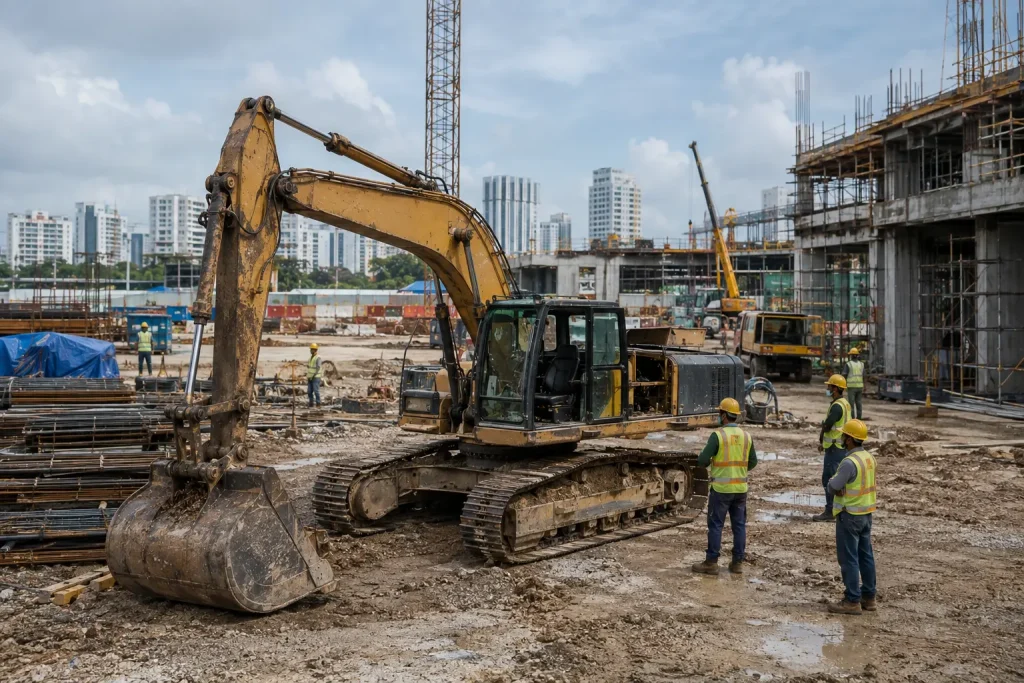
Businesses that track downtime causes systematically often find the same few root causes recurring, deferred routine maintenance, operating equipment beyond its rated limits, and inadequate pre-use inspection, all of which are preventable with a consistent maintenance routine rather than a reactive repair-when-it-breaks approach. Businesses that maintain equipment on a fixed schedule, rather than reactively after a fault appears, consistently report higher uptime and lower total repair costs over a fleet’s working life.
Practical, structured maintenance routines for two of the most commonly used categories of construction equipment are set out in Forklift Maintenance Tips for Safe and Efficient Operation and Generator Maintenance Checklist: A Complete Site Guide, both applicable to fleets of any size. Treating maintenance as a competitive advantage rather than a cost centre is increasingly common among businesses that recognise reliable equipment translates directly into more consistent project delivery, a meaningful differentiator in an industry where delays are so common.
Sustainability and Emissions Pressure
Sustainability expectations, from regulators, clients, and increasingly the public, have become a genuine operational consideration for construction businesses rather than a peripheral concern. Government agencies overseeing the built environment, including Singapore’s Building and Construction Authority, have progressively raised sustainability expectations for construction projects, and many private clients now include emissions and sustainability criteria directly within tender requirements, a shift that makes emissions profile a genuine equipment specification criterion alongside capacity and cost.
Businesses responding to this pressure tend to focus on a few practical levers rather than attempting a wholesale operational overhaul:
- Shifting appropriate parts of an equipment fleet to electric power, particularly for machines used in enclosed or urban environments where the emissions and noise advantages are most pronounced
- Reducing unnecessary idle running time across diesel-powered equipment
- Following structured fuel efficiency practices during day-to-day operation
- Prioritising equipment with better emissions performance when renewing or expanding a fleet
A detailed look at the specific benefits driving the shift toward electric equipment, beyond simple cost savings, is available in Benefits of Electric Forklifts: Why Warehouses Are Switching, which explains why this shift is accelerating even among businesses not directly required to make it.
Also read: Benefits of Electric Forklifts: Why Warehouses Are Switching
Turning Industry Challenges Into a Competitive Advantage
The challenges facing construction today, labor shortages, cost pressure, delays, safety expectations, equipment downtime, and sustainability demands, are unlikely to disappear, but businesses that address them systematically consistently outperform those that simply absorb the disruption as it comes. Treating equipment strategy, maintenance discipline, and planning rigour as core operational priorities, rather than secondary concerns, is what increasingly separates resilient construction businesses from those struggling to keep pace.
RR Machinery Pte Ltd supports Singapore’s construction and industrial sectors with reliable heavy machinery solutions and dependable servicing support built around these exact challenges. Browse our complete heavy machinery services or contact our team today to discuss how the right equipment strategy can help your business navigate these pressures more effectively.