
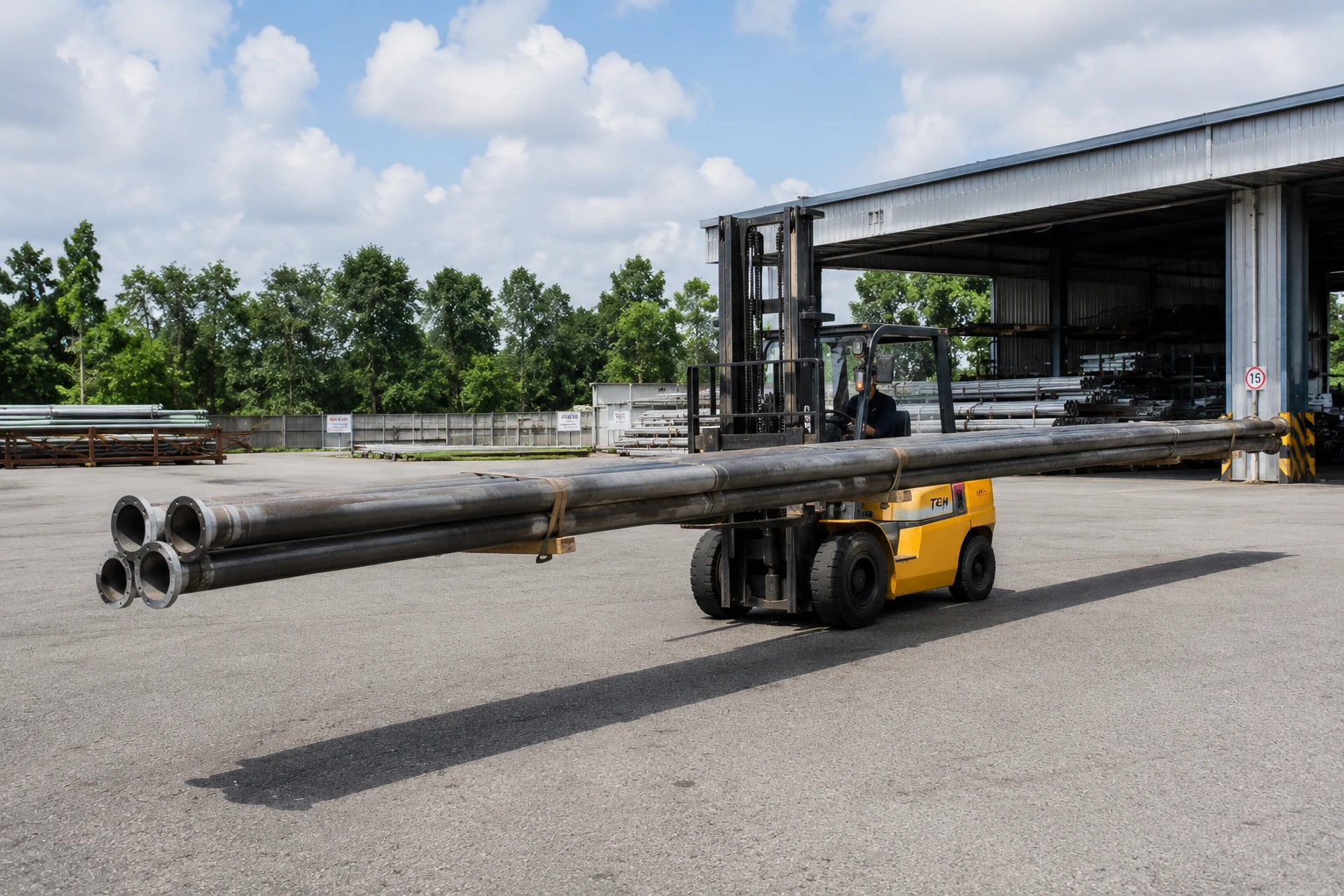
Two loads can weigh exactly the same and still represent completely different levels of risk to a forklift, and the reason comes down to a single measurement most operators have heard of but few fully understand: load center. A forklift’s rated capacity, the number printed on its data plate, is only accurate for a load positioned at a specific, standard distance from the forks. Move that same weight further out, and the machine’s actual safe capacity drops, sometimes dramatically, even though nothing about the load’s weight has changed.
Understanding load center is not an academic exercise, it directly determines whether a specific load can be lifted safely on a specific forklift, and misjudging it is one of the more common, avoidable causes of forklift tip-overs. This guide explains what load center actually means, how it is measured, and how to calculate it correctly for loads that do not match the simple, symmetrical boxes used on a rating plate diagram.
What Is Load Center?
Load center is the horizontal distance from the front face of a forklift’s forks to the centre of gravity of the load being carried, measured along the length of the forks. It is not the load’s total length, but specifically where that load’s weight is effectively concentrated.
Every forklift’s rated capacity is specified at a standard load center, most commonly 500 millimetres, referred to as the standard or nominal load center used across most rating plates and specification sheets. This standard exists so that different forklift models can be compared on equal terms, a forklift rated for 2,000 kilograms at 500 millimetres load center can be directly compared to another model with the same rating, without needing to account for different assumptions about load shape.
Why Load Center Exists as a Standard
Without a standardised reference point, forklift capacity ratings would be almost meaningless for comparison purposes, since a machine’s true lifting capability changes continuously depending on exactly where a load’s weight sits along the forks.
Manufacturers settled on a standard load center decades ago specifically to give buyers and operators a consistent, comparable capacity figure, understanding that real-world loads would often differ from this standard and require the operator to calculate an adjusted capacity accordingly. This is why a forklift’s rated capacity should always be understood as capacity at the standard load center, not an unconditional maximum weight that applies regardless of how a load is positioned.
How Load Center Affects Capacity
The relationship between load center and capacity comes down to the same counterbalance physics that keeps a forklift stable in the first place, a relationship explained in full mechanical detail below.
Also read: How a Forklift Really Works: The Mechanism Explained
Reading a Forklift’s Rating Plate
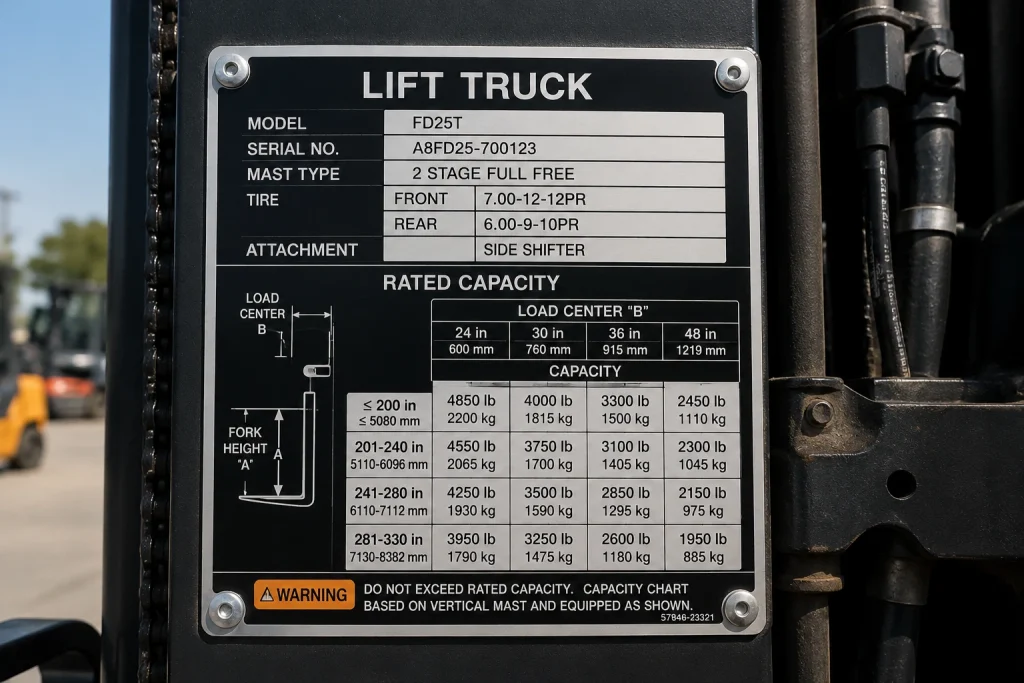
A forklift’s data plate typically shows a specific weight capacity paired with a specific load center distance, and this pairing is essential, the capacity figure alone means nothing without knowing the load center it was calculated for. Many rating plates also show a capacity chart or table listing several different load center distances alongside their corresponding maximum capacity, giving operators a more complete picture than a single number could provide.
Operators should treat the rating plate as the definitive reference for a specific machine rather than relying on a generic capacity figure remembered from a different forklift, since even models that look similar can carry meaningfully different capacity ratings depending on mast configuration, counterweight, and other design factors.
The Load Moment Relationship
As load center increases, meaning the load’s weight sits further from the forks, the tipping moment it creates around the forklift’s front axle increases proportionally, even though the load’s actual weight has not changed. This is the same lever principle at work in a see-saw, a given weight positioned further from the pivot point exerts more turning force than the same weight positioned closer to it.
Because the forklift’s counterweight can only offset a fixed amount of this tipping moment, a load positioned beyond the standard load center effectively demands more counterbalancing force than the machine was rated to provide at full capacity, which is precisely why rated capacity decreases as load center increases.
Calculating Actual Load Center for Real Loads
Rating plates and specification sheets assume a simple, symmetrical load, but real materials handled on a job site rarely arrive in a perfectly uniform shape, which is why calculating actual load center correctly matters for anything unusual.
Measuring Load Center for Regular Loads
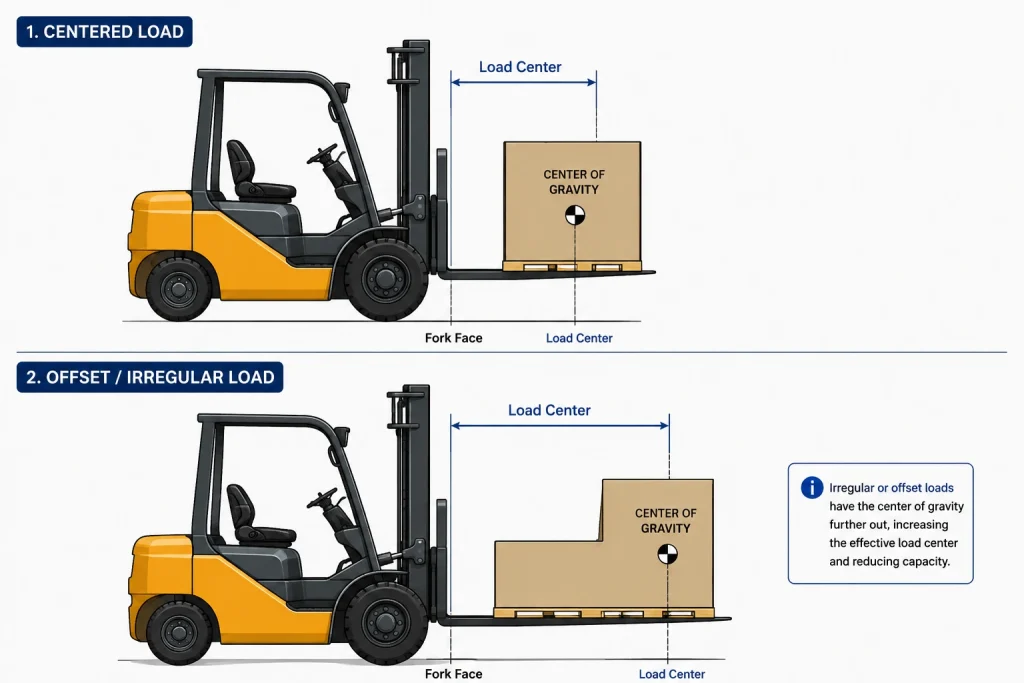
For a rectangular or uniformly shaped load, load center is simply half the length of the load when it is centred squarely against the fork backrest, since the centre of gravity of a uniform object sits at its geometric centre. A one-metre-long uniform pallet load, for example, has a load center of 500 millimetres when pushed fully back against the forks, matching the standard rating and requiring no capacity adjustment.
Handling Irregular or Offset Loads
Loads that are unevenly weighted, oddly shaped, or not pushed fully back against the fork backrest have a load center that differs from what their outer dimensions alone would suggest, and estimating this incorrectly is one of the most common sources of unsafe lifting. A load with extra weight concentrated toward its far end effectively has a load center further out than its physical length would imply, requiring a corresponding reduction in the safe weight that can be lifted.
When a load’s actual centre of gravity is uncertain, a cautious approach, treating the load center as greater than a quick visual estimate would suggest, is safer than assuming a more favourable, but potentially inaccurate, figure.
Extended Load Center and Capacity De-Rating
When a task requires a load center beyond the forklift’s standard rating, the machine’s safe capacity needs to be de-rated, reduced from its standard figure, to keep the load moment within safe limits.
How De-Rating Charts Work
Many forklifts include a capacity chart showing rated capacity across a range of load centers rather than a single figure, allowing an operator to look up the correct safe capacity for a specific load center distance directly rather than calculating it independently. Where no chart is available, manufacturers can typically provide load moment specifications that allow an equivalent calculation to be performed for a given machine and load combination.
Common Situations Requiring De-Rating
Long materials such as pipes, timber, or structural steel that cannot be centred close to the forks are a frequent source of extended load center situations, as are loads carried on attachments such as extension forks or booms that inherently shift the effective load center further from the machine. Understanding how different forklift classes and configurations handle these extended reach scenarios helps in specifying the right machine before a de-rating problem arises on-site.
Also read: Classes of Forklifts and Their Uses in Material Handling
A Practical Example
Consider a forklift rated for 2,000 kilograms at the standard 500 millimetre load center. If a specific load has its centre of gravity at 750 millimetres instead, the machine’s safe capacity at that load center is no longer 2,000 kilograms, it is a reduced figure calculated from the machine’s load moment limit, which needs to be checked against the manufacturer’s capacity chart for that specific model rather than assumed or estimated.
This example illustrates why two loads of identical weight, one centred at 500 millimetres and another at 750 millimetres, represent genuinely different levels of risk on the exact same machine, and why load center needs to be assessed for every unusual or oversized load rather than only for loads that visually appear at the outer edge of what the forklift can handle.
Common Load Center Mistakes
A handful of recurring errors account for a large share of load center-related incidents on real job sites:
- Assuming rated capacity applies regardless of load center. The number on a data plate is only accurate at the specified load center, not an unconditional maximum.
- Not pushing loads fully back against the fork backrest. A load riding forward on the forks has a greater effective load center than the same load pushed fully back, silently reducing the machine’s safe capacity.
- Misjudging the centre of gravity of irregular loads. Unevenly weighted or oddly shaped loads rarely have their centre of gravity where a quick visual estimate would suggest.
- Ignoring attachment effects on load center. Forks extensions, booms, and other attachments shift the effective load center further from the machine, and this shift needs to be factored into capacity calculations.
- Not consulting the specific machine’s capacity chart. Assuming a capacity figure from a similar-looking forklift, rather than checking the actual data plate for the machine in use, risks a meaningful miscalculation.
Understanding how to select the right forklift configuration from the outset for loads that regularly involve an extended load center is covered below, useful reading for businesses regularly handling long, heavy, or irregular materials.
Also read: How to Choose a Forklift: A Complete Buyer’s Guide
Lift with the Right Capacity in Mind
Load center is the missing piece that turns a single capacity number on a data plate into an accurate, situation-specific understanding of what a forklift can actually lift safely. Checking a load’s actual centre of gravity against the machine’s rated capacity chart, rather than relying on the standard figure alone, is what separates a genuinely safe lift from one that only appears safe on paper. Further general technical background on forklift design and rated capacity standards is available through Wikipedia’s overview of forklifts.
RR Machinery Pte Ltd offers a diverse selection of forklifts suited to every load and application. Contact us today for expert advice on matching the right forklift capacity and configuration to your specific loads.


A helpful guide for operators! Understanding forklift load center is important for safe, stable, and efficient lifting. This article explains it in an easy-to-follow way.