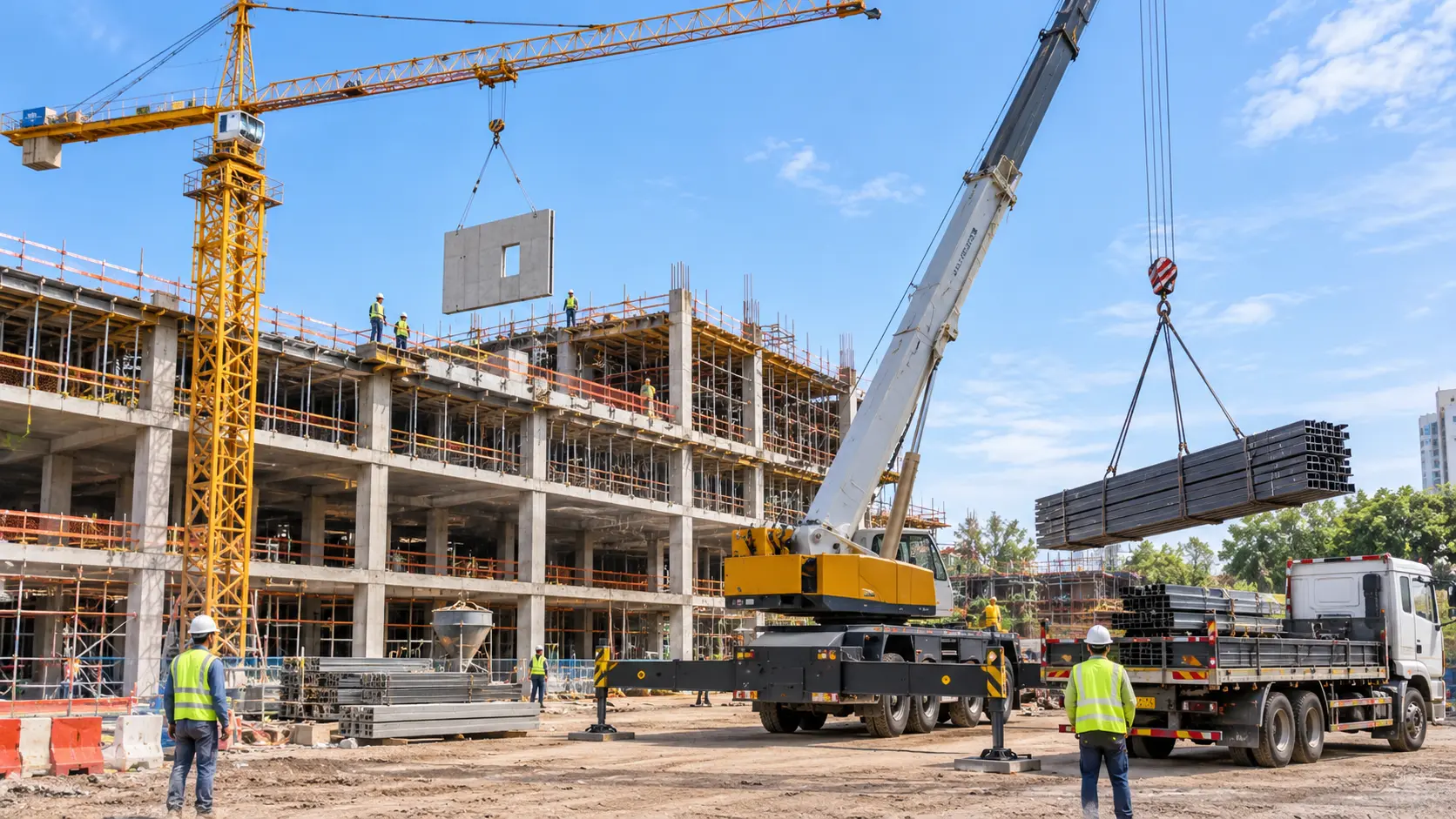
A construction crane is a machine that lifts and moves heavy materials vertically and horizontally across a building site, using a boom or jib, a hoist rope, and a hook. Cranes place steel beams, precast concrete panels, reinforcement, formwork, plant, and bulk materials exactly where they are needed, often at heights and distances no other machine can reach.
On most large projects, the crane sets the rhythm of the work. Deliveries, installation sequences, and even the layout of the site are planned around where the crane stands and what it can lift. This guide explains what construction cranes do, how they lift a load safely, the main types used on site, how to choose the right crane, how individual lifts are planned, who is involved in crane operations, and the safety practices that prevent incidents.
What a Construction Crane Does
A crane’s job is to move loads that are too heavy, too large, or too high to handle by any other means. On a typical building project, that includes structural steel and precast elements during the frame stage, bundles of reinforcement and formwork during concrete work, and building services equipment, cladding panels, and plant later in the project.
Cranes also support the logistics of the whole site. They lift materials from delivery trucks to storage areas or straight to the floor where they will be installed, which reduces double handling and keeps congested sites moving. Further general background on cranes and their history is available through Wikipedia’s overview of cranes.
How a Crane Lifts a Load
Every crane works on the same basic principle of balance and leverage. The load hangs from a hook on a hoist rope that runs over sheaves at the tip of the boom or along the jib. The crane’s own weight, counterweights, and, on mobile cranes, its outriggers, keep the machine stable as it lifts.
The further the load is from the crane’s centre of rotation, the greater the leverage it exerts, which is why a crane can lift much more close in than at full radius. The main structural parts that make this possible, from the boom and hoist to the counterweight and slewing ring, are explained in our guide to the parts of a crane. How capacity changes with radius and boom length, and why the rated figure on a crane’s specification is only part of the picture, is covered in our explanation of crane lifting capacity.
The Cranes You See on Construction Sites
Several types of crane are common on construction projects, each suited to a different kind of site and workload.
Tower cranes are fixed in one position for the life of a project, rising alongside tall buildings and covering a wide radius with their horizontal jib. They suit high rise construction where lifting is needed every day for months. The way they are erected, climbed, and operated is explained in our guide to tower cranes.
Mobile cranes are mounted on wheeled carriers and can drive to site, set up on outriggers, and start lifting within hours. They suit shorter lifting tasks and projects where a tower crane would be impractical, and the trade offs between the two are set out in our comparison of mobile and tower cranes.
Rough terrain cranes are compact mobile cranes with large tyres and four wheel drive, built for unpaved and uneven construction sites, as described in our guide to the rough terrain crane.
Crawler cranes move on tracks and can carry very heavy loads around a site without outriggers, making them common on large infrastructure and heavy lifting projects. How they work is explained in our guide to the crawler crane.
The wider range of cranes, including specialist and industrial types, is covered in the guide below.
Also read: Types of Cranes: A Comprehensive Guide
Choosing the Right Crane for a Project
The right crane depends on the work it needs to do and the site it has to work on. A few questions usually narrow the choice:
- What is the heaviest load, and at what radius? The combination of weight and distance from the crane matters more than weight alone.
- How high must loads be lifted? Building height and any obstacles the load must clear set the required boom or tower height.
- How long is the crane needed? A few days of lifting usually favours a mobile crane, while months of daily lifting may justify a tower crane.
- How much space is available? Tight urban sites may not have room for outriggers, counterweights, or the swing of a large crane.
- What are the ground conditions? Soft ground, buried services, basements, and slopes affect where a crane can stand and what support it needs.
- How will the crane reach the site? Access roads, turning space, and delivery routes affect which cranes can be brought in and assembled.
Answering these questions early, ideally during project planning, avoids discovering halfway through the job that the crane cannot reach a critical lift or that the ground cannot support it.
Planning a Lift
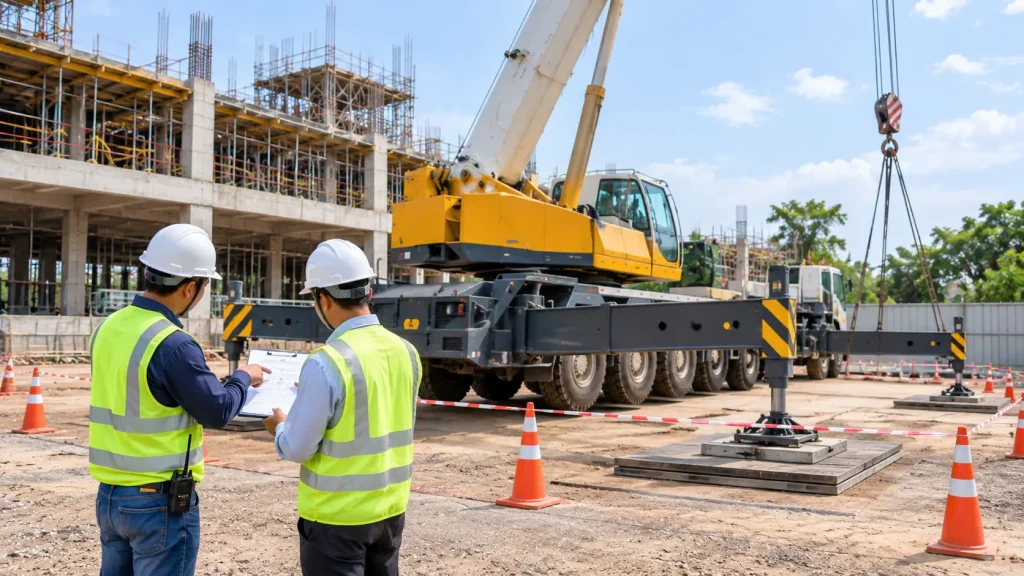
Every crane lift should be planned, and complex or critical lifts need a detailed written lift plan. Planning covers several key points.
The load. The total weight includes the load itself plus the hook block, slings, shackles, spreader beams, and any other lifting accessories. Weights should be confirmed, not guessed.
The radius and capacity. The planned radius at every stage of the lift is checked against the crane’s load chart, with a margin for safety. Reading load charts correctly is a skill in itself, explained in the guide below.
The ground and support. The pressure under outriggers or tracks is checked against the ground’s bearing capacity, and mats or engineered platforms are used where needed. Buried services, basements, and recent excavations are identified before the crane sets up.
The path of the load. The route the load will travel is checked for obstacles, overhead power lines, neighbouring structures, and other cranes, and the area beneath the load is closed to people.
Communication and weather. The crew agrees how the operator and signaller will communicate, and the lift is planned around wind and weather limits, since large or flat loads can catch the wind and swing.
Who Does What During Crane Operations

Crane work depends on a team, and every member has a defined role. Job titles vary between countries and companies, but the responsibilities are broadly similar.
The crane operator controls the crane and is responsible for operating it within its limits. The signaller, sometimes called a banksman, directs the operator when the load or the landing point is out of the operator’s view. The rigger selects and attaches the lifting accessories and makes sure the load is slung securely and balanced. The lifting supervisor oversees the lift on site and makes sure it follows the plan, while a competent or appointed person, often an engineer, prepares or approves the lift plan for complex and critical lifts.
Clear roles prevent the most dangerous situation in crane work, where everyone assumes someone else has checked something important.
When a Crane Is Not the Best Tool
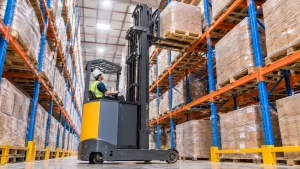
Cranes are powerful, but they are not always the most practical or economical choice. For lifting palletised materials onto lower floors or placing loads forward over obstacles, a telehandler is often faster to set up and more flexible on site, as compared in our guide to telehandlers and cranes.
When the task is lifting people rather than materials, such as installing cladding, inspecting a facade, or working on high fixtures, a purpose built access platform is the safer option. Crane lifted personnel baskets are generally reserved for situations where no other means of access is practicable, and the differences between the two approaches are explained in our comparison of boom lifts and cranes.
Crane Safety on Construction Sites
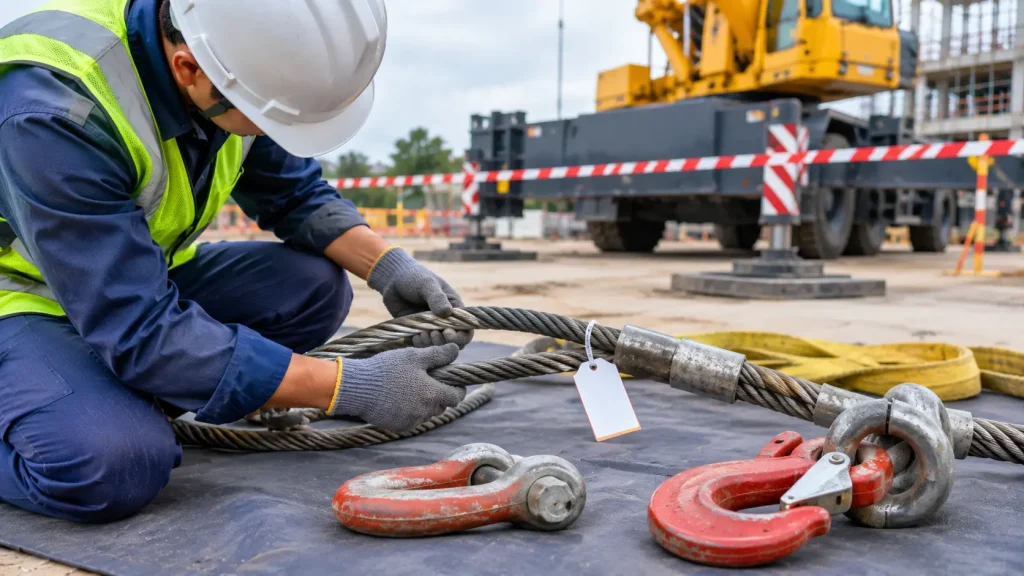
Most crane incidents trace back to a small number of causes: overloading or misjudging the radius, ground failure under outriggers or tracks, contact with overhead power lines, lifting in high winds, poor rigging, and breakdowns in communication. Each of these is preventable through planning, competent people, and discipline on the day.
Cranes and their lifting accessories also need regular inspection, testing, and maintenance by qualified people, with records kept for every machine. Exclusion zones beneath loads and around the crane’s swing must be enforced, and lifting should stop whenever conditions or the plan change. In Singapore, crane operations are covered by specific workplace safety requirements, and the Ministry of Manpower publishes detailed Workplace Safety and Health guidance on lifting operations and the competencies required. The wider principles of safe lifting are covered below.
Also read: Lifting Equipment Safety Tips for Safer Worksites
Equipment Support for Lifting and Work at Height
Many projects need more than a crane to move materials and reach work areas safely. When you contact the team, it helps to describe the lifting and access tasks involved, the heights and reach needed, the ground and access conditions on site, and how long each phase is expected to last. With these details, the right equipment can be recommended alongside your crane operations.
RR Machinery Pte Ltd supports Singapore’s construction and industrial sectors with reliable heavy machinery solutions tailored to your specific site conditions. Browse our complete heavy machinery services or contact our team today for practical advice on the right equipment for your project.