
Almost every high-rise construction site skyline features the same unmistakable silhouette, a tall vertical mast topped with a long horizontal arm, standing well above the building under construction itself. This is the tower crane, one of the most recognisable pieces of construction equipment in the world, and one of the few machines capable of lifting structural materials to heights that would be entirely impractical for any mobile crane to reach.
Despite how familiar the shape is, many people outside the construction industry have only a vague sense of how a tower crane actually works, how it is assembled at such extreme heights, or why it is chosen over other types of cranes in the first place. This guide explains exactly what a tower crane is, its key components, how it operates, and the main variants used across different construction projects.
What Is a Tower Crane?
A tower crane is a fixed, vertical crane consisting of a tall mast anchored to a foundation or attached to the building under construction, topped with a rotating horizontal arm, called a jib, that carries a trolley and hook for lifting and positioning materials across the site.
Unlike a mobile crane, which travels on wheels or tracks and can be relocated between sites or even between lift points on the same site, a tower crane remains fixed in one location for the duration of a project, assembled on-site piece by piece and often disassembled once the structure it served is complete. This fixed position, combined with its exceptional height and reach, is what makes the tower crane uniquely suited to the specific demands of high-rise construction.
Why Tower Cranes Are Used in High-Rise Construction
High-rise construction requires lifting structural steel, concrete formwork, and building materials to heights that grow taller as the project progresses, often reaching well beyond what any mobile crane’s telescopic boom could achieve. A tower crane’s mast can be extended in sections as a building grows taller, allowing the crane to keep pace with construction height in a way no mobile alternative can match.
Tower cranes also offer a combination of lifting height and horizontal reach that remains remarkably efficient for a fixed footprint, an important consideration on dense urban construction sites where ground space for equipment is often extremely limited. This efficient use of a small ground footprint to service an entire tall building is one of the primary reasons tower cranes dominate high-rise construction despite the complexity involved in assembling and later dismantling them.
How a Tower Crane Differs From Other Cranes
The defining structural difference between a tower crane and other crane categories is its fixed vertical mast, which anchors the crane to one location for the duration of a project rather than allowing it to travel between lift points the way a mobile or pick-and-carry crane does. This fixed positioning trades mobility for height and lifting consistency, since a tower crane’s rated capacity does not change with travel across uneven ground the way a mobile crane’s stability calculations must.
A detailed side-by-side comparison of how tower cranes differ from mobile cranes across capacity, mobility, and typical use case is available in Mobile Crane vs Tower Crane: Key Differences and Uses, useful reading for understanding exactly when a project needs a tower crane rather than a mobile alternative.
Also read: Mobile Crane vs Tower Crane: Key Differences and Uses
Key Components of a Tower Crane
A tower crane is built from a specific set of structural components, each playing a distinct role in how the machine achieves its combination of height, reach, and lifting capacity.
Understanding these components individually clarifies why tower cranes are assembled the way they are, and why each stage of assembly and operation depends on the components beneath it functioning correctly before the crane can safely lift a load.
The Base and Mast
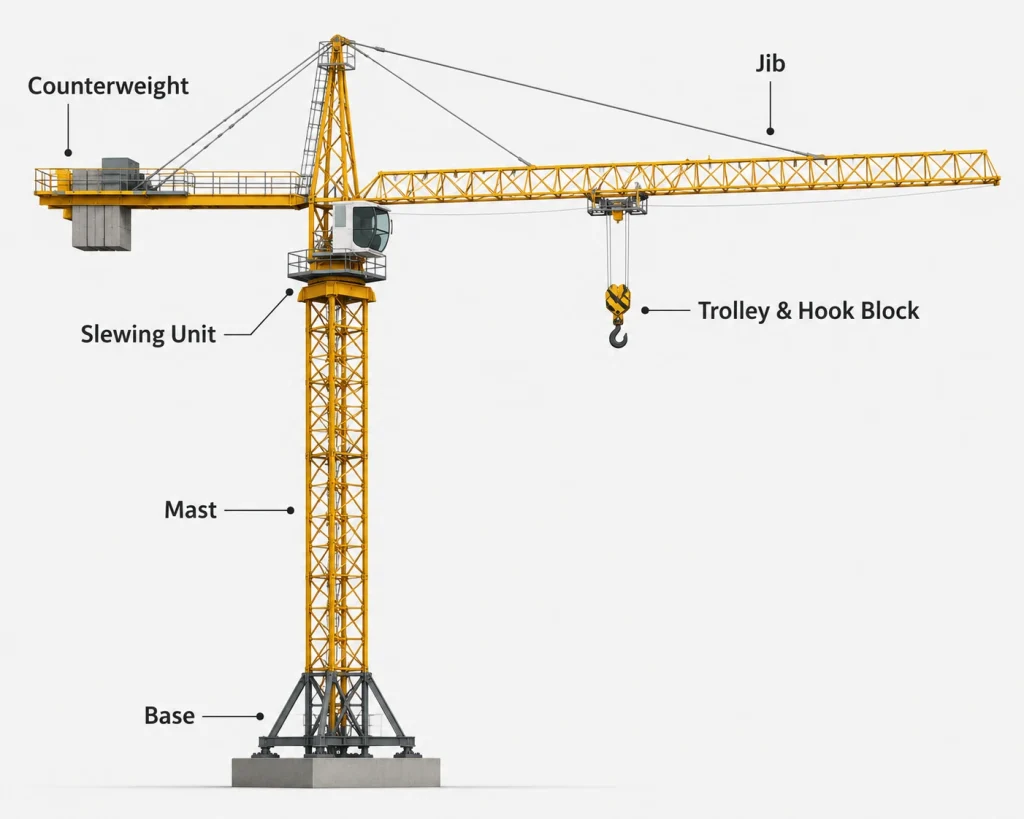
The base of a tower crane is typically a large concrete foundation, sometimes reinforced with steel anchor bolts embedded well below ground level, engineered to support the enormous vertical and lateral loads the crane will generate throughout its operating life. On some projects, the mast is instead tied directly into the building structure itself as it rises, a method called a tied-in or climbing configuration that allows the crane to reach heights a freestanding mast alone could not safely support.
The mast is a tall lattice steel tower, assembled from repeating sections, that provides the crane’s vertical height and structural rigidity. As a building grows taller, additional mast sections can be added through a climbing process, allowing the crane’s working height to increase in step with the structure it is servicing.
The Slewing Unit and Counterweights
At the top of the mast sits the slewing unit, a rotating mechanism that allows the entire upper assembly, including the jib, to rotate horizontally, typically through a full 360 degrees, giving the crane access to any point within its working radius without needing to reposition. This rotation is driven by an electric motor and gearbox specifically engineered to move the crane’s substantial upper structure smoothly and precisely.
Counterweights, positioned on the shorter rear section of the jib opposite the main lifting arm, balance the load being lifted on the working side of the crane, preventing the entire structure from tipping under load. The precise amount of counterweight required is calculated based on the crane’s specific model and configuration, making this one of the most carefully engineered aspects of the entire machine.
The Jib, Trolley, and Hook Block
The jib is the long horizontal arm extending from the top of the mast, typically divided into a longer working section where loads are lifted and a shorter counterweight section on the opposite side. A trolley runs along the working section of the jib, carrying the hoist rope and hook block, and can be moved inward or outward along the jib to position a load at different points within the crane’s working radius without needing to rotate the entire structure.
The hook block, suspended from the trolley by wire rope, is where the actual load is attached for lifting, and its capacity, along with the trolley’s position along the jib, together determine how much weight can be safely lifted at any given point in the crane’s reach. A detailed breakdown of these components and how they compare to those found in other crane types is available in The Parts of a Crane and Their Functions Explained.
Also read: The Parts of a Crane and Their Functions Explained
How a Tower Crane Works
Bringing these components together, a tower crane operates through a combination of rotation, trolley movement, and hoisting, each controlled independently by the operator from a cab positioned either at the top of the mast or, in some configurations, at ground level.
Understanding this operating sequence clarifies how a single, fixed machine can service an entire construction site’s lifting needs across every direction and height within its working envelope.
Lifting and Load Movement
To move a load, the operator first hoists it from ground level using the hook block, then rotates the entire jib assembly via the slewing unit to bring the load over its intended destination, adjusting the trolley’s position along the jib to fine-tune the load’s horizontal position before lowering it into place. This combination of rotation, trolley movement, and vertical hoisting gives the crane access to any point within a circular working area defined by the jib’s length.
Modern tower cranes include load moment indicators and anti-collision systems, particularly important on sites using multiple tower cranes simultaneously, automatically preventing the operator from executing a movement that would exceed the crane’s rated capacity or bring it into contact with another crane’s working envelope.
Climbing and Height Extension
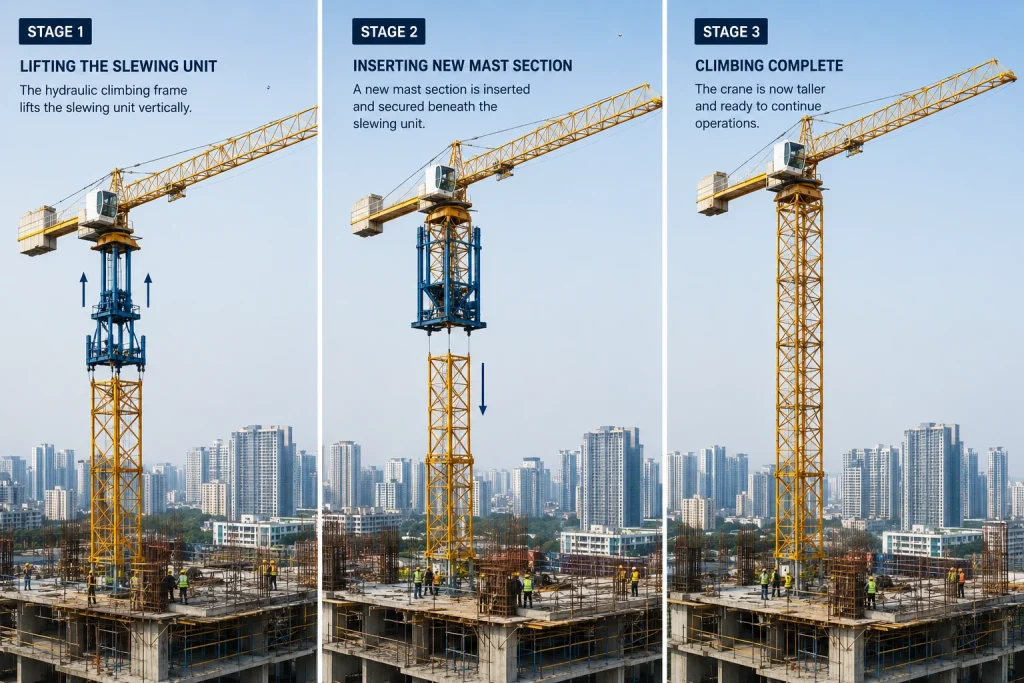
As a building rises, a tower crane’s mast needs to grow with it, achieved through a climbing process using a hydraulic climbing frame positioned within the mast structure itself. This frame lifts the crane’s slewing unit and jib assembly upward, creating a gap into which a new mast section is inserted and bolted into place, effectively adding height to the crane without needing to lower and rebuild the entire structure.
This climbing process is carried out incrementally throughout a project as the building grows, allowing a single tower crane to service a structure from its foundations through to its highest floors without ever needing to be replaced by a taller unit. Once construction is complete, the same process is reversed in stages to dismantle the crane, often using a smaller mobile crane to lower sections back to ground level.
Types of Tower Cranes
Tower cranes come in several configurations, each suited to different site layouts, structural heights, and surrounding obstacles.
Choosing the right configuration for a specific project depends heavily on site constraints, particularly the presence of neighbouring buildings or other cranes that might restrict how the jib can safely rotate and operate throughout the project.
Hammerhead Tower Cranes
Hammerhead tower cranes, the most recognisable configuration, feature a horizontal jib that remains level throughout its rotation, with the trolley moving along its length to position loads at different points within the crane’s radius. This configuration is efficient and straightforward to operate, making it the standard choice on sites with sufficient clearance for the jib to rotate freely without obstruction from neighbouring structures.
The consistent, level jib also makes hammerhead cranes well suited to projects where predictable, repeated lift paths are common, such as delivering materials to the same general area of a building repeatedly throughout a construction phase.
Luffing Jib Tower Cranes
Luffing jib tower cranes use a jib that can be raised or lowered at an angle, rather than remaining fixed horizontally, allowing the crane to adjust its effective working radius by changing the jib’s angle rather than relying solely on trolley position. This capability makes luffing jib cranes particularly valuable on congested urban sites, where the jib may need to avoid swinging over neighbouring buildings or other cranes operating nearby.
The ability to luff the jib upward also reduces the crane’s effective footprint when not actively lifting, an advantage on sites with multiple cranes operating in close proximity or strict boundaries on airspace intrusion over adjacent properties. A broader look at how tower cranes compare to compact, mobile alternatives suited to tighter or lower-rise sites is available in What Is a Rough Terrain Crane and How It Works, useful for understanding where each crane category fits across different project scales.
Also read: Types of Cranes: A Comprehensive Guide
Tower Crane Lifting Capacity and Load Charts
A tower crane’s lifting capacity is not a single fixed number, it varies considerably depending on how far along the jib a load is positioned, following the same fundamental load moment principle that governs capacity on mobile cranes as well.
Understanding this relationship is essential for planning lifts safely and efficiently, since attempting to lift a load at the wrong point along the jib can mean the difference between a straightforward lift and one that exceeds the crane’s rated capacity entirely.
How Capacity Changes With Radius
As the trolley moves further out along the jib, increasing the load’s distance from the mast, the maximum weight the crane can safely lift at that position decreases, in the same way a boom lift or mobile crane’s capacity decreases as its arm extends further from its base. This means a tower crane rated to lift a very heavy load close to the mast may only be able to lift a fraction of that weight at its maximum working radius.
A detailed explanation of this load moment principle and how it applies across different categories of crane is available in Crane Lifting Capacity Explained for Construction Projects, useful background for understanding why tower crane capacity charts are structured the way they are.
Reading a Tower Crane Load Chart
Every tower crane is supplied with a load chart specifying the maximum safe lifting capacity at each point along the jib’s working radius, and correctly reading this chart before any lift begins is one of the most fundamental safety responsibilities of both the operator and the site’s rigging team. Misreading or ignoring this chart is one of the most common causes of crane-related incidents on construction sites worldwide.
A clear, practical walkthrough of how to interpret a crane load chart correctly is available in How to Read a Crane Load Chart: A Clear Guide, directly applicable to tower cranes as well as the mobile and pick-and-carry cranes it was originally written to cover.
Tower Crane Safety and Operation
Given the scale, height, and lifting forces involved, tower crane operation is subject to some of the strictest safety and certification requirements of any construction equipment category.
These requirements exist because a tower crane incident, whether from overloading, structural failure, or collision with another crane, carries consequences that extend well beyond the immediate lift, often affecting the surrounding site and neighbouring properties as well.
Operator Certification and Rigging
Tower crane operators require specific certification distinct from other crane categories, reflecting the unique skills involved in operating a fixed machine with an extended reach, often from a cab positioned many storeys above the ground. Riggers and signal persons play an equally critical role, ensuring loads are properly secured and communication with the operator remains clear throughout every lift.
Given the height and scale involved, many jurisdictions require regular third-party structural inspection of a tower crane’s mast, jib, and foundation, in addition to routine operator checks, before the crane is certified fit for continued use throughout a project.
Wind Limits and Structural Inspection
A tower crane’s extreme height and large surface area make it particularly sensitive to wind loading, both on the structure itself and on any load being lifted, which is why every tower crane has a manufacturer-rated maximum wind speed for both active lifting and for the crane left unattended overnight in a free-slewing configuration. Exceeding this rated wind speed significantly increases the risk of structural stress or loss of load control.
Singapore’s Ministry of Manpower publishes detailed Workplace Safety and Health guidance covering the certification, inspection, and operating standards that apply to tower crane use on construction sites, reflecting the elevated risk profile this category of equipment carries compared to most other construction machinery.
Understanding the Machine Behind the Skyline
A tower crane’s combination of height, reach, and lifting capacity makes it one of the most essential pieces of equipment in high-rise construction, engineered through a specific set of components working together, from foundation and mast to slewing unit, jib, and hook block. Further technical background on tower crane engineering and classification is available through Wikipedia’s overview of tower cranes, covering the broader engineering history and design variations used across the industry.
RR Machinery Pte Ltd supports Singapore’s construction and industrial sectors with a full range of heavy machinery solutions tailored to your specific project needs. Browse our complete heavy machinery services or contact our team today for practical advice on the right equipment for your construction project.