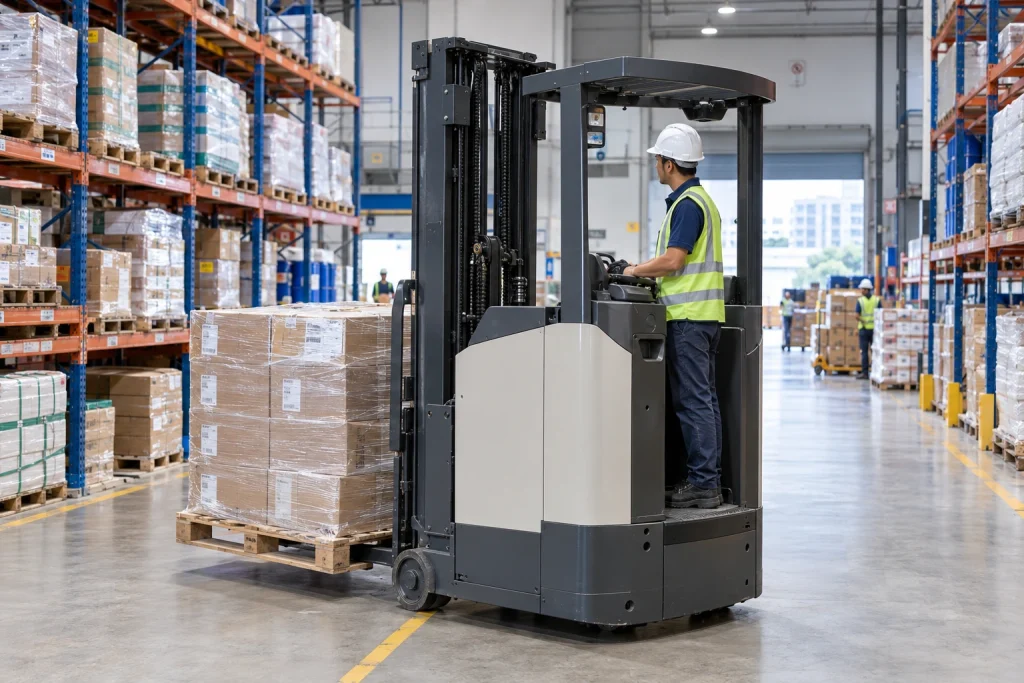
Watch a busy loading dock and you will often see operators stepping on and off their forklifts dozens of times an hour, scanning labels, checking pallets, and climbing back aboard. For that kind of work, sitting down slows everything. The stand up forklift was designed around this reality, letting the operator ride standing in a compact compartment and step off in a moment when the job needs it.
This guide explains what a stand up forklift is, how it differs from a sit down machine, the main types, where it works best, its advantages and trade offs, and the safety points that come with operating while standing.
How a Stand Up Forklift Differs From a Sit Down Model
A stand up forklift is a rider forklift in which the operator stands in a compartment at the rear of the machine rather than sitting in a seat. Most are electric, powered by a large battery, and built on a compact chassis designed for indoor work on smooth floors.
On many stand up models the operator stands sideways to the direction of travel, which makes it easy to look forward and backward without twisting around. Combined with a low step into the compartment, this lets operators get on and off quickly and see clearly in both directions, two things that matter a great deal when a shift involves frequent short moves, tight turns, and regular trips into and out of trailers.
In the common systems for classifying forklifts, stand up machines sit among the electric rider trucks and narrow aisle trucks, alongside their sit down counterparts. How those classes are organised, and what each one is built for, is explained in Classes of Forklifts and Their Uses in Material Handling. Further general background on forklift design is available through Wikipedia’s overview of forklifts.
Inside the Operator Compartment
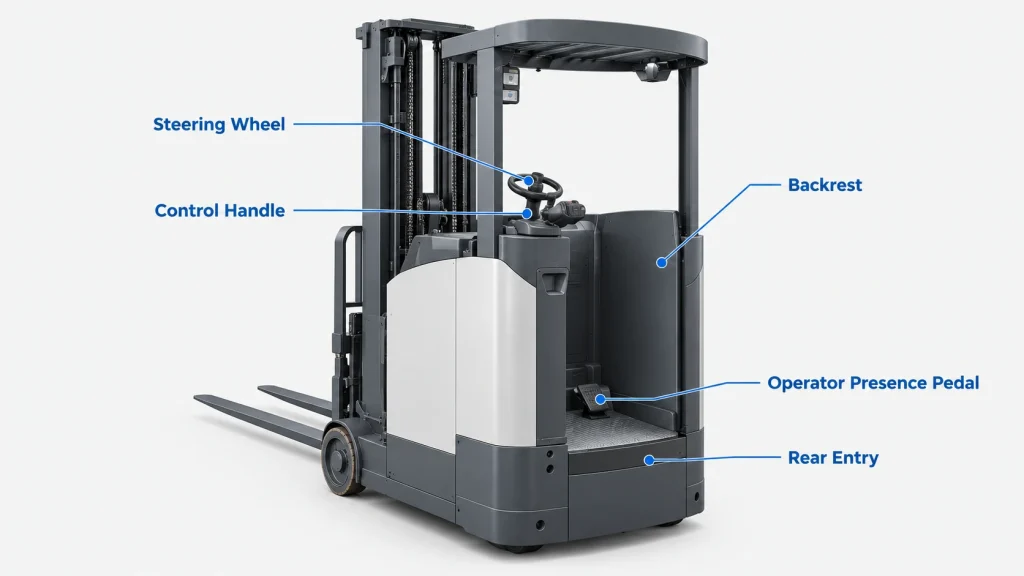
The compartment is what defines a stand up forklift. It surrounds the operator on most sides with a backrest and side protection, and leaves an open entry at the rear for stepping in and out.
Controls are arranged so they can be worked while standing. A steering wheel or tiller handles direction, while a control handle sets the direction of travel and speed, and separate levers or a multifunction handle raise, lower, and tilt the forks. A key safety feature is the operator presence pedal on the floor. The operator must keep a foot on it for the truck to move, and lifting the foot applies the brakes, so the truck stops if the operator steps off or loses balance.
Knowing what each part of the truck does makes these controls easier to learn, and the main components shared by most forklifts, from the mast and carriage to the counterweight, are covered in Parts of a Forklift: What Each Component Does.
Main Types of Stand Up Forklifts
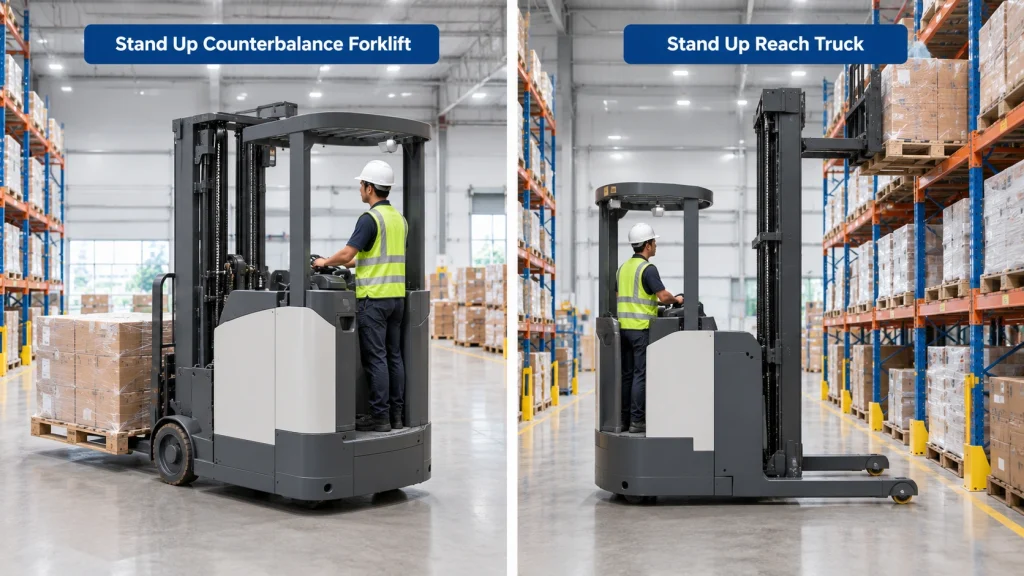
The term stand up forklift covers several machines that share the standing compartment but are built for different jobs. The two most common are the stand up counterbalance forklift and the stand up reach truck.
Stand Up Counterbalance Forklift
The stand up counterbalance forklift works like a conventional forklift, with the forks at the front and the weight of the truck and battery at the rear balancing the load. Because the operator stands rather than sits, the truck can be shorter than a comparable sit down model, which helps it turn in tighter spaces.
It is a favourite for dock work, where operators load and unload trailers, move pallets to staging areas, and step off frequently to check paperwork or adjust loads. Its compact size also suits warehouses with crowded floors and narrower aisles than a standard sit down truck would need.
Stand Up Reach Truck
The stand up reach truck is built for high racking in narrow aisles. Instead of driving forward into the rack, it extends its forks or mast outward to place and retrieve pallets, so it can work in aisles too narrow for a counterbalance truck and reach higher storage levels.
Reach trucks are excellent for put away and retrieval in racked storage but less suited to dock work or uneven floors. The differences between a reach truck and a conventional forklift, and when each is the better choice, are explained below.
Order pickers are sometimes grouped with stand up trucks because the operator also stands, but they work differently, raising the operator with the forks so individual items can be picked by hand from the racking. They are a specialised tool for picking rather than a general pallet mover.
Where Stand Up Forklifts Work Best
Stand up forklifts are at their best in indoor environments with smooth floors and plenty of short, varied moves. Typical settings include:
- Loading docks, where operators drive in and out of trailers and step off frequently
- Distribution centres with high volumes of short pallet moves
- Warehouses with tight aisles and crowded staging areas
- Cold storage facilities, where compact electric trucks are common
- Retail and wholesale backrooms with limited floor space
They are much less suited to outdoor yards, rough or uneven ground, and long travel distances. For that kind of work, a sit down truck or a machine built for outdoor conditions is usually the better choice.
Advantages and Trade Offs
The main advantage of a stand up forklift is speed in stop and go work. Getting on and off is quick, so time is not lost every time the operator needs to step down, and the sideways stance gives good visibility in both directions. The compact chassis turns tightly, which helps in crowded warehouses and narrower aisles, and electric power means no exhaust fumes indoors.
The trade offs are just as real. Standing for a full shift can be tiring, especially on long continuous runs, and anti fatigue matting in the compartment only goes so far. Stand up trucks are generally designed for smooth indoor floors, are less comfortable over bumps, and are not built for outdoor use. Operators trained only on sit down trucks also need proper training before switching, because the controls, stance, and braking behave differently.
Stand Up or Sit Down? How to Decide
The right choice depends on how the truck will spend its day. A few questions usually settle it:
- How often will the operator get on and off? Frequent dismounts favour a stand up truck.
- How far will loads travel? Short moves favour stand up, while long runs favour sit down for comfort.
- What is the floor like? Smooth indoor floors suit stand up trucks, while rough or outdoor surfaces call for a sit down or rough terrain machine.
- How tight are the aisles and staging areas? Compact stand up trucks handle tighter spaces.
- Who will operate it? Operators need training on the specific type, so the existing skills of the team matter too.
The broader factors in choosing a forklift, including capacity, lift height, power source, and attachments, are covered in How to Choose a Forklift: A Complete Buyer’s Guide. The sit down counterbalance truck, the most common alternative, is explained below.
Also read: Counterbalance Forklift: How It Works and When to Use It
Operating a Stand Up Forklift Safely
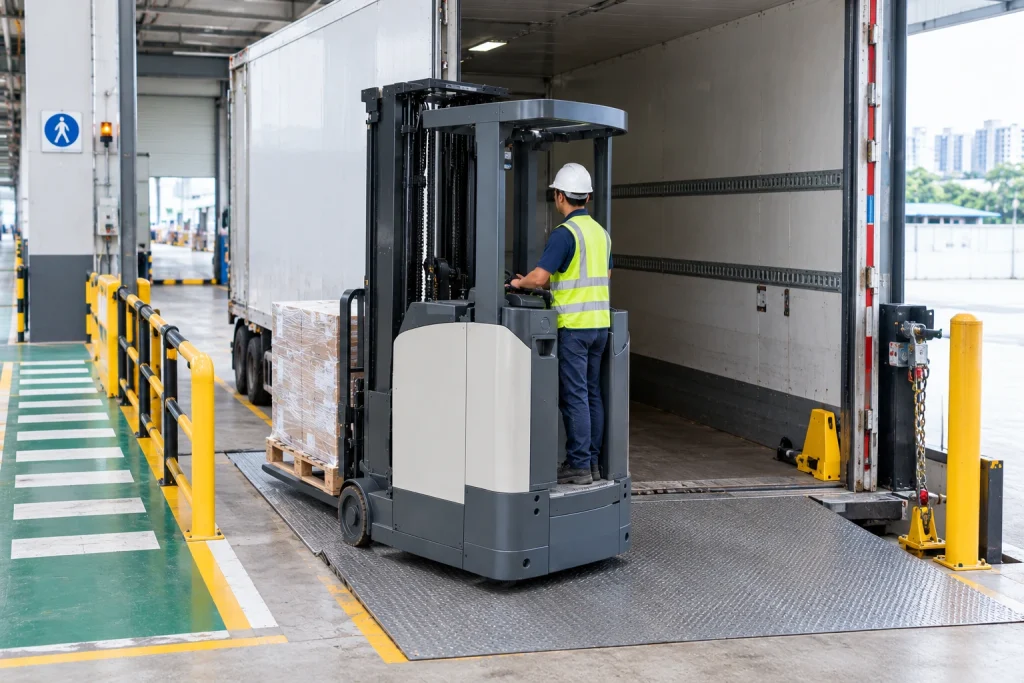
Standing changes some of the risks of forklift work. Operators must keep their whole body inside the compartment while the truck is moving, since a foot or hand outside the compartment can be caught between the truck and a rack, a wall, or another vehicle. The operator presence pedal should never be blocked or bypassed, and the truck should be brought to a full stop before the operator steps off.
Dock work deserves particular care. Trailers must be secured before a truck drives in, dock plates must be in position and rated for the load, and operators should stay well clear of dock edges. Speeds should be kept low in aisles and around corners, and operators should look in the direction of travel before every move. The basic techniques of safe forklift driving are covered in How to Drive a Forklift Safely and Correctly, and every operator should be trained and authorised for the specific type of truck they use. Singapore’s Ministry of Manpower publishes detailed Workplace Safety and Health guidance covering forklift operation and warehouse safety, and further practical safety habits are covered below.
Also read: Forklift Safety Tips for Safe and Efficient Operations
Battery Care and Daily Checks
Because most stand up forklifts are electric, the battery is central to both performance and safety. Charging should be done in a designated, well ventilated area, following the manufacturer’s procedure, and the battery and connectors should be checked for damage, leaks, and loose cables.
Before each shift, operators should also check the forks, chains, mast, tyres, brakes, horn, lights, and the operator presence pedal, and report any fault before the truck is used. A full routine for these checks is set out in Forklift Maintenance Checklist: A Complete Guide.
Forklift Rental in Singapore
Choosing the right forklift starts with a clear picture of the work. When you contact the team, it helps to share the weight and size of your loads, the lifting height needed, the width of your aisles, whether the work involves dock loading, the type of floor, and how long you expect to need the machine. With these details, the right forklift type and configuration can be recommended from the start rather than adjusted after delivery.
RR Machinery Pte Ltd offers a diverse range of forklifts for rent for warehouses, factories, and construction sites across Singapore, backed by factory certified technicians and full servicing support. Contact us today to ask about the right forklift for your operation.