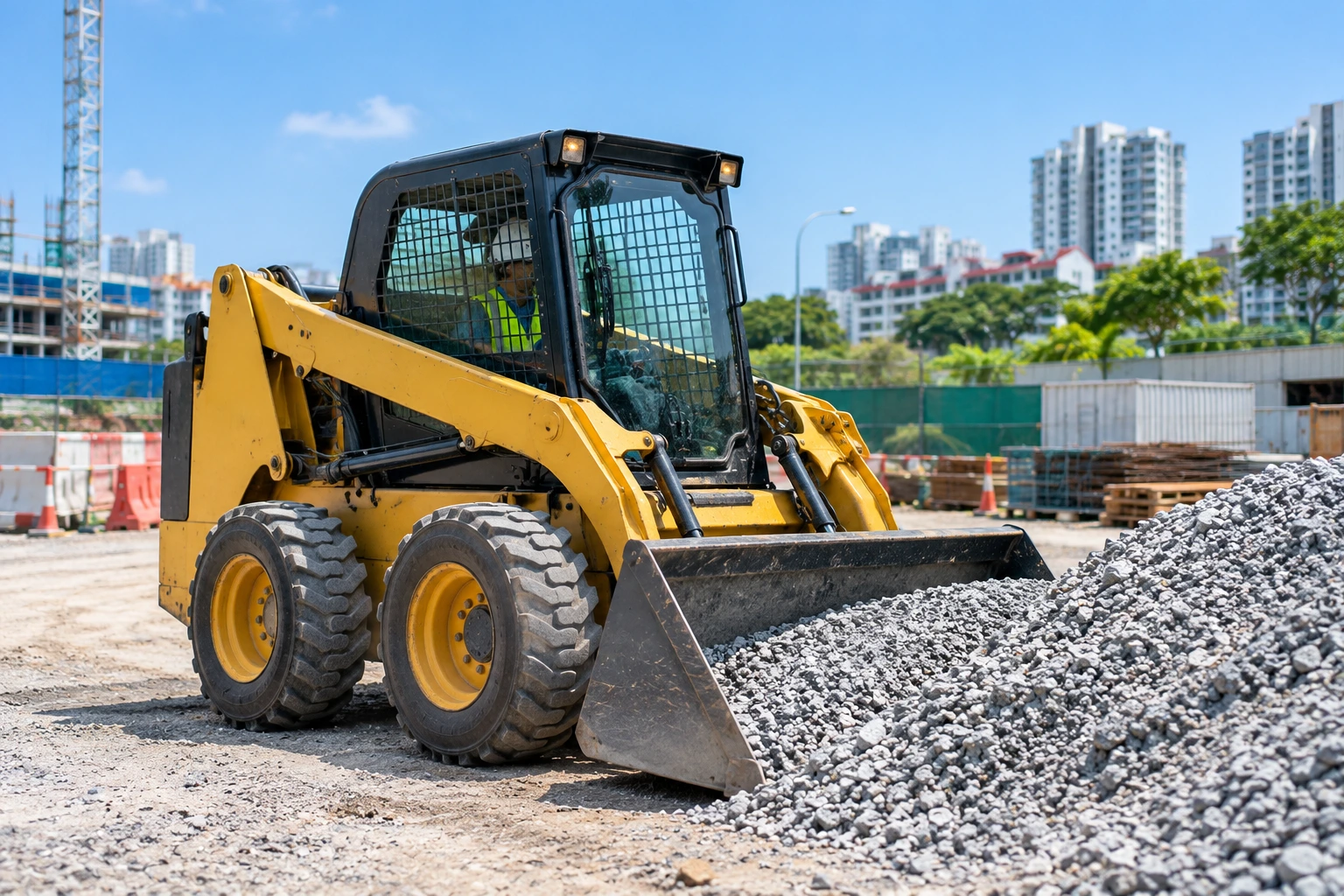
Walk onto almost any busy site, landscaping job, or yard and there is a good chance a small, boxy machine is darting around, scooping material, pushing debris, or lifting pallets into place. That machine is usually a skid steer loader, one of the most widely used compact machines in construction, because it does a remarkable range of jobs in a very small footprint.
This guide explains what a skid steer loader is, how its unusual steering works, the main parts that make it up, the attachments that give it so much versatility, and how it compares with other machines that often compete for the same jobs.
A Skid Steer Loader in Plain Terms
A skid steer loader is a compact, rigid frame machine with two lift arms mounted at the sides of the operator’s cab and a bucket or other attachment fixed at the front. It is built to push, scoop, carry, and lift material over short distances, and its small size lets it work in places where a larger loader or an excavator simply would not fit.
What sets it apart is the combination of size and flexibility. The front of the machine accepts a quick attach plate, so the bucket can be swapped for forks, a grapple, a sweeper, or dozens of other tools in a matter of minutes. A single machine can therefore replace several specialised ones on a small or medium sized job.
Skid steers sit within the wider family of earthmoving machinery, which also includes excavators, dozers, and larger loaders. A broader overview of that family, and where compact loaders fit within it, is covered below.
Also read: Earth Moving Equipment: Types, Uses, and Applications
How Skid Steering Works

The name describes how the machine turns. Unlike a car, a skid steer has no steering wheel and no angled front wheels. Instead, the wheels or tracks on each side are driven independently, and the operator steers by changing the speed or direction of one side relative to the other.
This simple arrangement is what gives the machine its remarkable agility, but it also shapes how it behaves on different surfaces and how it should be driven.
Independent Side Drive
Each side of the machine is powered by its own hydraulic drive. If both sides turn forward at the same speed, the machine drives straight ahead. If one side turns faster than the other, the machine curves toward the slower side, and if one side is held still, it pivots around that side.
Because the sides are controlled separately, there is no need for a steering linkage or an articulation joint. The frame stays rigid, which keeps the machine compact and mechanically simple, and it also contributes to the strength of the loader arms attached to that frame.
Pivot Turns and Their Trade Offs
When one side drives forward and the other drives in reverse, the machine can spin almost on the spot. This lets a skid steer turn within roughly its own length, which makes it extremely useful in tight yards, narrow access lanes, and crowded work areas where other machines would need several manoeuvres.
The trade off is that the wheels or tracks slide sideways across the ground during a turn, which is where the name skid steer comes from. On soft or finished surfaces such as turf, paving, and floor slabs, repeated tight turns can tear or scuff the surface, so operators learn to use wider, gentler turns where ground protection matters.
Main Parts of a Skid Steer Loader
A skid steer is built from a handful of major assemblies, and knowing what each one does makes it easier to compare machines and to understand their specifications:
- Chassis and engine. The rigid frame carries the engine, hydraulic pumps, and drive system. Most machines use a diesel engine, and the compact layout keeps the weight low and centred.
- Lift arms. Two arms rise from the rear of the machine to the front, raising and lowering whatever attachment is fitted. Their design affects both reach and digging performance.
- Quick attach plate. A standard mounting plate at the end of the arms allows attachments to be changed quickly, often without the operator leaving the cab.
- Operator cab. The cab sits between the lift arms and includes a protective frame, a seat restraint, and a safety bar or door, all designed to protect the operator from falling objects and rollover.
- Tyres or tracks. These carry the machine across the ground, and the choice between them has a large effect on traction, ground pressure, and surface damage.
- Hydraulic system. Pumps and valves power the drive motors, the lift arms, and the attachment, with auxiliary hydraulic lines supplying the tools fitted at the front.
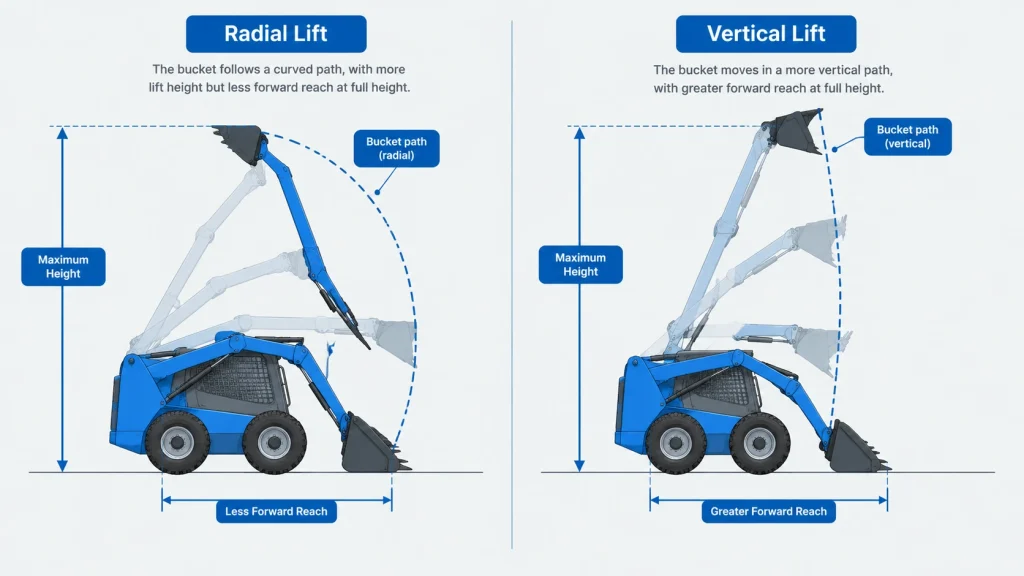
The lift arms deserve a closer look, because there are two common designs. Radial lift arms swing up in an arc, which gives excellent reach at ground level and strong digging performance, making them popular for grading and digging tasks. Vertical lift arms rise in a more upright path, which gives greater reach at full height and a more stable load, making them well suited to loading trucks and placing pallets at height.
Wheeled Skid Steers and Compact Track Loaders
Many machines of this type run on large rubber tyres, which are economical, quick on hard surfaces, and easy to maintain. Wheeled skid steers perform best on firm ground, paved areas, and general site work where speed and low running cost matter.
A close relative, the compact track loader, replaces the tyres with rubber tracks. The wider contact area spreads the weight, which gives better traction and lower ground pressure on soft, muddy, or sandy ground, and it also reduces sinking and surface damage. Tracked machines tend to cost more to buy and maintain, but they can work in conditions that would leave a wheeled machine spinning.
Attachments That Make It So Versatile
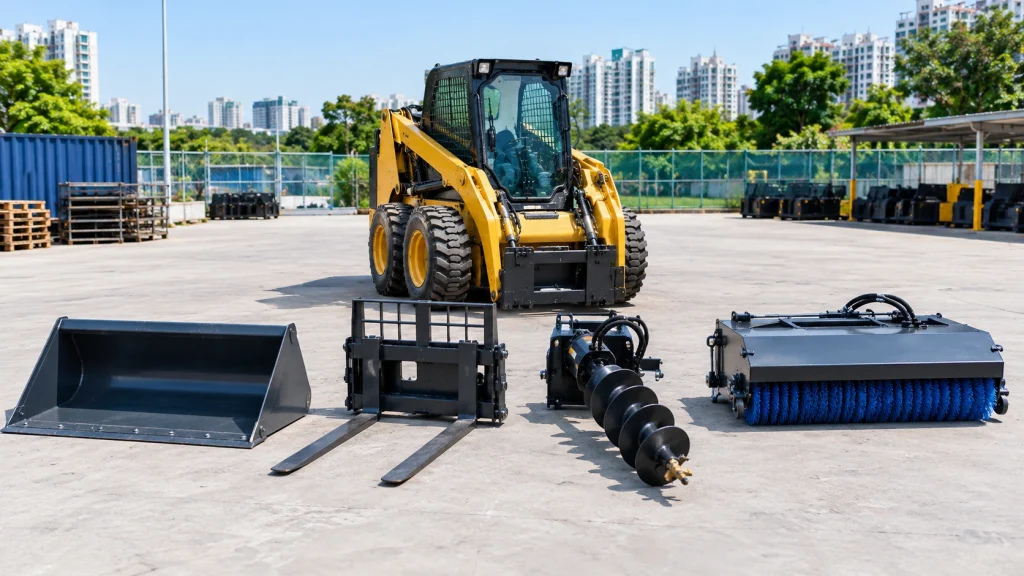
The attachment system is the reason a skid steer can handle so many different jobs. The same machine can change roles in minutes, and common attachments include:
- Buckets of various widths for digging, scooping, and levelling
- Pallet forks for moving palletised materials around a site
- Grapples for handling brush, debris, and irregular loads
- Augers for drilling post holes and foundations for light structures
- Trenchers for cutting narrow channels for pipes and cables
- Sweepers and brooms for cleaning paved areas
- Breakers and hydraulic hammers for breaking concrete and rock
- Brush cutters and mulchers for clearing vegetation
- Snow blades and blowers for clearing access routes in colder climates
Some attachments are powered by the machine’s auxiliary hydraulics, and each tool has its own flow and pressure requirements. Matching an attachment to the machine’s hydraulic output, and confirming that it fits the quick attach plate, is an important check before hiring or buying.
Where Skid Steer Loaders Earn Their Keep
Skid steers are most valuable on jobs where space is tight and the work is varied. Typical uses include landscaping and grading, general site cleanup, loading and moving materials such as soil, sand, and gravel, light demolition and debris removal, trenching and post hole work, and cleaning large paved areas.
They are also useful during the early stages of a project. Clearing debris, levelling small areas, and moving material around a compact site are all part of the groundwork covered in What Is Site Preparation in Construction? Steps and Process, and a skid steer often handles several of these tasks without needing a larger, more expensive machine.
Skid Steer Loaders Compared With Other Machines
Several machines overlap with a skid steer on certain tasks, and choosing between them depends on what the job actually needs. A skid steer is not the right answer to every problem, and knowing where its strengths end helps avoid hiring the wrong machine.
The differences usually come down to size, reach, and the type of work. A skid steer is a loader first, built to push, scoop, and carry, while other machines are built for digging, reaching, or heavy production loading.
Skid Steer vs Front End Loader
A front end loader is a larger, articulated machine built for moving large volumes of material and loading trucks quickly. It offers higher capacity and greater reach at height, but needs more room to operate and costs more to run. A skid steer trades capacity for compactness and the ability to turn in tight spaces.
On a large earthmoving job with a lot of material to move, the bigger machine usually wins. On a compact site, a skid steer is often the more practical and economical choice, and the way the two machines work is explained in more detail below.
Also read: Front End Loader: How It Works and When to Use One
Skid Steer vs Mini Excavator
A mini excavator digs below ground level, trenches, and works with a boom that can rotate independently of its tracks. A skid steer is better at pushing, levelling, and carrying material, but it is not designed for deep digging. Many sites use both, with the excavator digging and the skid steer moving and spreading the spoil. The wider range of excavator types, and how they differ from a loader, is covered in Types of Excavators for Construction and Earthmoving.
For tasks that combine digging and loading in one machine, a backhoe loader is another option, compared with excavators in Backhoe vs Excavator: Differences, Uses & How to Choose.
Skid Steer vs Telehandler
A telehandler uses a telescopic boom to lift loads to considerable height and reach across gaps, which a skid steer cannot do. Where a job needs materials lifted onto upper levels or placed beyond an obstacle, a telehandler is the better choice, as explained in What Is a Telehandler? Types, Uses and How It Works. A skid steer remains better for ground level material handling in tighter spaces.
Many sites use the two machines together. The skid steer gathers and moves materials from storage areas across the site, and the telehandler lifts them to upper levels or places them beyond obstacles. Treating them as partners rather than rivals often gives a more efficient setup than trying to make one machine do both jobs.
Strengths and Limits to Keep in Mind
The skid steer’s main strengths are its agility, its small footprint, and the range of jobs it can cover with different attachments. It can work in places larger machines cannot reach, and it can change tasks in minutes without bringing a second machine to site.
It also has real limits. Its reach and lifting height are modest compared with a telehandler or a large loader, its capacity is lower than that of bigger machines, and its short wheelbase makes it less stable on steep slopes and when carrying a raised load. Visibility from the cab can be limited, and tight turns can damage soft ground. Respecting these limits is a large part of using the machine safely and productively.
Operating a Skid Steer Loader Safely
A skid steer is small, but it is still a powerful machine, and the hazards are real. Operators should be trained and authorised for the specific machine, should enter and leave the cab only as the manufacturer intends, and should always use the seat restraint and safety bar. Loads should stay within the machine’s rated operating capacity, carried low, and slopes should be crossed with great care, since a raised load on a slope can tip the machine.
Bystanders need to be kept clear, because visibility around the machine is limited and it can turn quickly. Daily inspection, including the lift arms, attachment locking, hydraulic hoses, and tyres or tracks, helps to catch faults before they cause an incident. The broader principles that apply to all heavy equipment on a worksite are covered below.
Singapore’s Ministry of Manpower publishes detailed Workplace Safety and Health guidance covering operator training, plant safety, and work practices that apply to earthmoving machinery on local worksites. Further general technical background on this machine type is available through Wikipedia’s overview of skid steer loaders.
Hiring Equipment for Compact Earthmoving
Choosing the right machine starts with a clear picture of the job. When you contact the team, it helps to describe the type of work, the amount of material to be moved, how much space the machine will have to operate in, the ground conditions, and how long you expect to need it. With these details, the right machine and attachments can be recommended from the start rather than adjusted after delivery.
RR Machinery Pte Ltd supports Singapore’s construction and industrial sectors with reliable heavy machinery solutions tailored to your specific site conditions. Browse our complete heavy machinery services or contact our team today for practical advice on the right equipment for your project.