Ask about forklift sizing and the conversation almost always starts with load capacity, the maximum weight a forklift can safely lift, rather than physical dimensions or height the way it might for a crane or an aerial platform. This is not an accident of terminology, capacity is genuinely the figure that drives nearly every other sizing decision that follows, from mast height and tyre selection through to the physical footprint a forklift needs to manoeuvre.
This guide organises forklift sizing around three practical capacity classes, light-duty, mid-range, and heavy-duty, and covers the secondary factors, mast height and aisle width in particular, that matter just as much once a capacity class has been identified. Understanding these classes together, rather than fixating on capacity alone, is what actually determines whether a specific forklift genuinely fits a facility’s real operating conditions.
Why Load Capacity Comes First
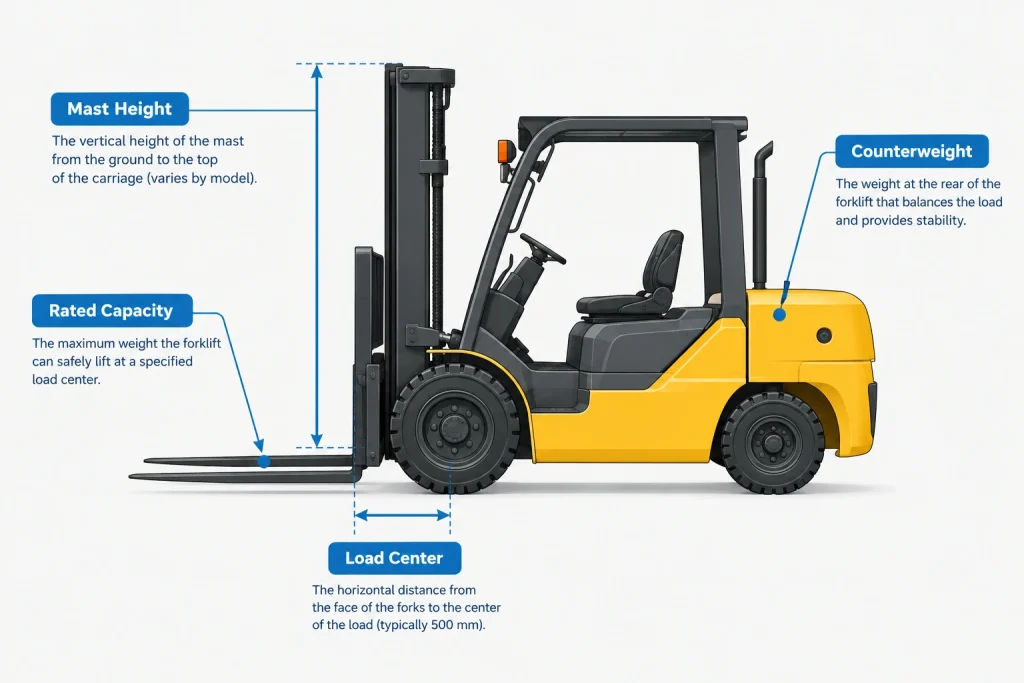
A forklift’s rated capacity, typically expressed in kilograms at a standard load centre, determines the scale of nearly every other component on the machine, the counterweight needed to prevent tipping, the mast and hydraulic system’s strength, and the tyre and axle rating required to carry the combined weight of the machine and its load safely. This is why forklift specifications lead with capacity rather than height or reach, unlike an aerial work platform where working height is usually the headline figure. Manufacturers group their model ranges around these same capacity bands, making rated capacity the fastest way to narrow down a shortlist of suitable machines before comparing individual specifications in detail.
Capacity figures are always quoted at a standard load centre, and a load positioned further from the forks than this standard reduces the safe capacity below the quoted figure, a relationship explained in detail below, essential reading alongside this sizing guide for any load that is not a simple, compact pallet.
Also read: Forklift Load Center: Why the Same Weight Isn’t Always Safe to Lift
Light-Duty Forklifts
Light-duty forklifts sit at the smaller end of the capacity range, suited to lighter loads and tighter operating spaces rather than heavy industrial material handling.
Typical Capacity and Mast Height
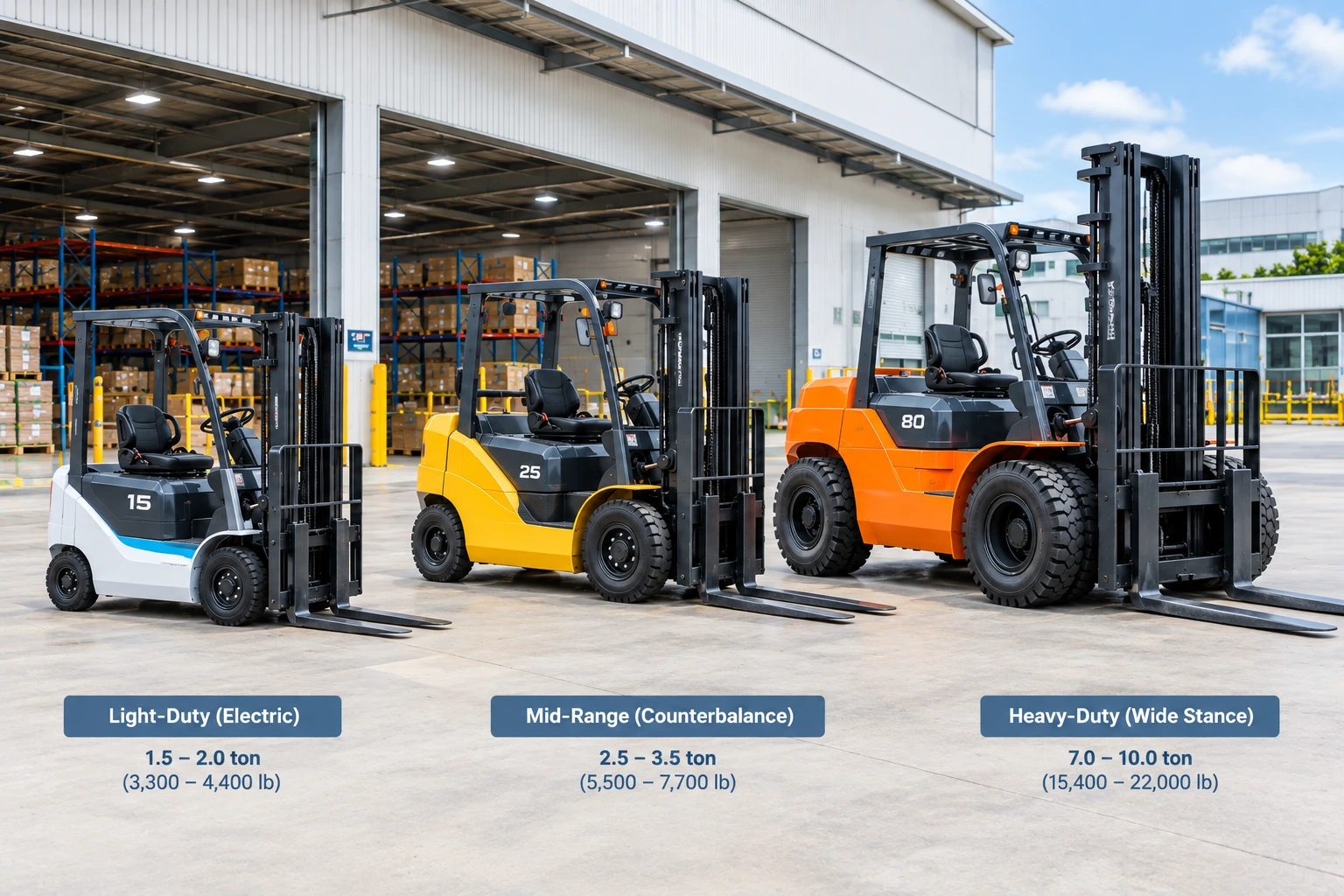
Light-duty forklifts typically offer capacities from around 1 to 2 tonnes, with mast lift heights generally reaching up to 4 to 5 metres, sufficient for lower warehouse racking and general pallet handling without needing the reinforced mast structure larger capacity classes require. Most models in this class are electric, reflecting their common use in indoor warehouse and retail environments where zero emissions and quiet operation matter more than raw lifting power.
Best Applications
Light-duty forklifts suit warehouse pallet handling, retail and light distribution work, and indoor tasks where manoeuvrability in tighter aisles matters more than handling heavy or oversized loads. Their smaller counterweight and overall footprint also make them easier to manoeuvre in confined spaces than larger capacity classes, a genuine advantage in older or smaller warehouse facilities not designed around wide aisle standards.
Mid-Range Forklifts
Mid-range forklifts represent the most commonly specified capacity class across general warehouse and light industrial operations, balancing genuine lifting capability against a footprint that remains practical for most active facilities.
Typical Capacity and Mast Height
Mid-range forklifts typically deliver capacities from around 2 to 5 tonnes, with mast heights commonly extending to 6 to 7 metres or more for higher racking configurations. This range covers standard counterbalance models running on either electric or internal combustion power, a separate choice driven by operating environment rather than capacity requirements alone.
Best Applications
Mid-range forklifts are the standard choice for general warehousing, manufacturing material handling, and distribution centre operations, where the combination of solid capacity and manageable footprint fits the widest range of everyday palletised loads. This capacity class also spans the widest variety of configurations, standard counterbalance, reach trucks, and rough terrain models among them, a distinction covered separately in 7 Different Types of Forklifts You Should Know.
Heavy-Duty Forklifts
Heavy-duty forklifts push capacity well beyond mid-range machines, built for handling oversized, dense, or unusually heavy loads that a standard counterbalance model could not lift safely.
Typical Capacity and Mast Height
Heavy-duty forklifts commonly handle capacities from 5 tonnes up to 50 tonnes or more for specialised container and heavy industrial handling equipment, with correspondingly larger counterweights, wider stances, and reinforced masts to safely manage these loads. Mast height at this scale is often secondary to raw capacity, since many heavy-duty applications involve lifting extremely heavy loads a relatively short distance rather than reaching high racking.
Best Applications
Heavy-duty forklifts are specified for port and container handling, heavy manufacturing, steel and timber yards, and any application involving loads well beyond standard pallet weights. Their scale also means considerably wider aisle and turning space requirements, a consideration covered in the next section that becomes increasingly important as capacity class increases.
Aisle Width and Footprint: The Overlooked Sizing Factor
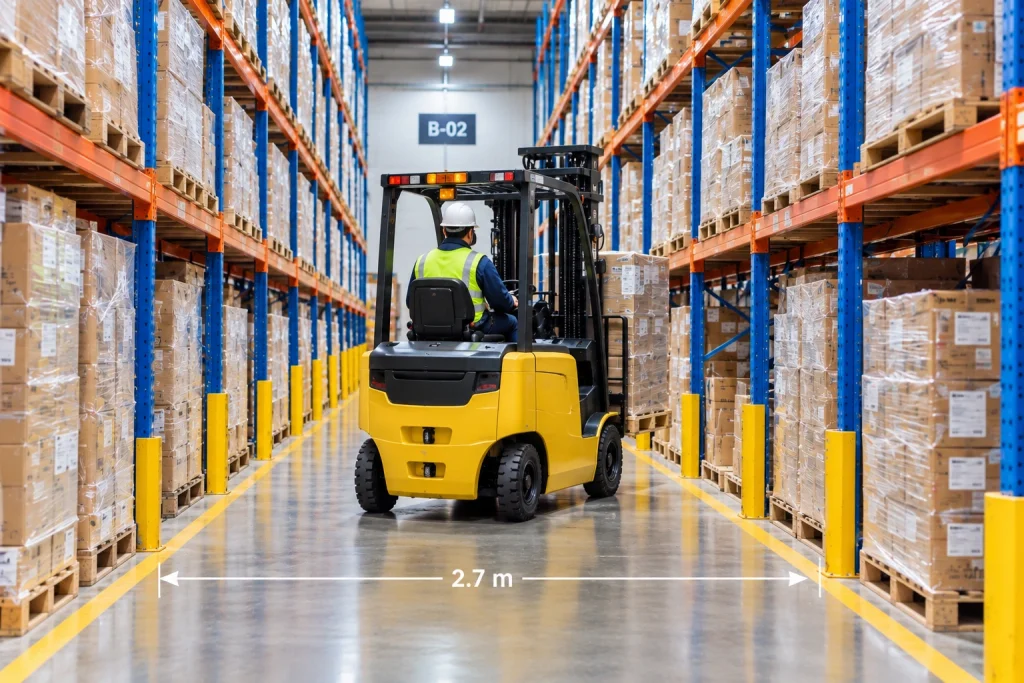
Capacity and mast height dominate most sizing conversations, but a forklift’s physical footprint and turning radius determine whether it can actually operate within a specific warehouse layout at all, regardless of how well its capacity matches the load requirement. Standard counterbalance forklifts generally require wider aisles to turn and manoeuvre than narrow-aisle or reach truck configurations, meaning a facility’s existing aisle width can rule out certain capacity classes and configurations before load requirements are even considered.
This is a genuinely different sizing dimension from load capacity, and confirming a facility’s actual aisle width against a specific forklift model’s turning radius avoids the costly discovery that an otherwise correctly sized machine simply cannot navigate the warehouse it was purchased or hired for. This check matters just as much for an existing facility being re-equipped as it does for a new build, since even a facility already running forklifts successfully can find a new, larger capacity model no longer fits the same aisles the previous machine navigated comfortably. Understanding how different forklift configurations, including narrow-aisle and reach truck designs built specifically around this constraint, address the trade-off between capacity and manoeuvrability is covered below, which brings capacity, mast height, and footprint together into a single selection framework.
Also read: How to Choose a Forklift: A Complete Buyer’s Guide
How Forklift Sizing Compares to Forklift Classification
Forklift size, covered in this guide through capacity, mast height, and footprint, is a different classification axis from the formal forklift class system, which groups machines by power source and design, electric rider trucks, internal combustion cushion or pneumatic tyre models, and rough terrain forklifts among the recognised categories. A specific size class can exist across several different formal classes, a mid-range capacity forklift might be an electric rider truck or an internal combustion pneumatic tyre model depending entirely on the operating environment, independent of its capacity rating.
Understanding both classification systems together gives a genuinely complete picture of forklift specification, since size alone does not determine which specific machine configuration suits a given power source or environment requirement. Further general technical background on forklift design standards is available through Wikipedia’s overview of forklifts.
Also read: Classes of Forklifts and Their Uses in Material Handling
Finding the Right Forklift Size for Your Facility
Forklift size comes down to matching load capacity, mast height, and physical footprint to the actual demands of a task and the facility it operates within, across light-duty, mid-range, and heavy-duty categories that each suit a distinct range of applications. Getting this decision right from the outset avoids the cost of an oversized machine that cannot manoeuvre through existing aisles or the safety risk of one that cannot genuinely handle the loads a facility needs to move, a decision worth revisiting for each new facility layout rather than assuming a machine that suited a previous site will automatically suit the next.
RR Machinery Pte Ltd offers a diverse selection of forklifts across every capacity class, backed by factory-certified technicians and full servicing support. Contact us today for expert advice on the right forklift size and configuration for your facility.