
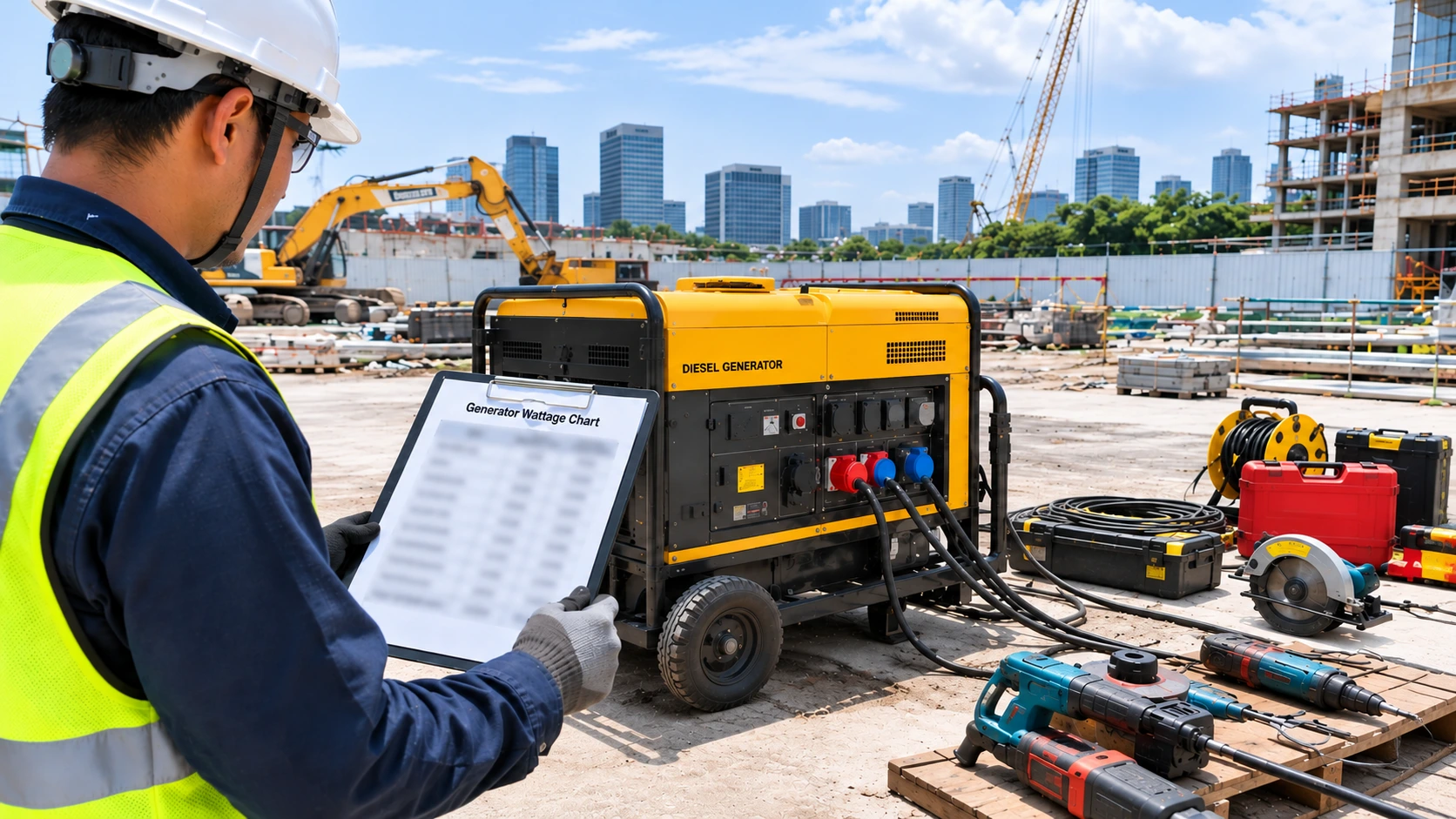
A generator sizing chart lists how much power common tools and equipment draw, so you can estimate the total load before choosing a generator. The chart below gives typical running and starting watts for equipment found on construction sites and in small facilities, followed by a simple method for turning those figures into a working estimate, a worked example, and a conversion chart from kVA to kilowatts.
Every figure is a typical range rather than an exact value for a specific model, since actual draw varies by brand, age, and condition. Use the chart as a starting point, and confirm the nameplate rating of the equipment you will actually run, especially where downtime would be costly.
Why Both Running and Starting Watts Matter
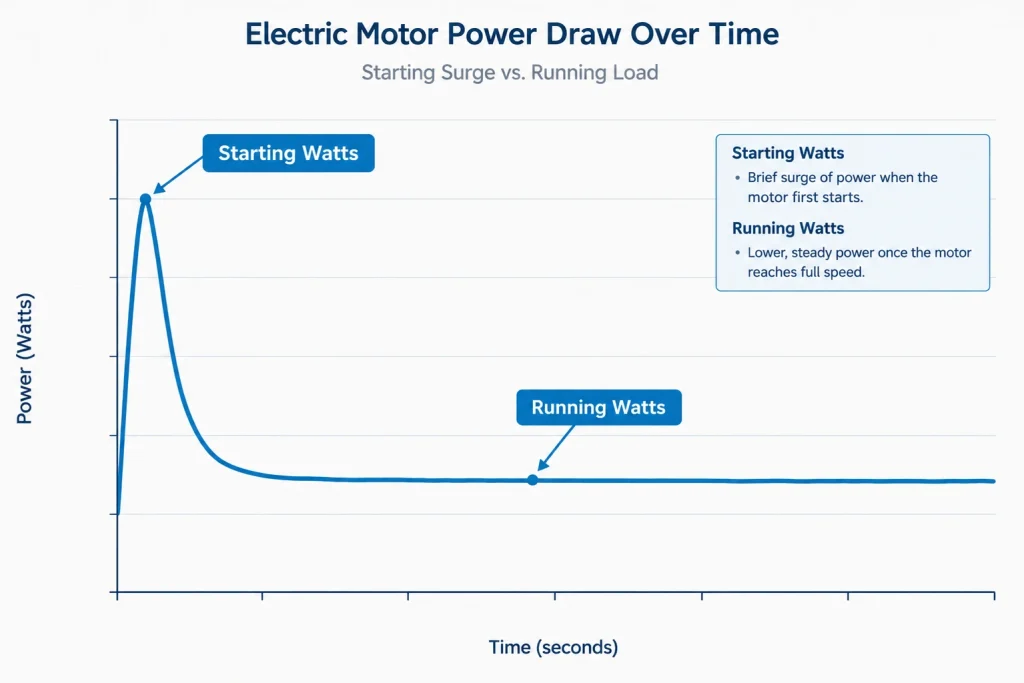
Most electric motors draw much more power for a brief moment when they start than they do once running at a steady speed, often two to three times the running figure. The motor needs extra current to overcome its own inertia before it reaches full speed, after which the draw settles to the running figure. A generator must be able to supply this starting surge as well as the steady load, which is why a sizing chart lists both figures for each item.
Ignoring the starting surge is the most common cause of an undersized generator. Adding up only running watts can look comfortably within the generator’s rating, until a motor starts and the surge pushes the demand above what the unit can deliver. A generator that trips or stalls when a pump or compressor starts, but runs fine once everything is going, is the classic symptom.
Also read: How to Calculate Generator Load: A Step-by-Step Guide
Generator Sizing Chart for Common Equipment
The figures below cover equipment commonly found across construction, small industrial, and site office settings, organised so that both the steady running draw and the brief starting surge can be checked at a glance for each item.
Equipment | Typical Running Watts | Typical Starting Watts |
LED work light | 100 W | 100 W |
Halogen work light | 500 W | 500 W |
Angle grinder | 1,000 to 2,000 W | 2,000 to 2,500 W |
Circular saw | 1,200 to 1,500 W | 3,000 to 4,500 W |
Small air compressor | 1,000 to 1,500 W | 3,000 to 4,500 W |
Concrete vibrator | 700 to 900 W | 1,800 to 2,400 W |
Concrete mixer (small) | 600 to 800 W | 1,800 to 2,400 W |
Water pump (1 HP) | 750 W | 1,800 to 2,200 W |
Submersible pump (small) | 400 to 600 W | 1,200 to 1,800 W |
Site office air conditioner | 1,200 to 1,500 W | 3,500 to 4,500 W |
Refrigerator (site office) | 150 to 300 W | 800 to 1,200 W |
Desktop computer and monitor | 200 to 400 W | 200 to 400 W |
Battery charger (power tools) | 100 to 300 W | 100 to 300 W |
Portable heater | 1,500 to 2,000 W | 1,500 to 2,000 W |
These figures reflect commonly published equipment specifications rather than any single manufacturer’s rating, and the nameplate or manual always takes priority when the two differ. Where a nameplate shows amps instead of watts, multiplying the amps by the supply voltage gives an approximate watts figure that can be compared with the chart. For equipment charged from the generator, such as battery powered tools or access platforms, check the charger’s own rating rather than the machine’s.
How to Use This Chart
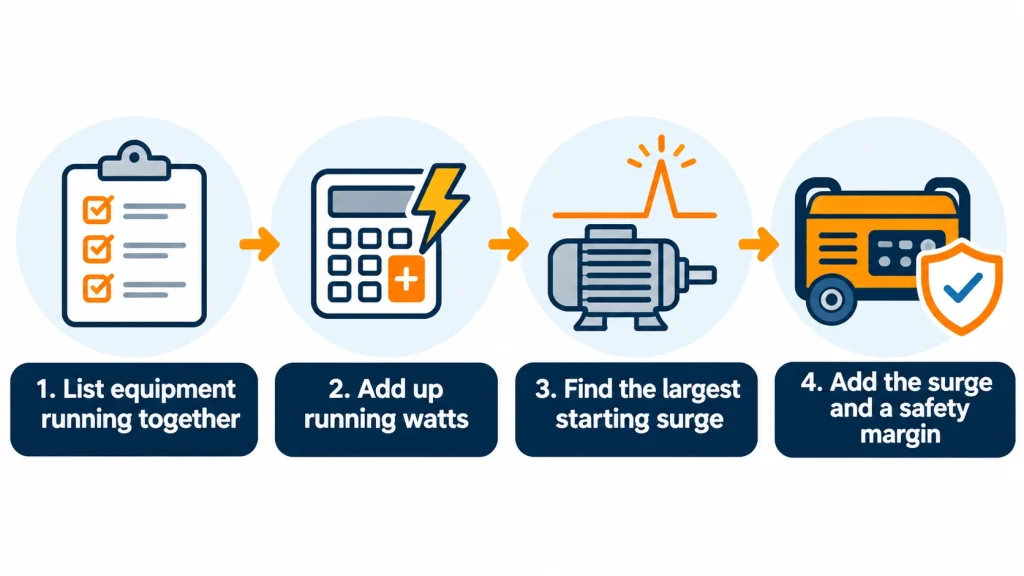
A simple method gives a realistic working estimate for most small and medium sites:
- List everything that will run at the same time. Include lighting, tools, pumps, site office equipment, and chargers.
- Add up the running watts. This is the steady load the generator will carry once everything is running.
- Find the motor with the biggest starting surge. For that one item, work out the extra power it needs at start up by subtracting its running watts from its starting watts.
- Add that extra starting power to the running total. Since motors rarely start at exactly the same moment, only the largest surge is usually added. Where several large motors could start together, add their surges as well.
Then add a sensible safety margin rather than sizing the generator exactly to the calculated figure. A margin covers equipment added later, gradual increases in draw as equipment ages, and the better voltage and frequency stability a generator delivers when it is not running at the very edge of its capacity. Oversizing has a cost too, since a generator running lightly loaded for long periods burns more fuel than it needs to, as explained in our fuel saving tips for construction equipment.
Also read: What Size Generator Do I Need? A Practical Sizing Guide
A Worked Example
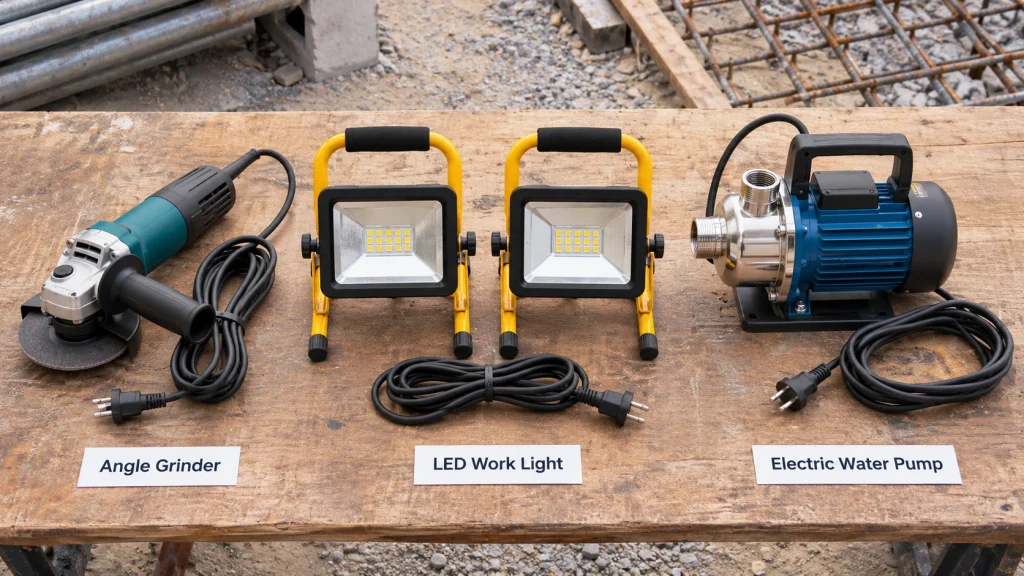
Consider a small site running an angle grinder, a water pump, and two LED work lights at the same time. Using the chart, the running watts are roughly 1,500 W for the grinder, 750 W for the pump, and 200 W for both lights, giving a running total of about 2,450 W.
The pump has the largest starting surge. Its starting figure of about 2,200 W is roughly 1,450 W more than its running figure of 750 W, so the extra starting power is about 1,450 W. Adding this to the running total gives a working estimate of about 3,900 W before any safety margin.
This shows why the method matters. Adding every item’s starting watts together would overstate the requirement, because motors rarely start at the same instant, while adding only running watts would understate it by ignoring the surge. The final step is converting the result into kVA so it can be matched against generator ratings.
Converting Watts to kVA
Generators are usually rated in kVA, while equipment is usually rated in watts or kilowatts. The link between the two is the power factor, which reflects how efficiently equipment uses the power supplied to it. Many generators are rated at a power factor of 0.8, which means a generator’s real power output in kilowatts is its kVA rating multiplied by 0.8. To go the other way, divide the required kilowatts by 0.8 to find the kVA rating needed.
The chart below converts common generator ratings to real power at a power factor of 0.8. Always check the power factor stated by the generator manufacturer, since some units are rated differently.
Generator rating (kVA) | Real power at 0.8 power factor (kW) | Equivalent in watts |
10 kVA | 8 kW | 8,000 W |
15 kVA | 12 kW | 12,000 W |
20 kVA | 16 kW | 16,000 W |
30 kVA | 24 kW | 24,000 W |
45 kVA | 36 kW | 36,000 W |
60 kVA | 48 kW | 48,000 W |
100 kVA | 80 kW | 80,000 W |
150 kVA | 120 kW | 120,000 W |
Applied to the worked example, a working estimate of about 3,900 W, or 3.9 kW, divided by 0.8 gives roughly 4.9 kVA before the safety margin is added. On a real site, that result is then rounded up to a generator size that leaves comfortable headroom.
Single Phase and Three Phase Loads
Small tools, lighting, and office equipment usually run on single phase power, while larger motors, compressors, and some site cabins use three phase power. A three phase generator can supply both, but single phase loads should be spread evenly across the three phases, because an unbalanced load can overload one phase while the others sit underused.
If a site mixes single phase and three phase equipment, or if any item is large compared with the generator’s rating, it is worth having a competent electrician check the load distribution and connections before the generator is put to work.
Common Sizing Mistakes
Adding only running watts. This leaves no room for motor starting surges and is the most common cause of trips and stalls.
Adding every starting figure together. This oversizes the generator and wastes fuel when motors are unlikely to start at the same time.
Confusing kW and kVA. A 10 kVA generator does not supply 10 kW of real power at a power factor below 1.
Forgetting future equipment. Loads usually grow over the course of a project, so a generator sized with no margin soon runs short.
Ignoring the duty. A generator running continuously as the main power source is rated differently from one used only for emergencies, a distinction explained in our guide to standby and prime generator ratings.
When a Chart Is Not Enough
A general chart works well for a rough estimate of common equipment, but it has limits. Equipment not listed here, unusual voltages, three phase motors, and sites running many loads at once all call for a more detailed, site specific calculation. Power factor also varies between equipment types, which a simple wattage chart has to simplify. Further general background on electrical power is available through Wikipedia’s overview of electric power.
Large sites, or sites where a generator will run close to its rating for long periods, benefit from a full calculation that accounts for which loads actually run together. Where equipment cycles on and off, a diversity calculation often shows that the real peak demand is lower than a simple sum of every possible load, and a practical framework for turning the result into a final decision is set out in our guide on choosing a generator. The main generator categories, and which type suits which load and site, are explained below.
Generator Rental Support
Matching a generator to your load is easier with a second pair of eyes on the numbers. When you contact the team, it helps to share the list of equipment you plan to run, any nameplate figures you have, whether the loads are single phase or three phase, how many hours a day the generator will run, and how long you expect to need it. For site projects, our guide to generators on construction sites covers the other practical points to plan for.
RR Machinery Pte Ltd offers a wide selection of power generators for sites and facilities across Singapore, across every capacity range, professionally maintained and tested before every delivery. Contact us today for expert advice on matching the right generator to your equipment load.