Construction has traditionally been one of the slower industries to adopt new technology, relying on paper drawings, manual surveys, and experience-based estimating long after other sectors had digitised much of their core operations. That has changed considerably over the past decade, as digital tools have moved from pilot projects at a handful of large contractors to genuinely mainstream practice across construction firms of every size.
Digital construction is not a single technology but a collection of related tools and practices, modelling software, sensors, drones, and connected equipment, that together change how a project is designed, planned, executed, and maintained. This guide explains what digital construction actually covers, the main technologies involved, and where the industry still faces real barriers to wider adoption.
What Is Digital Construction?
Digital construction refers to the use of digital tools and data-driven processes throughout a construction project’s lifecycle, from initial design and planning through to on-site execution and, increasingly, ongoing facility management after handover. It represents a shift away from construction as a purely physical, experience-driven trade toward a discipline that increasingly runs on data captured, analysed, and acted upon at every stage.
The term covers a genuinely broad range of practices: three-dimensional modelling that replaces two-dimensional drawings, sensors and drones that capture real-world site conditions digitally, GPS-guided machinery that executes designs with millimetre precision, and connected equipment that reports its own condition and performance in real time. What ties these practices together is a shared goal, reducing the errors, rework, and inefficiency that come from working with incomplete or outdated information.
Building Information Modelling (BIM)
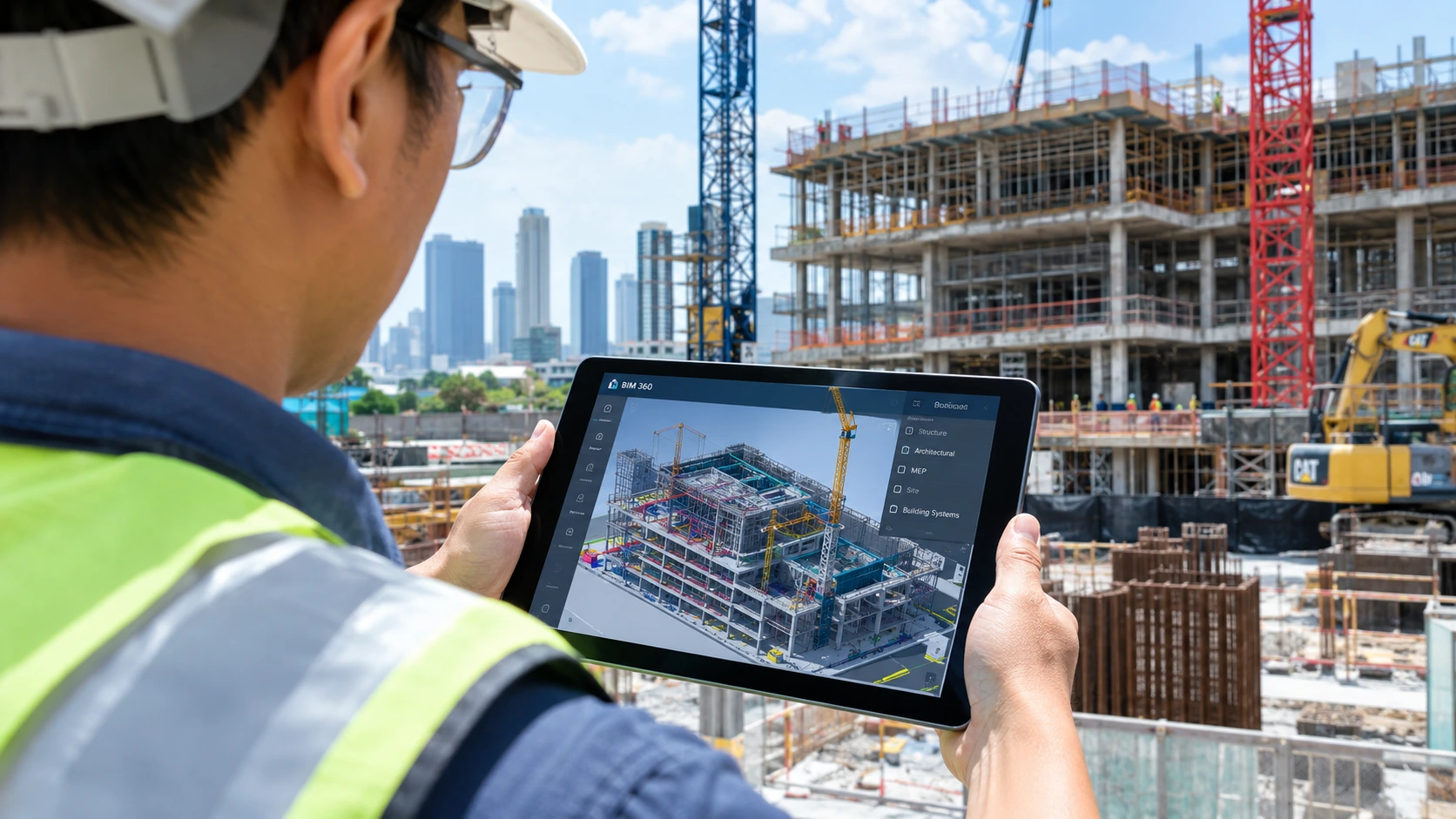
Building Information Modelling, universally known as BIM, is the most established and widely adopted digital construction technology, and for many contractors it represents the entry point into digital construction practice more broadly.
BIM replaces traditional two-dimensional drawings with a coordinated three-dimensional digital model that contains not just geometric information but data about materials, quantities, schedules, and costs, all linked together so that a change in one part of the model updates consistently everywhere that information appears.
What BIM Actually Does
A BIM model allows architects, engineers, and contractors to design and coordinate a building digitally before construction begins, identifying clashes between structural, mechanical, and electrical systems that would otherwise only be discovered on-site, often at significant cost to fix. Because the model contains data, not just geometry, it can also generate accurate quantity take-offs, support cost estimation, and feed directly into scheduling software, reducing the manual, error-prone process of extracting this information from drawings by hand.
Further technical background on how BIM models are structured and used across the project lifecycle is available through Wikipedia’s overview of Building Information Modelling, useful context for teams new to the practice.
BIM Adoption in Singapore
Singapore has been one of the more proactive markets in mandating and supporting BIM adoption, with government agencies requiring BIM submissions for building plan approval on projects above a certain size for some years now. This regulatory push has meant BIM literacy is increasingly a baseline expectation for contractors and consultants working on larger projects in Singapore, rather than an optional differentiator.
For smaller contractors and subcontractors, BIM adoption often starts with simply being able to view and navigate models produced by a project’s design team, even before investing in the software and training needed to actively author BIM content themselves.
Drones and Aerial Surveying
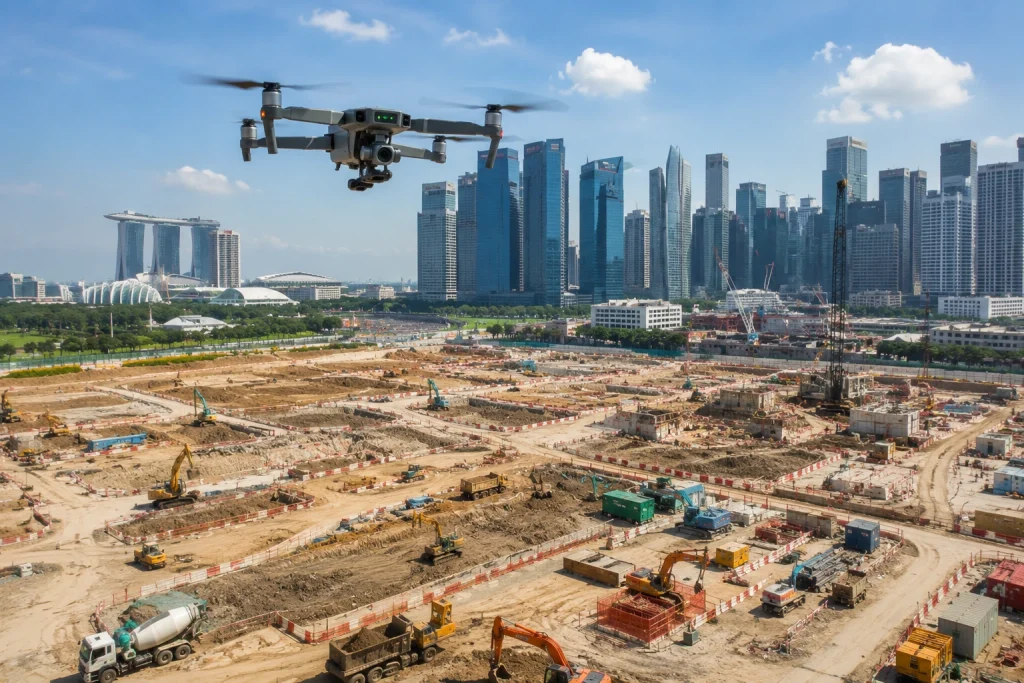
Drones have become one of the fastest-adopted digital construction technologies, largely because they solve a genuinely tedious and time-consuming traditional task, land surveying, considerably faster and often more accurately than ground-based methods alone.
A drone equipped with photogrammetry or LiDAR sensors can capture an entire site’s topography in a single flight, generating accurate digital terrain models used for earthworks planning, progress tracking, and volume calculations for cut and fill quantities. Regular drone surveys throughout a project also create a visual and data record of progress over time, useful for both internal project management and demonstrating progress to clients or lenders. Beyond surveying, drones are increasingly used for site security monitoring and for inspecting hard-to-reach structures such as tall building facades or bridge undersides, tasks that would otherwise require scaffolding or aerial work platforms simply to gain a visual inspection view.
GPS and Machine Control Technology
Machine control technology connects GPS positioning directly to a piece of earthmoving equipment’s hydraulic controls, allowing the machine to automatically grade or excavate to a digital design surface without an operator manually checking survey stakes or grade markers.
This represents one of the more direct connections between digital construction and the heavy equipment used to physically execute a project, and it has meaningfully changed how earthworks and grading operations are carried out on sites that have adopted it.
How Machine Control Works
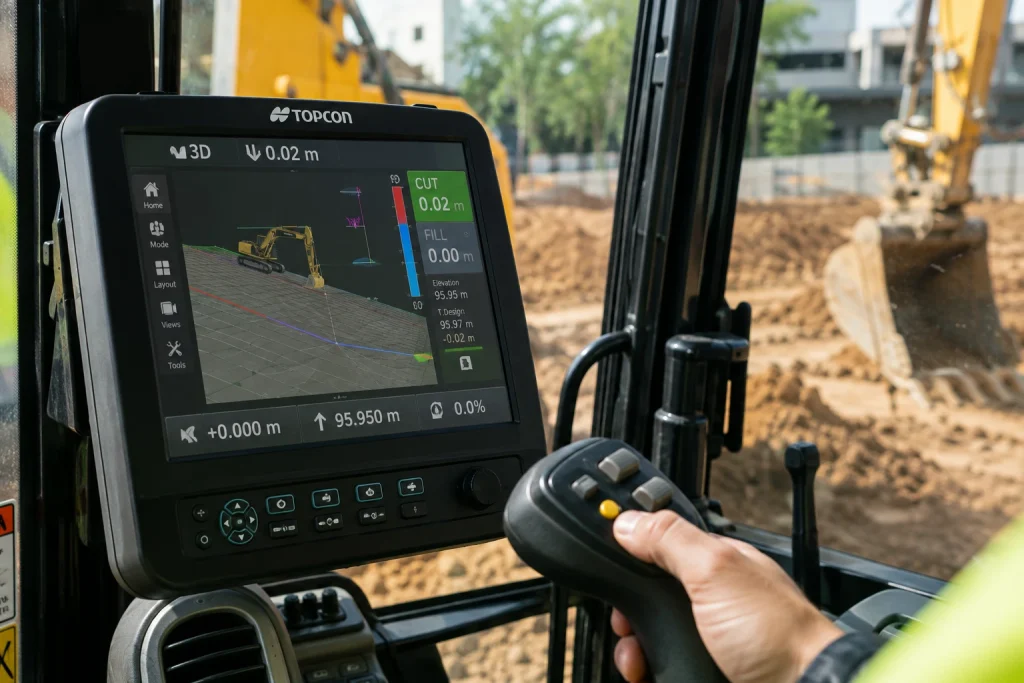
A machine control system uses GPS receivers mounted on the equipment, combined with a digital design surface loaded into an onboard computer, to calculate the difference between the machine’s current blade or bucket position and the design elevation in real time. On more advanced systems, this information is fed directly into the machine’s hydraulics, automatically adjusting blade height as the operator drives, rather than simply displaying the information for the operator to act on manually.
This technology is most commonly fitted to graders, dozers, and excavators, machines whose core function involves shaping ground to a specific design profile, though it is increasingly available across a wider range of earthmoving equipment as the underlying GPS and sensor technology becomes more affordable.
Benefits for Earthmoving Projects
Machine control significantly reduces the need for traditional survey staking, since the design surface exists digitally within the machine rather than needing to be physically marked out on the ground beforehand. This translates into faster grading work, fewer costly over-excavation or under-excavation errors, and reduced dependency on survey crews having to be present on-site continuously throughout an earthworks operation.
For contractors weighing up whether machine control technology is worth the investment for a specific project, the productivity gains tend to scale with project size and grading complexity, larger, more intricate earthworks projects generally see a stronger return than small, simple grading tasks where traditional methods remain perfectly adequate.
Equipment Telematics and Fleet Monitoring
Beyond machine control for active earthworks, a broader category of digital technology, telematics, connects nearly any piece of heavy equipment to the internet, reporting on its location, usage, fuel consumption, and mechanical condition without requiring anyone to physically inspect the machine.
This connected equipment data has become increasingly standard across modern generators, forklifts, and aerial work platforms, giving fleet managers visibility into their equipment that was simply unavailable a decade ago.
Real-Time Equipment Data
Telematics systems report metrics such as engine hours, fuel level, location, and fault codes back to a central dashboard in real time, allowing a fleet manager to monitor an entire equipment fleet across multiple sites without needing to physically visit each machine. This visibility is particularly valuable for equipment such as generators running unattended for extended periods, where remote monitoring can flag a developing fault or a fuel level dropping toward empty long before it becomes an on-site emergency.
Location tracking also has a practical security benefit, since equipment theft remains a genuine risk on construction sites, and telematics-equipped machinery can be tracked and, in some systems, remotely disabled if reported stolen.
Predictive Maintenance
Perhaps the most valuable application of equipment telematics is predictive maintenance, using real usage and condition data to schedule servicing based on actual equipment wear rather than a fixed calendar interval alone. A generator reporting unusually high running temperatures, for example, can trigger a maintenance check before a full failure occurs, extending the practical value of a routine such as the one covered in Generator Maintenance Checklist: A Complete Site Guide by adding real-time condition data on top of a fixed inspection schedule.
Also read: Generator Maintenance Checklist: A Complete Site Guide
Digital Twins and Project Simulation
A digital twin extends the BIM concept further, creating a continuously updated digital replica of a physical asset or site that reflects its actual, current condition rather than simply its original design intent.
Where a BIM model typically represents a building as designed and built, a digital twin ideally stays synchronised with the real asset throughout its operational life, incorporating sensor data, maintenance records, and performance information so that facility managers can simulate scenarios, predict maintenance needs, and plan changes against an accurate, current model rather than an increasingly outdated original design file. This technology remains at an earlier stage of adoption in construction compared to BIM or telematics, but interest is growing steadily as the underlying sensor and data infrastructure needed to keep a digital twin genuinely current becomes more accessible and affordable.
Construction Management Software and Site Planning
Beyond design and equipment-focused technology, a broad category of construction management software now supports scheduling, budgeting, document control, and site coordination digitally, replacing what was traditionally managed through spreadsheets, paper forms, and email.
These platforms typically integrate scheduling, cost tracking, and document management into a single system, giving project teams a shared, current source of truth rather than multiple disconnected files that quickly fall out of sync with each other. This digital coordination layer becomes particularly valuable at the planning stages of a project, where decisions made in a master plan need to translate accurately into a detailed construction site plan, a process that digital tools can track and version far more reliably than paper-based planning documents passed between project stakeholders.
Also read: Construction Site Planning: A Complete Guide
Challenges and Barriers to Digital Adoption
Despite clear productivity and quality benefits, digital construction technology still faces genuine adoption barriers across much of the industry, particularly among smaller contractors and subcontractors:
- Upfront cost. Software licences, sensor hardware, and machine control retrofits all require capital investment that can be difficult to justify for businesses running tight margins, particularly without a track record of the specific return these tools will generate for their own operations.
- Training and digital literacy. A workforce trained in traditional methods needs time and support to build confidence with new digital tools, and poorly managed technology rollouts can create resistance that undermines adoption even when the technology itself is sound.
- Fragmented software ecosystems. Many construction technology tools do not integrate cleanly with each other, forcing project teams to manually transfer data between systems that should, in principle, communicate automatically.
- Connectivity on remote or basic sites. Technologies that rely on real-time data transmission, telematics and cloud-based software in particular, depend on reliable site connectivity that is not always available on remote or newly established sites.
These barriers connect to several of the broader operational pressures facing the construction industry today, covered in more depth in Top Challenges in the Construction Industry and How to Overcome Them, which discusses labor, cost, and productivity pressures that digital tools are increasingly being adopted specifically to address.
Also read: Top Challenges in the Construction Industry and How to Overcome Them
Where Digital Construction Is Heading
Digital construction has moved from a competitive differentiator to an increasingly baseline expectation across much of the industry, and businesses that delay adoption risk falling behind competitors already capturing the productivity and quality benefits these tools provide. The technologies covered in this guide, BIM, drones, machine control, telematics, digital twins, and management software, are increasingly interconnected rather than standalone tools, and the businesses getting the most value from digital construction tend to be those integrating several of these technologies together rather than adopting any single tool in isolation.
RR Machinery Pte Ltd supports Singapore’s construction and industrial sectors with reliable heavy machinery solutions suited to modern, technology-driven project requirements. Browse our complete heavy machinery services or contact our team today for practical advice on equipping your next project.