
Almost nothing gets built directly on undisturbed, natural ground. Before a foundation is poured, a road is paved, or a retaining wall is backfilled, the soil beneath it needs to be compacted, mechanically compressed to remove air voids and increase its density, so that it can bear load predictably without settling or shifting once the structure above it is in service.
Soil compaction sounds like a simple, brute-force task, drive something heavy over the ground repeatedly, but the underlying engineering is considerably more precise than that. Different soil types respond to entirely different compaction mechanisms, moisture content has a dramatic effect on how well a given method actually works, and the results need to be measured and verified rather than assumed. This guide explains the main soil compaction methods in use today, the science behind why they work, and how to match the right method to a given soil and application.
Why Soil Compaction Matters
Loose, uncompacted soil contains a significant proportion of air voids between individual soil particles, and it is these voids, not the soil particles themselves, that collapse and cause settlement once a structure applies load to the ground over time. Compaction works by mechanically forcing soil particles closer together, expelling air and rearranging the particle structure into a denser, more stable configuration that resists further settlement under load.
Inadequate compaction is one of the most common root causes of pavement rutting, foundation settlement, and retaining wall movement, problems that often do not appear until months or years after construction, by which point remediation is far more disruptive and expensive than getting the compaction right the first time.
The Science Behind Compaction: Moisture and Density
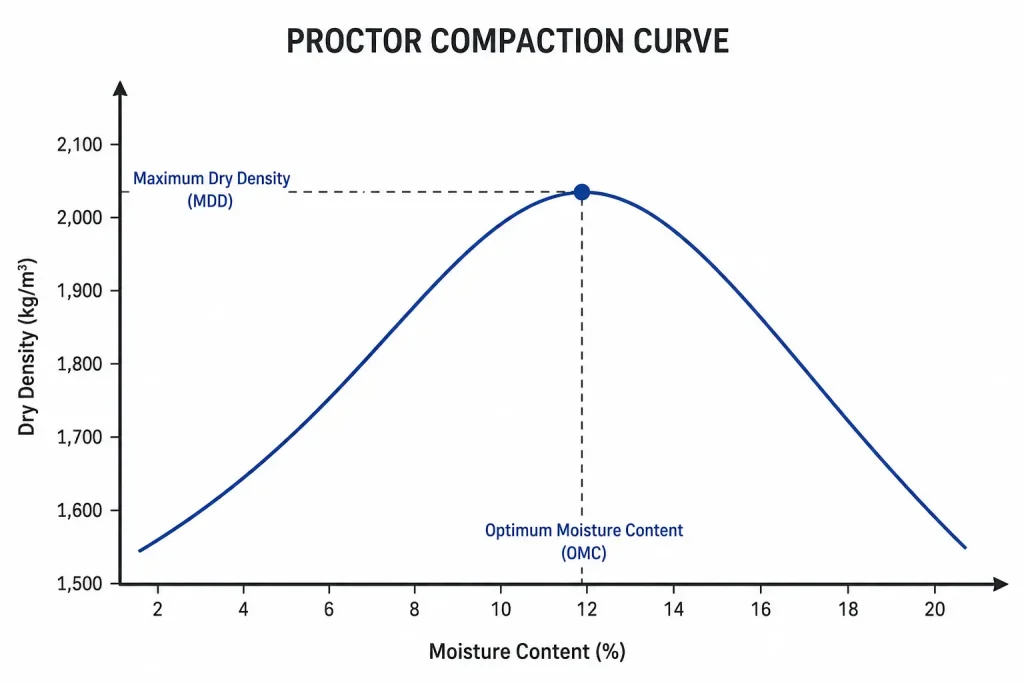
Soil compaction is governed by a relationship that surprises many people encountering it for the first time: for any given soil, there is a specific moisture content at which compaction achieves the highest possible density, and both drier and wetter soil compact less effectively than soil at this optimum point.
This relationship exists because water in soil acts as a lubricant between particles, allowing them to slide past one another into a denser arrangement under compactive effort. Too little moisture and the particles resist rearranging, held apart by friction; too much moisture and water itself begins occupying space between particles, physically preventing them from packing as closely together, and in extreme cases creating pore water pressure that resists compaction entirely. This relationship is typically established for a specific soil through a standard laboratory test, most commonly the Proctor compaction test, which compacts samples of the soil at a range of moisture contents to identify the optimum moisture content and the corresponding maximum dry density that field compaction work is then measured against. Further technical background on this relationship is available through Wikipedia’s overview of soil compaction, covering the engineering principles in more depth.
Understanding this relationship is why compaction specifications on a project almost always reference a target percentage of a laboratory-determined maximum dry density, typically 90 to 98 percent depending on the application, rather than simply specifying a number of roller passes, since the actual density achieved depends as much on moisture content as it does on the compactive effort applied.
Mechanical Compaction Methods
Four distinct mechanical principles are used to compact soil, and most compaction equipment on a construction site applies one of these principles, or a combination of them, depending on the machine’s design and the soil it is built to handle.
Choosing the wrong mechanical principle for a given soil type is one of the most common and costly compaction mistakes, since a method that works exceptionally well on granular material can be almost entirely ineffective on cohesive clay, and vice versa.
Static Weight Compaction
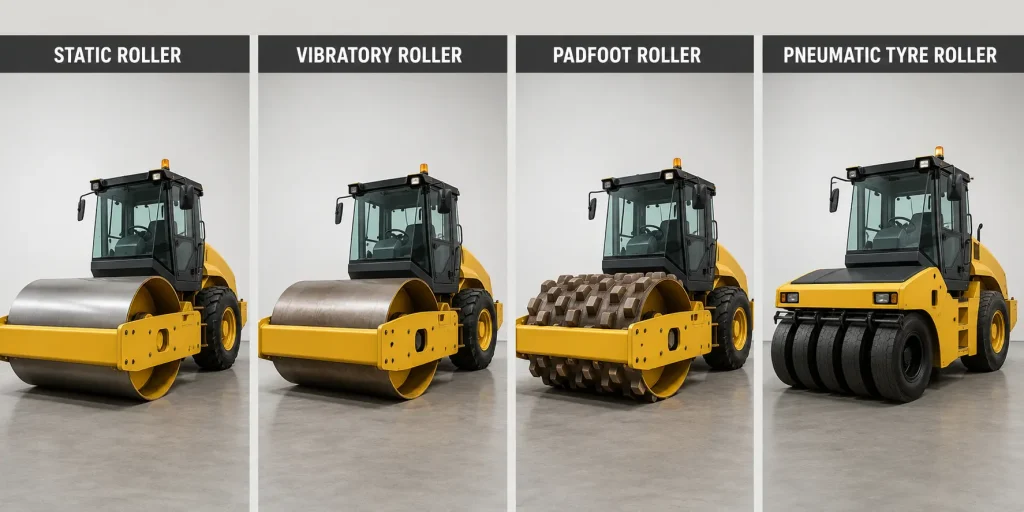
Static compaction relies simply on the dead weight of a roller or plate pressed down onto the soil surface, compressing particles together through sustained pressure rather than dynamic force. This is the oldest and most straightforward compaction principle, historically achieved with simple towed rollers, and it remains effective for certain applications even though it has largely been superseded by more dynamic methods for most large-scale earthworks.
Static compaction works best on soils that respond well to steady pressure, and it is generally less effective at achieving high density in coarse granular materials compared to vibratory methods, since static weight alone struggles to rearrange larger particles into a genuinely dense configuration.
Vibratory Compaction
Vibratory compaction adds rapid oscillation to a roller’s drum, applying repeated dynamic impact to the soil surface many times per second in addition to the machine’s static weight. This vibration is particularly effective on granular, cohesionless soils, sand and gravel, since the rapid oscillation temporarily reduces friction between particles, allowing them to settle into a denser arrangement far more effectively than static weight alone could achieve.
Vibratory rollers are the standard compaction equipment for granular subbase and base course material on most construction and road projects, and adjusting vibration frequency and amplitude allows the same machine to be tuned for different material types and lift thicknesses.
Impact and Tamping Compaction
Impact compaction delivers a sharp, repeated striking force to the soil surface, either through a rapid mechanical rammer or, at a larger scale, through padfoot or sheepsfoot rollers whose projecting pads penetrate into the soil and compact it from within the lift rather than only at the surface. This penetrating action makes impact and tamping methods particularly effective on cohesive soils, clay and silty clay, that resist the rearrangement vibratory compaction relies on.
Because the projecting pads walk out of the soil as it compacts and stiffens, padfoot rollers provide a natural visual indicator of compaction progress, when the pads stop penetrating deeply and the roller begins riding higher on the surface, the layer has reached a meaningfully compacted state.
Kneading Compaction
Kneading compaction, achieved primarily through pneumatic tyre rollers, compacts soil through a combination of pressure and a slight lateral, kneading motion as the tyres flex and roll across the surface. This kneading action is particularly effective for sealing the surface of asphalt and certain cohesive soils, achieving a smooth, dense finish that other compaction methods can struggle to replicate.
Pneumatic rollers are frequently used as an intermediate or finishing step after vibratory or impact compaction has achieved the bulk of the required density, refining surface texture and closing any remaining surface voids.
Also read: 5 Types of Rollers Used in Construction and Road Compaction
Matching Compaction Method to Soil Type
Because different mechanical principles suit different soil behaviours, selecting the right compaction method starts with correctly identifying the soil type being worked, granular or cohesive, since this single classification eliminates most of the wrong choices immediately.
Granular Soils: Sand and Gravel
Granular soils, sand, gravel, and crushed rock, compact best under vibratory energy, since the particles are largely cohesionless and respond well to the rapid oscillation that temporarily reduces inter-particle friction and allows denser packing. These soils are also comparatively insensitive to moisture content compared to cohesive soils, though some moisture still improves compaction by providing a degree of lubrication between particles.
Vibratory smooth drum rollers are the standard equipment specification for granular subbase and base course compaction on most construction and road projects, covered in more detail in Types of Compactors Used in Construction Projects, which breaks down the specific machine categories suited to this and other soil types.
Cohesive Soils: Clay and Silt
Cohesive soils, clay and clayey silt, resist the rearrangement that vibratory compaction relies on, since their particles bond together through cohesive forces rather than simply resting against each other under gravity. Impact and tamping methods, padfoot or sheepsfoot rollers in particular, are far more effective on these soils, since the penetrating pads break through the cohesive structure and compact the material from within the lift.
Cohesive soils are also considerably more sensitive to moisture content than granular soils, with a comparatively narrow optimum moisture range, working clay significantly wetter or drier than this optimum can make achieving specified density difficult regardless of how much compactive effort is applied.
Also read: Types of Compactors Used in Construction Projects
Compaction Testing and Quality Control
Compaction specifications on a construction project are only meaningful if the achieved density is actually measured and verified, rather than assumed based on the number of roller passes completed or how firm the ground appears underfoot.
Common field verification methods include:
- Sand cone test.
A traditional, highly accurate method that measures in-place density by excavating a small hole and calculating the volume removed based on how much calibrated sand is required to fill it. - Nuclear density gauge.
A fast, non-destructive method using radioactive source measurement to determine density and moisture content in seconds, widely used on active projects due to its speed compared to excavation-based methods. - Dynamic cone penetrometer.
A simpler, lower-cost method that measures resistance to a falling weight driving a cone into the ground, providing a rapid indication of relative compaction without needing to establish absolute density values.
Each layer of fill is typically tested before the next layer is placed, since compaction problems discovered only after multiple layers have already been placed on top require considerably more rework to correct than a problem caught at the layer where it originated.
Layer Thickness and Lift Control
Compaction equipment can only effectively densify soil to a limited depth below the surface it is working on, which is why fill material is placed and compacted in relatively thin layers, called lifts, rather than in a single thick deposit.
Lift thickness depends on both the compaction equipment being used and the soil type, heavier vibratory rollers can effectively compact thicker lifts of granular material than a smaller plate compactor could manage, while cohesive soils generally require thinner lifts than granular material to achieve consistent density throughout the layer. Exceeding the appropriate lift thickness for the equipment and soil in use is one of the most common causes of a layer that tests adequately compacted near the surface but remains under-compacted at depth, a problem that often goes undetected until settlement occurs later.
Common Soil Compaction Mistakes
A handful of recurring mistakes account for a large share of compaction-related settlement and pavement failures found on completed projects:
- Compacting outside the optimum moisture range.
Soil that is too wet or too dry will not reach specified density regardless of how much compactive effort is applied, and drying or wetting the material before compaction is often necessary rather than optional. - Using the wrong compaction method for the soil type.
Attempting to compact cohesive clay with vibratory equipment alone, or granular material with static rollers alone, produces poor results even with extended effort. - Excessive lift thickness.
Placing fill too thick for the compaction equipment being used leaves the base of each layer under-compacted even when the surface appears adequately dense. - Skipping verification testing.
Assuming adequate compaction based on visual appearance or roller pass count, rather than measured density, allows problems to go undetected until settlement occurs after construction. - Compacting over unsuitable subgrade.
Compacting fill over soft, wet, or organic material without first addressing the underlying subgrade simply compresses the problem layer beneath, rather than solving it.
Getting compaction right connects directly to the broader site preparation sequence covered in Construction Site Planning: A Complete Guide, where soil testing and compaction form one of several coordinated stages that need to be sequenced correctly before construction can proceed.
Also read: Construction Site Planning: A Complete Guide
Building on Solid Ground
Getting soil compaction right, choosing the correct mechanical method for the soil type, working within the optimum moisture range, controlling lift thickness, and verifying results through proper testing, is what allows everything built afterward to perform as designed rather than settling or shifting unpredictably over time. It is unglamorous, often invisible work once construction is complete, but it is foundational in the most literal sense.
RR Machinery Pte Ltd supports Singapore’s construction and industrial sectors with reliable heavy machinery solutions tailored to your specific site and soil conditions. Browse our complete heavy machinery services or contact our team today for practical advice on the right compaction equipment for your project.