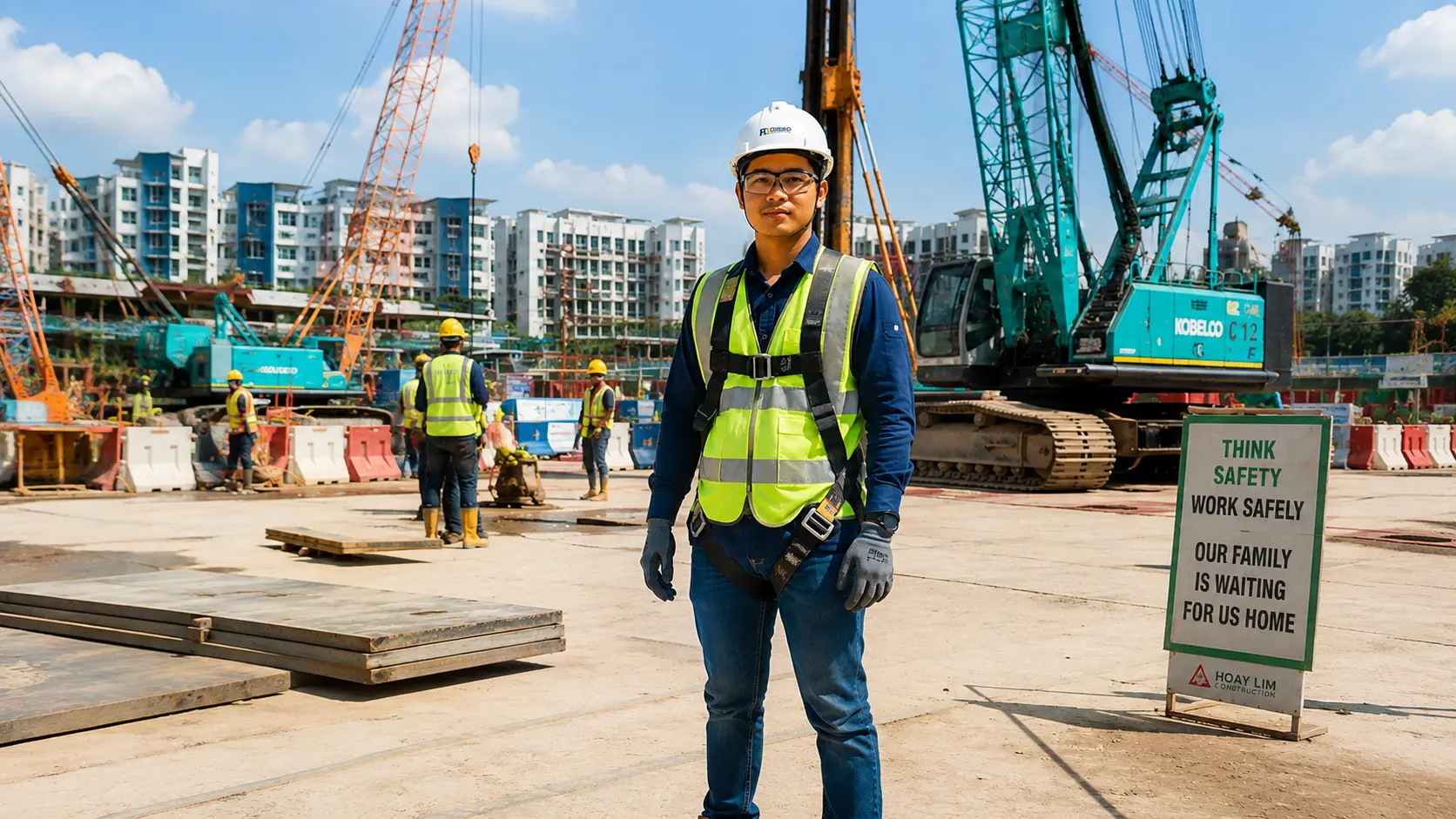
Personal protective equipment, PPE, is the most visible layer of safety on any construction site, the hard hats, harnesses, and high-visibility vests that make a busy site instantly recognisable even from a distance. Despite how familiar this equipment looks, PPE is deliberately positioned as the last line of defence in workplace safety, protecting a worker after every other control, engineering, procedural, and administrative, has already been applied to reduce the underlying hazard.
Understanding exactly what PPE is required for different construction tasks, why each item protects against a specific and well-documented risk, and how to select and maintain it correctly is essential knowledge for every worker, supervisor, and site manager. This guide covers every major category of PPE used in construction, from head and eye protection through to fall arrest systems, along with the compliance standards that govern their use in Singapore.
Why PPE Is Essential on a Construction Site
PPE sits at the bottom of what safety professionals call the hierarchy of controls, a framework that ranks safety measures from most to least effective: eliminating a hazard entirely, substituting it with something safer, engineering controls that isolate workers from the hazard, administrative controls that change how work is done, and finally PPE, which protects the individual worker once every other control has already been applied.
This position in the hierarchy matters because PPE does not remove risk, it reduces the severity of an incident that has already begun to occur. A hard hat does not prevent a tool from falling, it reduces the injury if one does. This distinction is why relying on PPE alone, without the engineering and procedural controls that should come first, leaves genuine gaps in a site’s safety programme regardless of how much protective equipment workers are wearing.
Head and Face Protection
Head and face injuries on construction sites typically result from falling objects, contact with fixed structures, or flying debris generated by cutting, grinding, or demolition work, three genuinely distinct hazards that require different equipment to address properly.
Because these hazards frequently occur together on an active site, most construction tasks require head and eye or face protection to be worn simultaneously rather than treated as separate, situational choices.
Hard Hats and Safety Helmets
Hard hats protect against impact from falling objects and against contact with fixed overhead hazards such as low beams or scaffolding, and they are typically classified by the level of impact and electrical protection they provide. Industrial safety helmets, increasingly used instead of traditional hard hats on many sites, add a chin strap and are designed to stay on the head during a fall or sudden movement, an important distinction for work at height or on uneven terrain where a hard hat could dislodge.
Helmets should be inspected before each use for cracks, UV degradation, or impact damage, since a compromised shell can fail at exactly the moment it is needed most. Manufacturers typically specify a maximum service life regardless of visible condition, since the plastic shell degrades with UV exposure over time even without an obvious impact.
Eye and Face Protection
Safety glasses protect against flying debris, dust, and minor impact hazards during general site work, while face shields provide broader coverage for tasks generating larger fragments or splash hazards, such as grinding, chipping, or working with chemicals. Tasks involving cutting or grinding masonry and concrete generate fine, high-velocity debris that safety glasses alone may not fully contain, which is why a face shield is often specified as additional protection layered over glasses rather than as a substitute for them.
Selecting eye protection rated for the specific task matters considerably, impact-rated safety glasses are not necessarily rated for chemical splash, and glasses alone offer no protection against fine dust that can enter around the frame during prolonged exposure to airborne particulates.
Hearing and Respiratory Protection
Construction sites expose workers to two hazards that share a common characteristic: both cause cumulative, often irreversible damage that frequently goes unnoticed until significant harm has already occurred.
Because both hearing loss and respiratory damage develop gradually rather than through a single acute incident, protective equipment for these hazards is easy to treat as optional on any single task, even though the cumulative risk across an entire career is substantial.
Hearing Protection
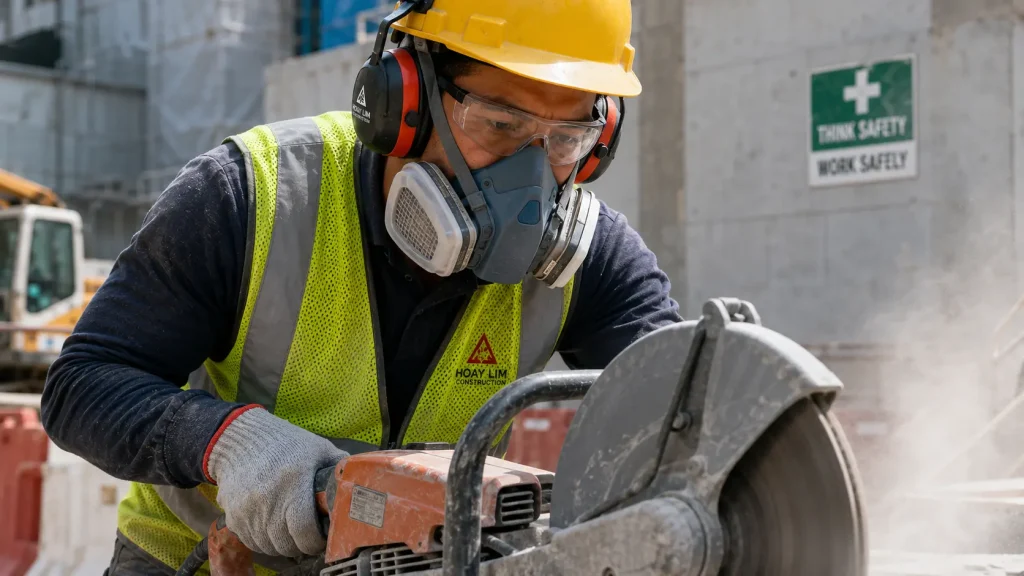
Prolonged exposure to equipment noise, from generators, compactors, saws, and heavy machinery, causes permanent, irreversible hearing loss that develops gradually and without pain, making it one of the most under-recognised occupational health risks in construction. Earplugs and earmuffs are both effective when correctly rated for the noise level involved, and combining both is often specified for particularly loud tasks such as operating a jackhammer or working near an active compactor.
Hearing protection needs to be matched to the actual noise level of the task, since overprotection can itself create a hazard by preventing a worker from hearing warning signals, verbal instructions, or approaching equipment on a busy site.
Respiratory Protection and Airborne Dust
Cutting, grinding, or drilling concrete and masonry releases respirable crystalline silica dust, a serious and well-documented cause of silicosis and other long-term lung disease when inhaled repeatedly without adequate protection. A detailed look at how this specific hazard arises and the dust control measures that address it directly is covered in How to Cut Concrete: Methods, Tools & Safety Guide, useful reading for any worker or supervisor overseeing cutting or grinding tasks.
Respirator selection depends on the specific airborne hazard, disposable dust masks provide only limited protection against fine silica particles, while properly fitted half-face or full-face respirators with the correct filter cartridge offer meaningfully better protection for tasks generating significant dust or fume exposure. Fit testing matters considerably for respirators, since even a correctly rated mask provides little protection if it does not seal properly against the wearer’s face.
Also read: How to Cut Concrete: Methods, Tools & Safety Guide
Hand and Foot Protection
Hands and feet are involved in nearly every physical task on a construction site, which is exactly why hand and foot injuries remain among the most common categories of workplace injury despite how straightforward the protective equipment involved actually is.
Gloves
Glove selection needs to match the specific task, cut-resistant gloves for handling sharp materials, chemical-resistant gloves for handling cement, adhesives, or solvents, and impact-resistant gloves for tasks involving heavy tools or materials, since no single glove type protects effectively against every hazard a construction site presents. Gloves that are too loose reduce dexterity and grip, increasing the likelihood of dropped tools or materials, while gloves that are too tight restrict circulation and cause fatigue over a full shift.
Wet cement and concrete exposure deserves particular attention, since prolonged skin contact can cause chemical burns that workers frequently underestimate because the sensation builds gradually rather than causing immediate, obvious pain.
Safety Footwear
Safety boots with reinforced toe caps protect against falling or rolling objects, while puncture-resistant soles guard against nails, rebar, and other sharp debris common on an active site. Many construction safety boots also include ankle support, a meaningful benefit given how frequently construction work involves uneven ground, ladders, and scaffolding where ankle injuries are a genuine and common risk.
Slip-resistant outsoles matter as much as impact protection, particularly on sites involving wet concrete, mud, or metal decking, where a fall caused by poor footing can cause injuries just as serious as those from an impact the boot’s toe cap was designed to prevent.
Fall Protection Equipment
Falls from height remain one of the leading causes of fatal construction injury worldwide, making fall protection equipment among the most safety-critical categories of PPE covered in this guide.
Fall protection is rarely a single piece of equipment but a complete system, harness, lanyard, and anchor point, that only functions correctly when every component is rated correctly and properly connected together.
Harnesses and Lanyards
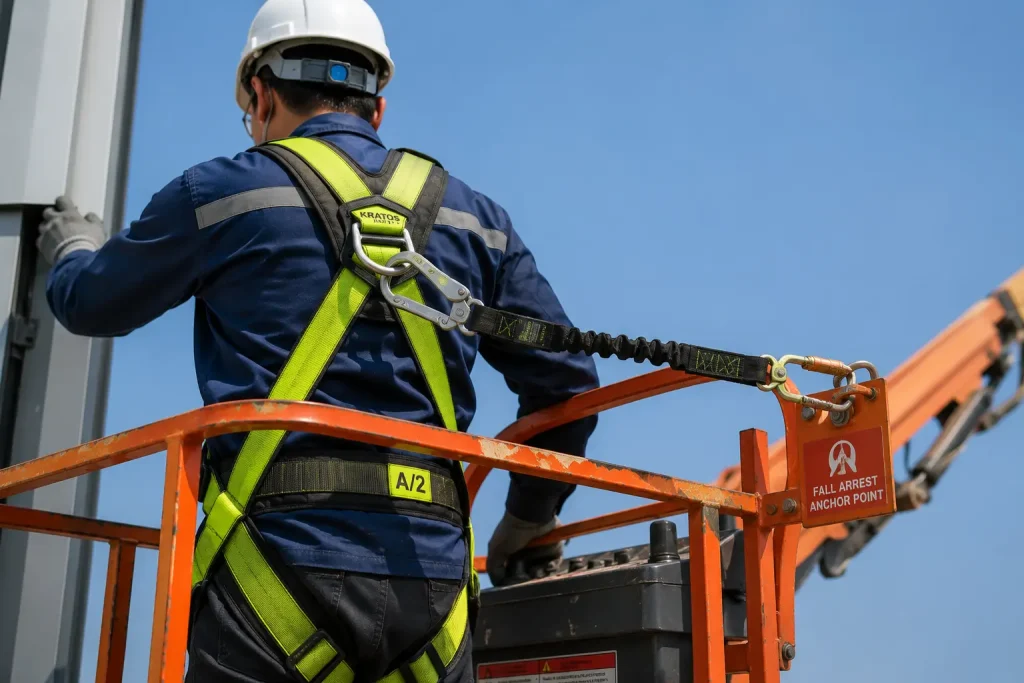
A full-body harness distributes the force of a fall across the shoulders, thighs, and pelvis, a significant improvement over older waist-belt designs that could cause severe internal injury during a fall arrest. Lanyards, the connecting element between harness and anchor point, come in fixed-length and self-retracting configurations, with self-retracting lanyards generally reducing fall distance and arrest force compared to a fixed-length alternative.
Harnesses need to be inspected before every use for webbing damage, stitching integrity, and buckle function, and manufacturers specify a maximum service life that applies regardless of how well-maintained a harness appears, since webbing degrades from UV exposure and mechanical wear even without visible damage.
Anchor Points and Connection
An anchor point needs to be rated for the specific fall arrest load it may be required to withstand, and connecting a lanyard to an unrated structure, a piece of scaffolding, a handrail, or an improvised fixing, is one of the most common and dangerous shortcuts taken on construction sites. A detailed explanation of fall protection requirements and how they apply across different equipment and working conditions is covered in Working at Height: Safety Guidelines, Risks, and Best Practices, useful context for understanding how personal fall arrest equipment fits within a site’s broader working-at-height controls.
Also read: Working at Height: Safety Guidelines, Risks, and Best Practices
When Fall Protection Is Required
Most jurisdictions, including Singapore, specify a minimum height threshold above which fall protection becomes mandatory, though many sites apply fall protection requirements more conservatively than the legal minimum given how severe even a relatively short fall can be. Tasks on ladders, scaffolding, roof edges, and aerial work platforms all typically require some form of fall protection, whether through personal fall arrest equipment or passive controls such as guardrails.
High-Visibility Clothing
High-visibility clothing serves a different purpose from most other PPE categories, protecting workers not from a direct physical hazard but from the risk of being struck by moving vehicles or equipment due to poor visibility.
Fluorescent colours and reflective strips make workers visible both in daylight and under artificial or vehicle headlight illumination, a critical factor on sites with active vehicle movement, poor lighting, or reduced visibility conditions such as dust or rain. Hi-vis clothing needs to be kept reasonably clean to remain effective, since heavy soiling significantly reduces the fluorescent and reflective properties that make the garment functional rather than merely compliant in appearance.
PPE Standards and Compliance in Singapore
PPE used on Singapore construction sites needs to meet recognised safety standards, and employers carry a legal responsibility to provide appropriate PPE and ensure it is actually used correctly rather than simply made available.
Singapore’s Ministry of Manpower publishes detailed Workplace Safety and Health guidance covering PPE requirements, training obligations, and the specific standards equipment must meet across different categories of construction and industrial work. Many PPE items used in Singapore are also expected to meet recognised international standards, such as ISO ratings for safety footwear and EN standards for helmets and eye protection, giving site managers a consistent basis for specifying equipment regardless of supplier. Further general background on PPE categories and their intended protective function is available through Wikipedia’s overview of personal protective equipment.
Common PPE Mistakes and How to Avoid Them
Even with the right equipment available, a handful of recurring mistakes account for a disproportionate share of PPE-related incidents on construction sites:
- Wearing damaged or expired equipment. Helmets, harnesses, and respirators all have a limited service life, and continuing to use equipment past its rated lifespan removes the safety margin it was designed to provide.
- Selecting the wrong PPE for the task. A dust mask rated for nuisance dust does not protect against fine silica particles, and impact-rated eye protection does not necessarily protect against chemical splash.
- Poor fit. Oversized gloves, an improperly adjusted harness, or a loose respirator all reduce the equipment’s effectiveness, sometimes to the point of providing little genuine protection at all.
- Treating PPE as the only control. Relying on PPE alone, without addressing the underlying hazard through better engineering or procedural controls, leaves gaps that PPE was never designed to fully close.
- Inconsistent use. Wearing required PPE only when a supervisor is visibly present, rather than consistently throughout a task, is one of the clearest predictors of a site where an incident is eventually likely to occur.
A broader set of principles for building consistent, genuinely effective safety habits across an entire site is covered in 10 Construction Site Safety Rules Every Worker Should Know, which explains the reasoning behind core site rules in a way that helps make consistent PPE use, and safety compliance generally, stick under real working conditions.
Also read: 10 Construction Site Safety Rules Every Worker Should Know
Building a Genuinely Protected Workforce
PPE remains an essential, non-negotiable part of construction site safety, but it works best as the final layer of a broader safety programme rather than a substitute for eliminating hazards at their source. Selecting the right equipment for each specific task, maintaining it correctly, and wearing it consistently, not just when supervision is present, is what actually determines whether PPE protects a workforce in practice rather than simply on paper.
RR Machinery Pte Ltd supports Singapore’s construction and industrial sectors with reliable heavy machinery solutions and safety-conscious operational support across every project. Browse our complete heavy machinery services or contact our team today for practical advice on equipping your site safely and effectively.