Some jobs at height cannot be reached by simply going straight up. A building may have a canopy in the way, a plant room may have pipework crowding the access path, or a tree may need work from above a fence line. A knuckle boom lift is built for exactly this kind of problem, because its jointed arm can rise, bend, and reach over an obstacle before placing the platform where the work actually is.
This guide explains what a knuckle boom lift is, why the design is so useful around obstructions, which jobs it suits best, how power source and ground conditions affect the choice, and what safe operation looks like when overhead hazards are close by.
What Makes a Boom Lift a Knuckle Boom Lift
The name comes from the joint. Just as a finger bends at its knuckle, a knuckle boom lift has boom sections connected by pivot points, with hydraulic cylinders controlling the angle at each joint. Because every section can move independently, the operator can fold the arm into a shape that the job needs, rather than being limited to a single straight line of extension.
In everyday conversation the same machine is called an articulating boom lift, and many crews simply say knuckle boom. These terms describe one design, a jointed boom mounted on a rotating turret. The word cherry picker is also used loosely for machines of this kind, a naming overlap that is explained in What Is a Cherry Picker? Types, Uses & How It Works.
Within the wider boom lift family, the knuckle design sits alongside telescopic and trailer mounted machines, each solving a different access problem. A side by side look at the full range is available in Types of Boom Lifts: Which One Does Your Job Need?. It is also worth knowing that the phrase knuckle boom is used on truck mounted loader cranes, which share the jointed arm idea but are built to lift materials rather than carry people, so the two should not be confused when specifying equipment.
For a broader introduction to how this machine type works and what benefits it offers, the dedicated guide below covers the fundamentals in more depth.
Also read: Articulating Boom Lift: Uses, Benefits, and How It Works
The Up and Over Reach That Sets Knuckle Booms Apart
A straight boom can only place its platform somewhere along a single line extending from the machine. A knuckle boom lift can place the platform anywhere within a much more flexible working envelope, which is why it is often the only practical choice when the direct path to the work is blocked.
This flexibility comes with a learning curve. Operators need to think about the position of each boom section, not just the position of the platform, and the combination of movements that gets the platform to its destination safely is not always the most obvious one. Good operators build a mental picture of the arm’s shape before they begin moving it.
Reaching Over and Around Obstacles
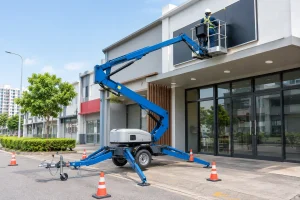
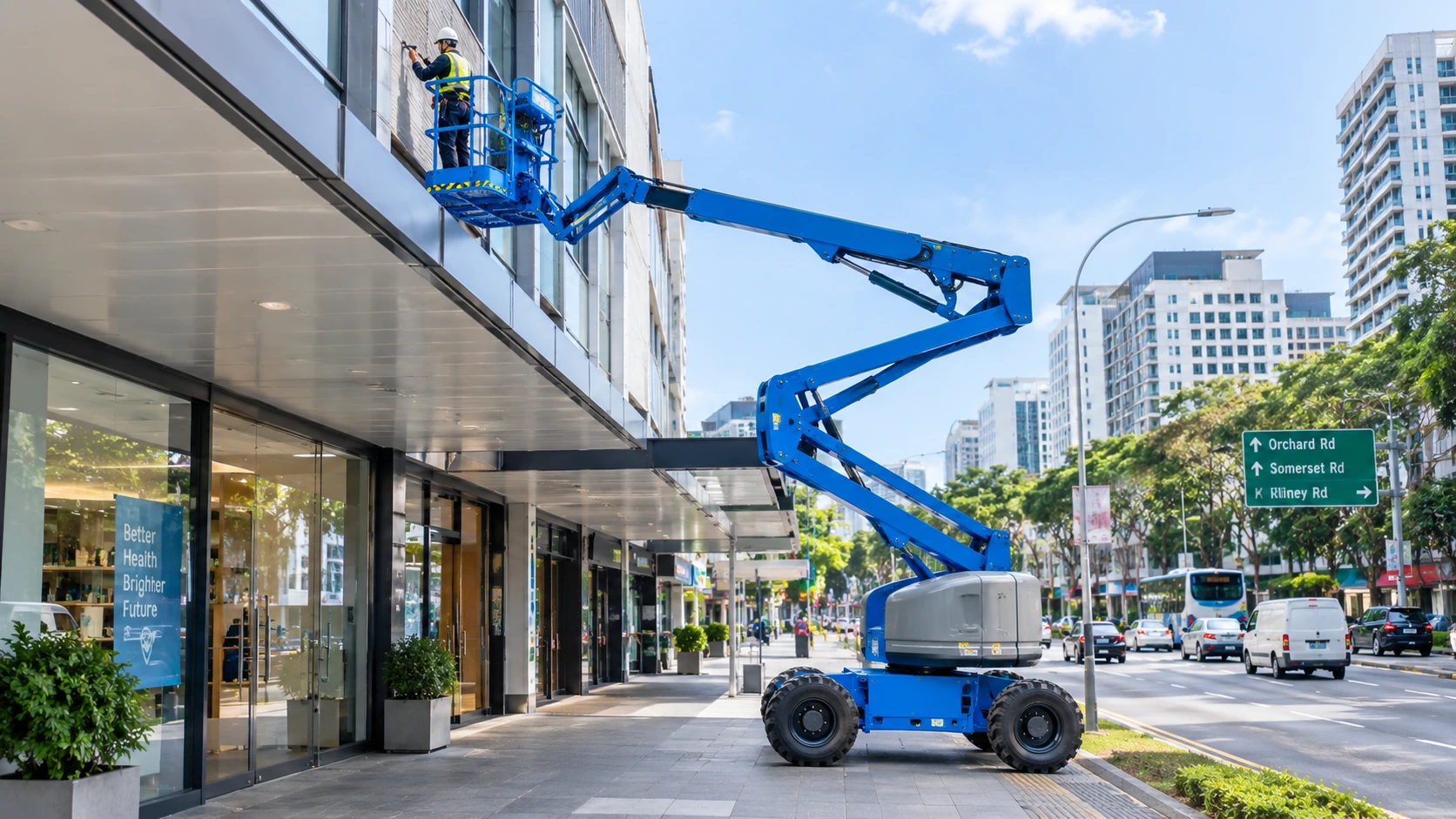
The defining advantage of a knuckle boom lift is the ability to rise vertically past an obstruction and then extend horizontally beyond it. A machine can sit on firm ground beside a loading canopy, a parked vehicle, a flowerbed, or a fence, raise the lower boom, and then fold the upper section outward so the platform ends up above and past the obstacle.
This matters on busy sites and in built up areas where there is rarely enough room to position a machine directly under the work. Being able to work over the top of an obstacle also means fewer disruptions to the area below, since walkways, parked equipment, and delicate landscaping can stay exactly where they are.
Reaching Below the Machine
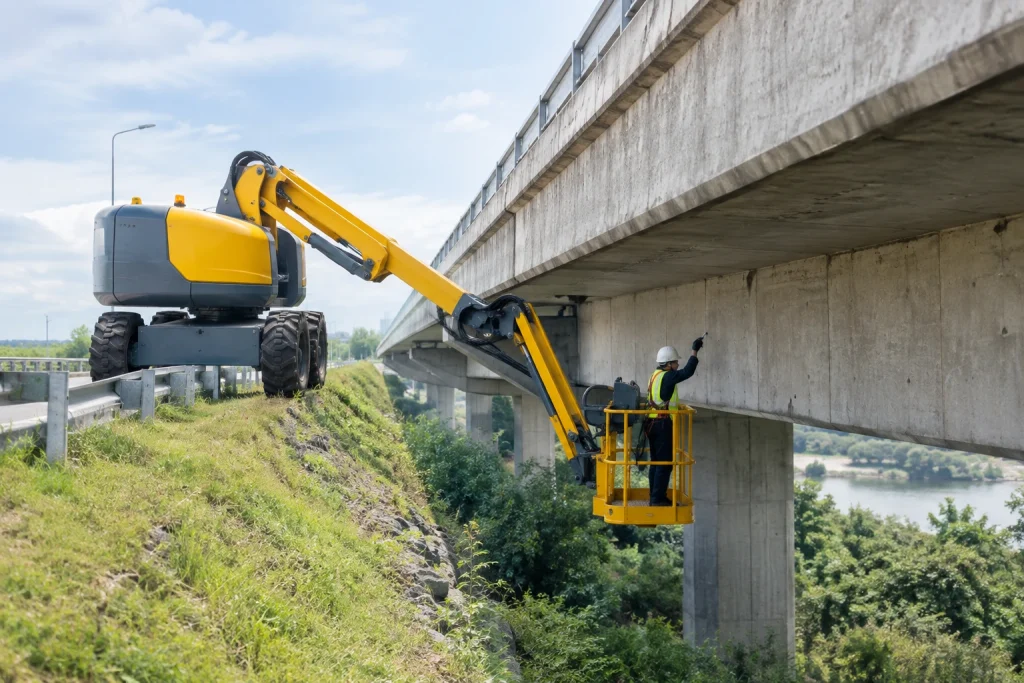
Many knuckle boom lifts can lower the platform below the level the machine itself is standing on. This allows work on the underside of a bridge deck, over the edge of a retaining wall, or down the side of a loading dock, tasks that a straight boom with a fixed minimum angle simply cannot do.
This capability is especially valuable for inspection and maintenance of infrastructure, where the work surface is below the only place a machine can be positioned. Operators still need to respect the machine’s rated envelope in this position, because the load limits at extreme angles are not the same as at a conventional working position.
Platform Positioning and Rotation
At the tip of the boom, most knuckle lifts carry a short extra arm known as a jib, and the platform itself rotates and keeps itself level as the boom moves. These features let workers fine tune their position at the very end of the reach, turning the platform to face a wall or a pipe run without moving the whole machine.
Careful positioning at this final stage is often what separates a quick job from a frustrating one. Being able to make small adjustments from the platform controls means fewer trips back to the ground and less time spent repositioning the base machine.
Jobs a Knuckle Boom Lift Handles Best
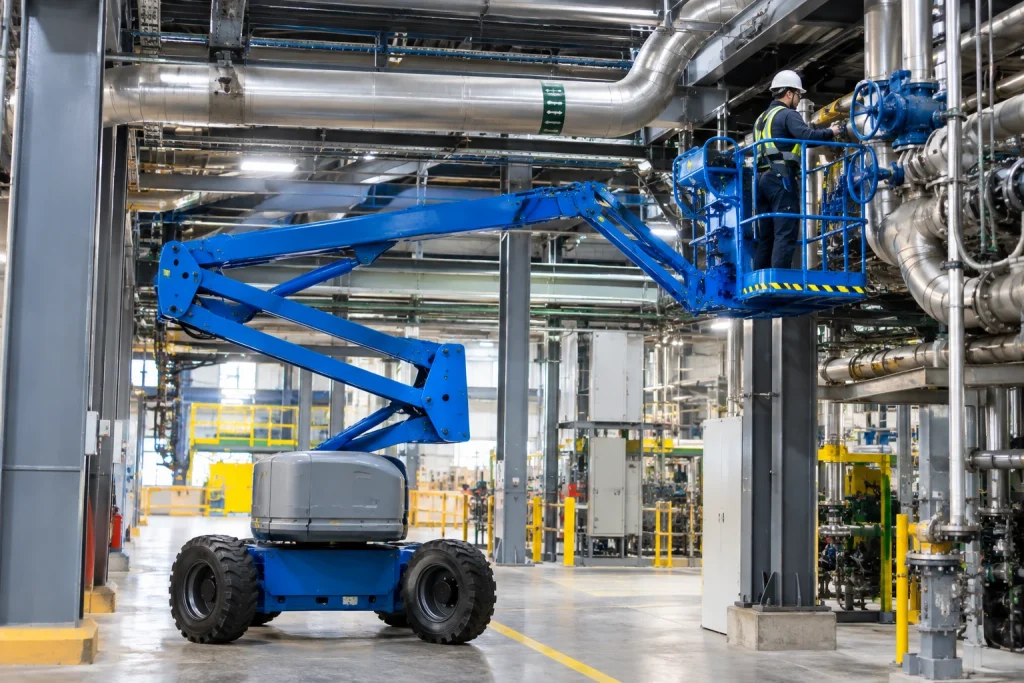
The same flexibility that makes a knuckle boom lift valuable also makes it a poor choice when it is not needed, so it helps to be clear about the situations where it genuinely earns its place. Typical applications include:
- Facade cleaning, painting, and repair on buildings with canopies, balconies, or landscaping at street level
- Tree trimming and removal where the machine cannot park directly beneath the work
- Industrial plant maintenance, where pipework, ducting, and structures block a straight vertical path
- Steel erection and structural work that requires placing workers at awkward angles
- Signage installation and replacement above entrances, awnings, and shopfronts
- Inspection work on bridges, flyovers, and elevated structures from below or alongside
- Shipyard and facility work, where the access route is cluttered or irregular
When the task simply requires straight vertical access in a clear, flat area, a different machine may be more economical. A direct comparison between boom lifts and platform lifts that rise straight up is covered in Boom Lift vs Scissor Lift: Which One Should You Choose?, which is useful for confirming the right category before choosing between boom lift types.
It is also worth being clear about what a knuckle boom lift is not. It is a platform for carrying people and tools to a work position, not a lifting machine for hoisting heavy loads into place. Projects that need to move heavy materials rather than position workers are better served by a crane, a decision explored in Boom Lift vs Crane: How to Choose for Your Project.
Also read: Choosing Between Articulating and Telescopic Boom Lifts
How a Knuckle Boom Lift Differs From a Straight Boom
A telescopic boom extends in a straight line, usually offering the greatest horizontal reach for a given machine size when the path to the work is clear. A knuckle boom lift trades some of that outright outreach for the ability to place the platform in positions a straight boom cannot reach at all.
In practice, the choice comes down to the site. Open ground with an unobstructed approach tends to favour a telescopic machine, while confined or cluttered sites favour the knuckle design. Some projects use both on the same job, with a telescopic boom handling long clear reaches and a knuckle boom handling the awkward corners.
Further general technical background on this equipment category, including how aerial work platforms are classified, is available through Wikipedia’s overview of aerial work platforms.
Power Options and Ground Conditions
Choosing a knuckle boom lift is not only about reach. The power source and the way the machine moves across the ground decide where it can actually be used, and they affect running costs, noise, and site access.
These decisions interact with each other. A machine suited to a smooth indoor floor will behave very differently on soft, uneven outdoor ground, and a machine built for rough terrain may be too heavy or too noisy for a finished interior. Thinking about the full journey from delivery to work position avoids surprises on the day.
Electric and Hybrid Models
Electric knuckle boom lifts run on batteries, producing no exhaust fumes and far less noise than a diesel engine. This makes them suitable for indoor use and for noise sensitive locations such as hospitals, shopping centres, and occupied commercial buildings, where a combustion engine would be disruptive or simply not permitted.
Hybrid machines combine a battery with a small engine, giving the quiet operation of electric power for most of the time while retaining the ability to recharge or boost output when needed. They suit sites that move between indoor and outdoor work within the same project.
Diesel Models
Diesel powered knuckle boom lifts are the usual choice for outdoor construction and industrial sites, where long running hours, rough ground, and the absence of convenient charging points make a combustion engine practical. They typically offer strong drive performance on slopes and uneven surfaces.
The trade off is noise and exhaust emissions, which rule them out for enclosed spaces and make them less welcome in residential or sensitive areas during working hours. Refuelling is quick compared to recharging, which suits tasks that run across multiple shifts.
Tyres and Tracks
Most knuckle boom lifts move on large tyres, often with four wheel drive for outdoor use. Some compact models use tracks, which spread the machine’s weight over a larger area and cope better with soft ground, lawns, and sensitive surfaces that tyres could damage.
Whichever running gear is used, the ground beneath the machine must be able to carry its weight, particularly when the boom is extended and the load is concentrated on one side. Checking ground conditions and any underground services before positioning the machine is a basic step that should never be skipped.
Is a Knuckle Boom Lift Right for Your Site?
A few practical questions help to confirm whether a knuckle boom lift is the right machine before a quote is requested:
- Is there an obstacle between the only place the machine can stand and the place the work needs to happen?
- Does the task require reaching over something, around something, or below the level of the machine?
- Will the machine work indoors, outdoors, or both, and what power source does that point to?
- Is the ground firm and level enough to carry the machine’s weight, and is the access route wide enough to bring it in?
- What combined weight of people, tools, and materials will the platform need to carry at the furthest point of the reach?
If most of the answers point towards obstacles and awkward positions, a knuckle boom lift is likely the right fit. If the access is clear and straight, a simpler and often cheaper option may do the job just as well.
Safe Operation Around Obstacles and Overhead Hazards
The flexibility of a knuckle boom lift introduces hazards that a simple vertical lift does not have. When the arm folds around a structure, there is a real risk of workers being trapped between the platform and a fixed object, and operators must keep a clear view of the space around the platform at all times. A second person on the ground to watch clearances is a sensible precaution on any complex manoeuvre.
Overhead power lines, structures, and other hazards must be identified before the boom is raised, with the full range of motion considered rather than only the final position. Every person on the platform should wear a harness connected to the designated anchor point, and wind and weather should be monitored throughout the task. The wider principles that govern this kind of work are covered in Working at Height: Safety Tips and Guidelines.
Operators should also be properly trained and familiar with the specific machine they are using. Singapore’s Ministry of Manpower publishes Workplace Safety and Health guidance covering training, inspection, and operating standards that apply to aerial work platforms on local worksites. A practical walkthrough of safe operating technique, from pre use checks through to shutdown, is available below.
Also read: How to Operate a Boom Lift Safely: A Step-by-Step Guide
Hiring a Knuckle Boom Lift in Singapore
Hiring the right machine starts with a clear picture of the job. When you contact the team, it helps to share the height and outward reach you need, where the obstacles sit between the machine and the work area, what the ground and access route are like, whether the work is indoors or outdoors, and how long you expect to need the machine. With these details, the right knuckle boom lift configuration, power source, and size can be recommended the first time rather than adjusted after delivery.
RR Machinery Pte Ltd offers an extensive range of boom lifts, including knuckle boom configurations for work around obstacles, backed by factory certified technicians and full servicing support. Contact us today for expert advice on the right machine and a quote tailored to your site