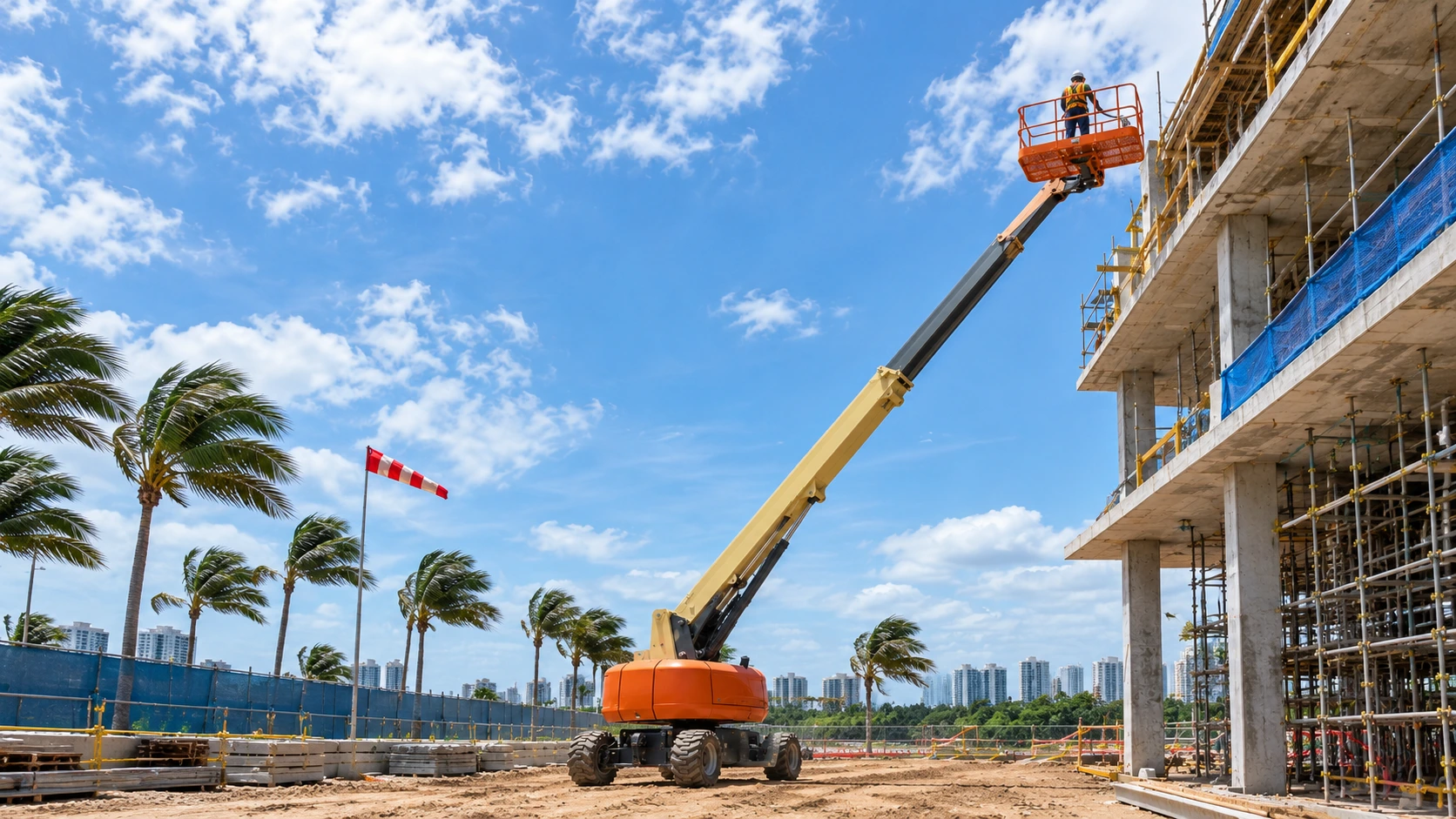
Wind is one of the few hazards on a boom lift that cannot be seen, and one of the easiest to underestimate. A breeze that feels mild at ground level can be much stronger at the platform, and a single gust can push a raised platform hard enough to swing the boom, unsettle the machine, or throw a worker against the guardrails. Knowing the wind speed limit for the machine, and acting on it, is a basic part of working safely at height.
This guide explains what the wind speed limit for a boom lift is, why wind behaves differently at height, how to measure it on site, what lowers the safe limit, how the rules differ between machine types, and what to do when the wind starts to pick up.
What Is the Wind Speed Limit for a Boom Lift?
Every boom lift has a maximum rated wind speed set by its manufacturer, shown on the capacity plate and in the operator’s manual. That figure is the highest wind speed in which the machine may be used with its rated load, and it is the only limit that matters for that particular machine.
Many boom lifts designed for outdoor use are rated for a maximum wind speed of 12.5 metres per second, roughly 45 km/h, which is the design figure used in common international standards for mobile elevating work platforms. Some models carry a lower rating, and machines rated for indoor use only are designed for no wind at all and must not be used outdoors. The rated figure applies to gusts as well as the average wind speed, so a day with steady light wind but strong gusts can still be outside the limit.
The Beaufort scale, which describes wind strength by its visible effects, is a useful reference for understanding what these speeds feel like, and further general background is available through Wikipedia’s overview of the Beaufort scale. On that scale, the common outdoor rating sits at the level often described as a strong breeze, when large branches move and wires begin to whistle.
Why Wind Matters More at Height
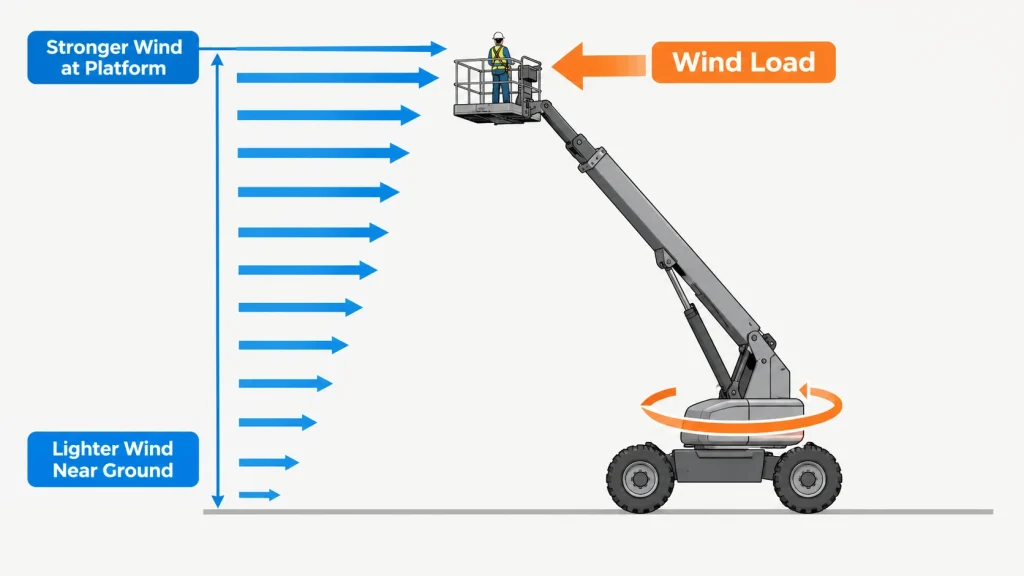
Wind at ground level is a poor guide to the conditions at the platform. Buildings, trees, and the ground itself slow the air near the surface, while the air higher up moves more freely, so the same day can feel calm below and gusty above.
The design of a boom lift adds to the effect. The platform, the workers on it, and the long boom all catch the wind, and because the platform sits at the end of a long arm, even a modest force there creates a large turning effect on the machine below.
Wind Gets Stronger With Height
Wind speed generally increases with height above the ground, because there is less friction from surfaces and obstacles. This means a reading taken at ground level will usually underestimate the wind at the platform, sometimes by a wide margin on a tall machine.
For this reason, wind speed should be checked at or near the working height, not just at the base of the machine. A handheld anemometer used on the platform, or a sensor mounted at height, gives a far more reliable picture than a judgement made from the ground.
The Platform and Boom Act Like a Sail
Anything with a large flat surface catches the wind. The platform, its guardrails, the workers standing in it, and any materials carried on it all present an area for the wind to push against, and that push acts at the furthest point from the machine’s base.
The result is a force that tries to swing the boom sideways and, in the worst case, tip the machine. The further the boom is extended outward and upward, the greater the leverage the wind has, which is why wind and outreach have to be considered together rather than separately.
Gusts and Sudden Changes
Gusts are short bursts of wind that are much stronger than the average speed, and they are often the real danger. A platform can be stable in a steady breeze and then be pushed hard by a gust that arrives without warning.
Sudden changes in wind direction can be just as unsettling, especially near buildings, where air is funnelled between structures or swirls around corners. Operators should treat gusty, changeable conditions as more hazardous than a steady wind of the same average speed.
How to Measure Wind Speed on Site
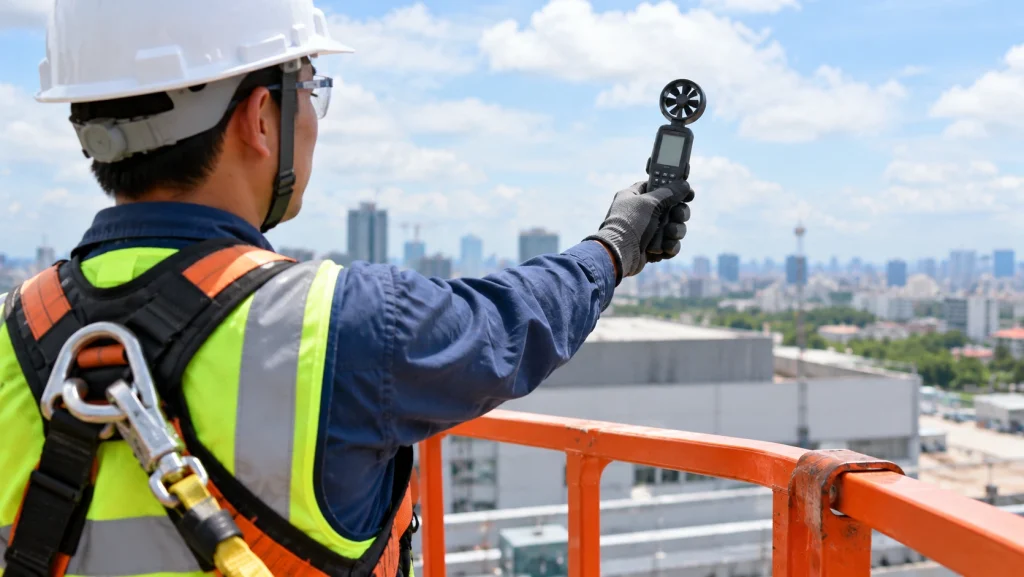
Relying on how the wind feels is not enough. A practical approach combines forecasts with measurement on the day:
- Check the forecast before work starts. Look at expected wind speeds and gusts for the whole working period, not just the morning.
- Use an anemometer. A handheld anemometer gives a direct reading. Take readings at platform height where possible and note the strongest gusts, not just the average.
- Use onboard sensors where fitted. Some machines have wind sensors that warn the operator or prevent operation above the rated limit.
- Watch for visible signs. Swaying trees, moving flags, flying dust, and noise in overhead wires all indicate wind building up, and are a reason to take a fresh reading.
- Recheck through the day. Conditions change, so wind should be monitored throughout the task rather than checked once.
In Singapore, current forecasts and weather warnings are published by the Meteorological Service Singapore, which is a useful first check when planning work at height.
Factors That Lower the Safe Limit
The rated wind speed assumes normal use of the machine. Several common situations reduce the margin of safety and should prompt a more cautious approach:
- Carrying large flat materials. Sheets of glass, panels, signage, and boards act like sails and greatly increase the wind load on the platform. Many manufacturers restrict or prohibit carrying such items.
- Attaching banners or coverings. Anything that increases the surface area of the platform or boom adds to the force of the wind.
- Working at full outreach. The further the platform extends from the base, the greater the leverage of any wind acting on it.
- Working near tall buildings. Gaps between buildings can funnel and accelerate wind, creating local gusts much stronger than the general forecast.
- Open and exposed sites. Coastal areas, open ground, and elevated structures tend to have stronger and steadier winds.
- Soft or sloping ground. Wind adds to any instability already present from poor ground conditions.
When any of these apply, stopping work below the rated limit is often the sensible decision, and the manufacturer’s manual should be checked for specific restrictions.
Wind Considerations by Machine Type
Different machines respond to wind in different ways. Telescopic boom lifts often reach the greatest heights and outreach, which can increase their exposure to wind at full extension. Articulating machines tend to keep the platform closer to the base but are often used around structures where wind can be turbulent, a design covered in Articulating Boom Lift: Uses, Benefits, and How It Works.
Vehicle mounted machines, commonly called cherry pickers, depend on correctly deployed outriggers to resist wind loads, as explained in What Is a Cherry Picker? Types, Uses & How It Works. Scissor lifts rise straight up with a compact base, and many compact electric models are rated for indoor use only, a difference worth checking before moving work outdoors, as compared in Boom Lift vs Scissor Lift: Which One Should You Choose?. The wider range of platforms and their typical uses is described in Types of Aerial Work Platform and Their Common Uses.
Whatever the machine, the rule is the same: the rated wind speed on that machine’s plate is the limit, and it must never be exceeded.
Also read: Types of Boom Lifts: Which One Does Your Job Need?
Planning Work Around Wind and Weather in Singapore
Singapore’s weather can change quickly. Thunderstorms often bring sudden gusts ahead of the rain, and squalls can arrive with little warning, sometimes in the early morning. Lightning is also common, and a raised boom is one of the most exposed points on a site during a storm.
Planning around these conditions means checking forecasts before the shift, building some flexibility into the schedule for weather delays, and agreeing in advance on clear stop work criteria, such as a maximum measured wind speed below the machine’s rating or the first sign of lightning. Workers should know that lowering the platform early is always acceptable and never treated as a delay to be avoided. The wider principles of planning work above ground safely are covered below.
What to Do When the Wind Picks Up
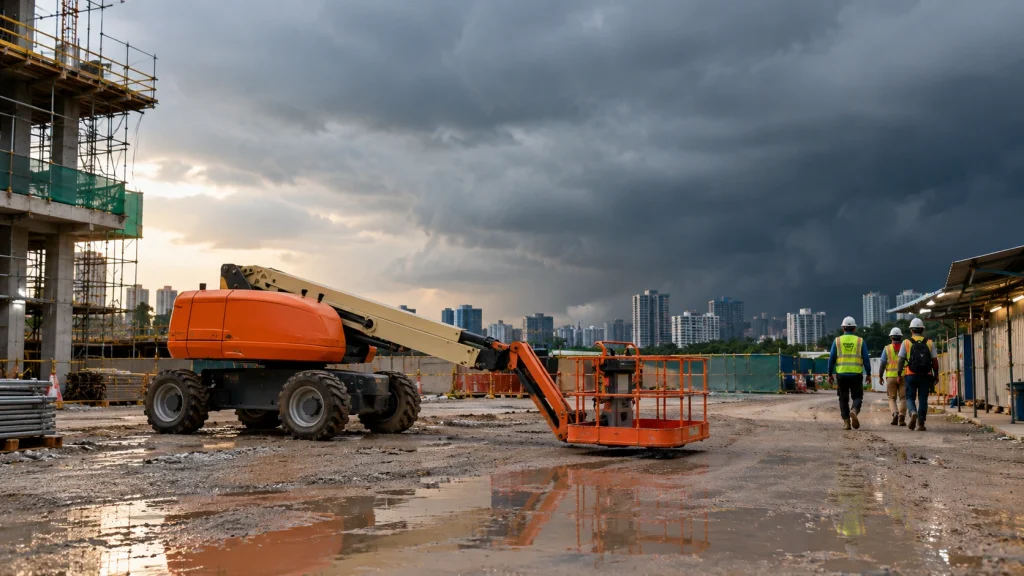
If wind speeds rise toward the limit while the platform is raised, act early rather than waiting to see whether conditions settle:
- Stop work and secure any tools and materials on the platform.
- Retract the boom smoothly to reduce outreach, keeping movements slow to avoid adding to any swaying.
- Lower the platform to the ground in a controlled way.
- Stow the machine in its travel position and park it where it is not exposed to falling objects or flooding.
- Wait for conditions to improve and take a fresh reading before resuming, rather than restarting on a single calm moment.
- Report and record the stoppage so that the decision and the readings are available to supervisors.
Workers on the platform should stay attached to the designated anchor point throughout, and nobody should try to finish a task quickly before the wind arrives.
Building Wind Checks Into Daily Routine
Wind should be part of every pre use briefing on a boom lift job. Operators should confirm the machine’s rated wind speed from its plate, check the forecast for the working period, take a reading before raising the platform, and agree with the supervisor on when work will stop. These checks take only a few minutes and remove most of the guesswork from a decision that has to be made quickly once the wind rises.
Singapore’s Ministry of Manpower publishes detailed Workplace Safety and Health guidance covering work at height and the safe use of aerial work platforms, which should be read alongside the manufacturer’s instructions. A practical walkthrough of safe boom lift operation, from checks before use through to shutdown, is available below.
Also read: How to Operate a Boom Lift Safely: A Step-by-Step Guide
Choosing the Right Boom Lift for Exposed Sites
Wind exposure is worth discussing before a machine is booked, especially for tall structures, open sites, and work near the coast. When you contact the team, it helps to share the working height and outreach needed, how exposed the site is, whether large materials will be carried on the platform, whether the work is indoors or outdoors, and how long you expect to need the machine. With these details, a machine with a suitable rating and configuration can be recommended from the start.
RR Machinery Pte Ltd offers an extensive range of boom lifts for indoor and outdoor work at height, backed by factory certified technicians and full servicing support. Contact us today for expert advice on the right machine and a quote tailored to your project.