Dig a deep hole in soft ground and its sides will try to fall in. Remove a wall from an old building and the floors above will try to drop. Shoring is the temporary support that stops both from happening, holding soil or structure in place long enough for the permanent work to be built safely.
Because shoring is temporary, it rarely appears in finished photographs of a project, yet it is behind almost every basement, deep trench, and major renovation. This guide explains what shoring is, when it is needed, the main methods used for excavations and buildings, how shoring is designed and monitored in Singapore, and how to work safely around it.
Shoring in Simple Terms
Shoring is a temporary system of supports used during construction, repair, or demolition to prevent soil, structures, or newly built elements from moving or collapsing. It carries loads that would otherwise act on unsupported ground or on parts of a building that are not yet strong enough, or no longer strong enough, to carry them on their own.
The word covers two quite different jobs. Excavation shoring holds back the sides of trenches and pits so they do not cave in. Structural shoring props up floors, walls, and beams while a building is altered, repaired, or under construction. Both share the same purpose: keeping things where they are until the permanent structure can take over. Further general background on the term is available through Wikipedia’s overview of shoring.
Shoring is often confused with retaining walls, but the difference is permanence. A retaining wall is designed to hold back soil for the life of the structure, while shoring is installed for a construction stage and then removed or left in place only where the design allows. The permanent options for holding back soil are compared in the guide below.
Also read: Types of Retaining Walls: Structures and When to Use Each
When Is Shoring Needed?
Shoring is needed whenever the ground or a structure cannot be trusted to support itself during the work. Common situations include:
- Trenches and pits deep enough, or in ground loose enough, that their sides could collapse
- Basement excavations close to roads, utilities, or neighbouring buildings
- Excavations below the water table, where groundwater adds pressure and softens the soil
- Renovations that remove or alter load bearing walls, columns, or beams
- Repairs to damaged or deteriorating structures that can no longer carry their full load
- New concrete floors and slabs that need support until the concrete gains strength
The decision is not based on depth alone. Soil type, groundwater, nearby loads such as stockpiles and machines, vibration from traffic or equipment, and how long the excavation will stay open all affect whether shoring is needed and what kind.
Shoring for Excavations
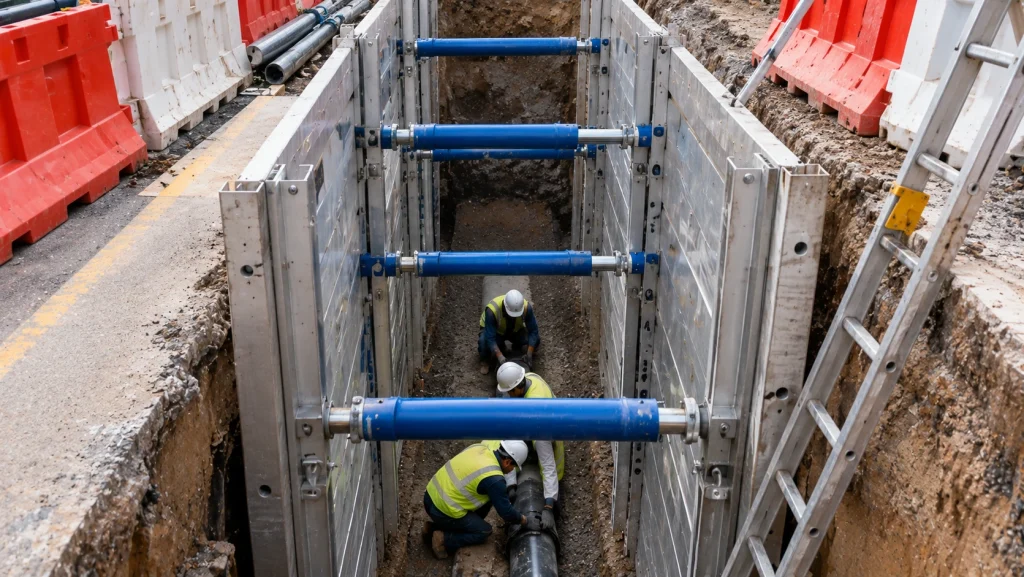
Excavation shoring is chosen according to the depth of the excavation, the soil, the groundwater, and the space around the site. Small trenches can often be supported with simple, quick systems, while deep basements in built up areas need engineered walls that may stay in the ground permanently.
The methods below range from the simplest to the most substantial. Excavations deep enough to need the heavier systems are usually part of projects that rely on deep foundations, a distinction explained below.
Also read: Shallow vs Deep Foundation: Key Differences Explained
Timber and Hydraulic Shoring
For trenches, timber shoring uses vertical boards held against the trench walls by horizontal members and cross braces. It is flexible and can be adapted to awkward shapes, but it takes time and skill to install correctly and relies heavily on the quality of the timber and the workmanship.
Hydraulic shoring replaces timber struts with lightweight aluminium or steel cylinders that are pumped against the trench walls. It is quicker to install and remove, can often be put in place from outside the trench, and applies a controlled pressure to the soil, which makes it a common choice for utility trenches where speed and worker safety both matter.
Trench Shields and Boxes
Trench shields, often called trench boxes, are strong steel or aluminium frames lowered into a trench. Strictly speaking, they protect workers inside them rather than holding the soil in place, so if the trench wall moves, it moves against the shield instead of onto the people working within it.
Shields are quick to move along a trench as work progresses, which suits pipe laying and similar linear work. The gap between the shield and the trench wall, and the way workers enter and leave the shield, need careful attention, since the protection only exists inside the box.
Sheet Piling
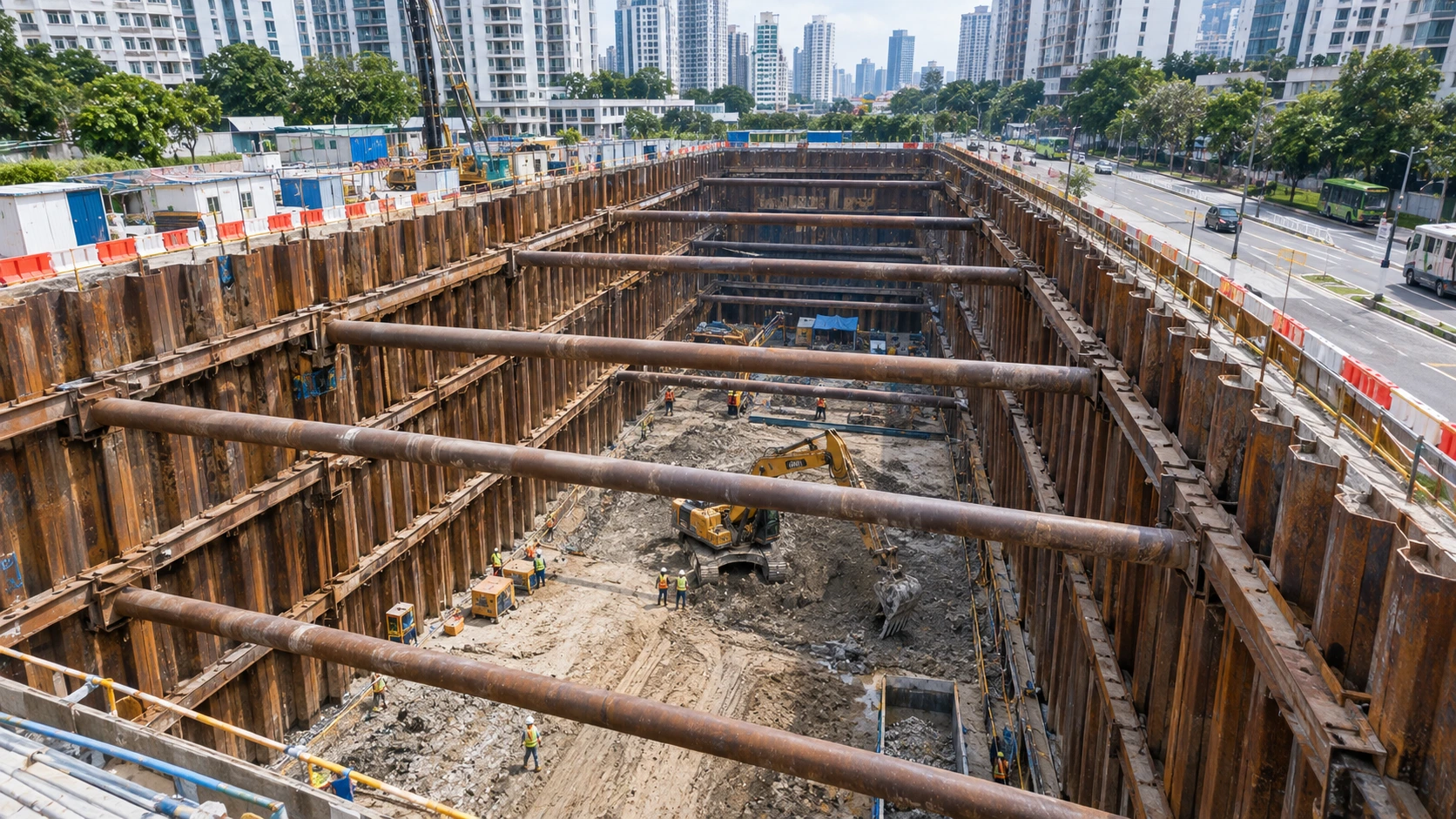
Sheet piles are interlocking steel sections driven or pressed into the ground before excavation begins, forming a continuous wall that holds back soil and, in many cases, limits the flow of groundwater. As the ground inside is dug out, the wall may be supported with horizontal walers and struts or with ground anchors.
Sheet piling suits soft ground and sites close to water, and it can be removed after the permanent structure is complete. Installation methods matter in built up areas, since vibratory or impact driving can disturb neighbours, while pressed installation is quieter but slower.
Soldier Piles and Lagging
Soldier pile walls use vertical steel sections installed at intervals, with horizontal timber or precast panels, called lagging, placed between them as excavation proceeds. The system is economical and adaptable, but because the lagging is not watertight, it suits ground where groundwater is not a major concern.
For deeper excavations in difficult ground, more substantial walls are used, such as contiguous or secant bored piles and diaphragm walls. These are engineered structures in their own right and often form part of the permanent basement.
Structural Shoring
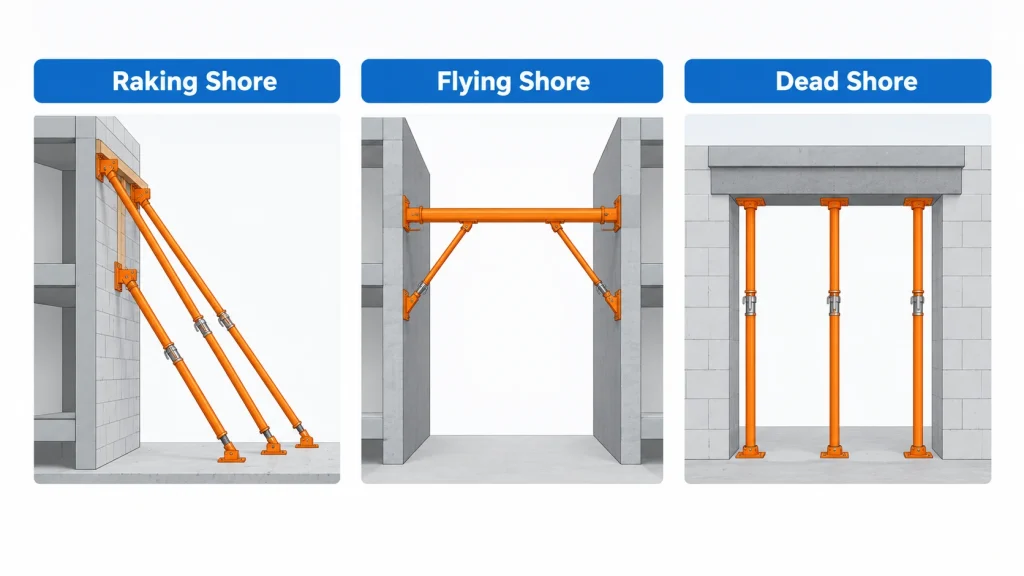
Structural shoring supports buildings rather than soil. It is used when part of a structure is weakened, altered, or not yet complete, and it usually transfers loads safely down to the ground or to a part of the structure that can carry them.
Raking shores are inclined supports set against the outside of a wall to stop it leaning or bulging, often used when a neighbouring building is demolished or a wall shows signs of movement. Flying shores span horizontally between two buildings, supporting both while the structure that once stood between them is removed or rebuilt. Dead shores are vertical supports that carry the load of walls and floors directly, allowing openings to be formed or foundations to be repaired beneath them.
In new construction, the most common structural shoring is the system of props supporting formwork and freshly poured concrete slabs. The props hold the slab until the concrete reaches enough strength to carry itself, and backpropping on floors below spreads the load of the work above. The formwork these props support is covered in Types of Concrete Formwork: A Complete Guide.
Shoring for Deep Excavations in Singapore
Singapore’s dense urban sites, soft marine clays in some areas, and high groundwater make temporary support for deep excavations a serious engineering matter. Excavations for basements and underground structures are typically supported by earth retaining or stabilising structures, commonly known as ERSS, which are designed by qualified professional engineers.
The Building and Construction Authority sets out the requirements for the design, approval, and supervision of such works, and project teams should check the current rules for their specific excavation rather than relying on general guidance. In practice, this means shoring for deep excavations is planned well before work starts, with designs reviewed, construction supervised, and ground and building movements monitored throughout.
How Shoring Is Installed and Monitored
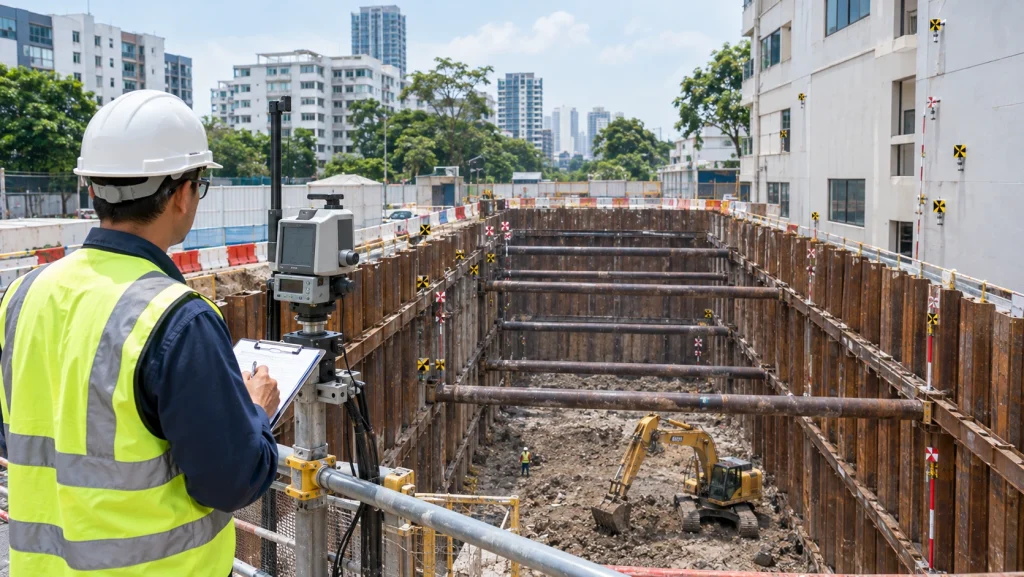
Every shoring system starts with an assessment of the ground, groundwater, nearby structures, and loads that will act near the excavation, including machines, stockpiles, and traffic. For anything beyond simple trench work, a design sets out the type of support, its sequence of installation, and the limits on how the excavation can proceed.
Installation then follows that sequence closely. In many systems, supports are added stage by stage as the excavation deepens, so digging too far ahead of the bracing is a common and dangerous mistake. The machines doing the digging need careful coordination with the shoring crew, and the range of excavators used for this work is described in Types of Excavators for Construction and Earthmoving.
Once installed, shoring is inspected regularly and after events that could affect it, such as heavy rain, nearby vibration, or accidental impact from plant. On deeper excavations, instruments track ground movement, wall deflection, groundwater levels, and settlement of nearby buildings, with trigger levels that prompt action if movement exceeds what the design allows. Removal is just as carefully planned, since taking supports out in the wrong order can release loads suddenly.
Common Causes of Shoring Failure
Shoring failures are rare when systems are designed, installed, and maintained properly. When they happen, the causes are usually familiar:
- Excavating deeper or faster than the shoring sequence allows
- Placing heavy machines, materials, or spoil heaps too close to the edge
- Underestimating groundwater or failing to control it
- Removing or altering supports without approval
- Using damaged, undersized, or poorly maintained components
- Skipping inspections after heavy rain or other changes on site
Each of these is preventable, which is why clear procedures, competent supervision, and regular inspection are as important as the shoring itself.
Working Safely Around Shored Excavations
People should only enter a trench or excavation when the support system is in place, inspected, and approved, and should never work beyond the end of the shoring or outside a trench shield. Safe access and exit, such as properly secured ladders, must be provided, and nobody should climb on the shoring itself.
Machines working near an excavation need to keep a safe distance from the edge, set by the design or a competent person, and their movements should be coordinated with the people working below. Singapore’s Ministry of Manpower publishes detailed Workplace Safety and Health guidance covering excavation work and site safety, and the daily checks that help keep a site safe are set out in Construction Site Safety Checklist: A Complete Guide. The wider principles for working around heavy plant near excavations are covered below.
Equipment Support for Excavation Projects
Excavation and shoring work depends on the right machines being available at the right stage. When you contact the team, it helps to describe the depth and size of the excavation, the ground and access conditions, the space available for machines near the edge, and how long each stage of the work is expected to take. With these details, the right equipment can be recommended from the start rather than adjusted after delivery.
RR Machinery Pte Ltd supports Singapore’s construction and industrial sectors with reliable heavy machinery solutions tailored to your specific site conditions. Browse our complete heavy machinery services or contact our team today for practical advice on the right equipment for your project.