Two machines define the earthmoving phase of almost every construction, mining, and civil infrastructure project: the front end loader and the bulldozer. Both move earth. Both operate on large, powerful drivetrains matched to the demands of heavy material handling. Both appear on equipment schedules for the same category of work, earthmoving, site preparation, and bulk material management. And both are frequently misunderstood, deployed on tasks the other would perform more efficiently, or specified as alternatives when in reality they are designed to be used together.
The front end loader and the bulldozer are not competing solutions to the same problem. They are complementary machines, each optimised for a distinct set of earthmoving tasks, and each capable of operations the other cannot perform at all. The loader scoops and carries, it picks material up, places it in a bucket, and deposits it precisely at a different location. The bulldozer pushes, it applies the full tractive effort of its engine and tracks to a blade, moving material horizontally across the ground surface in bulk.
These two actions are mechanically and operationally different. Understanding when each machine is the right choice, and when both are needed in sequence, is essential knowledge for project managers, site engineers, and equipment planners on any project with significant earthmoving content.
How a Front End Loader Works
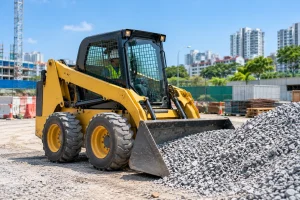
A front end loader, also called a wheel loader, is a self-propelled machine on four large rubber tyres with a bucket mounted on hydraulic lift arms at the front. The bucket scoops material by driving forward into a pile, curling the bucket to fill it, raising the arms to carry the load clear of the ground, and driving to the deposit location where the bucket is tilted forward to dump the load.
The loader’s operational cycle is: drive forward into the material to fill the bucket, reverse to pull clear, travel to the dump point, a truck, a hopper, a stockpile, raise the bucket, tip the load, and return to the material pile for the next pass. This cycle can be completed in under 60 seconds in favourable conditions, making the loader one of the highest-production machines available for loading operations.
The loader is built on four rubber tyres, not tracks, giving it travel speeds of 20 to 40 kilometres per hour on site roads, good manoeuvrability, and fast repositioning between work areas. It is articulated, the front and rear frames steer independently at a central pivot joint, giving it a tight turning radius relative to its size.
For a comprehensive explanation of the front end loader’s design, types, and attachment options, the complete guide to front end loaders and their application in construction and mining covers every operational aspect in detail.
Also read : Bulldozer vs Excavator: Differences and When to Use Each
How a Bulldozer Works
A bulldozer is a tracked machine that moves material by pushing it with a wide steel blade mounted at the front. The blade, available in multiple configurations including straight, angle, universal, and semi-universal, contacts the material surface and accumulates material ahead of it as the machine advances. The operator raises, lowers, tilts, and in some configurations angles the blade hydraulically to control the volume of material pushed and the profile of the finished surface.
The bulldozer’s tracked undercarriage distributes its weight over a large ground contact area, providing low ground pressure and high traction on soft, sloped, and uneven surfaces. Its tractive effort, the horizontal pushing force it can apply, is determined by its engine torque, its transmission gear reduction, and the friction between its tracks and the ground. On a large dozer, this pushing force can exceed 80 tonnes, making it by far the most powerful ground-level material mover in the earthmoving equipment family.
Most bulldozers are also fitted with a rear ripper, one to five tines that penetrate into hard or compacted ground to break it up before the blade pushes the loosened material. The combination of ripping and pushing in a single machine makes the bulldozer capable of working in material conditions that would defeat any loader attempting to fill its bucket by crowding into undisturbed hard ground.
For a detailed breakdown of bulldozer types, from compact models to large mining dozers, and the full range of blade and undercarriage configurations, the complete guide to types of bulldozers and their application on construction sites covers every configuration in operational detail.
Front End Loader vs Bulldozer: A Direct Comparison
Material Movement Method
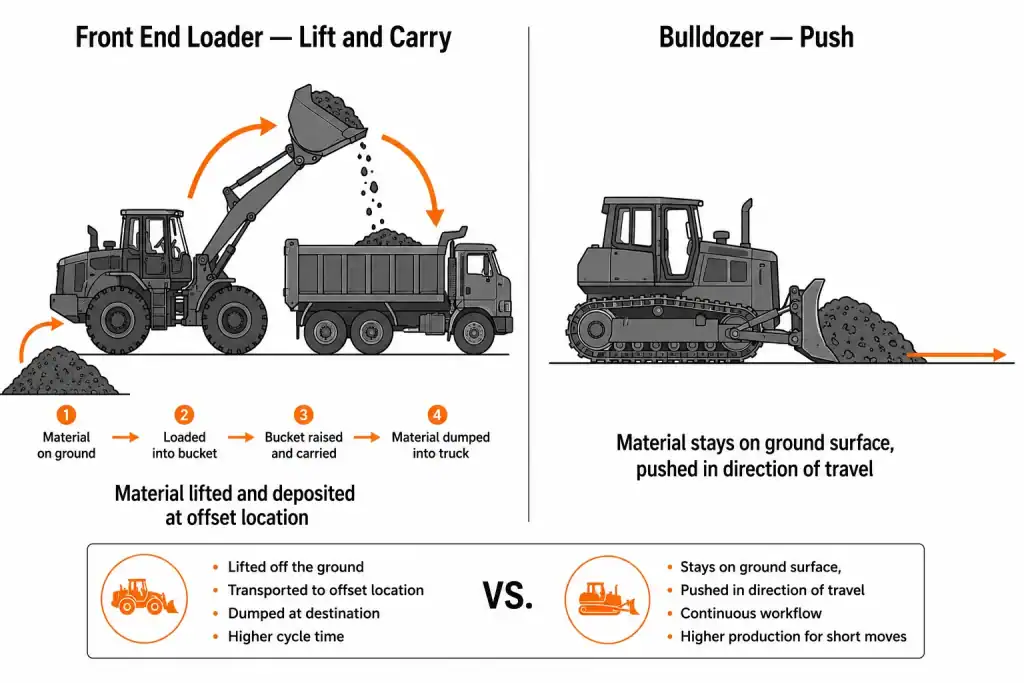
The most fundamental difference between these two machines is how they move material.
The loader lifts and carries. It scoops material from a pile into its bucket, lifts the bucket clear of the ground, travels to the deposit point with the material elevated in the bucket, and deposits the material by tipping. The material travels through the air, elevated above ground level for the duration of the carry, and is placed at a specific, controlled location. This lift-and-carry mechanism is what makes the loader capable of loading trucks, filling elevated hoppers, and depositing material at points that are not directly in front of the machine’s travel path.
The bulldozer pushes. It moves material across the ground surface in a rolling mass ahead of its blade, with the material staying in contact with the ground surface throughout. The bulldozer cannot lift material above ground level, cannot deposit material at a point that requires a change of elevation, and cannot load a truck, it can only push material from where it is to where the machine is pointing.
This single difference in material movement mechanism determines which machine is appropriate for any specific earthmoving task. If the task requires material to be elevated, loaded into a truck, deposited on top of an embankment, placed in a hopper, the loader is the correct machine. If the task requires maximum volume of material to be moved across the ground surface as fast as possible, bulk pushing, embankment spreading, clearing operations, the bulldozer is the correct machine.
Productivity on Bulk Pushing
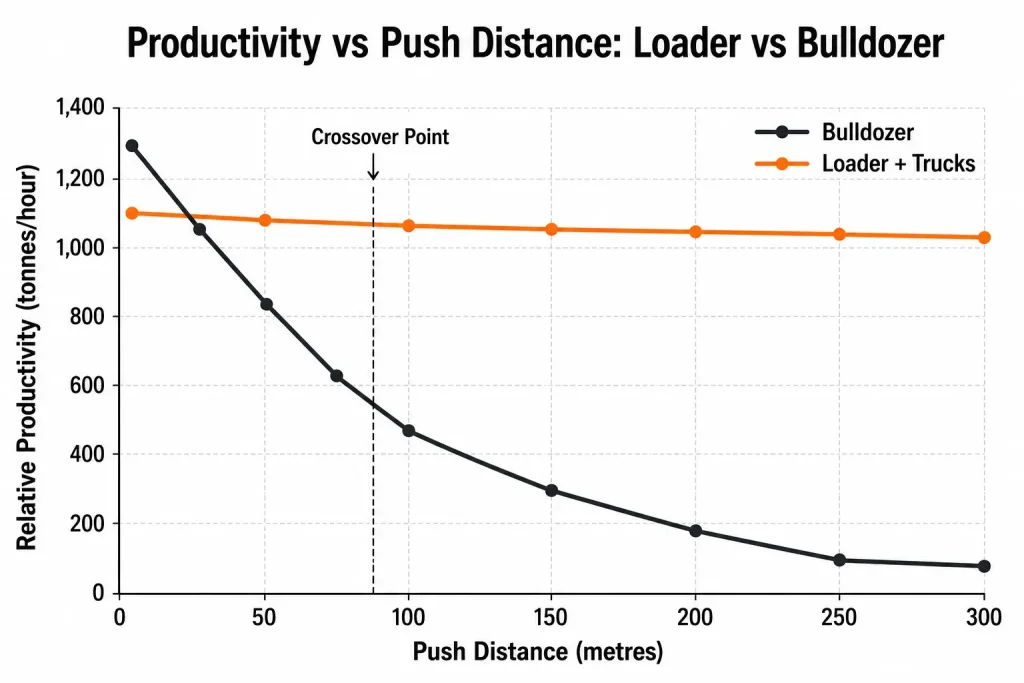
For moving large volumes of loose material across the ground surface in a single direction, the bulldozer significantly outperforms the loader. A bulldozer pushing loose fill across a flat site can move several hundred cubic metres per hour in a single pass. The loader, performing the same task with its bucket, requires multiple bucket cycles, each involving a fill, a carry, a dump, and a return, to move the same volume. The loader’s cycle involves distance travel, deceleration, dumping, and returning to the pile; the bulldozer’s push is continuous and uninterrupted for the length of the push distance.
However, the bulldozer’s productivity advantage diminishes sharply as push distance increases. Beyond approximately 80 to 100 metres, the time spent by the bulldozer travelling back to the cut after each push reduces its effective hourly output significantly. For long-distance material movement, the loader loading trucks, which then haul the material to the destination, becomes more economical than a bulldozer pushing the same distance directly.
Truck Loading Capability
The loader excels at loading trucks, the machine drives into the material pile, fills its bucket, reverses, positions beside the truck, and tips the bucket into the truck body. A skilled loader operator working with a matched truck fleet can load a 20-tonne articulated dump truck in two to four passes, maintaining the truck cycle time and maximising haul fleet productivity.
The bulldozer cannot load a truck at all. Its blade is not a bucket, it cannot lift material above the height of the truck side walls or contain material in an elevated position for dumping. The bulldozer can push material into a position where a loader or excavator can load trucks, but it cannot perform the loading function itself. On any project where excavated material must be removed from site, unsuitable ground, surplus cut material, demolition debris, a loader or excavator must be in the fleet regardless of whether a bulldozer is also present.
Ground Conditions
The bulldozer’s tracked undercarriage gives it fundamentally better performance on soft, wet, and uneven ground than the loader’s rubber-tyred undercarriage. Wide track shoes distribute the bulldozer’s weight over a large contact area, providing the low ground pressure that allows it to operate on waterlogged fill, freshly placed earth, and sloped terrain where a wheeled loader would spin tyres, sink, or be unable to maintain control.
The loader, on rubber tyres, is more susceptible to ground softness, a heavily loaded loader on soft ground creates deep tyre ruts, reduces traction, and can become bogged. Loader productivity on soft or freshly disturbed ground is significantly lower than on a firm base. On construction sites after heavy rainfall, or on soft fill during the early stages of embankment construction, the bulldozer can continue working in conditions that prevent the loader from operating effectively.
In dry, firm ground conditions on a well-established site, the loader’s tyres provide excellent traction and the speed advantage of the wheeled machine becomes significant. The choice between tracked and wheeled for ground conditions is directly parallel to the distinction between crawler and wheeled excavators, as covered in the complete guide to types of excavators and how ground conditions affect machine selection.
Precision and Placement
The loader can deposit material at a precise location, a specific truck, a designated stockpile area, a particular hopper, with accuracy determined by the operator’s skill and the machine’s manoeuvrability. This precise placement capability makes the loader the correct machine for segregating materials, building separated stockpiles, and distributing materials to specific destinations around a site.
The bulldozer deposits material wherever its blade stops pushing, it can shape broad areas of ground surface to a rough profile, but it cannot reliably deliver material to a precise location offset from its direct travel path. For final trimming of surfaces to design grade and cross-section, a motor grader follows the bulldozer to achieve the precision that the dozer’s blade geometry cannot provide. The motor grader’s role in the earthmoving sequence, and how it complements both bulldozers and loaders, is covered in the guide to types of graders and their application in road and site construction.
Travel Speed and Site Mobility
The loader travels at 20 to 40 kilometres per hour on site roads, capable of moving quickly between work areas, repositioning to new tasks, and covering large sites efficiently. This speed makes the loader productive on large sites where different work areas are separated by significant distances.
The bulldozer travels at 5 to 12 kilometres per hour, slow enough that long repositioning moves consume significant productive time. On large sites, a bulldozer deployed at a single work area for an extended period is more productive than one that must frequently travel between areas. The bulldozer’s slow travel speed also makes it impractical for road travel between sites, like the crawler excavator, it must be transported by low-loader.
Fuel Efficiency and Operating Cost
For loading operations, filling trucks from a stockpile, the loader is typically more fuel-efficient per tonne loaded than using a bulldozer-plus-loader combination, because the loader alone completes the task in a single machine operation. For bulk pushing operations, the bulldozer is more productive per litre of fuel consumed at the task it is designed for.
Operating costs for both machine types are significant, large earthmoving machines consume substantial fuel and require regular service and maintenance. The total cost of ownership calculation, acquisition or rental cost, fuel, maintenance, tyres (loader) or tracks and undercarriage (bulldozer), differs between the types and must be assessed against the specific production requirements of the project.
Also read : Road Construction Equipment List: Every Machine Explained
When to Use a Front End Loader
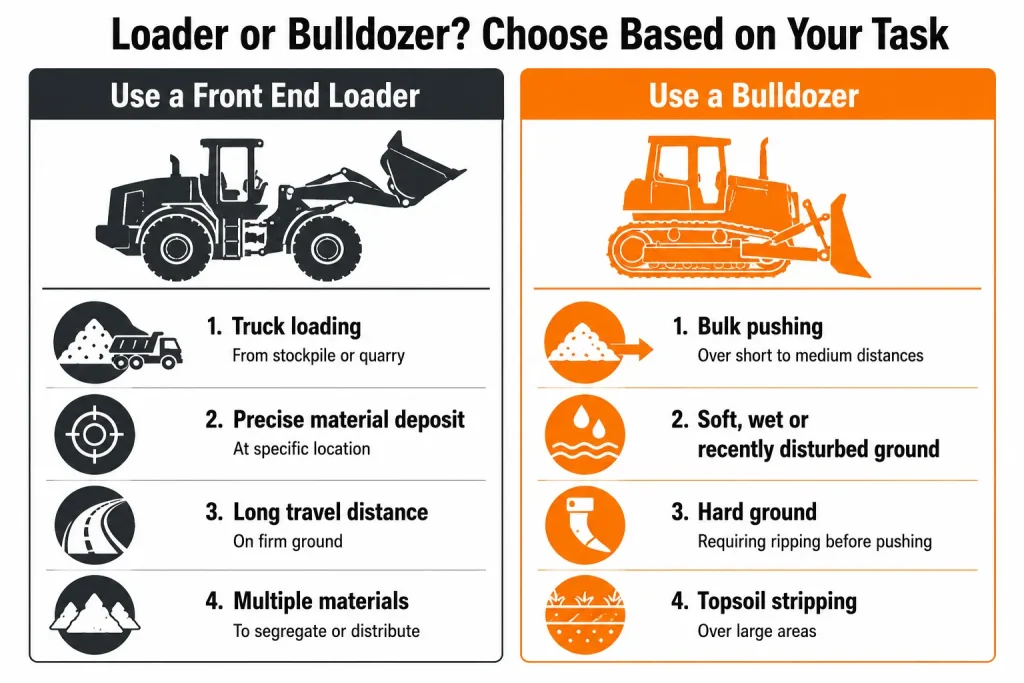
The front end loader is the right choice when:
- Truck loading is the primary task
Loading trucks from stockpiles, quarry faces, and processing plant feeds is the loader’s optimal application. Its bucket capacity, cycle speed, and ability to deliver a controlled load to a truck body make it the most productive and economical truck loading machine available.
- Material must be deposited at a specific location
Feeding a crusher, filling a concrete batching plant aggregate bin, distributing materials to different areas on a large site, all tasks requiring material to be placed at a defined, offset destination, suit the loader’s lift-and-carry mechanism.
- The site has firm ground and long haul distances
Loaders travel fast on firm ground. On sites where the loading point and the dump point are separated by more than 80 to 100 metres, the loader loading trucks is more economical than a bulldozer pushing the full distance.
- Multiple materials must be handled and segregated
A loader with a quick-coupler can switch between bucket, pallet forks, and other attachments to handle different material types on the same site, aggregate, block pallets, structural steel, making it a versatile site logistics machine beyond pure earthmoving.
When to Use a Bulldozer
The bulldozer is the right choice when:
- Bulk pushing over short to medium distances is the primary task
Topsoil stripping from a large area, pushing fill from a delivery stockpile into an embankment, clearing rough terrain, all tasks involving large volumes of material moved across the surface over distances up to 80 to 100 metres, are the bulldozer’s optimal application.
- The ground is soft, wet, or recently disturbed
The bulldozer’s tracked undercarriage operates in conditions that prevent the loader from working effectively. On waterlogged fill, soft natural ground, and steeply sloped terrain, the tracked dozer is the only machine that can maintain productivity.
- Hard or compacted material must be ripped
The bulldozer’s rear ripper breaks up compacted soil, weathered rock, and cemented material that neither a loader bucket nor an excavator can penetrate efficiently. The rip-and-push operation is unique to the bulldozer in the earthmoving fleet.
- Finish grading after bulk earthworks
A bulldozer fitted with a GPS grade control system can achieve finish grade tolerances approaching motor grader accuracy over large areas, useful on projects where a dedicated grader is not on site for the rough grading phase.
Using Loaders and Bulldozers Together
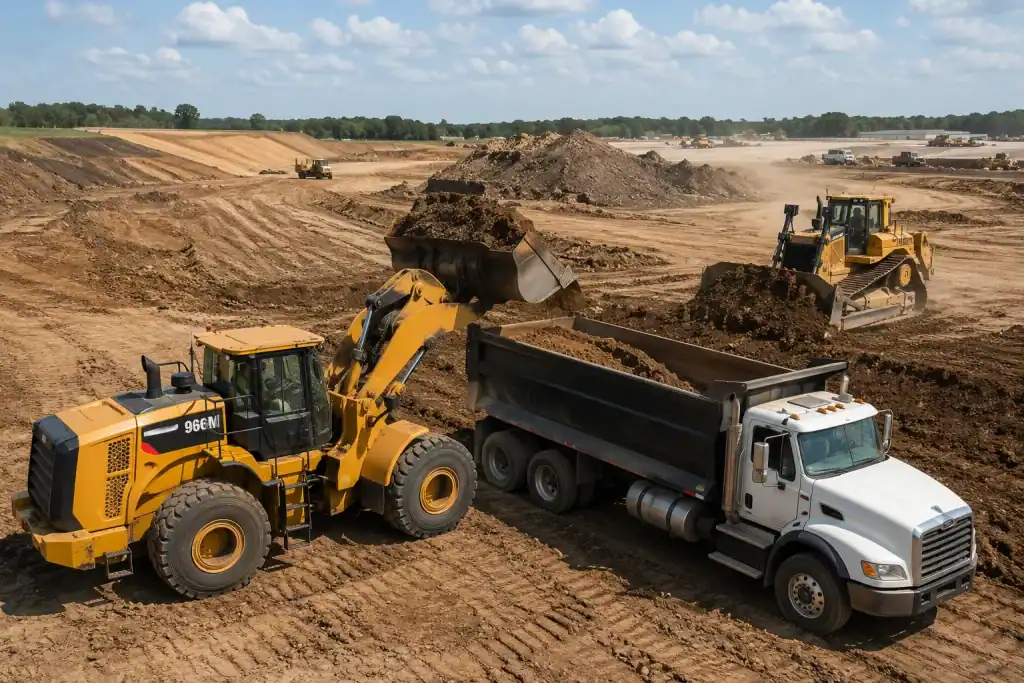
On most significant earthmoving projects, the front end loader and bulldozer are not alternatives, they are used together in a coordinated sequence that makes the most of each machine’s strengths.
The bulldozer leads: stripping topsoil across the corridor, pushing bulk fill from truck delivery points into the embankment, ripping hard ground ahead of the excavators, and rough-grading the formation after bulk earthworks. The loader follows: loading the stripped topsoil into trucks for disposal, feeding aggregate into the base course spreader from stockpiles, loading trucks with surplus cut material for haul to the fill area, and distributing materials across the site that the bulldozer has prepared.
On a road construction project, the typical earthworks fleet includes bulldozers, excavators, loaders, motor graders, and compactors, all operating simultaneously in different areas of the site, each performing the task it is best suited for. The coordination of this fleet, managing routes, production rates, and the handover between operations, is a core element of site management on civil projects, as covered in guidance on construction site planning and the coordination of heavy plant on civil and road projects.
Also read : Heavy Equipment Safety: A Complete Site Guide
Two Machines, One Earthmoving Programme
The front end loader and the bulldozer are built for different tasks and operate on different structural principles. The loader lifts and carries with speed and precision on firm ground; the bulldozer pushes with force and traction on any ground condition. Neither machine is superior, each is superior at the tasks it was designed for.
The correct approach to earthmoving plant selection is not to choose between the two but to understand which tasks in the programme each machine is best suited for, and to build a fleet that deploys each type where its advantages are decisive. On most substantial earthmoving projects, that means both.
RR Machinery provides a comprehensive range of construction and earthmoving equipment for sale and rental, including front end loaders, bulldozers, excavators, motor graders, and supporting plant, all maintained to full operational standard and supported by experienced equipment specialists. Explore our full range of earthmoving and construction equipment solutions, or contact our team for practical advice and a clear quotation matched to your site conditions, material volumes, and project programme.