
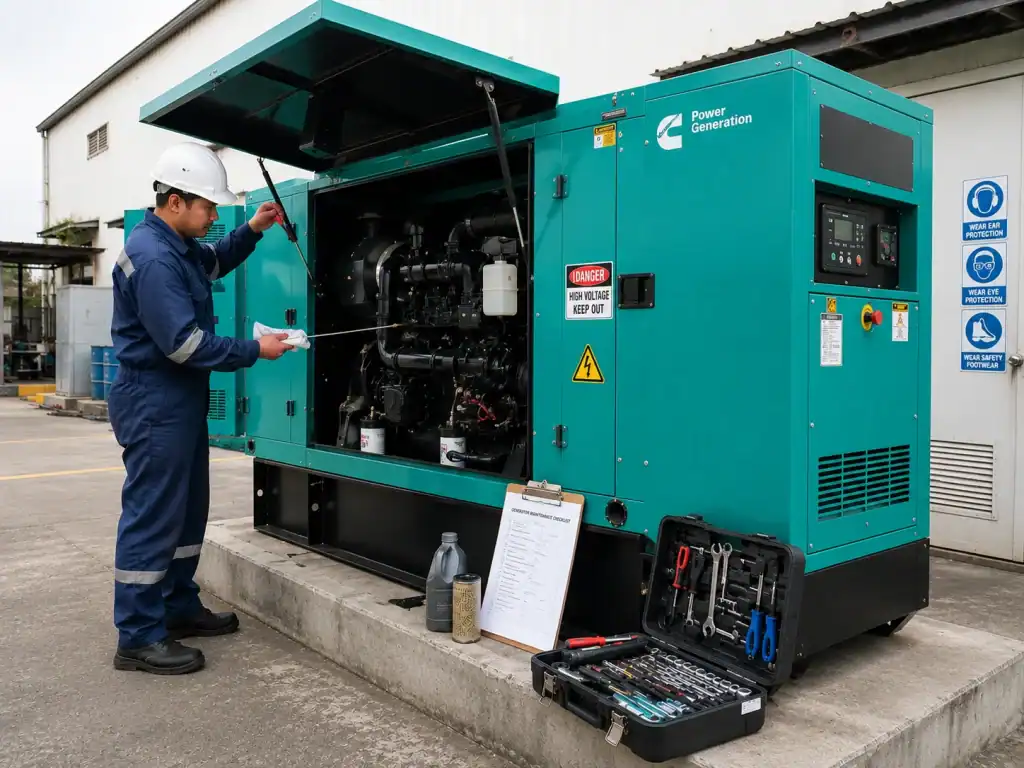
A generator that is well-maintained runs reliably when it is needed, operates efficiently within its rated fuel consumption, and achieves its full designed service life before major overhaul is required. A generator that is poorly maintained, or not maintained at all, fails at the worst possible moment: during a mains outage, at peak demand on a critical project phase, or in a remote location where replacement or repair is days away.
Generator maintenance is not an optional overhead. It is the operational discipline that determines whether the generator is an asset, a reliable power source that keeps the site or facility running, or a liability that absorbs repair costs, causes downtime, and eventually requires early replacement. For construction sites, industrial facilities, events, and standby power installations, the cost of a generator failure almost always exceeds the cumulative cost of the maintenance that would have prevented it.
This guide sets out the complete generator maintenance programme: the daily checks that must be completed before each operating period, the weekly and monthly tasks that maintain the generator’s systems in good condition, the annual and major service requirements that protect the engine and alternator across the machine’s full operating life, and the specific considerations for diesel and petrol generators that affect how maintenance is planned and executed.
Why Generator Maintenance Matters
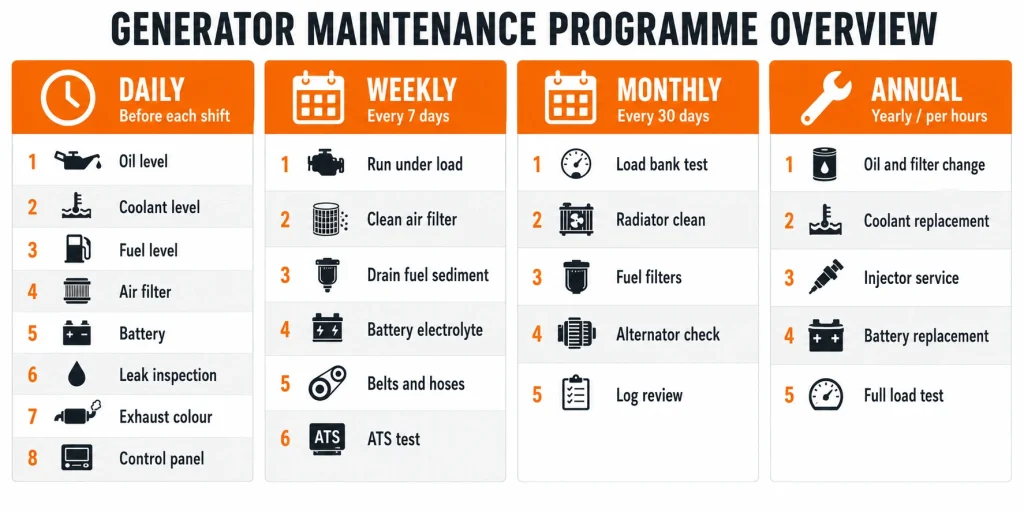
The generator is a complex machine, an internal combustion engine, a lubrication system, a cooling system, a fuel system, an electrical system, and an alternator, all operating under sustained load, often in dusty, hot, or humid conditions, sometimes with limited supervision. Each of these systems has components that degrade in service and must be inspected, serviced, and replaced at defined intervals to prevent failure.
The consequences of maintenance failures are not abstract. An engine oil that has not been changed at the correct interval breaks down under heat and load, loses its lubricating properties, and allows metal-to-metal contact in the engine bearings and cylinder walls, damage that is expensive to repair and that can write off the engine entirely if it progresses to seizure. A coolant level that has not been checked and has dropped below the minimum allows the engine to overheat, warping the cylinder head and destroying the head gasket, a repair that costs many times the price of a coolant top-up. An air filter that has become blocked reduces airflow to the engine, causes rich running, increases fuel consumption, produces black exhaust smoke, and accelerates engine wear.
Each maintenance task in the schedule below prevents a specific failure mode. Understanding why each task matters, not just what to do, is what separates a maintenance programme that is carried out with genuine attention from one that is completed as a paperwork exercise.
Also read : Diesel vs Petrol Generator: Which One Should You Choose?
Daily Generator Maintenance Checklist
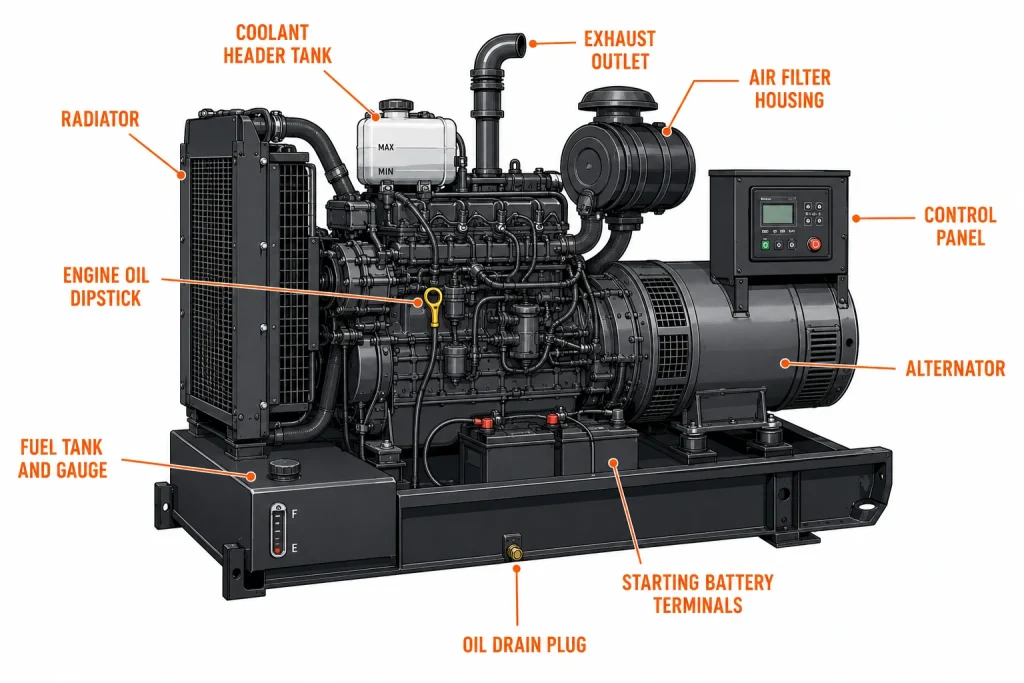
The daily check must be completed before the generator is started for each operating period, or at the start of each shift if the generator runs continuously. It takes less than ten minutes and is the single most important element of the maintenance programme.
- Engine oil level
Check the oil level on the dipstick with the generator stopped and on a level surface. The oil level must be between the minimum and maximum marks on the dipstick. Top up with the correct grade of oil specified in the manufacturer’s manual if the level is below the minimum. Never overfill, oil above the maximum mark can cause oil carry-over into the air intake and combustion, which damages the engine.
- Coolant level
Check the coolant level in the header tank or overflow bottle with the engine cold. The level must be between the minimum and maximum marks. Top up with the correct coolant mixture, typically a 50/50 mix of antifreeze and distilled water, if the level is low. Never remove the radiator cap on a hot engine, the system is pressurised and scalding coolant will be ejected.
- Fuel level
Check the fuel level gauge or sight glass. On a generator that will be run for an extended period, confirm there is sufficient fuel for the operating cycle without running dry. Running a diesel generator out of fuel introduces air into the fuel system, requiring bleeding before the engine will restart, a time-consuming procedure that causes operational disruption.
- Air filter condition
Visually inspect the air filter indicator if fitted, a red indicator or restriction gauge that signals when the filter is blocked. On generators without an indicator, visually inspect the air filter element if accessible. A heavily contaminated filter must be replaced before operating the generator.
- Battery condition
Check the battery terminal connections for tightness and corrosion. On generators with a battery condition indicator or voltmeter, confirm the battery is in a charged state. A generator that fails to start due to a flat or defective starting battery is a preventable failure, battery condition must be confirmed daily on standby generators that may not have been run recently.
- Visual inspection for leaks
Walk around the generator and inspect for oil leaks beneath the engine, coolant leaks from hose connections and the radiator, and fuel leaks from the tank, fuel lines, and injector connections. Any leak identified must be rectified before the generator is operated. A fuel leak near hot engine components is a fire hazard.
- Exhaust system condition
Inspect the exhaust outlet for unusual smoke colour. Blue or grey smoke indicates oil burning, possible piston ring or valve seal wear. Black smoke indicates a rich fuel mixture, possible injector fault, blocked air filter, or overloading. White smoke on a cold start is normal condensation; persistent white smoke when the engine is warm indicates coolant entering the combustion chamber, a serious fault requiring immediate investigation.
- Control panel check
Confirm all indicators are normal, no fault codes, no warning lights illuminated. Confirm the generator is in the correct operating mode, auto start for standby applications, manual start for prime power applications.
- Record the check
Log the date, the operator, and the findings in the generator’s daily log. Note any abnormal observations even if no action was taken at the time. The log provides a running record that allows developing trends, gradually increasing oil consumption, slowly rising coolant temperature, to be identified before they become failures.
Weekly Generator Maintenance Checklist
The weekly check builds on the daily inspection with additional tasks that take approximately 30 minutes to complete.
- Run the generator under load (standby generators)
A standby generator that is not regularly exercised under load accumulates condensation in the engine oil, allows battery charge to deplete, and on diesel generators develops wet stacking, carbon accumulation in the exhaust system from running at low load or no load. Run the generator at a minimum of 30 percent of its rated load for at least 30 minutes per week. An automatic weekly exercise cycle programmed into the generator’s controller is the most reliable way to ensure this is done consistently.
- Check and clean the air filter
Remove the air filter element and inspect it for contamination. A paper element can be gently tapped to dislodge loose dust, never blow it out with compressed air, which damages the filter media. A filter that is heavily contaminated with oily residue or cannot be cleaned must be replaced. Record the condition and the action taken.
- Inspect fuel tank for water and sediment
Diesel fuel absorbs water from atmospheric condensation, and water in the fuel system causes injector corrosion and microbial growth that blocks fuel filters. Open the tank drain valve briefly to drain any water and sediment that has settled to the bottom of the tank. The drain should be clear diesel, the presence of water (which appears as a distinct layer) indicates a tank that requires more thorough draining and possibly fuel polishing.
- Check battery electrolyte (flooded lead-acid batteries)
On generators fitted with flooded lead-acid starting batteries, check the electrolyte level in each cell and top up with distilled water if the level is below the top of the plates. Never use tap water, minerals in tap water contaminate the electrolyte and reduce the battery’s life.
- Inspect all belts and hoses
Check the alternator drive belt, fan belt, and any other drive belts for tension, cracking, fraying, and glazing. A belt that is loose, cracked, or glazed must be replaced before it fails in service, a broken alternator belt on a running generator causes the battery to discharge and the engine to overheat simultaneously. Inspect all coolant hoses for softness, hardness, cracking, and swelling at the hose clamps.
- Check transfer switch operation (standby generators)
On standby generators with an automatic transfer switch (ATS), confirm the ATS operates correctly, mains simulation, generator start, transfer, and retransfer. A faulty ATS that does not transfer the load to the generator during a mains failure defeats the entire purpose of the standby installation.
Also read : Aerial Lift vs Boom Lift: Differences and How to Choose
Monthly Generator Maintenance Checklist
Monthly tasks require more time, typically one to two hours, and should be scheduled to avoid disruption to the generator’s operational availability.
- Check and adjust valve clearances (where applicable)
On older diesel generators and some petrol generators, the valve clearances, the gaps between the rocker arms and valve stems, must be checked and adjusted at defined intervals. Incorrect valve clearances cause poor combustion, increased fuel consumption, and reduced power output. Many modern generators use hydraulic valve adjusters that are self-adjusting, but the maintenance schedule must be checked to confirm.
- Test the load bank (standby generators)
Where a load bank is available, conduct a load bank test at the generator’s rated output for a minimum of two hours. Load bank testing confirms the generator can sustain full rated output, exercises the engine at working temperature, burns off wet stacking deposits in diesel generators, and provides the only reliable evidence that the generator will perform as required during a real mains outage. The relationship between load testing and generator performance is discussed in the context of how to choose a generator and confirm its duty rating for any application.
- Inspect and clean the radiator
Check the radiator core for dirt, debris, and insect accumulation that reduces airflow and cooling efficiency. Clean the radiator with low-pressure compressed air, never with a high-pressure washer, which damages the cooling fins. Confirm that the coolant fan operates freely and that the fan belt tension is correct.
- Check fuel system components
Inspect the primary and secondary fuel filters for contamination and replace if required. Inspect fuel lines for chafing, cracking, and loose connections. On generators with a fuel day tank, check the day tank level sensor and float operation.
- Inspect the alternator
Check the alternator for moisture ingress, carbon brush wear (on brushed alternators), and the condition of the rotor and stator windings where accessible. Confirm the alternator output voltage and frequency are within specification using a calibrated meter.
- Review the operating log
Review the daily log for the preceding month. Identify any recurring observations, repeated oil top-ups, recurring fault codes, gradual changes in temperature readings, that indicate developing issues requiring investigation before the next service.
Annual Generator Maintenance and Major Service
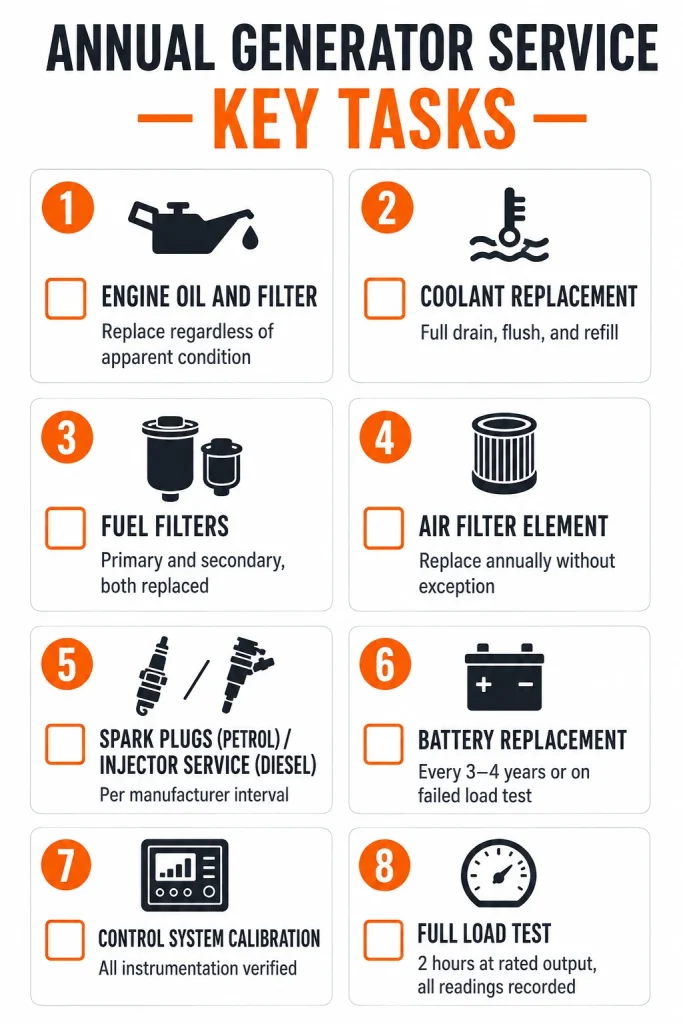
The annual service is the most comprehensive maintenance event in the generator’s maintenance programme. It is typically carried out by a qualified generator service technician and covers every system on the machine.
- Engine oil and filter change
Drain and replace the engine oil and oil filter regardless of apparent oil condition. Oil analysis, sending a sample to a laboratory for spectroscopic analysis, is a worthwhile addition to the annual service, providing early warning of engine wear by identifying elevated concentrations of wear metals in the oil. The correct oil grade and specification must be confirmed from the manufacturer’s maintenance manual, using the wrong grade degrades lubrication and may void the warranty.
- Coolant replacement
Drain and replace the engine coolant on the schedule specified by the manufacturer, typically every two years, or annually in severe conditions. Used coolant becomes acidic as its inhibitor package depletes, corroding the cooling system from the inside. A cooling system flush before refilling removes accumulated scale and corrosion products.
- Fuel filter replacement
Replace both primary and secondary fuel filters regardless of apparent condition. Fuel filters that appear clean may be close to their service life limit and should not be relied on for another year of operation.
- Air filter replacement
Replace the air filter element at the annual service. An air filter that is within visual inspection tolerance at the monthly check may still be at or near its service life limit, replace it annually without exception.
- Spark plug replacement (petrol generators)
On petrol generators, inspect and replace spark plugs at the annual service. Worn or fouled spark plugs cause misfiring, increased fuel consumption, and difficult starting. The correct plug type and gap must be confirmed from the manufacturer’s specification.
- Injector service (diesel generators)
Diesel injectors should be inspected and tested at the intervals specified by the manufacturer, typically every 1,000 to 2,000 operating hours or at the annual service, whichever comes first. Worn or contaminated injectors produce poor atomisation of the fuel, causing incomplete combustion, black smoke, increased fuel consumption, and carbon accumulation in the combustion chamber.
- Battery replacement
Generator starting batteries should be replaced every three to four years regardless of apparent condition, or sooner if a battery capacity test indicates reduced capacity. A battery that has adequate voltage when measured on a voltmeter but inadequate cranking current when tested under load will fail to start the generator, the only reliable test is a load test, not a voltage measurement. The battery management principles relevant to generator starting batteries are directly related to those that apply to electric access equipment, as covered in the guide to battery care and charging for electric site equipment.
- Control system calibration
Confirm the accuracy of all instrumentation, voltage, frequency, current, temperature, oil pressure, against calibrated reference instruments. Confirm the correct operation of all protection systems, high temperature shutdown, low oil pressure shutdown, overcurrent protection. Test the automatic start and transfer sequence from end to end.
- Full load test and acceptance
At the conclusion of the annual service, conduct a full load test at rated output for a minimum of two hours, confirming stable voltage, frequency, and temperature throughout. Record all readings. The completed annual service record, including all parts replaced, all test results, and the technician’s sign-off, must be retained in the generator’s permanent maintenance file.
Generator Maintenance for Construction Site Generators
Construction site generators operate in some of the most demanding conditions of any generator application, dusty environments that block air filters rapidly, variable loads as trades work through the day, fuel delivered from site fuel bowsers of variable quality, and often limited shelter from sun and rain. These conditions require maintenance intervals that are at the shorter end of the manufacturer’s specified range and daily checks that are carried out with particular attention to air filter condition and fuel quality.
On construction sites where the generator must power a range of equipment, from welfare facilities and lighting to large motors on pumps and compressors, the interaction between the generator’s condition and the quality of power it supplies to connected equipment is direct. A generator with worn injectors or incorrect fuel mixture produces voltage instability that affects sensitive electronic equipment and variable frequency drives. Understanding how load characteristics interact with generator performance is part of the broader generator load calculation and site power planning process for construction operations.
For sites where the generator must be sized correctly for the connected loads, including the starting loads of large motors and the aggregate demand of the full site equipment list, the systematic sizing approach covered in the practical guide to what size generator is needed for construction and industrial applications provides the framework for specifying a generator whose maintenance requirements are matched to its operational duty.
Maintenance Records and Compliance
Every maintenance task, daily check, weekly inspection, monthly service, and annual overhaul, must be recorded in the generator’s maintenance log. The maintenance log is the documentary evidence that the machine has been properly cared for. It is required for warranty claims, for insurance purposes, for regulatory compliance on sites where generator operation is subject to environmental or safety permits, and for informed decisions about when the generator’s service life is approaching the point at which replacement is more economical than continued maintenance.
The maintenance log must record the date, the task performed, the parts replaced, the technician or operator who performed the work, and any observations about the machine’s condition. Entries must be legible, accurate, and retained for the full operational life of the machine.
For construction sites where multiple generators are in service simultaneously, a centralised maintenance management system, even a simple spreadsheet tracking service due dates, oil change intervals, and battery replacement schedules, prevents the oversights that occur when maintenance is tracked informally. The disciplined approach to equipment records that applies to generator maintenance is part of the broader equipment management framework that covers all categories of construction plant, as set out in guidance on heavy equipment safety and equipment inspection requirements for construction operations.
Also read : Front End Loader: How It Works and When to Use One
Maintain It Right, Run It When It Matters
A generator that is maintained to its schedule runs reliably, efficiently, and safely for its full designed service life. The maintenance tasks in this guide, from the daily five-minute check to the annual major service, are not administrative burdens. They are the specific actions that prevent the specific failure modes that cause generators to fail at the moments when reliable power is most critical.
RR Machinery provides a comprehensive range of power generators for rental and sale, diesel prime power units, standby generators, and silent canopy models across a wide kVA range, all maintained to full operational standard before deployment and supported by experienced power specialists. Explore our full range of power generator options for construction, industrial, and standby applications, or contact our team for maintenance support, servicing advice, and a clear quotation matched to your power requirements and site conditions.