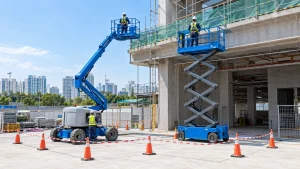
The electric scissor lift is the most widely used aerial work platform in warehouses, commercial construction, interior fit-out, and facilities management. Its zero-emission drive system, quiet operation, and non-marking tyres make it the default choice for indoor access work at height. But unlike a diesel-powered machine that runs as long as there is fuel in the tank, an electric scissor lift depends entirely on its battery, and a battery that is not correctly charged, maintained, or monitored will reduce the machine’s operational availability, shorten its service life, and eventually leave a crew waiting for a platform that will not lift.
Understanding how to charge a scissor lift correctly, not just the physical steps of connecting the charger, but the battery chemistry that determines why the procedure matters, the conditions under which charging should and should not take place, and the monitoring and maintenance that extend battery life across the machine’s operating life, is practical knowledge for site managers, plant coordinators, and any operator responsible for managing electric access equipment on a project.
This guide covers everything relevant to scissor lift battery charging: the types of battery used in scissor lifts and how each behaves, the correct charging procedure step by step, the common errors that reduce battery life and operational availability, the indicators that tell you when a battery is failing, and the safety requirements that apply throughout the charging process.
Types of Battery Used in Scissor Lifts
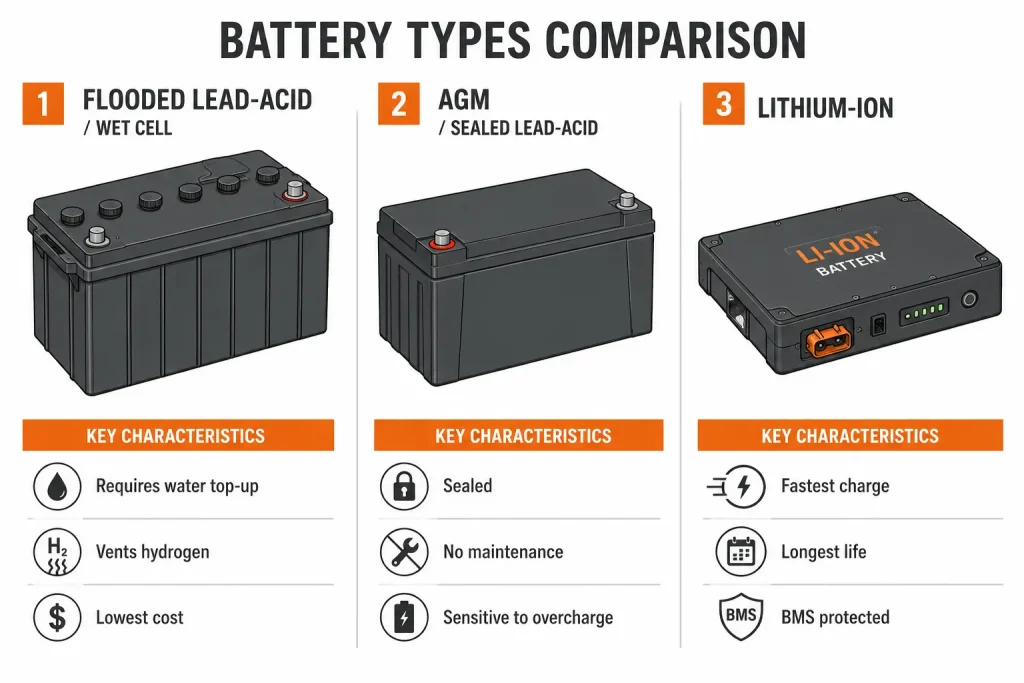
Not all scissor lift batteries are the same, and the correct charging procedure depends on the battery chemistry installed in the machine. Three battery types are currently in common use across the scissor lift market.
Also read : Boom Lift vs Cherry Picker: Key Differences Explained
Flooded Lead-Acid Battery
The flooded lead-acid battery, also called a wet cell battery, is the traditional and still the most widely used battery type in scissor lifts. It consists of lead plates submerged in a liquid electrolyte solution of sulphuric acid and water. During charging and discharging, chemical reactions at the lead plates convert electrical energy to chemical energy and back.
Flooded lead-acid batteries are robust, relatively low-cost, and well-understood by service technicians. Their primary maintenance requirement is regular electrolyte top-up, the charging process causes the electrolyte to gas, losing water through evaporation, and the cells must be topped up with distilled water at regular intervals to maintain the correct electrolyte level. Allowing the electrolyte level to drop below the top of the plates causes irreversible sulphation of the exposed plate area, permanently reducing the battery’s capacity.
Flooded lead-acid batteries must be charged in a well-ventilated area. The gassing that occurs during charging releases hydrogen gas, which is flammable and can accumulate to dangerous concentrations in enclosed spaces. This is not a theoretical risk, hydrogen accumulation in unventilated battery charging areas has caused explosions and fires on construction and industrial sites.
AGM Battery (Absorbed Glass Mat)
The AGM battery is a sealed lead-acid battery in which the electrolyte is absorbed into fibreglass mat separators rather than existing as free liquid. The sealed construction eliminates the need for electrolyte top-up and prevents acid spillage, making AGM batteries suitable for installation in any orientation and for use in environments where a wet cell battery’s maintenance requirements or spillage risk are unacceptable.
AGM batteries have lower internal resistance than flooded batteries, allowing faster charge acceptance and better performance under high-current discharge, relevant for scissor lifts that make frequent platform raises during a shift. They are more sensitive to overcharging than flooded batteries: overcharging an AGM battery causes the sealed case to vent, releasing the absorbed electrolyte and permanently damaging the cell.
AGM batteries require a charger specifically designed or configured for AGM chemistry. Using a standard flooded battery charger on an AGM battery will typically result in overcharging and premature failure.
Lithium-Ion Battery
Lithium-ion batteries are increasingly specified in new scissor lift models, particularly in the compact and mid-range classes designed for indoor use. Lithium-ion batteries offer significantly higher energy density than lead-acid chemistry, more usable energy in a smaller, lighter package, faster charging, a flatter discharge curve that maintains consistent performance throughout the discharge cycle, and a longer cycle life before capacity degrades to the point of replacement.
Lithium-ion scissor lift batteries typically recharge to 80 percent capacity in two to three hours and to full capacity in four to five hours, significantly faster than the eight to ten hours required for a full lead-acid charge cycle. They also support opportunity charging, partial charges during breaks or between shifts, without the cycle-life penalty that partial charging imposes on lead-acid batteries.
The charging system for lithium-ion batteries is integrated and managed by a battery management system (BMS) that monitors cell voltage, temperature, and state of charge in real time, preventing overcharging, over-discharging, and operation outside the battery’s safe temperature range. The BMS makes lithium-ion charging more straightforward for the operator, connect the charger, and the BMS manages the rest, but the charger used must be compatible with the battery’s BMS protocol. Using a non-compatible charger bypasses the BMS protection and risks thermal runaway, a dangerous failure mode in lithium-ion chemistry.
How to Charge a Scissor Lift: Step-by-Step Procedure
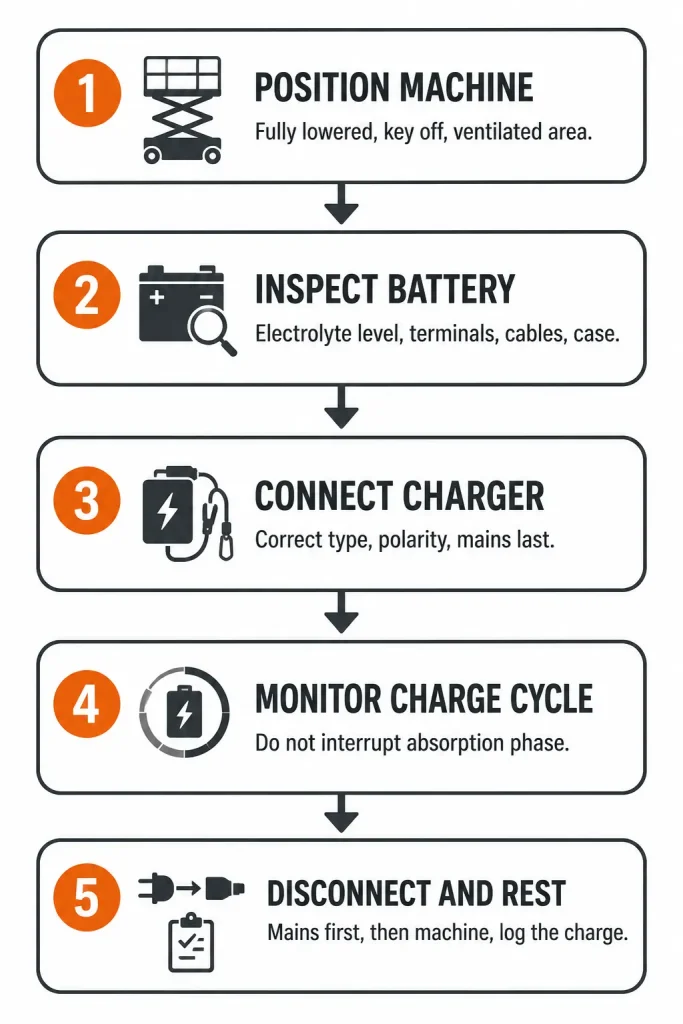
The correct charging procedure applies across battery types, with variations noted where the procedure differs between chemistries.
Position the Machine Correctly Before Charging
Before connecting the charger, the scissor lift must be in its fully lowered, transport position with the platform at its lowest height. Charging a scissor lift with the platform elevated creates unnecessary risk, if someone inadvertently operates the controls during charging, or if a fault causes unintended movement, the consequences are more severe with the platform at height.
The machine should be parked on a firm, level surface in an area with adequate ventilation, essential for flooded lead-acid batteries, and recommended for all battery types as a general safety measure. The area around the machine should be clear of ignition sources, particularly relevant during flooded lead-acid charging where hydrogen gas is released.
The key switch should be in the off position. Leaving the machine switched on during charging allows parasitic loads, control systems, indicator lights, telematics, to draw current from the battery during the charge cycle, reducing charging efficiency and potentially confusing the charger’s charge termination logic.
Inspect the Battery Before Connecting the Charger
Before connecting the charger, a brief visual inspection of the battery and its connections should be carried out. Check for:
Electrolyte level (flooded lead-acid only): The electrolyte should be visible above the top of the plates in each cell. If the level is low, top up with distilled water, not tap water, which contains minerals that contaminate the electrolyte, before charging. Do not top up after charging, when the electrolyte is expanded by heat; top up before the charge cycle begins.
Terminal condition: Battery terminals should be clean, tight, and free of corrosion. White or blue-grey deposits on the terminals indicate electrolyte vapour corrosion, which increases terminal resistance and reduces charging and discharge efficiency. Clean corroded terminals with a wire brush or terminal cleaner before connecting the charger.
Battery case condition: Check for cracks, swelling, or deformation of the battery case. A swollen lead-acid battery case indicates overcharging. A swollen lithium-ion battery case is a serious safety concern, the machine should be taken out of service immediately and the battery inspected by a qualified technician before any further use or charging.
Cable condition: Check the battery cables and the charging cable for damage, fraying, or exposed conductors. Damaged cables must be replaced before charging proceeds.
Connect the Charger Correctly
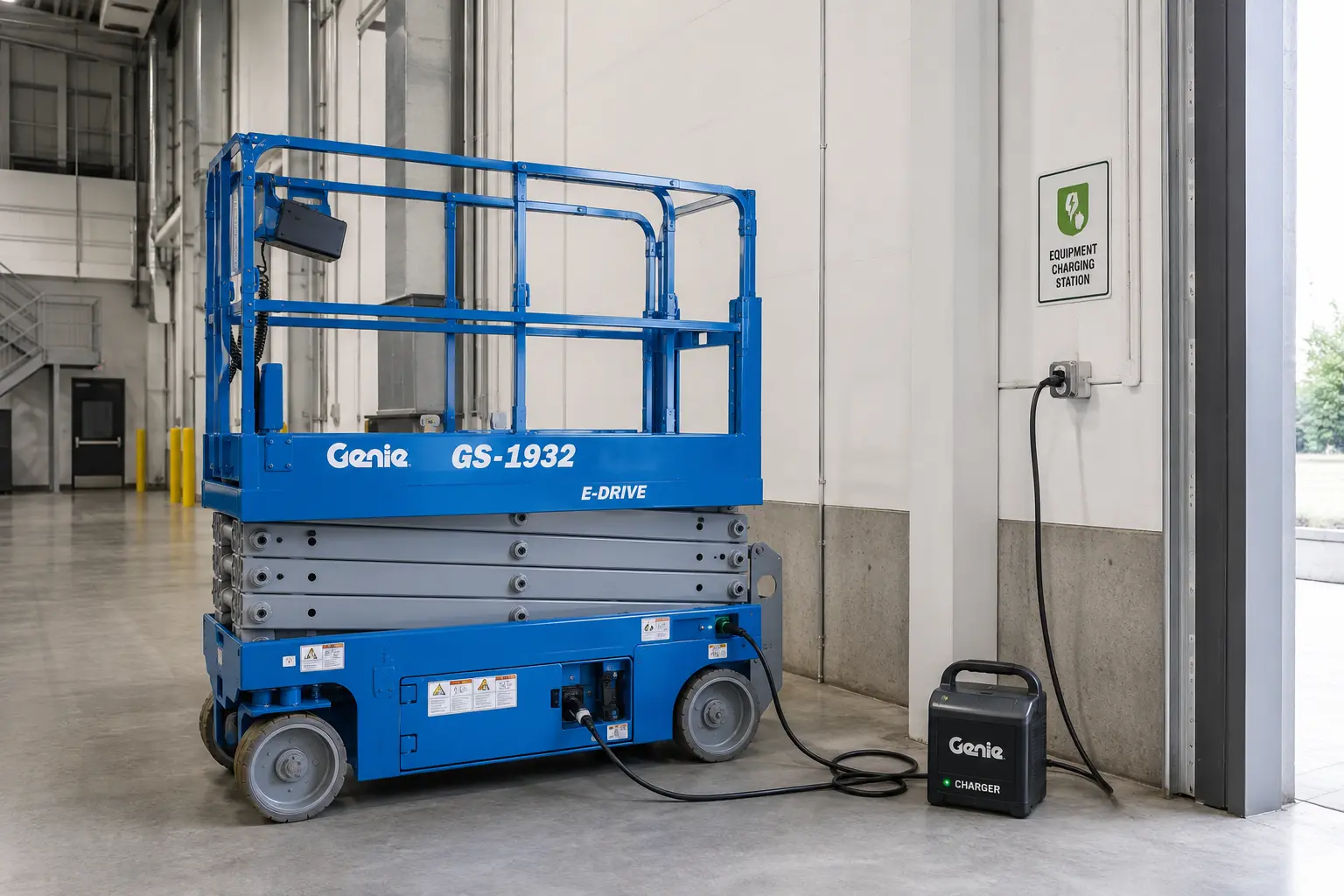
Connect the charger to the machine’s charging socket, on most scissor lifts, this is a dedicated charging inlet separate from the battery terminals, with a polarised connector that prevents incorrect connection. On machines where the charger connects directly to the battery terminals, connect positive to positive and negative to negative, reversing polarity will damage both the charger and the battery.
Confirm the charger is set to the correct battery type and voltage before switching it on. A charger set to a higher voltage than the battery’s rated voltage will overcharge and damage the battery. A charger set to the wrong chemistry profile, AGM profile applied to a flooded battery, or vice versa, will follow an incorrect charge curve, resulting in either undercharging or overcharging.
Plug the charger into the mains supply last, after all connections to the machine are secure. This sequence prevents sparking at the battery terminals during connection.
Monitor the Charge Cycle
Once charging begins, the charger should indicate that it is receiving current and progressing through the charge cycle. Modern smart chargers display charge status, bulk charge, absorption, float, and indicate when the cycle is complete. On older chargers with analogue meters, the ammeter reading falls progressively as the battery approaches full charge.
For flooded lead-acid batteries, do not interrupt the charge cycle before the absorption phase is complete. Consistently stopping the charge during the bulk phase, before the battery reaches full charge, causes progressive sulphation that reduces the battery’s capacity over time. This is one of the most common causes of premature battery failure on construction sites where charging is interrupted to return the machine to service before the cycle is complete.
The total charge time depends on the battery’s state of discharge at the start of the cycle. A battery at 50 percent state of charge will take approximately half the time to reach full charge compared to a battery at 20 percent. For flooded lead-acid batteries, a full charge cycle from a deeply discharged state typically takes eight to twelve hours, which is why overnight charging is the standard practice for scissor lifts on construction sites and in facilities management operations.
For lithium-ion batteries, the BMS will indicate when the charge cycle is complete and will automatically switch to a maintenance mode that prevents overcharging. The machine can be left connected to the charger indefinitely without risk of overcharging, the BMS manages this automatically.
Disconnect and Prepare the Machine for Use
When the charge cycle is complete, disconnect the charger from the mains supply first, then disconnect it from the machine. This sequence prevents sparking at the battery terminals during disconnection.
For flooded lead-acid batteries, allow the battery to rest for at least thirty minutes after a full charge cycle before putting the machine back into heavy use. The charge cycle generates heat in the battery, and allowing it to cool reduces thermal stress on the plates and improves the accuracy of the battery state-of-charge indication.
Record the charge event, date, duration, and any observations about the battery’s condition, in the machine’s service record. Tracking charge cycle frequency and duration over time provides early warning of battery capacity decline before it becomes an operational problem.
Also read : How to Build Scaffolding: A Step-by-Step Site Guide
How Long Does a Scissor Lift Battery Last Per Charge?
The runtime a scissor lift delivers per charge depends on the battery capacity, the battery’s state of health, the frequency and height of platform raises during the shift, and the condition of the surface the machine is travelling on.
As a general guide, a fully charged scissor lift battery on a standard electric model will support a full eight-hour shift of moderate use, frequent platform positioning but with time at height between raises, on a smooth indoor surface. Heavy use, continuous raising and lowering, frequent travel on rough or inclined surfaces, cold ambient temperature, will reduce runtime significantly, sometimes to four to six hours from a full charge.
As a lead-acid battery ages and its capacity declines, the usable runtime per charge decreases. A battery at 70 percent of its original capacity delivers approximately 70 percent of its original runtime. When runtime drops to the point where the machine cannot complete a full shift on a single charge, the battery is approaching the end of its service life and should be tested and replaced.
This runtime consideration directly affects how scissor lifts are deployed on sites where continuous access is required, sites where the generator or mains power supply must be planned to accommodate overnight charging of the MEWP fleet. The power load from charging multiple scissor lifts simultaneously is a relevant input to the site power sizing calculation, directly connected to the process of calculating generator size and managing electrical load on construction sites.
Common Charging Mistakes and How to Avoid Them
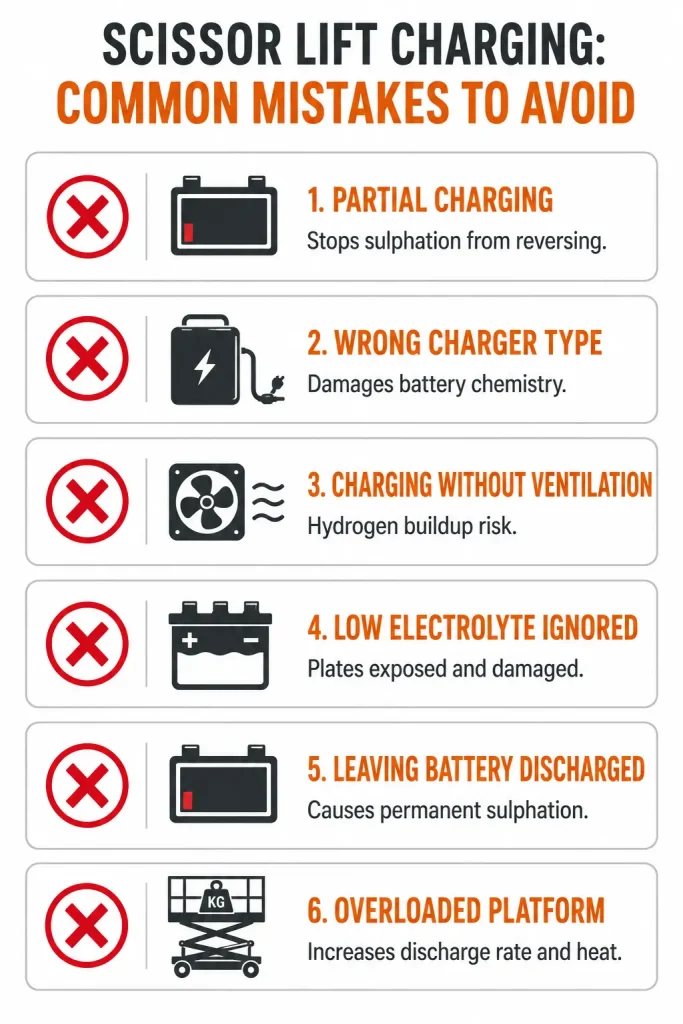
- Partial charging of lead-acid batteries
Consistently returning a lead-acid battery to service before it reaches full charge causes progressive sulphation, lead sulphate crystals form on the plates and are not fully dissolved during the abbreviated charge cycle. Over time, the sulphated area reduces the battery’s active plate area and its capacity. The correct practice is to complete the full charge cycle, or at minimum the absorption phase, before the machine is returned to service.
- Using the wrong charger
Connecting a charger designed for a different battery chemistry or voltage damages the battery and may create a safety hazard. Each machine must be charged with its specified charger type. If the original charger is lost or damaged, the replacement must match the battery chemistry, voltage, and current rating specified by the machine manufacturer.
- Charging in unventilated spaces
Flooded lead-acid batteries release hydrogen during charging. Charging in an enclosed, unventilated space allows hydrogen to accumulate to flammable concentrations. All flooded battery charging must take place in a well-ventilated area, with no ignition sources within the immediate vicinity.
- Ignoring low electrolyte level
Allowing a flooded battery to charge with the electrolyte below the plate level causes the exposed plate area to sulphate and overheat, permanently reducing capacity and shortening battery life. Check and top up electrolyte before every charge cycle.
- Leaving a discharged battery uncharged
A deeply discharged lead-acid battery that is left in a discharged state for an extended period, days or weeks, suffers progressive sulphation that may render it unrecoverable. If a machine is to be stored, the battery should be fully charged before storage and placed on a maintenance charger that keeps it at full charge without overcharging.
- Overloading the platform and increasing discharge rate
Operating a scissor lift with a platform load that exceeds its rated capacity not only creates a safety hazard, it also draws higher current from the battery, increasing the discharge rate and generating more heat in the battery cells. Platform overloading accelerates battery degradation in addition to its structural and stability risks. The safety requirements that govern scissor lift operation, including platform load limits and the inspection obligations that apply before each use, are directly aligned with the working-at-height safety principles that apply across all categories of aerial work platform, as set out in guidance on lifting equipment safety and pre-use inspection for powered access equipment.
Battery Maintenance Beyond Charging
Correct charging is the most important single factor in battery life, but it is not the only one. A complete battery maintenance programme for a scissor lift fleet includes:
- Regular equalisation charges (flooded lead-acid)
An equalisation charge is a controlled overcharge, at a slightly higher voltage than the normal charge termination voltage, that mixes the electrolyte, dissolves minor sulphation, and balances the charge level between cells. Equalisation should be performed monthly or as specified by the battery manufacturer, using a charger with an equalisation mode.
- Specific gravity testing (flooded lead-acid)
A hydrometer test of the electrolyte specific gravity in each cell indicates the state of charge and identifies cells that are performing below the level of the others. A cell with consistently low specific gravity after a full charge may be failing and should be flagged for specialist assessment.
- Battery capacity testing
A load test, discharging the battery at a known rate and measuring the total capacity delivered before the voltage falls to the cut-off level, quantifies the battery’s remaining capacity as a percentage of its original rating. This test should be performed annually or whenever there are concerns about reduced runtime.
- Terminal cleaning and retorquing
Battery terminal connections should be cleaned and retorqued at every service interval. Loose or corroded terminals increase resistance, generate heat, and reduce the efficiency of both charging and discharge.
For sites where scissor lifts are deployed alongside other access equipment, including cherry pickers, boom lifts, and mobile scaffold towers, the battery maintenance requirements of the electric MEWP fleet are one element of the broader equipment management programme that keeps all working-at-height equipment operational and safe. An understanding of the full range of aerial work platform types and their respective maintenance and operational requirements is covered in the guide to what a cherry picker is and how it compares to other aerial work platforms.
When to Replace a Scissor Lift Battery
A scissor lift battery should be replaced when any of the following conditions apply:
The battery’s usable runtime per charge has fallen to less than 60 to 70 percent of its original rating, confirmed by a load test, not by estimation. The machine cannot complete a representative working shift on a single charge under normal operating conditions.
A load test confirms remaining capacity below 80 percent of the original rating, for batteries in intensive daily use, this threshold may trigger early replacement to prevent operational disruption.
One or more cells in a flooded battery consistently show low specific gravity after a full charge, indicating cell failure. A battery with one failed cell will not perform reliably even if the remaining cells are in good condition.
The battery case is cracked, swollen, or leaking. A physically damaged battery is a safety hazard and must be replaced immediately, regardless of its remaining capacity.
Replacing the battery before it fails operationally, based on capacity test results rather than waiting for the machine to run out of charge mid-shift, is the approach that minimises site disruption and maintains the machine’s availability throughout the project.
Also read : What Is Mobile Scaffolding? Types, Uses and Safety
Charge It Right, Use It Right
The scissor lift battery is not a consumable to be run down and discarded, it is a major component of the machine whose condition directly determines the machine’s operational availability, its runtime per shift, and its total cost of ownership over the machine’s working life. Correct charging procedure, consistent maintenance, and timely replacement based on objective capacity testing are the practices that maximise battery life and keep electric scissor lifts operational when the site needs them.
RR Machinery provides a comprehensive range of scissor lifts and aerial work platforms for rental and sale, all maintained to full operational standard with batteries in tested, serviceable condition. Explore our full range of scissor lift and aerial work platform options, or contact our team for practical advice and a clear quotation matched to your working height, site conditions, and access requirements.